What does it mean to "read a combination" of cards
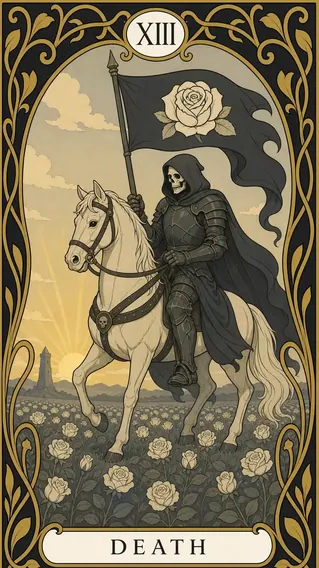
A Tarot card combination is not the sum of their individual meanings, but a conversation between them: one card sets the theme, the second clarifies, limits, or reinforces it. Death next to the Ten of Pentacles is not "end" and "wealth" separately, but a specific meaning at their intersection: most likely, it refers to the completion of a material phase—a sale, an inheritance, or closing a deal—rather than literal death or quick enrichment.
Therefore, experienced readers almost never read cards one by one, even if they draw only a single card of the day: adjacent cards provide the context without which a single meaning remains too general. In a combination, we usually distinguish a leading card, which defines the theme, and a clarifying card, which narrows it down to a specific situation.
This principle works the same for two cards as it does for an entire spread: first, look for the general meaning of the group, and only then see how an individual card changes it. Reading cards "left to right," mentally substituting the ready-made meaning of each in turn, is the most common way to get a contradictory and confusing result.
How to find the leading card in a pair
Three signs help determine the leading card, and they work together, not in sequence.
- Position in the spread. In most spreads, positions are not equal: a "core of the issue" or "current situation" position carries more weight than "advice" or "hidden influence." The card from the more significant position is usually the leading one.
- Major Arcana vs. Minor Arcana. Major Arcana describe major themes and life processes, while Minor Arcana describe specific circumstances and everyday details. Next to a Major Arcana card, a Minor card almost always plays a clarifying role, not the other way around.
- Suit matching the essence of the question. If the question is about relationships and the spread contains both cups and swords, the cups will lead—they are directly about feelings, while swords in this context are more likely to show how those feelings are thought about or what is said about them.
Pair, triplet, quartet: how reading differs
Reading two, three, and four cards are different tasks, and a typical beginner's mistake is trying to read them all the same way.
Two cards are a theme and its clarification. The task is simple: understand which of the two is leading, and read the second as an answer to the question "in what key?"
Three cards almost always describe dynamics rather than three separate themes: a "past — present — future" or "situation — action — result" spread is read as a sequence where the direction is important—does the tension increase toward the third position or dissipate, does the suit repeat from card to card or, conversely, change to the opposite in meaning.
Four cards or more should not be read "in a chain," linking every pair to every other pair, as that is redundant. Here, it is not line-by-line reading that works, but grouping: first, look at which suits and ranks are most prevalent, and then analyze specific pairs within the identified theme.
In a spread of four or more cards, it is useful to mentally break them into "position + position" pairs rather than trying to hold all connections at once: for example, compare the situation card with the advice card separately from the obstacle card with the result card. This breakdown almost always provides a clearer picture than trying to read the entire spread as one sentence.
Combinations by suit: what prevalence indicates
When there are several cards of the same suit in a spread, it is a signal that should be read before individual pairs.
- Prevalence of Wands — the spread is about action, initiative, and speed: the theme is resolved through movement rather than waiting. Many Wands in a row usually means that inaction now costs more than an error in action.
- Prevalence of Cups — the spread is about feelings and relationships, even if the question was about work or money: the emotional side of the situation means more than the rational one at this moment.
- Prevalence of Swords — the theme is conflict, dispute, or intense mental work: the spread is more about what is happening in the mind and in conversations than about external events.
- Prevalence of Pentacles — the spread is about the practical, material side: money, body, daily life, concrete results, rather than intentions and feelings.
If all four suits are represented roughly equally in the spread, the situation itself is multifaceted, and reducing it to one theme would be an oversimplification.
Combinations by rank: aces, court cards, repeats
Cards combine differently by rank than by suit: here, it is not the theme that is important, but the structure of the situation.
- Two or more Aces — this is a doubled beginning, but in different spheres indicated by the suits. Two Aces do not mean "double luck": they show that a new stage is starting simultaneously in two areas of life, and this is more of a burden than a gift.
- Two court cards side by side — usually about people and their roles for each other, not about an abstract idea. It is worth looking at who is "higher" in the hierarchy (Kings and Queens set the tone, Pages and Knights are more likely to be executors or beginners) and whether their suits match.
- Repeating rank (e.g., two fives or two nines in different suits) — a sign that similar tension or a similar stage is manifesting in several areas of life at once: not a coincidence, but a systemic feature of the moment.
Reversed cards in combination
A reversed position in a combination changes not the entire spread, but specifically the card it refers to—and it is important not to confuse the effect on the leading card with the effect on the clarifying one.
If the leading card is reversed, the theme of the spread is read as blocked, delayed, or unfolding internally rather than in external events.
If the clarifying card is reversed, it is not the theme that changes, but its shade: the same phenomenon, but with resistance, delay, or unspoken nuances.
A dangerous pattern is reading a pair of an upright and a reversed card as an automatic "contradiction" between them. This does not always work: sometimes a reversed clarifying card simply shows from which side the theme has not yet manifested, rather than a dispute between the cards.
Why you shouldn't memorize combination meanings
Tables of "meanings of all Tarot combinations" can be found online—and you should stay away from them, not out of superstition, but because of arithmetic. There are 78 cards in a deck, the number of all possible pairs is 78×78, and that is without considering reversed positions, positions in the spread, and, most importantly, the question itself. Even if you read such a table to the end, it will be of no use: the same pair of cards means different things in a relationship spread versus a career spread, in an "advice" position versus a "fear" position.
A combination is read not from a table, but from the question: first, the theme is determined—what the spread is about at all—then the leading card, and only then how the adjacent cards clarify it. A memorized pair without this context is just a beautiful but useless pattern.