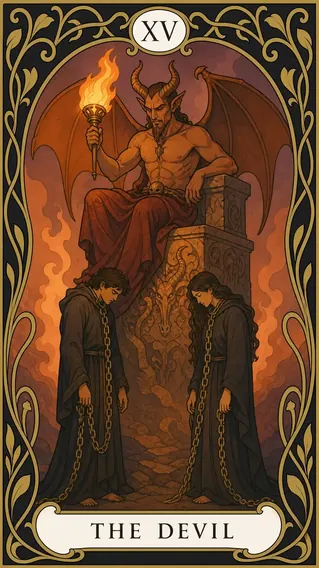
What does the combination of the Tower and the Devil mean?
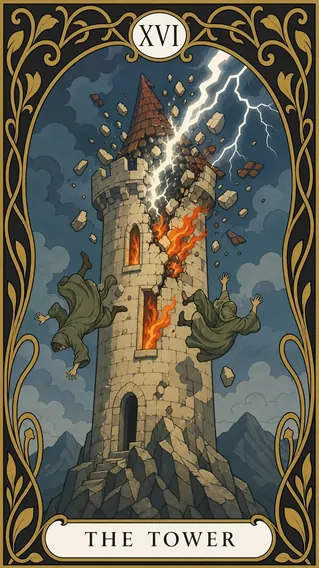
The Devil and the Tower stand consecutively in the deck—as the fifteenth and sixteenth arcana—and essentially describe one story in two phases. The Devil is the mechanics: a voluntary bond that relies on some gain and has no lock on the chains, only the habit of not taking them off. The Tower is the event: the moment when a structure that was held together by force collapses on its own, without warning and without asking.
The leading card in the pair is usually read as the one in the position of the cause or current state, and the clarifying one as the one that shows development or outcome. The Devil in the cause position and the Tower in the outcome is the most frequent and "natural" option, matching the order of the cards in the deck: an addiction that ends in a collapse. The reverse order—the Tower in the cause, the Devil in the clarification—does not speak of movement toward a collapse, but of what was revealed only after it: what was not previously acknowledged as an addiction became visible only when everything fell apart.
A nuance lost in retellings: neither card is "stronger" than the other by default. Priority is set not by the order of writing in the pair's name or the order in the deck, but by the position in the reading where the card landed.
The Tower and The Devil in the reversed position
Reversing one or both cards in this pair usually points not to a different story, but to a different speed and stage of the same one.
- Only the Tower is reversed, the Devil is upright. The bond is active and recognized as such, but the collapse is being delayed: the person spends energy trying to keep the structure from falling, even though the crack is already visible. This is the most protracted of the three options.
- Only the Devil is reversed, the Tower is upright. The collapse in the outside world has already occurred, and the realization of the addiction that led to it comes only now, in hindsight. Often, it is only after such a blow that a person calls things by their names for the first time.
- Both cards are reversed. The collapse is happening inside, not outside: there is no clear event, but both the bond and its destruction are happening quietly, stretched out over time. Externally, it may seem that nothing is changing, although internally the process is already ending.
Common to all three cases: the reversed position in this pair almost always means that the denouement is postponed, not canceled.
The Tower and The Devil in relationships
In a relationship reading, this pair is one of the most recognizable patterns: an attachment that is held together not by agreement, but by the benefit for each side—attention, status, fear of being alone—and which breaks not by gradual cooling, but by a sharp rupture or the exposure of deception.
The order of the cards changes which phase the reading is looking at. Devil → Tower describes a relationship that is still holding on, but on its last legs: the structure is cracking, the collapse is a matter of time, not fact. Tower → Devil is about a relationship where the break has already happened, and only now is it becoming clear how dependent and unequal the connection was, which was previously called just "complicated."
A separate disclaimer that cannot be skipped in this pair: if the pattern is based not on emotional dependency, but on violence, threats, or control, this is not "passion that collapsed," but a situation requiring an exit plan and real people nearby, not a reading. The cards describe the structure, not justify what is happening within it.
The Tower and The Devil in work and money
In a career and money reading, the pair usually paints a picture of "golden handcuffs" that are snapping: a job or financial agreement that a person has long outgrown or that is draining them, but the salary, loan, or fear of starting over holds them tighter than any contract—and then a sharp change occurs: layoffs, closing of a department, a collapse of income that was considered stable.
If the Devil leads and the Tower follows, the bond with the job or debt is still active, but at its limit; this is the moment when it is worth honestly calculating the price out loud, rather than waiting for the decision to be made for you. If the Tower leads and the Devil follows, the collapse (firing, loss of a client, a large unplanned expense) has already happened, and the reading shows that behind it was a long-standing dependence on one support: one client, one position, one agreement without a backup plan.
The advice of the pair in this area is the same regardless of the order: do not rebuild the exact same structure that fell after the collapse.
What to do if this combination appears
The practical meaning of the pair is simple, though not always pleasant: first, honestly name what is keeping you in the situation, rather than judging yourself for still being in it—and separately accept that the sharp part, if it has already happened or will happen, is not about punishment, but about removing what was already held together by force.
What is worth doing in essence:
- Name the gain. Any prolonged bond has something you get from it—peace, money, a sense of being needed. Without an honest name, the exit does not hold.
- Separate the loss and the relief. After a collapse, there is usually both, and admitting the second to yourself is no less important than the first.
- Do not make big decisions in the first days after the blow. The Tower shows the moment of collapse, not the moment when everything needs to be decided finally.
- Do not assemble the same structure again. If a support has collapsed once, it already had a flaw—it is worth understanding what it was before building a similar one.
If the plot is based on addiction, violence, or severe loss, this is the domain of a doctor, psychologist, and loved ones nearby, not a reading. The cards help to see the structure of the situation—the decision and help remain with the person.
Frequently asked questions about the Tower and The Devil combination
What is more important in this pair, the Tower or the Devil?
No card is more important by default—priority is set by the position in the reading, not the order of writing in the pair's name. The card in the position of the cause or current state is read as the leader, the second as a clarification or development. The Devil in the cause and the Tower in the outcome is the most frequent order: an addiction that ends in a collapse.
Is the Tower and the Devil together a sign of a breakup?
The pair describes a pattern, not a guaranteed outcome: an attachment held together by benefit, not agreement, which usually ends sharply, not by gradual cooling. Whether a specific connection will break and when, the cards do not say—they show the nature of the bond, and the decision remains with the people involved in it.
What does it mean if both cards appear reversed?
Both reversed cards in this pair usually mean that the process is happening inside, without a clear external event: both the bond and its destruction are stretched out in time and are not noticeable from the outside. The denouement is not canceled, just postponed and passes more quietly than in the upright position.
Is the Devil after the Tower a sign that the addiction was always there?
Often yes, but in the sense of realization, not a diagnosis: the collapse has already occurred, and only after it did it become clear how deep the attachment was, which was not previously called an addiction. The card does not put a label—it indicates that it is worth taking a closer look at what held the situation together before the blow.