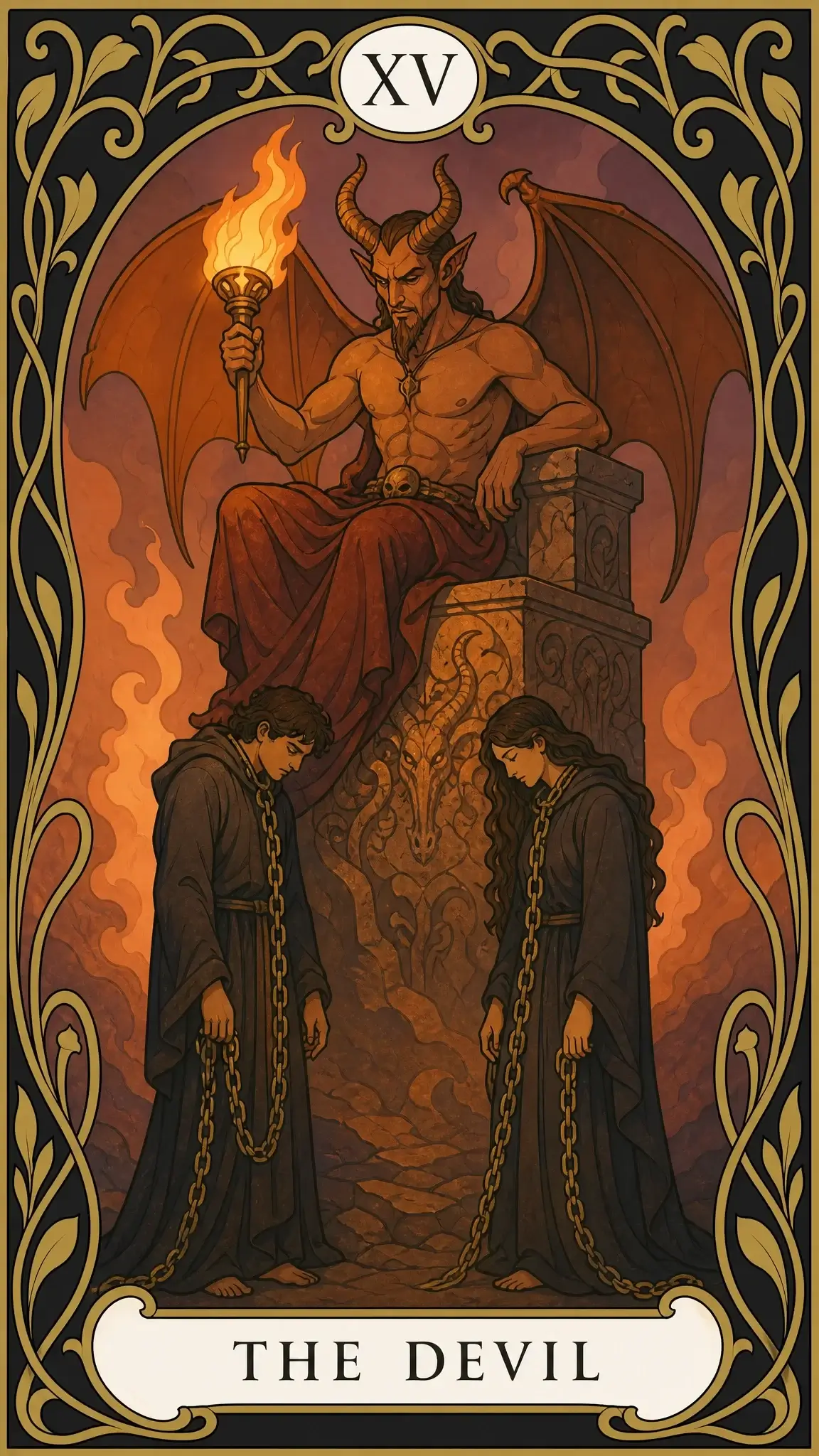
What does The Devil mean in Tarot
The upright Devil is a situation in which a person is involved voluntarily and from which they do not leave, even though the exit is not locked. A job that drains you but pays; relationships that are bad but familiar; a habit that comforts and destroys at the same time.
An important nuance often lost in retellings: The Devil describes a deal, not violence. There is always something a person receives: money, status, a sense of being needed, peace, or the lack of need to make decisions. Until this gain is named, the cycle cannot be broken — only the visible part goes away, but the cause remains.
The second side of the card is vitality. The Devil is connected to physicality, desire, excitement, and greed for life. Not every plot of his is pathological: sometimes he simply says that a person is driven by a strong desire, and one should deal not with the desire, but with the price.
Reversed Devil: meaning
The reversed Devil is almost always a movement toward the exit, but at different stages:
- Awareness. A person calls an addiction an addiction for the first time. Nothing has changed yet, but the illusion of "I can stop anytime" has crumbled.
- Breaking the cycle. A real exit: quit, left, gave up. Often accompanied by emptiness — there is nothing yet to fill the freed-up space.
- Relapse. Less often: returning to where one had already escaped from, usually quieter and more shameful than the first time.
Neighboring cards help to choose: next to The Star or Temperance — recovery, next to the Eight of Cups — a conscious departure, next to The Moon — an attempt to convince oneself again that everything is fine.
The Devil in a "yes or no" spread
In "yes/no" spreads, The Devil answers yes — and this is the case where "yes" is worse than "no". The desired outcome will usually be achieved, but with a condition that will manifest later: an obligation, a tie, or dependence on a person or money.
It answers particularly unambiguously to questions like "will this connection last" — yes, it will last, because it is held not by love, but by a bond.
The reversed Devil in a yes/no spread is closer to no: the bond weakens, and what was held by it falls apart. For the question "will I be able to get out," this is, on the contrary, a good answer.
The Devil in relationships and feelings
In a relationship spread, the upright Devil is a connection held not by agreement, but by a bond. Strong attraction, jealousy, "I can't be with you and I can't be without you" swings, dependence on the attention of a specific person.
In the position of feelings, this is passion without peace: intense, physical, exciting — and with a constant background of anxiety. There is no steady warmth in the card in either the upright or reversed position; warmth is described by the Two and Ten of Cups.
A separate frequent plot is relationships that both sides consider wrong and continue. The Devil describes exactly this: not deception, but a conscious continuation.
The reversed Devil in relationships is the moment when one of the two no longer has enough of the gain for which they were enduring it.
An important caveat: the card describes a voluntary bond. If there is violence, threats, or control in a relationship, this is not "diabolical passion," but a situation that requires an exit plan and real people nearby, not a spread.
The Devil in work and money
In career spreads, The Devil is golden handcuffs. A job that a person has long outgrown or that drains them, but the salary, mortgage, status, or fear of starting over hold them tighter than any contract.
In money, the card speaks of income with a condition: a loan, installment plan, money from a person who will later present a bill, earnings that require silence. Neighboring cards will show the scale: with the Ten of Pentacles, it is a conscious trade-off; with the Five of Swords, it is already an unhealthy story.
What The Devil advises in a work spread: calculate the price out loud. Not "leave immediately," but honestly name what you are receiving and what you are paying. Half of The Devil's plots are held exactly by the fact that this calculation was never spoken aloud.
The Devil as a person: man and woman
In the "what kind of person" position, The Devil describes someone you are drawn to and near whom you lose your freedom. Not necessarily a villain: often this is a bright, attractive person who knows how to be needed so much that it becomes uncomfortable without them.
The Devil-man in a spread is charming, powerful, and knows how to bind; there is a lot of intensity and little peace around him. The Devil-woman is the one around whom everything revolves, and whose approval begins to determine the mood of others.
This is not necessarily a description of a manipulator. Sometimes the card speaks not about the person, but about the fact that the querent themselves has made them the center of their life.
The Devil in the thoughts position
In the thoughts position, The Devil represents obsession. A person is fixated on the same thing: a job they need to quit, a person they need to forget, or a bet they need to place. Thoughts go in circles and always return to the same point.
This also includes internal bargaining: "just one more time," "I'll quit after I get my bonus," "after the holidays." The Devil in thoughts is almost always accompanied by very convincing arguments for why you shouldn't change anything—and that is its main sign, not the strength of the desire.
What to do if you draw The Devil
The Devil's advice is unpleasant in its precision: name what you are getting out of this. Don't judge yourself, but honestly formulate the gain—without it, the exit won't hold, and the person will return.
What you should actually do:
- Find the gain. Money, peace, a sense of being needed, the right not to make decisions—there is always something there.
- Calculate the cost for a year. Not for one evening, but for twelve months of the same life.
- Remove the autopilot. Most of the attachment is held by habitual action, not by a decision: the same route, the same chat, the same button.
- Find a replacement for the gain. The empty space after leaving is the main reason for returning.
And separately: if it concerns substance abuse, gambling, or a situation involving violence, this is the domain of specialists and loved ones, not a reading. The card describes the mechanics well, but it does not replace professional help.
What is depicted on the card
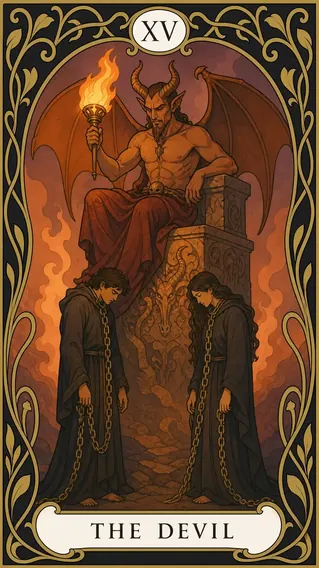
Our Devil features a horned figure with a torch on a high throne, with a glow behind them. At the foot of the throne are two people in chains, with horns and tails, standing calmly and almost mundanely.
The scene is read as follows:
- Chains on the necks — the most important detail of the card: the loops are wide, they can be taken off over the head. No one is locked in; everyone is standing there voluntarily.
- Horns on the people — those below are gradually becoming like the one above. That is how long-term presence in such a situation works.
- Torch pointing down — light directed the wrong way: there is understanding, but it serves to justify rather than to escape.
- Calm poses — no one is being tortured here. That is the essence of the card: the suffering in it is voluntary and habitual.
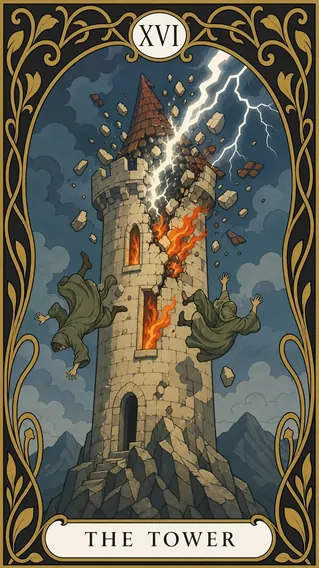
At the top is the Roman numeral XV, at the bottom the English name THE DEVIL: our deck is drawn in the Rider-Waite tradition, where The Devil is the fifteenth, right before The Tower.
The Devil as the card of the day
The Devil as the card of the day is a day of temptations and getting stuck. It is easy to overspend, stay up too late, text someone you shouldn't, or agree to terms that will seem oppressive tomorrow.
A useful mindset: do not sign contracts and do not take on long-term commitments; anything you want to do immediately, put off until tomorrow. And notice where exactly the day is going—The Devil shows habits well that are usually not noticed.
Frequently asked questions about The Devil card
Is The Devil in Tarot a curse or evil?
No. In the practice of interpretation, this arcana describes addiction and voluntary attachment, not external influence. A key detail of the drawing is the chains, which can be removed. The card says that a person chooses for themselves and continues to choose, knowing the price.
What does a reversed The Devil mean?
Most often, it is a movement toward the exit: awareness of the addiction, weakening of the attachment, or an actual break in the cycle. Less often, it is a relapse and a return to where one was already escaping from. The stage is shown by the surrounding cards.
Does The Devil mean strong love?
It means strong attraction, but not calm attachment. It is passion with an anxious background, jealousy, and mood swings. Even warmth in the deck is described by the Two and Ten of Cups, not The Devil.
Is The Devil a "yes" or "no"?
More of a "yes," but with a condition: the desired outcome will be achieved, but the price will manifest later—in the form of an obligation or addiction. For the question "will I be able to get out," the answer is the opposite: an upright The Devil says "not yet," while a reversed one says "yes."
Which arcana number is this?
The fifteenth major arcana, the card has the Roman numeral XV. In the Rider-Waite deck, which ours is based on, The Devil comes after Temperance (XIV) and before The Tower (XVI).