What the Eight of Swords means in Tarot
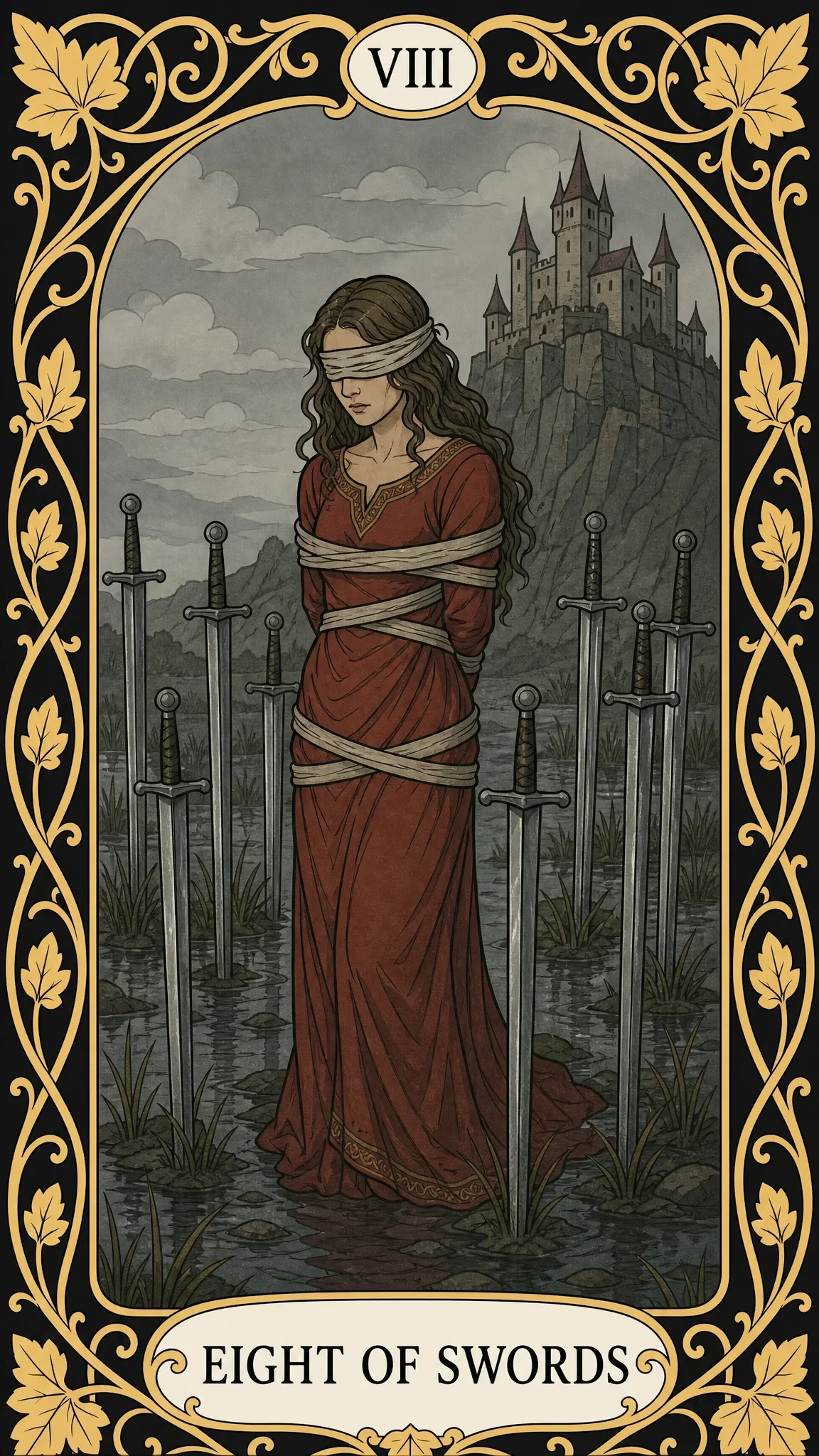
The Eight of Swords is one of the most recognizable images of the minor arcana: a woman with a blindfold, her hands tied with cloth, surrounded by blades stuck in the ground. The first thing to note: the trap in this card is almost always internal, not external. The swords are not placed close together; there is enough space between them to pass through, but the person does not see this because they have blindfolded themselves.
An important nuance often lost in retellings: the minor arcana describes an episode, not destiny. The Eight of Swords is not about one's entire life being a prison, but about a specific situation in the coming days or weeks where it seems there is no choice: a job that has become stifling, a conversation one is afraid to start, a decision being postponed because only bad options are visible. The element of swords is air, and here, air represents thoughts: the card is specifically about how the mind narrows the picture of what is happening down to a single hopeless scenario.
The upright position reads this situation honestly: the feeling of helplessness is real, but objective obstacles are usually fewer than they seem. It is important to distinguish this state from literal lack of freedom — if the question is not about a metaphor but a real situation, more details can be found in the section "What to do if the Eight of Swords appears".
Reversed Eight of Swords: meaning
The reversed Eight of Swords is the moment when the blindfold is removed, even if not completely. Usually, the spread refers to one of three options, and the question itself helps to choose.
- The first step has already been taken. The person has finally spotted the way out and is starting to act, albeit slowly and hesitantly.
- Acknowledging one's role in the trap. There is a realization that the dead end was partly created by one's own avoidance, not just external circumstances.
- Relief after long tension. A situation that held one in a vice is finally resolving — not always gracefully, but with palpable relief.
There is also a difficult interpretation that should not be ignored: sometimes the reversed card shows not a solved problem, but only the beginning of realizing its scale — for example, addiction or unhealthy relationships. Here, working with the card ends where working with a specialist begins.
Eight of Swords in a "yes or no" spread
In "yes/no" spreads, the Eight of Swords leans towards a cautious no — not because the path is objectively closed, but because the person is not yet ready to see the way out. If the question is "will it work out," the upright card answers: for now, it feels like it won't, although real obstacles may be significantly fewer.
If the question is phrased differently — "is there a way out at all" — the answer is more likely affirmative; the exit is simply not where it is being sought. It is useful to rephrase the question: not "will it resolve itself," but "what is preventing me from seeing the solution."
The reversed position in this spread is read more gently: yes, the situation is starting to shift, the first step toward the exit has already been taken or is about to be taken.
Eight of Swords in relationships and feelings
In a relationship spread, the upright Eight of Swords often describes the feeling of being stuck in a couple or a situation from which one sees no way out: it is scary to leave, scary to stay, scary to start a conversation about the problem. Sometimes this feeling is amplified by one's own assumptions — the partner never said what is being attributed to them, but the assumption holds tighter than any real words.
For single people, the card can mean a fear of trusting again after a painful experience: the connection is not forbidden by anyone, but the person keeps everyone at a distance, fearing a repeat of old pain.
The reversed position signifies the removal of this fear: the conversation has finally taken place, a decision has been made, and the perspective on the situation has become clearer. A direct disclaimer is needed here: if the words "stuck in a relationship" are not about anxiety, but about a real threat, control, or violence from a partner, a card spread is not the place to resolve this issue. Such a situation is a reason to contact a specialist or a support service, not to read cards.
Eight of Swords in work and money
In career spreads, the Eight of Swords represents a job that seems like a dead end: rigid frameworks, a boss one is afraid to argue with, obligations that are hard to break. Often, there are more options than are visible from within the position — changing departments, talking directly, looking for another place — they are simply not considered because one has become accustomed to viewing the situation as hopeless.
Regarding money, the upright position is the feeling that expenses or debts have cornered one so much that it seems nothing can be changed. This is more of a psychological dead end than a mathematical one: there are often steps that reduce tension — reviewing the budget, talking to a creditor, asking for an installment plan — they are simply not thought of in a state of panic.
The reversed card is the beginning of movement: the first call, the first edit to a resume, the first conversation about renegotiating terms.
Eight of Swords as a person: man and woman
When the Eight of Swords appears in the "what kind of person" position, it describes the role of someone who has cornered themselves: they exaggerate risks, are afraid to act, and see fewer exits than there actually are.
A woman as the Eight of Swords is someone who keeps her anxiety to herself and does not ask for help, even though there is someone nearby who could help. A man as the Eight of Swords is someone who gets stuck in analysis and self-criticism instead of taking action, even though the way out is likely simple.
It is useful to remember: this is not about a weakness of character, but about a temporary state. In a spread, it is worth looking at the cards nearby that speak of support and a sober perspective from the outside — often they turn out to be the missing piece of the puzzle.
Eight of Swords in the position of thoughts
In the position of thoughts, the Eight of Swords represents an obsessive loop of the same scenario: the mind is occupied by a single thought that "there is no way out," and any alternatives are dismissed before they can even be considered.
This is a state of tunnel vision, characteristic of the Swords as an element of air: too many thoughts about a single dead end and too little attention to the actual facts at hand. If Pentacles appear nearby in the spread, the anxiety is likely practical, concerning money or obligations; if Cups are nearby, the anxiety is more emotional, concerning what others might think or how they might react.
What to do if you draw the Eight of Swords
The card's advice is simple, though not the easiest: remove the blindfold yourself, because no one else will do it for you from the outside. The Eight of Swords is about a trap that you can leave if you stop mistaking your own assumptions for reality.
What you should actually do:
- Separate facts from assumptions. Write down what is actually hindering you and what is just fear or someone else's potential opinion.
- Find one gap between the "swords." Don't look for a complete escape plan right away—one concrete step that narrows the dead end is enough.
- Ask someone from the outside. Tunnel vision is usually cleared by the perspective of someone who isn't stuck in the same situation.
- Do not confuse a psychological trap with real imprisonment.
If the question is not a metaphor but a real situation—where a person is being held against their will, threatened, or restricted in their movement or communication—a Tarot reading is not the place for a solution. This is a matter for professionals: a psychologist, a lawyer, a support service, or, in case of immediate danger, emergency services. The card can show a state of anxiety, but it does not replace real help and should not delay it.
What is depicted on the card
On our card, a woman in a dark red dress stands on marshy ground amidst low grass. Her eyes are covered by a thick blindfold, and her hands are bound to her torso with wide strips of fabric. Around her, half-submerged in water, eight swords are stuck in the ground—not in a tight ring against her body, but at a noticeable distance from each other, leaving clear paths between the blades. In the distance, on a rocky hill, is an illuminated castle with several towers that can be reached if one wishes.
The scene is interpreted as follows:
- The blindfold — it is not the swords that keep the woman trapped, but her own ignorance of what is happening around her.
- Spaced-out, not closed-in swords — a way out physically exists; it is simply not visible when blinded.
- The castle in the background — the goal or normal life remains attainable; they are not destroyed or taken away, only temporarily hidden behind a fog of anxiety.
The difference from traditional iconography should be stated directly: in a classic deck, the hands are usually tied behind the back, and the swords are placed closer together, almost like a cage around the legs. In our version, the hands are bound in front, and there are obvious gaps between the swords: the emphasis here is even more strongly on the fact that the dead end is largely imagined, not literally impassable.
Eight of Swords as the card of the day
As the card of the day, the Eight of Swords is a signal to stop and check if the situation is really as hopeless as it seems in the morning. The day is suitable for separating real obstacles from imagined ones, rather than making rash decisions in the heat of the moment.
If the card is drawn reversed, the day will likely bring relief: a conversation you've been putting off will happen on its own, or a solution will come more easily than expected.
Frequently asked questions about the Eight of Swords card
Is it a Major or Minor Arcana?
Minor Arcana, suit of Swords, element of Air. There are 56 Minor Arcana cards in a Tarot deck—14 cards for each of the four suits, and the Eight of Swords is the eighth card of the Swords suit.
How does the Eight of Swords differ from the Eight of Pentacles?
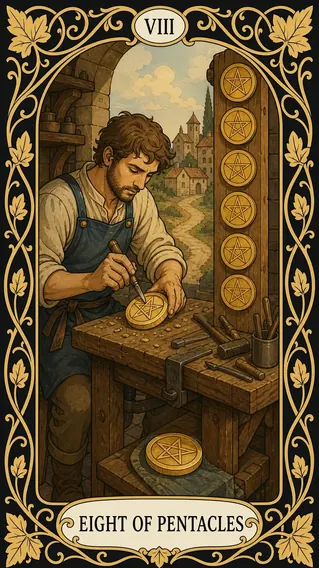
Both cards are about the eighth stage of the suit, but of a different nature. Swords are the element of air, thoughts: the Eight of Swords is about the feeling of a dead end, which one's own fear and distorted perception prevent them from leaving. Pentacles are the element of earth, labor: the Eight of Pentacles is about focused practice and honing a skill, without a trap or anxiety. If the spread is about a state of constraint and fear, it's about Swords; if it's about diligence and mastery, it's about Pentacles.
Is the Eight of Swords a yes or no?
Probably no: the card says that the person does not yet see a way out, not that a way out does not exist. If the question is about the fact of "will it work out," the answer is cautiously negative. If the question is about whether there is a solution at all, the answer is more likely yes—it just hasn't been seen yet.
What does the reversed Eight of Swords mean?
Removing the blindfold: the first step out of a dead end, acknowledging your role in the situation, or relief after long tension. Sometimes it is only the beginning of realizing a serious problem, not its solution, and then the card should be followed by professional help.
Does the Eight of Swords mean real danger or imprisonment?
The card itself is about a psychological, self-limiting feeling of being trapped, not about literal lack of freedom. But if the question is asked about a real situation where a person is being held against their will, or their movement or communication is restricted, this is a reason to contact a professional, a support service, or emergency services, rather than looking for an answer in a spread.