What the Nine of Swords means in Tarot
Swords are the suit of the mind: thoughts, arguments, decisions, sharp words. The Nine of Swords is the heaviest card of this suit in terms of feeling, although nothing is happening on the surface: a person is simply sitting in bed in the middle of the night, face in their hands.
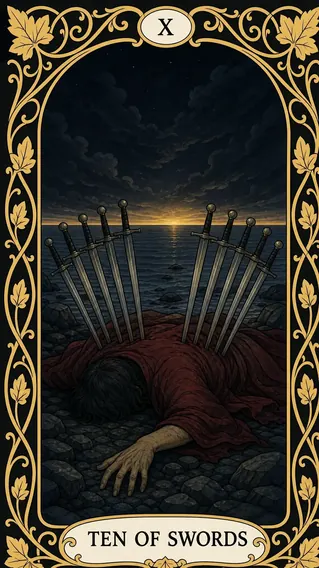
An important nuance to address immediately: the Minor Arcana describes an episode, not destiny. The Nine of Swords is not a diagnosis or a sentence for years to come, but a specific sleepless night, a difficult week, or a period when anxiety has taken over a sober view of things. The neighboring Ten of Swords in the same suit is a different story, about the limit after which recovery begins; the Nine stands before it, in the thickest part of anxiety, but not yet at the bottom.
The number nine in the Minor Arcana almost always signifies proximity to the end of a cycle—the last step before the ten. In Swords, this proximity is felt as maximum mental tension: thoughts go in circles, finding new reasons for worry, and it seems there will be no end to it. The upright position is read unambiguously: the anxiety is real and painful, but its size in the head is almost always larger than the size of the problem itself. The card shows not that disaster will necessarily happen, but the state the mind is currently in—and that is why a spread with such a card should not be taken as a prediction of specific bad events.
Reversed Nine of Swords: meaning
The reversed Nine of Swords is the same anxiety, but at a moment when something begins to change. Usually, the spread refers to one of three options, and the question itself provides the clue.
- Anxiety begins to let go. The worst point has passed, and thoughts gradually stop spinning in the same circle.
- The decision to stop being silent. The person finally tells someone about what has been gnawing at them in solitude—a partner, a friend, a specialist—and this is the first step toward relief.
- Anxiety goes deeper. Outwardly, the person holds it together and even looks calm, but the insomnia and racing thoughts continue; they have simply stopped talking about it.
There is a heavier reading that should be stated directly: sometimes the reversed position means that the anxious state has been dragging on for a long time and has become a habitual background of life. If the spread describes exactly this picture, it is a reason not to look for an answer in the cards, but to consult a doctor or therapist: a spread can name a feeling, but it cannot cure it.
The Nine of Swords in a "yes or no" spread
In "yes/no" spreads, the Nine of Swords is usually read as no—but what matters is not the letter of the answer itself, but where it came from. The card shows a state in which anxiety obscures a sober assessment: a decision made at three in the morning under the weight of obsessive thoughts will likely change by morning.
If the question is "should I make a decision now, in this state," the answer is negative, and this is not about the outcome of the matter, but about the fact that now is not the time to decide. Anxiety is a poor advisor precisely because it exaggerates risks and prevents you from seeing options.
The reversed position in this spread means "too early to say": the anxiety has not yet let go enough to draw conclusions. It is more useful to rephrase the question not as "what will happen," but "what will help me calm down enough to make a decision at all."
The Nine of Swords in relationships and feelings
In a relationship spread, the upright Nine of Swords describes not the conflict itself, but the anxiety surrounding it: the fear that a partner has fallen out of love, suspicions without evidence, endless replaying of a single phrase or look in search of hidden meaning. This card is not about what actually happened, but about how much anxiety has distorted the picture.
In the position of feelings, the Nine of Swords often points to guilt: the person blames themselves for something said or unsaid, returning time and again to the same episode. Sometimes there is a real reason for a conversation behind this, and sometimes—only the fear that there is a reason.
The reversed Nine of Swords in relationships means anxiety is beginning to be voiced aloud: they finally decide to ask directly instead of guessing alone at night. This is usually a relief, even if the conversation itself is difficult—the uncertainty in this card is almost always heavier than any honest answer.
The Nine of Swords in work and money
In career spreads, the Nine of Swords is anxiety about a result that has not yet arrived: the fear of failing a project, receiving a bad evaluation, or losing a position, even if there may be no formal grounds for this. The card well describes the nights before an important decision by management or a client, when the imagination paints the worst-case scenario long before the facts.
In money, the upright position is anxiety about future expenses or debt, often exaggerated relative to the real amount: calculations in the head go in circles, but it never reaches paper and numbers. The card is not about the size of the problem, but about the fact that worrying about money prevents you from assessing it calmly.
The reversed Nine of Swords in work and money is the decision to finally face the numbers or the situation: open accounts, talk to a supervisor, stop putting off an unpleasant conversation. Anxiety here most often turns out to be greater than the real scale of the matter.
The Nine of Swords as a person: man and woman
When the Nine of Swords appears in the "what kind of person" position, it describes not the character as a whole, but a state: someone who is currently experiencing intense, often hidden anxiety. Outwardly, such a person may appear composed, but at night they do not sleep because of thoughts they do not share.
The Nine of Swords man is someone who is used to not showing worry and experiencing it in silence, which makes those around him think everything is fine. The Nine of Swords woman is someone who blames herself more than the situation requires and finds it difficult to accept support, even when it is offered.
This description is not a diagnosis or a permanent character trait, but rather a current state: as soon as the source of anxiety is clarified or receives support, the person usually returns to their normal state. If there are cards nearby in the spread that speak of help and conversation—the Three of Cups, the Star—this is a good sign that support is already near.
Nine of Swords in the thoughts position
In the thoughts position, the Nine of Swords describes a state of mind almost literally: obsessively replaying the same scenario, most often the worst-case one. Thoughts don't come one by one, but in a swarm, and it's usually impossible to cope with them by willpower alone—which is why the image on the card is about night, not day: in the dark and silence, it is hardest to control this flow.
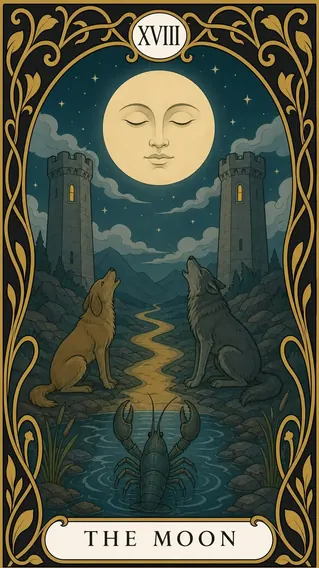
If other Swords cards appear nearby in the spread, the anxiety is likely related to a specific thought or conflict that can be put into words. Next to the Moon, the anxiety feels more like a vague, unformed premonition without a clear cause. In both cases, the card does not say that the anxiety is justified by facts—it only says that the person is currently experiencing it.
What to do if you draw the Nine of Swords
The card's advice is simple, but that is exactly why it is hardest to follow at night: do not take conclusions made in a state of anxiety seriously until morning. The Nine of Swords is a card of the moment when thoughts distort the scale of what is happening, not a card of an accurate diagnosis of the situation.
What you should actually do:
- Postpone the decision until morning. A thought that seems like a catastrophe at 3 AM almost always looks different during the day.
- Speak the anxiety out loud or write it down. Thoughts that spin silently seem bigger than the same thoughts spoken or put on paper.
- Do not stay alone with it. Call a loved one—not for a solution, but simply so you don't have to think alone.
- Check facts separately from feelings. Anxiety is good at painting the worst-case scenario and bad at calculating its probability—it is worth intentionally checking one against the other.
Plainly and directly: if anxiety and insomnia are not one-off events but drag on for weeks, interfering with sleep, eating, or working, a Tarot spread does not treat such a condition and does not replace a visit to a doctor or therapist. The card can name the feeling a person is living with, but a specialist, not a deck of cards, helps to cope with long-term anxiety and insomnia.
What is depicted on the card
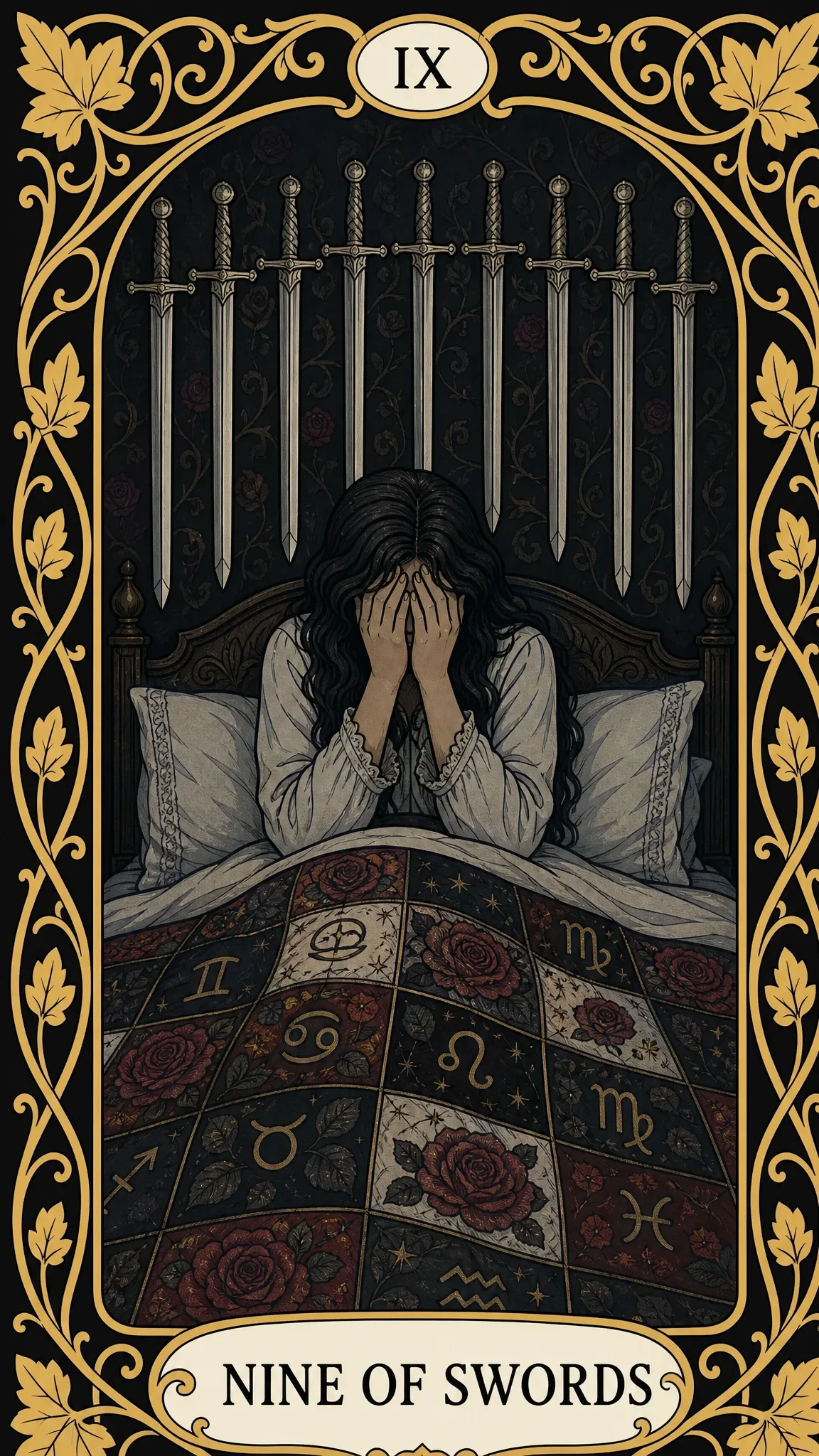
On our card, a woman in a white nightgown sits on a bed, covering her face with both palms; long dark hair falls over her shoulders. Above the headboard, nine swords hang in a row on a dark wall, points upward. The body is covered by a quilted blanket with a pattern of dark red roses and golden zodiac signs—Taurus, Gemini, Cancer, Leo, Virgo, Pisces, and others woven between the flowers.
The scene is read as follows:
- Nine swords on the wall — the anxieties themselves haven't gone anywhere: they hang right where they were, in a neat row. None are raised or brandished—the threat is not active right now; it exists only as a thought about it.
- Face covered by hands — the person is not looking at the reality around them, but remains one-on-one with an internal picture of what is happening, which may differ greatly from what is actually hanging on the wall.
- Blanket with zodiac signs and roses — a lived-in, warm, arranged world: the bed, the house, and everyday life haven't gone anywhere, despite the anxiety. This contrast between the cozy bed and the row of swords overhead is the essence of the card: the danger is mostly in the head, not in the room.
- Sitting, not lying down pose — anxiety woke the person in the middle of the night, not letting them sleep until morning.
At the top of the card is the Roman numeral IX, at the bottom is a plaque with the English name NINE OF SWORDS.
The Nine of Swords as the card of the day
The Nine of Swords as the card of the day is a signal that anxious thoughts will be louder today than the real reasons for them. The day is not suitable for dealing with all problems at once, but for separating what truly requires attention from what just seems urgent in a state of anxiety.
If the card is drawn reversed, the day may bring the first relief: a conversation that was being put off, or simply a calmer night after several difficult ones. If the anxiety is too strong on this day and interferes with functioning, it is wiser to talk to a loved one or a doctor rather than trying to cope with it alone.
Frequently asked questions about the Nine of Swords card
Is it a Major or Minor Arcana?
Minor Arcana, suit of Swords, element of Air. There are 56 Minor Arcana cards in a Tarot deck—14 cards for each of the four suits, and the Nine of Swords describes not fate, but a state of anxiety at a specific moment, closer to the end of the cycle of cards in this suit.
How does the Nine of Swords differ from the Nine of Cups?
Both cards are nines, but in meaning, they are almost opposites. The Nine of Swords (Air) is about exhausting anxiety and thoughts that exaggerate a problem. The Nine of Cups (Water) is about satisfaction and fulfilled desires, one of the most auspicious cards in the deck. If the spread is about worry and insomnia, it's about swords; if it's about contentment and joy, it's about cups.
Is the Nine of Swords a yes or a no?
Usually no, but it's not about the event itself, but the state in which the decision is made: anxiety is currently distorting the scale of what is happening. It is more useful not to rush with an answer, but to return to the question when your head is calmer.
What does the reversed Nine of Swords mean?
The same anxiety, but at a stage of change: it is either starting to recede, or the person is finally deciding to talk about it. Less often, the anxiety goes inward and continues silently, no longer showing externally.
If anxiety and insomnia persist for a long time, will a spread with this card help?
No, and it is important to say this directly. A spread can name a feeling—intense anxiety, exhausting night thoughts—but it does not treat chronic anxiety and insomnia. If the condition lasts for weeks and interferes with your life, you should consult a doctor or therapist rather than looking for an answer in the cards.