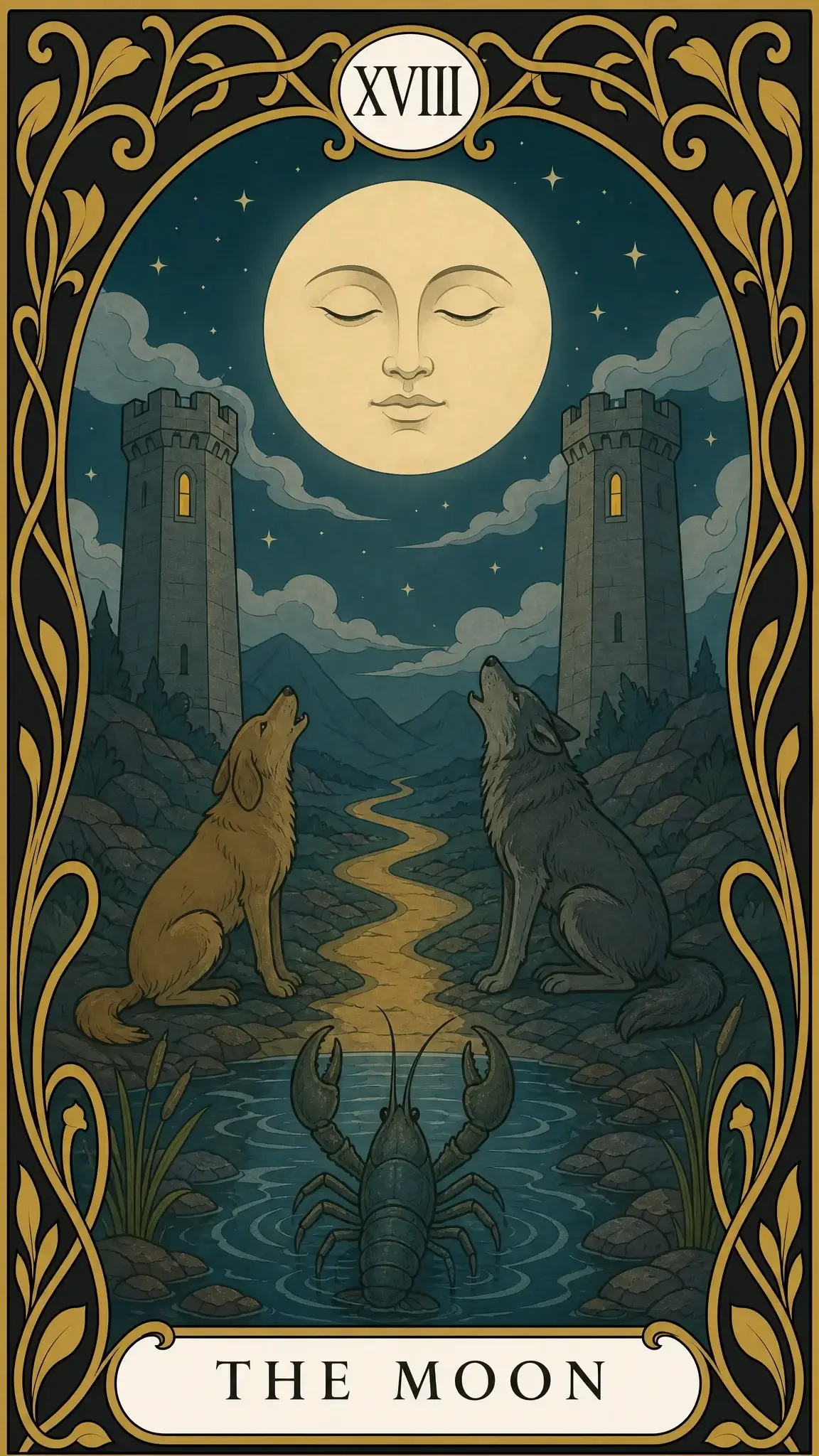
What does The Moon mean in Tarot
The upright Moon is a situation where there is not enough data, but the person has already drawn conclusions. They see outlines and fill in the rest themselves, usually based on their fears rather than facts.
An important nuance often lost in retellings: The Moon does not deceive, it leaves things unsaid. It rarely points to malicious intent; more often, it is a situation where someone hasn't said everything, where promises are vague, where the answer is evasive — and the person fills in the gap with the worst-case scenario.
The second half of the meaning is intuition. The Moon has a productive side: in the fog, ordinary ways of figuring things out don't work, and another one kicks in — gut feeling, dreams, the premonition that "something is wrong here." In spreads, The Moon often appears as confirmation that a premonition is well-founded — but you will still have to verify it with more than just a gut feeling.
Reversed Moon: meaning
The reversed Moon is usually read as emerging from the fog. It typically carries one of three meanings:
- Clarity returns. Circumstances become clear, the unspoken is voiced, anxiety subsides, and it turns out it was greater than the situation itself.
- The truth surfaces. What was hidden comes to light — not dramatically like the Tower, but mundanely.
- Self-deception in the final stage. Less common, but it happens: the person already sees the discrepancy and continues to convince themselves that everything is fine.
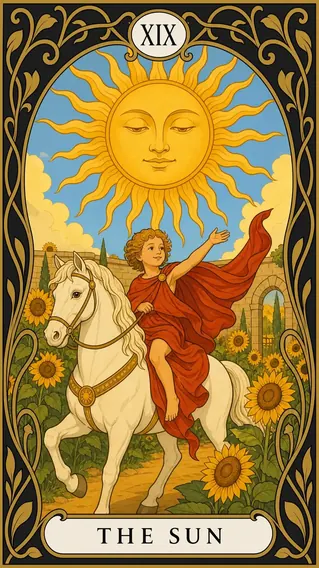
The question of the spread and neighboring cards help to choose: next to the Sun or the Star — clarification; next to the Seven of Cups or the Devil — more likely stubborn self-deception.
The Moon in a "yes or no" spread
In "yes/no" spreads, The Moon is the most honest of the evasive cards: it answers "there is no answer yet". Not "no," but "it is pointless to guess with this data."
Practically, this is read as advice to postpone a decision: right now, the person is evaluating not the situation, but their version of the situation. If an answer is absolutely necessary, it leans towards negative — not because it won't work out, but because acting blindly is more costly than waiting.
The reversed Moon in a yes/no spread is closer to yes: the fog is clearing, and what was hindering you stops being an obstacle.
The Moon in relationships and feelings
In a relationship spread, the upright Moon describes the unspoken. Not necessarily deception: more often it is two people who do not talk about the main thing, and each lives with their own guess about what the other is thinking.
In the position of feelings, The Moon is attachment mixed with anxiety. The person does not understand if they love or are afraid of losing; jealousy here often grows not from facts, but from silence. There is no steady, calm warmth in this card: its feelings are always tinged with "what if."
A separate frequent meaning is relationships where one idealizes the other. The Moon shows not the person, but an image, and the difference will be revealed later.
The reversed Moon in relationships is a conversation that finally took place, and the relief that follows.
The Moon in work and money
In career spreads, The Moon is an opaque situation: unclear agreements, promises without deadlines, a manager who is not saying something, a project with a vague brief.
Regarding money, the card speaks of amounts that the person does not see in full: hidden conditions, non-obvious commissions, income that "should be there." Neighboring cards will show exactly what is hidden: next to the Seven of Swords — intentionally; next to the Eight of Pentacles — simply not yet formalized.
What The Moon advises in a work spread: get the missing data before, not after, making a decision. Ask a direct question, request it in writing, clarify the deadline. Almost everything that seems ominous under The Moon turns out to be either harmless or obviously unacceptable when put in writing.
The Moon as a person: man and woman
In the "what kind of person" position, The Moon describes someone who is difficult to read. Not necessarily a liar: often this is a closed person whose motives have to be guessed, and there is constantly a feeling of the unspoken around them.
The Moon-man in a spread is someone who answers evasively and leaves room for interpretation; there are many guesses and few facts around him. The Moon-woman is someone whose mood changes with the tides, and those around her start adjusting to them before they understand the reason.
Important: The Moon shows your inability to see the person, not necessarily their duplicity. Sometimes, behind the fog, someone simple is revealed who just wasn't asked directly.
The Moon in the thoughts position
In the thoughts position, The Moon represents nocturnal overthinking. A person cycles through scenarios, each darker than the last, and by morning, they believe the gloomiest one. This also includes intrusive dreams and the feeling that "something is wrong" without being able to pinpoint what.
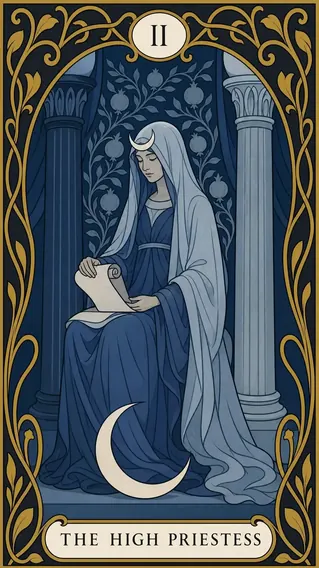
To distinguish a valid premonition from anxiety, use a simple test: a premonition usually points to a specific discrepancy that can be named and verified. Anxiety refuses to be named and demands you take it at its word. Surrounding cards provide clarity: near Swords, it's the work of an anxious mind; near The High Priestess, it's more likely a genuine intuition.
What to do if you draw The Moon
The Moon's advice sounds boring but works almost every time: don't make decisions in the fog. As long as the picture is incomplete, any decision is made not about the situation, but about your fantasy of it.
What you should actually do:
- Separate facts from guesses. Literally: write down what is known for sure and what is imagined.
- Ask a direct question. Most "lunar" scenarios fall apart after one uncomfortable question asked out loud.
- Don't make decisions at night. This isn't mysticism: under The Moon, your evening assessment of a situation is systematically gloomier than your morning one.
- Give it time. The Moon is a card of cycles; much will clear up on its own without intervention.
And separately: if anxiety doesn't let go for weeks and keeps you from sleeping, this is a conversation not for the cards, but for a doctor or psychologist. The Moon describes a state well, but it does not cure it.
What is depicted on the card
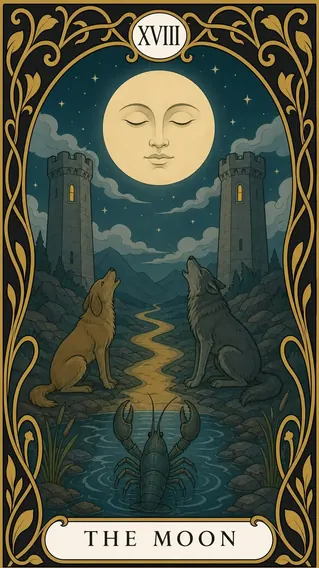
On our Moon card, there is a full moon with closed eyes in the night sky, two towers on the edges, and a path leading into the distance between them. A dog and a wolf sit by the water howling at the moon, and a crayfish crawls out of the water onto the shore.
The scene is interpreted as follows:
- The moon with closed eyes — there is light, but it doesn't reveal; it distorts. Under the moonlight, everything is recognizable, yet everything looks different.
- The dog and the wolf — the tamed and the wild within one person: what they know about themselves and what emerges at night.
- The crayfish from the water — what rises from the unconscious: an old fear, a forgotten episode, an unnamed feeling.
- The path between the towers — there is a path, but it is only visible one step at a time. The card doesn't forbid you from walking, it forbids you from running.
At the top is the Roman numeral XVIII, at the bottom the English name THE MOON: our deck is drawn in the Rider-Waite tradition, where The Moon is the eighteenth arcanum, between The Star and The Sun.
The Moon as the card of the day
The Moon as the card of the day means a day when you shouldn't trust your own assessment of what's happening. Your mood will fluctuate, other people's words will seem loaded with hidden meaning, and trifles will grow into problems.
A useful mindset: postpone important conversations and decisions until tomorrow, don't clarify anything via text (it's especially easy to misinterpret tone there), and treat evening conclusions as a rough draft. It's a good day for sleep, observation, and journaling — and a bad one for ultimatums.
Frequently asked questions about The Moon card
Does The Moon in Tarot mean deception?
Not necessarily. More often it means a lack of information and overthinking: part of the picture is hidden, and the person fills it in themselves. Intentional deception is shown by other cards — the Seven of Swords, The Devil. The Moon is closer to "you don't see everything" than to "you are being deceived."
What does a reversed Moon mean?
Usually, it means the fog is lifting: what was left unsaid is spoken, anxiety subsides, and the situation clears up. Less often, it indicates self-deception in the final stage, when the discrepancy is already visible, but the person continues to convince themselves otherwise. Surrounding cards help to choose the right interpretation.
Is The Moon a "yes" or "no"?
The Moon answers "it's unclear for now." It indicates that there isn't enough data for an answer and it's better to postpone the decision. If an answer is absolutely required, it leans toward "no," but because of a lack of readiness rather than impossibility.
Does The Moon mean infidelity?
On its own, no. It describes ambiguity and anxiety, not a fact. Suspicion under The Moon often turns out to be a consequence of silence, not events. Conclusions about infidelity are made based on the combination of cards and, more importantly, on verifiable facts, not just the spread.
Which arcanum number is this?
The eighteenth Major Arcanum; the card features the Roman numeral XVIII. In the Rider-Waite deck, which our deck is based on, The Moon comes after The Star (XVII) and before The Sun (XIX).