What the High Priestess means in Tarot
The upright Priestess is a situation where a person knows more than they can justify. They see the discrepancy, feel the mood, and understand what is happening — but there is no proof, and there is nothing to talk about yet.
An important nuance often lost in retellings: The Priestess does not prevent action, she prevents fuss. Her advice is not inaction, but observation: wait, watch, and let the situation manifest itself. Unlike the Moon, where the picture is distorted, here the picture is correct — it is just not yet complete.
The second side of the card is mystery. The Priestess often indicates that something is hidden from the querent: not necessarily maliciously, sometimes it is just not the right time. It also indicates that they themselves are keeping something quiet — this is quite common in her narratives.
Reversed Priestess: meaning
The reversed Priestess is usually read in one of three ways:
- Ignoring intuition. The person felt something was wrong and convinced themselves it was just their imagination. This is the most frequent scenario, and it is usually confirmed later.
- The secret is out. What was hidden has come to light — sometimes to one's relief, sometimes inconveniently.
- Superficiality. A decision was made based on the visible part, without looking deeper.
Neighboring cards help to choose: next to the Moon — self-deception, next to Swords — too much reasoning and not enough listening to oneself, next to the Sun — the secret was revealed safely.
The Priestess in a "yes or no" spread
In "yes/no" spreads, the High Priestess is a card of silence. She answers "not now": not a refusal, but an indication that the answer has not yet formed or should not be voiced.
Often this is the most accurate answer to questions about other people's intentions: the other person has not yet decided, and any answer would be a fabrication.
The reversed Priestess in a yes/no spread is closer to yes in the sense of "it will be revealed soon": what was hidden will become known, and the question will resolve itself.
The Priestess in relationships and feelings
In a relationship spread, the upright Priestess represents unspoken things, but in a calm way. There is sympathy, understanding without words, and things that are not yet spoken about. This is often an early stage where both feel everything and neither names it.
In the position of feelings, the Priestess describes a deep but closed attachment. The person feels a lot and shows little — not out of coldness, but because they do not feel the need to prove it.
A separate common theme is secret relationships or a connection that is not told to others. The Priestess points directly to this.
The reversed Priestess in relationships means either a secret has been revealed, or the person ignored their own "something is wrong here" and moved on.
The Priestess in career and money
In career spreads, the Priestess is a period when it is better to observe than to act. Processes are underway that are not being publicized: reshuffles, negotiations, decisions that will be announced later.
Regarding money, the card speaks of an incomplete picture: not all conditions are known, some information has been withheld. Neighboring cards will show what this threatens: with the Seven of Swords — intentional omission, with the Two of Pentacles — simply not everything is finalized yet.
What the Priestess advises in a work spread: do not force things and gather information. Her plots collapse when a person, without figuring things out, demands certainty — they usually receive a hasty and disadvantageous answer.
The Priestess as a person: man and woman
In the "what kind of person" position, the Priestess describes someone who understands a lot and says little. Observant, closed-off, it is difficult to get close to them quickly, but they see more than others.
The Priestess woman in a spread is reserved, deep, keeping both her own and others' secrets; she is difficult to read, but she is reliable. The Priestess man is someone who does not argue or explain, but simply knows, and over time turns out to be right.
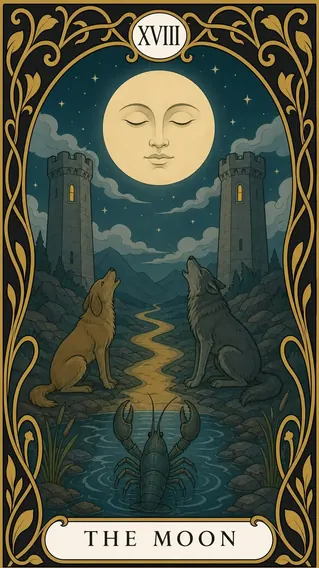
The difference from the Moon: the Priestess does not confuse. Next to her, things are unclear, but not alarming — she does not mislead, she simply does not tell everything.
The High Priestess in the position of thoughts
In the position of thoughts, The High Priestess represents inner silence and observation. You aren't making plans or arguing with yourself; you are watching and noting, holding off on conclusions.
This also includes the feeling of "I know, but I can't explain it." This is not the anxiety of The Moon: here, it is calm knowledge without proof. Surrounding cards clarify: next to Swords, it's an attempt to rationalize what is already clear; next to The Moon, it's the risk of mistaking fear for intuition.
What to do if you draw The High Priestess
The advice of The High Priestess is to be silent and observe. Do not decide, do not clarify, do not demand clarity right now.
What you should actually do:
- Write down your feelings. Don't act on them yet, just record them: in a week, it will be clear whether it was intuition or anxiety.
- Don't force a conversation. With this card, the winner is the one who lets the situation unfold.
- Gather what's missing. Observation is productive here: what isn't said is usually visible through actions.
- Don't share too much. The High Priestess describes both other people's secrets and the need to keep your own equally well.
And separately: the silence of this card is temporary. If the pause lasts for months and turns into a way to avoid talking altogether, we are no longer talking about The High Priestess, but about the Two of Swords — being stuck.
What is depicted on the card
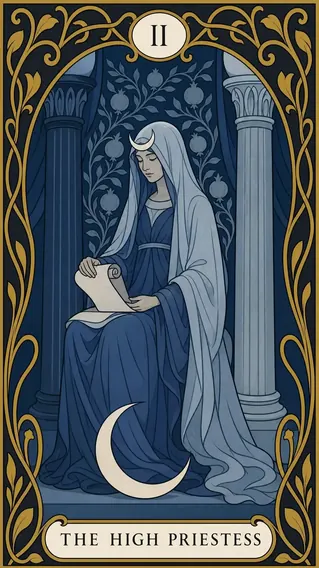
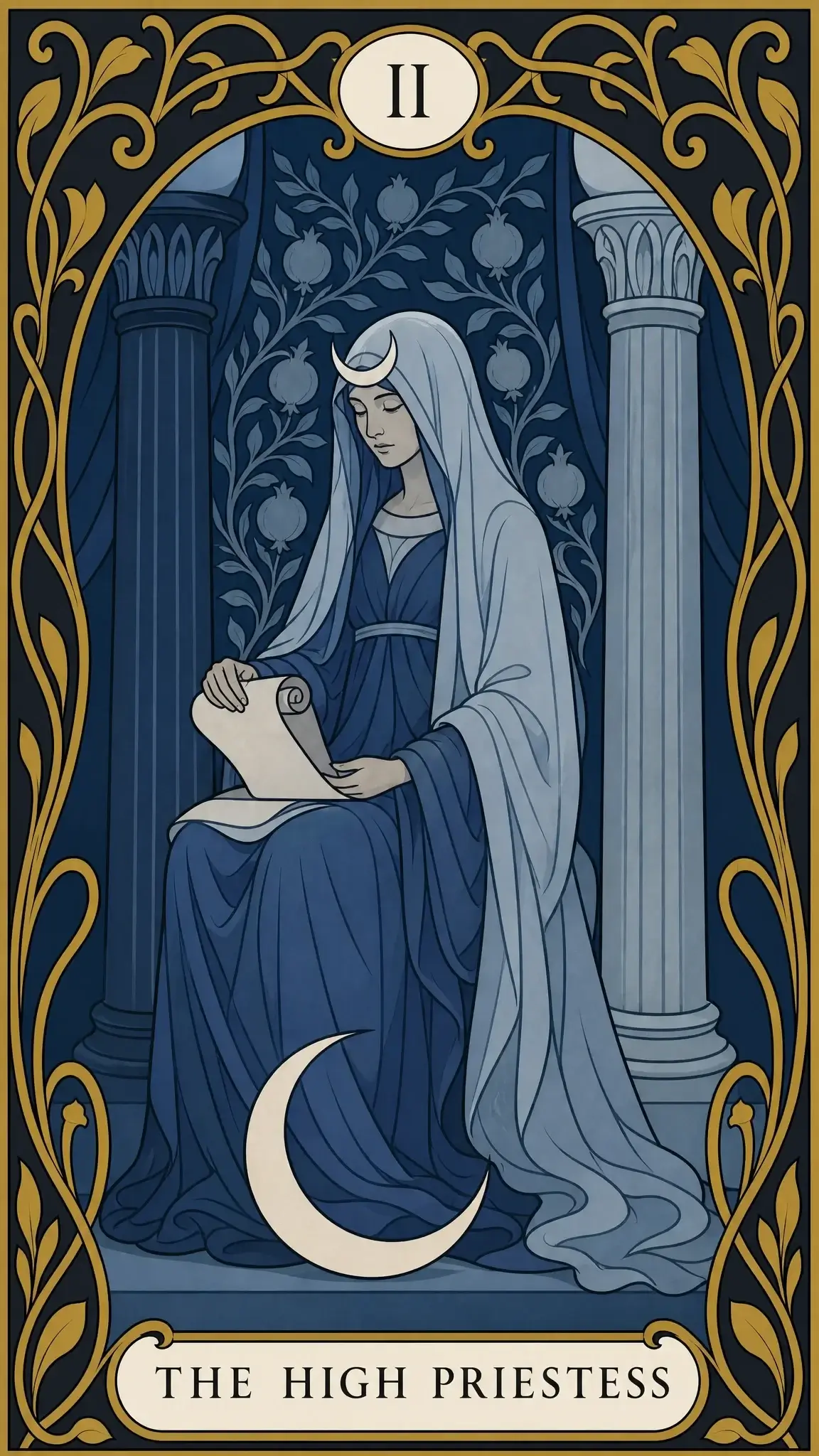
On our High Priestess, there is a woman in a blue veil sitting between two pillars with a scroll in her hands. At her feet is a crescent moon, behind her is a veil, and everything is kept in cool blue tones.
The scene is read as follows:
- The veil behind her — what is hidden. It is not locked, but it is not pulled back either: knowledge is accessible, just not to everyone and not immediately.
- The scroll in her hands — knowledge written down but not read aloud. She keeps it rolled up.
- Two pillars — opposites between which she sits without choosing either. Unlike The Lovers, no choice is required here.
- The crescent moon at her feet — cycles and intuition; the same moon as on the XVIII Major Arcana, but here it is under control rather than ruling the scene.
At the top is the Roman numeral II, at the bottom is the English name THE HIGH PRIESTESS: our deck is drawn in the Rider-Waite tradition, where The High Priestess is the second Major Arcana.
The High Priestess as the card of the day
The High Priestess as the card of the day is a day for observation. You don't need to decide anything, but you can notice a lot: intonation, a slip of the tongue, someone else's mood.
A useful mindset: speak less and don't immediately respond to things that require an immediate answer. It's a good day for reading, silence, and working alone — and a bad one for resolving conflicts or making public statements.
Frequently asked questions about The High Priestess card
What does The High Priestess mean in Tarot?
Knowledge that cannot yet be expressed in words: intuition, hidden circumstances, and the need to wait. She does not forbid action, but advises you to first see how the situation unfolds on its own.
How is The High Priestess different from The Moon?
With The Moon, the picture is distorted: a person overthinks and usually scares themselves. With The High Priestess, the picture is accurate, just incomplete — she doesn't mislead, she just doesn't tell the whole story. Next to The High Priestess, things are unclear, but calm.
What does a reversed High Priestess mean?
Most often, it's ignored intuition: a person felt something was wrong and convinced themselves it was just their imagination. It can also mean the revelation of a secret or a decision made based on the superficial part of a situation.
Does The High Priestess mean I'm being lied to?
Not necessarily. It says that not everything is known, and the reason might be harmless: the time hasn't come, a decision hasn't been made yet, or the person hasn't figured it out themselves. Intentional deception is shown by other cards.
Which arcana number is this?
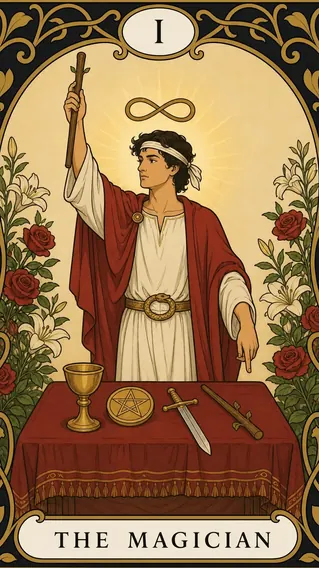
The second Major Arcana, the card has the Roman numeral II. In the Rider-Waite deck, which ours is based on, The High Priestess comes after The Magician (I) and before The Empress (III).