What does the High Priestess and The Tower combination mean?
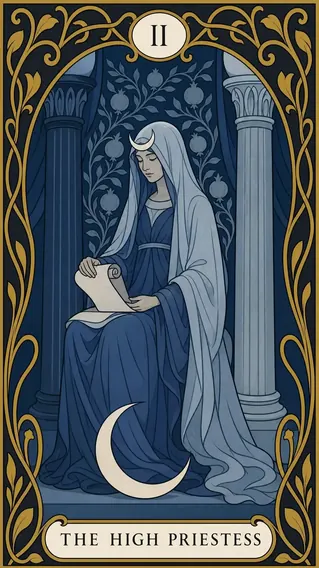
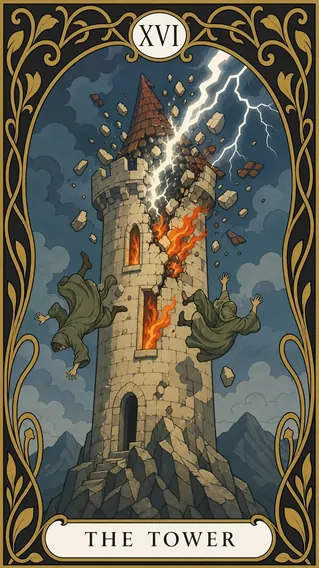
The High Priestess is the second Major Arcana, a card of knowledge that cannot yet be proven: observation, a pause, the feeling that something is happening, even if it's too early to talk about it. The Tower is the sixteenth Arcana, a card of the moment when the hidden becomes clear abruptly and without preparation: a structure that held on an agreement or a promise collapses all at once. Together, these cards describe the transition from a quiet phase of knowledge to a loud phase of rupture, and which card comes first significantly changes the focus of the analysis.
If the leading card is the Priestess, the meaning of the combination shifts to the preparatory period: the person has long noticed something, collected details, and forced nothing, and this pause is the main subject of the analysis. The Tower in such a layout is read as a logical consequence of prolonged silence, not as a separate, unpredicted event.
If the leading card is The Tower, the attention shifts to the moment of the collapse itself: what could have been revealed gradually happens abruptly. The Priestess works as a background here—she explains where the suddenness came from, even though the signs were noticeable earlier, they just weren't looked at directly.
The High Priestess and The Tower in a reversed position
A reversal in this pair changes not the strength, but the nature of the delay—it is worth analyzing three cases separately.
- Only the Priestess is reversed (The Tower is upright). There was intuition, but it was pushed aside: it seemed like it wasn't the time, or you didn't want to deal with it. The collapse still happens, but it catches you more off guard than it could have—there was a warning signal, but it wasn't acted upon.
- Only The Tower is reversed (The Priestess is upright). Quiet knowledge continues, but the resolution is drawn out: what should have been revealed at once drags on for weeks through unspoken conversations and half-admissions. The hardest part is not the fact itself, but that clarity does not come in time.
- Both cards are reversed. The most stagnant option: intuition is ignored, and the impending collapse is suppressed from within, preventing it from coming out. Externally, it may be quiet and stable, but the pressure continues to grow inside—and this is exactly what should be verified with facts, rather than assuming it will "resolve itself".
The High Priestess and The Tower in relationships
In a relationship spread, this pair most often describes a story where unspoken issues existed long before an open conversation. One or both partners had long noticed inconsistencies—in behavior, in plans, in what is said versus what is actually done—but postponed a direct conversation because there was no proof, only a feeling.
Then comes the moment when it is no longer possible to remain silent: a fact is revealed, something that wasn't said before is spoken, or the relationship changes abruptly after a long lull. This is not necessarily about infidelity—it is more often about incompatible expectations that both sides felt but did not name aloud.
Important caveat: the card does not say exactly what will be revealed or by whom. It describes the form—long, quiet accumulation and a sharp resolution—not the specific content of someone else's intentions. You shouldn't make claims about the reader's real partner based on the spread: that requires a conversation, not cards.
The High Priestess and The Tower in work and money
In a work spread, the combination often describes a situation where non-obvious signals accumulated for months: unexplained reorganizations, a manager's unspoken words, or project oddities that seem insignificant individually. The Priestess here is precisely this phase of gathering observations, when there is no official information, but an internal feeling has already formed.
The Tower shapes what has been accumulated into a sharp announcement: reorganization, dismissal, closing a department, or the departure of the person everything relied on. Formally, for many, this sounds like "no one expected it," even though some people on the team felt something was wrong in advance—they just didn't verify it with facts.
In money, the structure is the same: conditions that seemed stable were actually held together by a single agreement without a backup plan, and this is revealed at a moment when it is too late to change things. Analyzing such a pair is a reason to check vague suspicions against concrete data before chance does it for you.
What to do if this combination appears
This pair is not about predicting a specific event, but about the nature of the transition—and you can work with this practically.
- In the Priestess phase — verify, don't just feel. Observation is useful, but sooner or later, a hunch should be checked against facts: documents, a direct question, actions, not just your mood.
- Don't drag out the silence indefinitely. A pause has a price, and The Tower in this combination is often a consequence of prolonged silence, not an external accident.
- In The Tower phase — don't decide in the heat of the moment. The first reaction to sudden news is rarely the best; major decisions should be postponed for at least a few days.
- Separate loss from relief. After a collapse, there is usually both at the same time.
If the spread concerns a difficult topic—breakups against a background of dependency, codependent relationships, health, or abuse—the cards do not replace a conversation with a professional: a doctor, lawyer, or psychologist. The decision in such a situation is made by the person themselves, based on the facts of their life, not on the interpretation of cards.
FAQ about the High Priestess and The Tower combination
What is more important in this pair, the High Priestess or The Tower?
The meaning depends on which card is leading. If the Priestess is first, the analysis shifts to the phase of quiet observation and its cost. If The Tower is first, the focus is on the moment of sudden revelation. In both cases, the second card clarifies the background, not the essence.
What does the High Priestess and The Tower combination mean in relationships?
Most often, a story where inconsistencies were noticed long ago but not spoken aloud, and then a moment occurred after which it was no longer possible to remain silent. This is not necessarily about infidelity: it is often about expectations that diverged even without it.
What if The Tower appears reversed next to the Priestess?
A reversed Tower next to an upright Priestess means the resolution is drawn out: what could have been revealed at once drags on through unspoken conversations. If the Priestess is reversed and The Tower is upright, there was a signal, but it was ignored, and the collapse happened anyway.
Does this pair mean something bad will happen?
No, the card combination does not predict a specific event. It describes the nature of the transition from quiet knowledge to a sharp resolution—and whether to prepare, check facts, or continue observing is decided by the person themselves, not the spread.