What does The Tower mean in Tarot
The upright Tower is the moment when a structure built over years collapses in a single day. Work, relationships, a long-held perception of yourself or a loved one, a five-year plan—the surrounding cards will show exactly what it is.
An important nuance often lost in retellings: The Tower does not create the problem; it exposes it. Lightning strikes a building that already had a flaw in its foundation—it just wasn't visible while everything looked decent on the surface. Therefore, in spreads, The Tower often appears not as a warning of future disaster, but as a description of what the person already suspected but chose not to verify.
The second half of its meaning is liberation. After The Tower, you no longer need to support what required effort: pretending, dragging things out, justifying, or proving. This rarely feels like a gift in the first week, but almost always does after a few months. In the classic sequence of arcana, The Star follows The Tower—a card of quiet recovery—and this is no random order.
Reversed Tower: meaning
The reversed Tower is the same lightning, but slowed down. It is usually read in one of three ways, and the question of the spread helps to choose.
- The collapse has already begun, but is not being acknowledged. Everything is holding together because the person is spending enormous energy to keep it that way. This is the most common scenario.
- The crisis passed more gently than it could have. There was a blow, but it was a glancing one: not a firing, but a difficult conversation; not a breakup, but an honest clearing of the air.
- The destruction is internal, not external. Nothing has changed on the outside, but everything has collapsed on the inside—this is often what burnout looks like.
The reversed position almost always means that the process is drawn out over time and that the person still has a choice in how it ends. The upright Tower leaves no choice—that is the difference.
The Tower in a "yes or no" spread
In "yes/no" spreads, The Tower is almost always read as no—but with a caveat that is more important than the answer itself. It refuses not because nothing will happen, but because what happens will not be what was intended: the structure being asked about will not hold.
The answer flips if the question itself is about change. "Will I leave?", "Will this end?", "Will the truth come out?"—here, The Tower answers with a decisive yes, and usually faster than the person is ready for.
The reversed Tower in this spread means "no, but softer": the event is delayed, not everything collapses at once, and the person has time to prepare. The worst outcome is the prolonged waiting when the crack is already visible, but the decision is constantly being postponed.
The Tower in relationships and feelings
In a relationship spread, the upright Tower describes an exposure: something is revealed that changes the entire picture, and returning to the way things were is no longer possible. This is not necessarily infidelity—often it is the realization that partners want fundamentally different things, and both have felt this for a long time.
In the position of feelings, The Tower is read as a strong but overwhelming emotion: not steady attachment, but a shock. An infatuation that sweeps away all plans; resentment after which a person suddenly stops holding on; the shock that a loved one was not who they seemed to be. There is no steady warmth in this card, neither in the upright nor in the reversed position.
If the relationship continues after The Tower, it will be a different relationship, rebuilt on new terms. The card poorly describes attempts to "go back to how it was": it is precisely "how it was" that it removes.
The reversed Tower in relationships is a drawn-out conversation that has been postponed for months. Everyone understands everything, but no one wants to be the first to start.
The Tower in work and money
In career spreads, The Tower is a sharp change in circumstances: layoffs, team disintegration, the closing of a department, the departure of a key person on whom everything depended. Sometimes it is your own decision to leave, made suddenly after long-term accumulation.
Regarding money, the card speaks of an unplanned expense that breaks the budget, or income that was considered stable but turned out not to be. Surrounding cards will show the scale: with the Two or Five of Pentacles, it is significant; with The Sun or The World, it is more of a shake-up than a catastrophe.
What The Tower truly advises in a work spread: stop investing in things that rely on one person, one client, or one agreement without a backup plan. The card highlights exactly those kinds of structures.
The Tower as a person: man and woman
When The Tower appears in the "what kind of person" position, it describes not a character, but a role in someone else's life. This is someone whose arrival changes the layout: they bring news, present facts, or destroy a comfortable illusion. Often, they did not plan this themselves.
The Tower-man in a spread is sharp, direct, and unable to sugarcoat things; around him, it is impossible to pretend that everything is fine. The Tower-woman is the one who asks the uncomfortable question out loud and does not accept an evasive answer.
This is not a description of a "bad person." It is a description of an encounter after which something for the querent stops working the old way. Sometimes such a person turns out to be the most honest one in their circle.
The Tower in the position of thoughts
In the position of thoughts, The Tower represents an obsessive expectation that everything is about to collapse. A person replays the worst-case scenario, sleeps with one eye open, and catches themselves bracing for a blow that hasn't happened yet.
Sometimes the premonition is justified and the person simply spotted a crack before others. Sometimes it is anxiety that takes on a life of its own. Neighboring cards help distinguish this: next to Swords, it is more likely an anxious mind; next to realistic Pentacles, it is more likely a sober assessment.
What to do if you draw The Tower
The Tower's advice is unpleasant in its simplicity: do not hold on to what is already falling. After such a card, your main energy should not be spent on the loss itself, but on trying to glue the structure back together — and that is exactly what drains a person to zero.
What you should actually do:
- Check the foundation, not the walls. What exactly turned out to be unstable — and why was it acceptable for years?
- Do not make big decisions in the first few days. The Tower is a card of the moment of impact, not a card of conclusions. Conclusions are made later.
- Separate the loss from the relief. After a collapse, there is usually both, and admitting the latter to yourself can be harder than the former.
- Take care of the basics. Sleep, food, money for the month ahead, a real person nearby to talk to.
And separately: if the card appeared at a time when things are truly difficult, a reading does not replace a conversation with a loved one or a professional. Cards describe the situation well, but they do not help you live through it.
What is depicted on the card
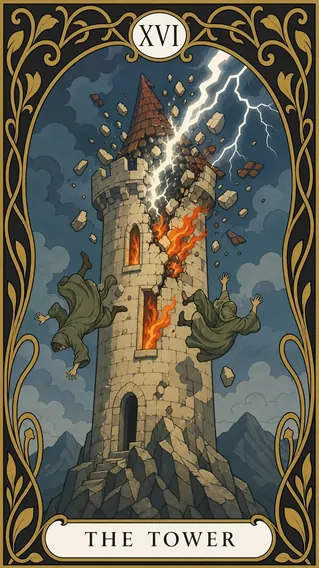
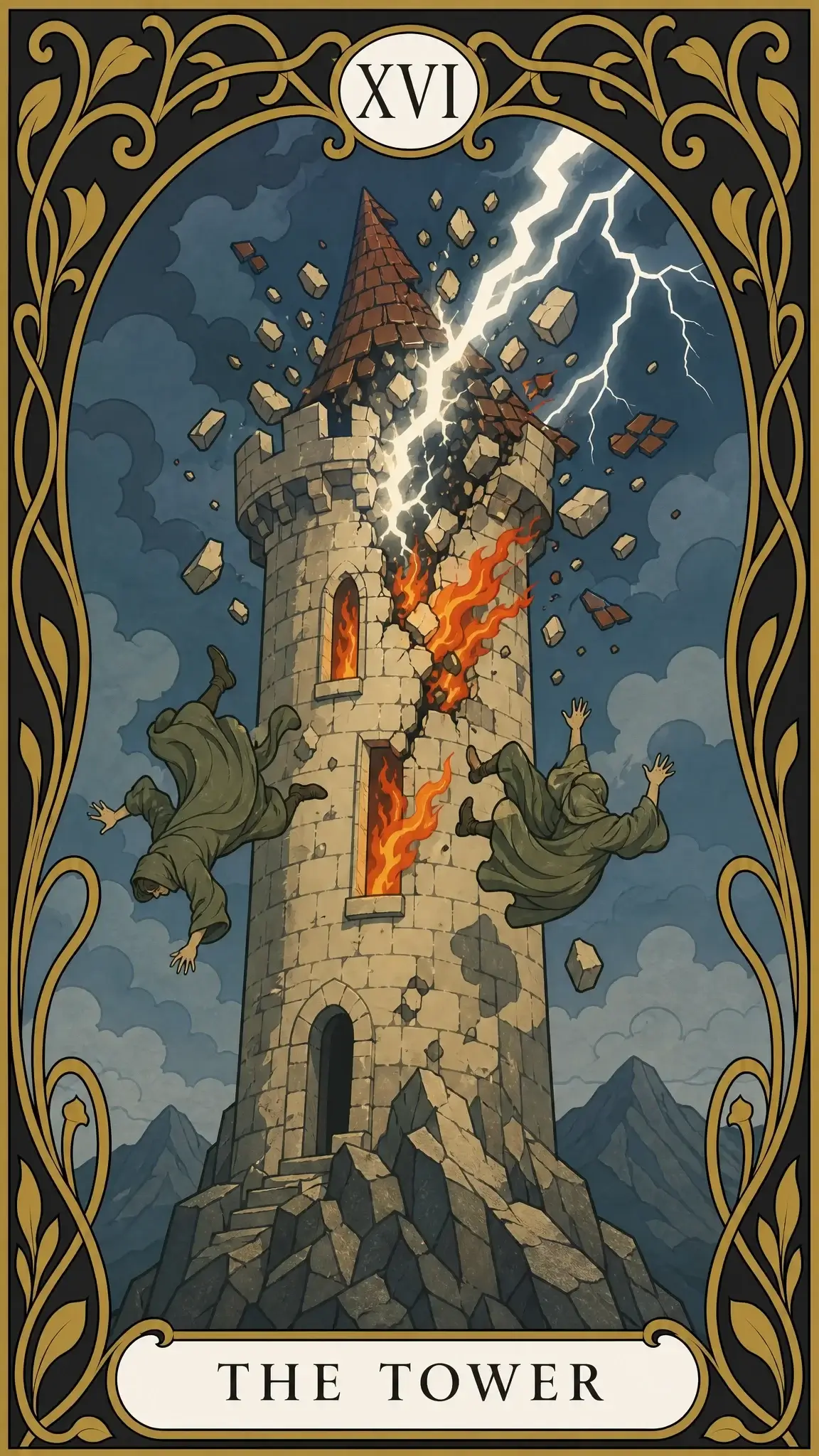
On our Tower, there is a stone watchtower on a rocky peak being struck by lightning. The roof is cracked, flames are bursting from the windows, and debris of masonry and tiles is flying in all directions. Two figures in dark green cloaks are falling headfirst with their arms outstretched.
This scene is interpreted as follows:
- The rock under the tower — what the person considered an unshakable support. Note that the structure is collapsing, but the rock remains: the foundation of life is more intact than it seems at the moment of impact.
- Lightning — an external event that could neither be predicted nor negotiated. It strikes from above, at the highest point.
- Fire in the windows — what has been burning from within for a long time, it just wasn't visible from the outside before.
- Falling figures — they haven't crashed, they are in flight. In the classic Tower, this is the most underestimated element: the card shows the moment of the fall, not its outcome.
At the top of the card is the Roman numeral XVI, at the bottom is the English name THE TOWER: our deck is drawn in the Rider-Waite tradition, where The Tower is the sixteenth card.
The Tower as the card of the day
The Tower as the card of the day rarely foretells a catastrophe — it is more often a day when something is revealed. A letter arrives, a forgotten detail surfaces, someone says aloud what was kept silent.
A useful mindset for such a day: do not schedule important negotiations that require composure, and do not make final decisions in the heat of the moment. Treat unexpected news as information, not as a verdict — The Tower shows the moment when the truth becomes visible, and it is up to the person to decide what to do with it.
Frequently asked questions about The Tower card
Is The Tower in Tarot always bad?
No. The Tower describes a sharp breakdown, not a punishment: what was already unstable collapses. Usually, it is the method that is unpleasant, not the result — in the deck, The Star, the card of recovery, follows The Tower. In a reading about a long-drawn-out situation, The Tower is often read as a way out, not as a disaster.
What does the reversed Tower mean?
The same breakdown, but drawn out: a crisis that is postponed, delayed, or experienced internally without changing anything on the outside. Sometimes it is a glancing blow. The main difference from the upright position: the person still has a choice in how everything will end.
Does The Tower mean a breakup?
Not necessarily. More often it means that something has been revealed, after which the previous relationship is no longer possible. From there, it is either a breakup or a relationship rebuilt on different terms. The card has nothing to do with "going back to how it was" — it is precisely "how it was" that it removes.
Is The Tower a "yes" or "no"?
In yes/no readings, The Tower is read as "no" — but with a caveat: the issue will not be resolved in the old way anyway. If you ask "will everything stay as it is," the answer is negative. If you ask "will the situation change," the answer is affirmative.
Which arcana is this?
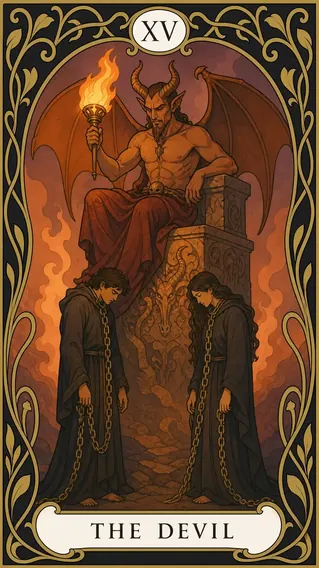
The sixteenth Major Arcana; the card bears the Roman numeral XVI. In the Rider-Waite deck, which ours is based on, The Tower comes after The Devil (XV) and before The Star (XVII).