What Death means in Tarot
Upright Death is the line after which the previous version of life ceases to exist. It doesn't mean "it will get worse" or "it will get better," but rather that it is no longer accessible: a job you cannot return to, relationships that cannot be restored to their former state, or a role a person can no longer play.
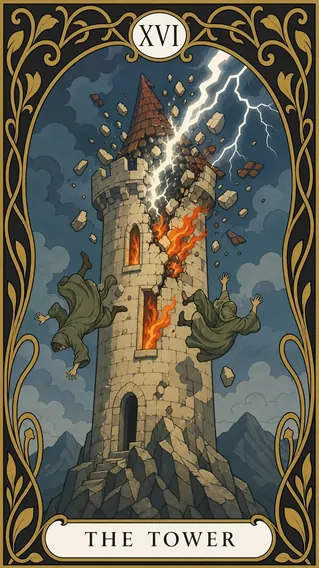
Unlike the Tower, Death rarely arrives suddenly. Usually, by the time it appears, everything is already over—it just hasn't been named aloud yet. Therefore, in spreads, it more often states a fact than warns, and the question asked with it is not "will it happen?" but "how much longer will you pretend it hasn't?"
The second half of its meaning is making space. Death has no reverse gear in the deck, and that is its mercy: as long as the old is formally alive, the new cannot begin. This is why, in spreads about stagnation, Death is read as a positive card, even though it looks intimidating.
Reversed Death: meaning
Reversed Death is an end that is not acknowledged. Formally, nothing is finished: relationships drag on, the position is held, the project is "on pause"—but there is no living substance left in it.
It is usually read in one of three ways:
- A prolonged farewell. Everything is over, but no one says it aloud, and both sides waste energy maintaining appearances.
- Resistance to change. The person knows the stage has ended and holds onto it out of fear of the void that will follow.
- Slow completion. The process is underway but drawn out: not a clean break, but a gradual fading away.
The reversed position almost always means the price of delay is rising. Upright Death is painful once; reversed Death is painful little by little and for a long time.
Death in a "yes or no" spread
In "yes/no" spreads, Death answers no—but not "nothing will happen," rather "not in the form you are asking about."
The answer flips to yes if the question is about completion: "will this end?", "will I let go?", "will something new begin?"—here the card answers affirmatively and without reservations.
Reversed Death in a yes/no spread is the most inconvenient answer: "no, but you will drag it out." It speaks not of the result, but of the fact that the decision will be postponed again.
Death in relationships and feelings
In a relationship spread, upright Death means the previous format is exhausted. This is not always a breakup: sometimes it looks like a transition from infatuation to another quality, from a romantic relationship to friendship, or from living together to living apart. But one thing is common—you cannot go back to how it was.
In the position of feelings, Death describes emptiness and calm after the pain has passed. This is not grief in the acute phase: the acute phase is the Three of Swords or the Tower. Death comes later, when it no longer hurts but feels empty, and the person discovers with surprise that the feelings have simply ended.
If the relationship continues after Death, it is built anew and with different terms. The card poorly describes attempts to "give it another chance on the same terms"—it is precisely those foundations that it removes.
Reversed Death in relationships describes a couple that has long since drifted apart internally but continues to live together out of habit, for the sake of children, housing, or fear of loneliness.
Death in work and money
In career spreads, Death is the closing of a direction, leaving a profession, or the end of a position or role. Often this is the person's own decision, made after long deliberation: not a flash, but a "I can't and don't want to anymore."
Regarding money, the card speaks of the end of an income source that was relied upon as permanent—and simultaneously that you will have to look for a replacement that is not the same, but different. Neighboring cards show exactly how it will end: with the Ace of Pentacles, it is a change for the better; with the Five of Pentacles, it is a period without support.
What Death advises in a work spread: stop resuscitating what is no longer breathing. The main losses here are not from the end itself, but from the months spent trying to delay it.
Death as a person: man and woman
In the "what kind of person" position, Death describes someone who closes doors. Not an evil person—a final one: they do not return to the past, do not give second chances on the same terms, and do not participate in resuscitating what they consider finished.
A Death-man in a spread is someone who leaves once and for all, often calmly and without a scene. A Death-woman is someone who has internally made the decision long before the conversation, so she cannot be persuaded: the conversation was not about the decision, but about announcing it.
This is not a description of cruelty. Often such people are the most honest in their circle—they simply do not know how to pretend that something is still alive.
Death in the thoughts position
In the thoughts position, Death is an internal "that's enough" that a person hasn't yet said aloud. They aren't scrolling through the future, but the result: drawing a line, counting what's been spent, and trying on a life without this part.
Sometimes, alongside it are thoughts about one's own mortality and what time is spent on. These are heavy but sound thoughts, and they shouldn't be confused with despair: Death in thoughts describes sobriety, not a crisis. Neighboring cards help distinguish this — next to the Nine of Swords, it's more like anxiety; next to the Hermit and Temperance, it's calm reflection.
What to do if you draw Death
The advice of Death is the simplest and most uncomfortable: admit that it is over. Don't start something new, don't draw conclusions — first, just call an end an end.
What you should actually do:
- Stop checking if it has come back to life. Each check returns you to the beginning and stretches out the process.
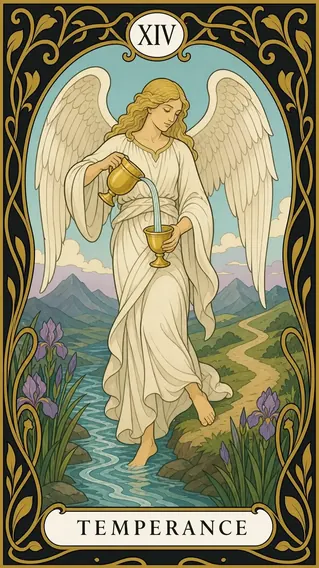
- Give yourself a pause without a plan. After Death, the next card in the deck is Temperance — a card of slow recovery, not an immediate start.
- Sort through the legacy of this stage. What to take with you (skills, connections, self-understanding) and what to leave behind.
- Don't look for someone to blame. Death describes a completion, not someone's mistake; looking for a culprit is the most common way to avoid finishing.
And separately: if the card appears during a real loss, the reading does not replace a living person nearby and does not replace a specialist. The cards describe the situation, but they do not live it for you.
What is depicted on the card
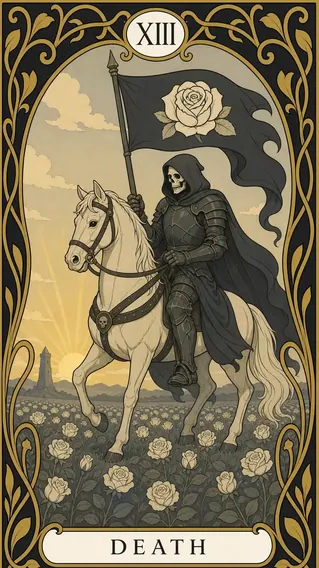
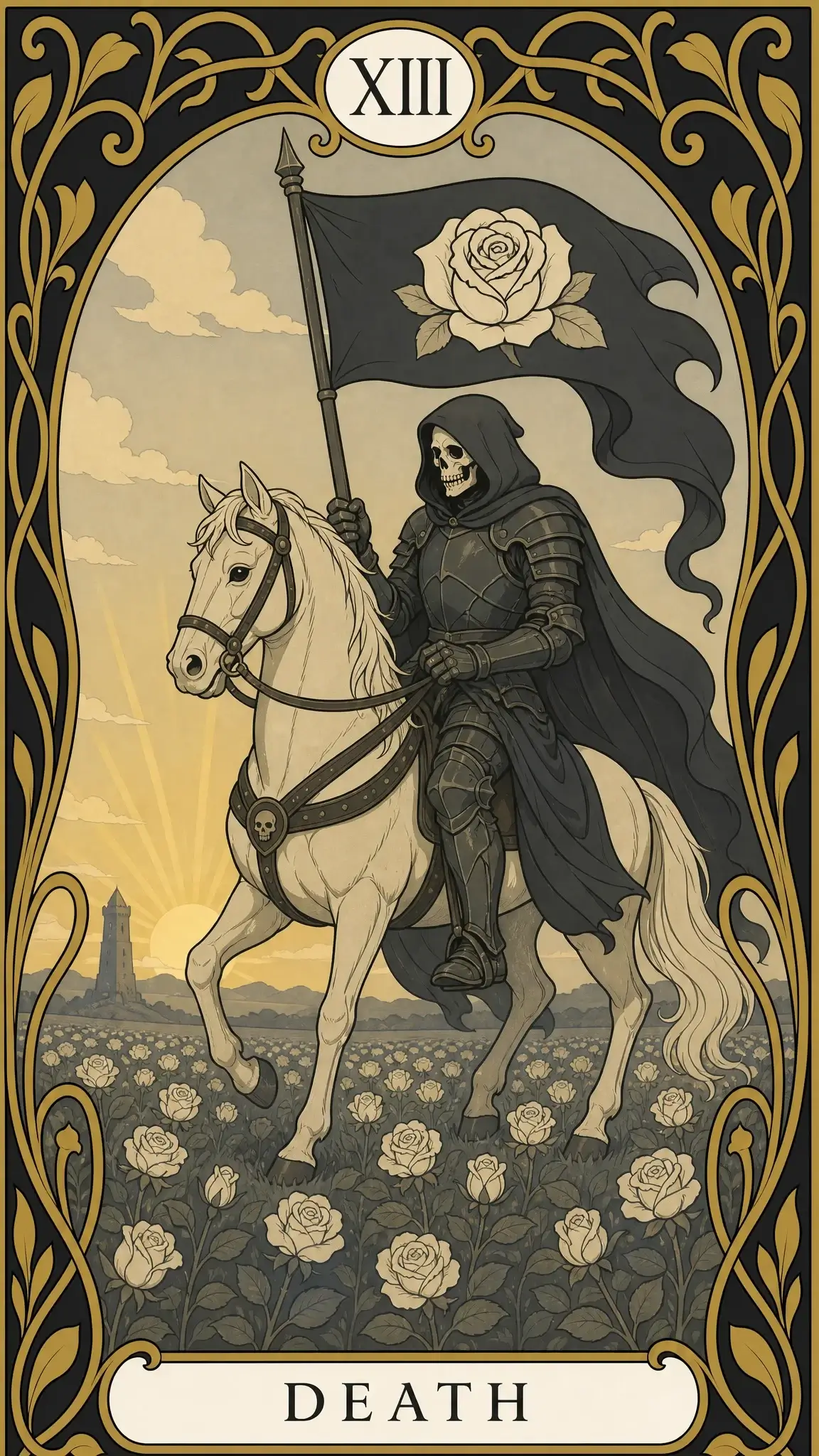
On our Death card, there is a rider in dark armor on a white horse, carrying a black banner on which a white rose has bloomed. The horse walks with a steady gait across a light field; in the distance, between two towers, the sun is rising.
The scene is read as follows:
- White horse — not a color of mourning, but of purification: what is happening is irreversible, but not dirty.
- Steady gait — Death does not attack and is not in a hurry. Unlike the Tower, it does not strike: it passes through.
- White rose on a black banner — the only living spot on the card. Traditionally, it is read as what remains after the end and the reason for which it occurred.
- Sunrise between the towers — a boundary. The same sun appears in the Moon (XVIII) card in the deck, only there it has not yet risen.
At the top is the Roman numeral XIII, at the bottom is the English name DEATH: our deck is drawn in the Rider-Waite tradition, where Death is the thirteenth arcanum.
Death as the card of the day
Death as the card of the day is almost never about loss. More often, it is a day when something naturally comes to an end: a task is closed, a period is put in correspondence, an idea that has been dragged out for a long time is let go.
A useful mindset for such a day: don't start anything big and don't sign long-term commitments. It's a good time to sort through, throw away, delete, unsubscribe, and finish — and a bad time to hold onto someone.
Frequently asked questions about the Death card
Does the Death card in Tarot mean death?
No. In the practice of interpretation, this arcanum describes the completion of a stage, not physical death. Even in health readings, it is read as the end of a previous state and a transition to another. The name is scarier than the meaning: in essence, it is a card of irreversibility, not demise.
Is Death a bad card?
It is uncomfortable, but not evil. Death describes what has already ended and clears space for what comes next. In a reading about a long-stuck situation, it is read as a way out. What's bad isn't that the stage has ended, but how much energy is spent trying not to admit it.
What does reversed Death mean?
An end that is not acknowledged: relationships drag on, a job is kept, but there is no living substance left in them. Sometimes it's just a slow fading instead of a sharp break. The main difference from the upright position: the price of delay grows over time.
How does Death differ from the Tower?
The Tower is a sudden blow to what seemed solid; Death is a calm completion of what was already coming to an end. The Tower catches you by surprise, Death more often confirms what the person already knew themselves. And after the Tower comes the Star, and after Death comes Temperance: different recovery after different ends.
Which arcanum number is this?
The thirteenth major arcanum; the card has the Roman numeral XIII. In the Rider-Waite deck, which ours is based on, Death comes after the Hanged Man (XII) and before Temperance (XIV).