What the combination of The Tower and Death means
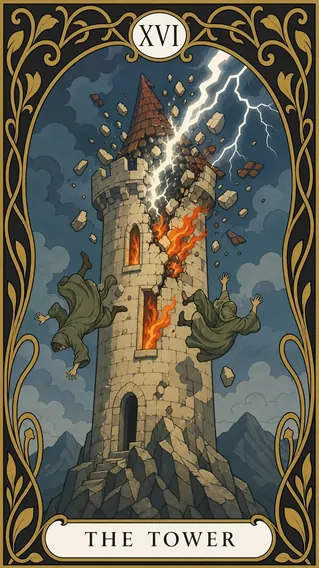
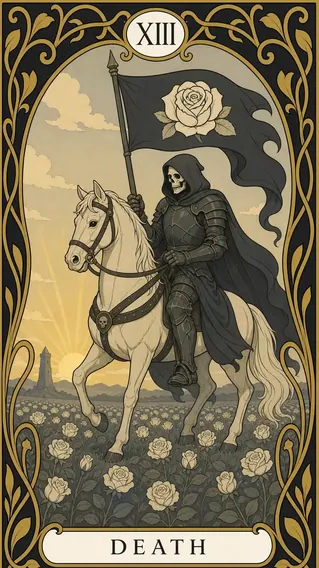
The Tower and Death are the two heaviest Major Arcana cards, and together they describe an end that has neither retreat nor a compromise option. The Tower is a breakdown from the outside: a sharp, external event that collapses a structure that seemed solid. Death is the realization that the process is already internally complete and there is no going back to the way things were. Together, they close the matter from two sides at once: a visible event has occurred on the outside, and there is final acceptance of what happened on the inside.
Which card leads determines where the impulse comes from. If The Tower leads, the analysis begins with an external blow: the event happens from the outside, and the person hasn't yet realized its scale—Death nearby shows that after the initial shock, there will be no turning back under any circumstances. If Death leads, the order is reversed: everything was already finished internally long before the visible event, and The Tower describes the moment when this becomes visible to others—not the beginning of the end, but its final point.
The Tower and Death in the reversed position
Reversing one or both cards changes not the meaning, but the speed and visibility of what is happening. It is worth analyzing three cases separately.
If only The Tower is reversed and Death is upright, the end is already accepted internally, but the external event that should have confirmed it is delayed or happens more quietly than expected: the conversation is postponed, the announcement doesn't happen, and the decision exists for now only for one person.
If only Death is reversed and The Tower is upright, the external breakdown has already happened, but internal acceptance has not yet arrived: the person continues to act as if there is a way back, even though events have already decided everything for them.
If both cards are reversed, the reading describes a prolonged crisis without a resolution: the end is ripe both outside and inside, but both sides—the event and the recognition—are delayed simultaneously, and it is this double delay that takes more strength than the end itself.
The Tower and Death in relationships
In relationships, this pair—the most frequent sub-intent for which it is searched—describes a breakup that happens suddenly and is simultaneously final: not a gradual cooling off, but a moment after which the very possibility of the previous format disappears.
If The Tower leads, the breakup is triggered by a specific event—a revealed fact, a difficult conversation, an action that cannot be ignored—and Death nearby confirms that after this event, there will truly be no return, no matter how much one might want it. If Death leads, the event merely formalizes what was long decided internally: feelings ended before the visible reason occurred, and The Tower here is simply the moment when it finally became official for both parties.
A nuance that is often lost: the pair does not say that new relationships will be worse than the previous ones—it only says that the previous format is closed irrevocably. If the reading is about the loss of a loved one rather than a breakup, the cards describe the nature of the moment, but the conversation about the loss itself should be held with living people nearby or a specialist, not with a reading.
The Tower and Death in work and money
In work and money, the combination of The Tower and Death usually describes a closure that happens immediately and completely: not a budget cut, but the disappearance of the position, project, or source of income that was relied upon as permanent.
If The Tower leads, the event comes from the outside and without warning—a reorganization, the closing of a department, a decision made by someone other than the querent—and Death clarifies that there will be no return to the previous role, even if a similar vacancy formally appears. If Death leads, the picture is different: the person has already internally left the business long before the official dismissal or closure, and The Tower merely records the external point at which this becomes a fact for everyone else.
The practical conclusion for both orders is the same: holding onto a structure that stands on one client, one manager, or one agreement without a backup plan is more costly than admitting that the support has already disappeared.
What to do if this combination appears
The advice of this pair is simple in formulation and difficult in execution: do not waste energy trying to hold onto a structure that is no longer standing on its own feet, neither outside nor inside.
What is worth doing in essence:
- Do not confuse the initial reaction with the final decision. In the first days after the blow, any major steps—quitting in response, a sharp conversation, a public announcement—should be postponed: The Tower shows the moment of shock, not the moment when one should act.
- Admit that the internal conclusion has already been reached if Death leads—holding onto formalities longer will not save you from the consequences, but only delay them.
- Separate grief and relief. After such an end, there is usually both, and not allowing yourself to acknowledge the relief is a common mistake.
- Take care of the basics: sleep, money for the coming weeks, a living person nearby.
Note: If the question concerns a heavy loss, health, or addiction, the reading describes the nature of the change, not a diagnosis or what to do next—for that, you should turn to a doctor or specialist, not the cards.
Frequently asked questions about The Tower and Death combination
What is more important in this pair, The Tower or Death?
No card is "more important" by default—the one that stands first in the spread is what matters. If The Tower is first, the analysis begins with an external blow, and Death clarifies its irreversibility. If Death is first, the internal conclusion was reached before the external event, and The Tower merely makes it visible to others.
What does a reversed Tower next to Death mean?
The end is already accepted internally (upright Death), but the external confirming event is delayed or happens more quietly than expected—the decision exists, but it hasn't been voiced out loud yet.
Does this pair mean a breakup?
In a relationship reading—yes, but not just any, but a final one: the previous format is closed without the right to "return to how it was." Sometimes the narrative is read more broadly—as the end of a stage, not necessarily a breakup between two people.
Can one find out when the end will come from this pair?
No, the cards do not name dates or predict specific events—they describe the nature of the change. If the situation concerns health or a heavy loss, you should turn to a doctor or specialist for specifics, not the reading.