What the Queen of Cups means in Tarot
The Queen of Cups is one of the four court cards of the suit of Cups, the element of water in its most stable, reflective state: not a burst of feeling, but a depth that has already settled and is not clouded by trifles. If the Ace of Cups is a sudden, not yet understood emotion, then the Queen is about sensitivity and empathy becoming second nature.
An important nuance to mention right away: minor arcana, including court cards, describe a specific episode, the quality of the current moment, or a person's role in a situation — not their entire destiny. The Queen of Cups is not a verdict on character or a lifelong status: in a spread, she most often indicates how one should behave now, or the person who is next to the querent in this specific story.
The upright position is read as mature empathy: the ability to listen without dissolving into someone else's pain, to feel subtly without losing one's footing. This is a warm, but not saccharine card — the Queen of Cups' care goes hand in hand with calmness, not with performative self-sacrifice.
Reversed Queen of Cups: meaning
The reversed Queen of Cups is the same sensitivity, but having lost its boundaries. A spread usually refers to one of several options, and a question helps to sort it out.
- Emotional overload. There are too many feelings — your own and others' — and it is no longer possible to cope with them calmly.
- Care without anything left for yourself. Helping others has become such a habit that your own needs are postponed or not noticed at all.
- Resentment held in silence. Instead of a direct conversation, there is unspoken tension that accumulates and then breaks out in the wrong place.
- Feelings as a tool of influence. Occasionally — not sincere empathy, but playing on others' experiences to get the desired reaction.
There is also a softer reading: sometimes the reversed Queen of Cups is simply a signal to take a pause and stop being a shoulder to cry on for everyone, rather than a diagnosis of a spoiled character.
Queen of Cups in a "yes or no" spread
In "yes/no" spreads, the Queen of Cups leans towards yes — but with a caveat: the answer is affirmative if the decision is based on feelings, intuition, and care for people, rather than cold calculation. The card supports questions like "should I trust this person," "will I be able to make contact," or "will I be heard."
If the question requires a tough, rational assessment — for example, a financial risk without an emotional component — the Queen of Cups is not the most reliable advisor: she sees the situation through feelings, not numbers.
The reversed position in this spread is read as "yes, but emotions prevent you from seeing clearly": the desire to trust is there, but it is worth taking a moment to separate empathy from an objective assessment of what is happening.
Queen of Cups in relationships and feelings
In a relationship spread, the upright Queen of Cups is one of the most auspicious signs: deep attachment, emotional intimacy, a partner (or your own state) who knows how to listen and not devalue others' experiences. This is a card of relationships where there is room for feelings, not just words and agreements.
For the question "what does the other person feel," the card often describes sincere, calm attachment — without stormy dramas, but also without indifference. For a single position — readiness for intimacy without rushing and without trying to appear as someone else.
The reversed Queen of Cups in relationships — feelings exist, but are expressed poorly: through jealousy, resentment that one is afraid to voice, or excessive dissolution in the partner to one's own detriment. Sometimes it is also about a person who uses emotional intimacy to gain control.
Queen of Cups in work and money
In career spreads, the Queen of Cups well describes professions where empathy is valued: psychology, medicine and care, working with people, customer support, creative and therapeutic fields. The card speaks of success through understanding the needs of others, rather than through pressure or fierce competition.
In money, the upright position means intuitive but balanced decisions: income related to caring for people, creativity, or trusting relationships with clients. This is not a card of quick profit, but rather of stable income where long-term relationships are built.
The reversed Queen of Cups at work — burnout from others' problems, difficulty saying no to colleagues or clients, blurred professional boundaries. In money — decisions made under the influence of pity or guilt, rather than sober calculation.
Queen of Cups as a person: man and woman
Here, a general caveat about court cards is important: the Queen of Cups describes the manner of carrying oneself and the quality of energy, not necessarily the person's gender in the spread. The Queen is a style of behavior (accepting, sensitive, intuitive) that is found in both men and women in life; the gender of the card's character should not be taken literally.
The Queen of Cups person is someone people go to share things with, knowing they will be listened to without judgment and without rushing with advice. Usually, this is a person with developed intuition: he or she reads the interlocutor's mood before they manage to say anything out loud.
The flip side is also common to both: it is difficult for such a person to draw a line between caring for others and caring for oneself, and others' emotions sometimes become their own faster than they would like.
Queen of Cups in the position of thoughts
In the position of thoughts, the Queen of Cups represents a state where decisions are made through feeling rather than a list of arguments: "I feel this is right" carries more weight than dry logic. This is not irrationality, but a different way of processing information—through atmosphere, intonation, and the unspoken.
The difficulty is that with this mindset, it is easy to overthink for another person or start worrying about someone else's state more than they do themselves. If Swords appear nearby in the spread, it is worth temporarily engaging a rational check of your feelings; next to Pentacles, intuition is more likely to find practical application.
What to do if the Queen of Cups appears
The card's advice is simple: trust your feelings, but don't forget your own boundaries. The Queen of Cups is about care and sensitivity, not self-sacrifice—quality empathy begins with noticing and considering your own state as well.
What to do in practice:
- Listen without rushing to give advice. If the card appears in the context of a relationship or conversation, the most powerful thing you can do is make the person feel heard.
- Separate your own from others'. Before taking on someone else's anxiety, take a moment to ask yourself if it is truly about you.
- Give yourself the same warmth you give others. Care directed only outward eventually leads to exhaustion.
- Do not make serious decisions at the peak of emotions. The intuition of the Queen of Cups is reliable when there is time to trust it, not when a decision is needed right now.
If the reason for the question is a difficult emotional situation, a loved one's addiction, or your own burnout from caring for others, the spread does not replace a conversation with a specialist: the card shows the quality of feelings, not a solution to complex problems in place of the person.
What is depicted on the card
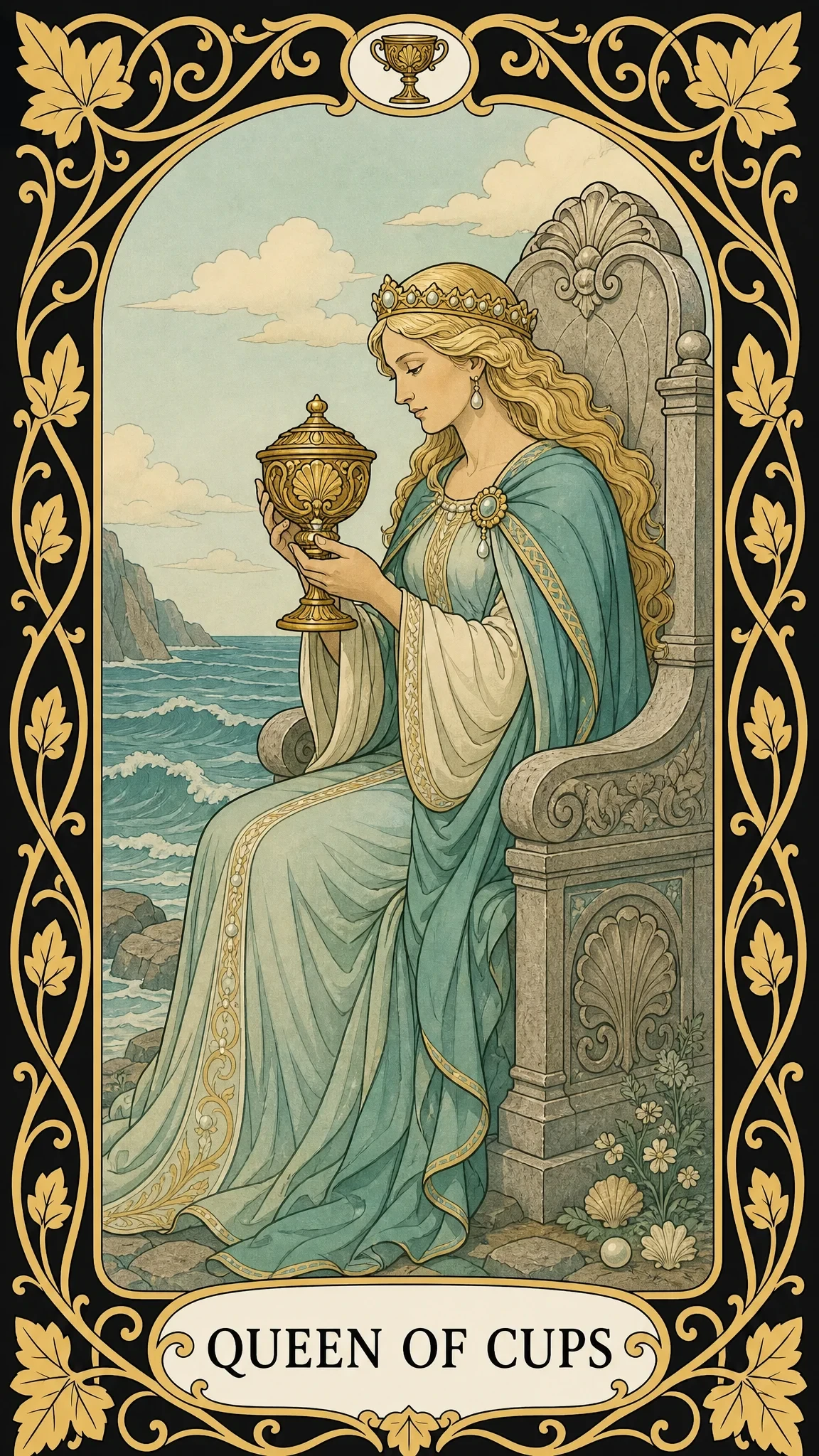
On our card, the Queen sits on a carved stone throne right at the water's edge: the waves almost touch the base of the throne, and rocky shores and a cloudy sky are visible in the distance. She holds a closed golden cup with a lid in both hands and looks down into it—not outward at the viewer.
The scene is interpreted as follows:
- A closed, not open cup. In classical iconography, the Queen's cup is often decorated with figures and appears slightly open for visions; on our card, the vessel is closed with a lid—the focus shifts from "generously sharing feelings with everyone" to "protecting the inner world without spilling it out." This is a subtle but meaningful distinction: sensitivity here is not for show, but carefully guarded.
- The throne is on the very border of water and land, rather than half-in the water as in the traditional image—the Queen does not drown in emotions nor does she sit apart from them, but stays right at the junction where feelings meet a solid foundation.
- Shells and a pearl at the base of the throne, flowers next to the stone. Seashells and pearls are what is born under the pressure of water and time; the flowers at the base are the few living things that grow where they are cared for.
- A crown with pearls and a turquoise cloak with a gold trim—status combined with the same watery, soft, yet vibrant character.
At the bottom of the card is a plaque with the English name QUEEN OF CUPS.
The Queen of Cups as the card of the day
The Queen of Cups as the card of the day is a good reason to slow down and listen: to yourself, to loved ones, and to what has remained unsaid. The day is suitable for heart-to-heart conversations, caring for someone, or, conversely, finally taking care of yourself.
If the card appears reversed, the day is more about the risk of taking on too many of other people's worries. A useful mindset is not to try to solve all the emotional issues around you in one day, but to choose one conversation or one boundary that is worth setting calmly.
Frequently asked questions about the Queen of Cups card
Is this a Major or Minor Arcana?
Minor Arcana, suit of Cups, element of Water. There are 56 Minor Arcana cards in the Tarot deck in total—14 cards for each of the four suits, and the Queen of Cups is one of the four court cards of this suit, alongside the Page, Knight, and King.
How does the Queen of Cups differ from the Queen of Swords?
Both cards are about mature feminine energy on a throne, but of a different nature. Cups are the element of water, feelings: the Queen of Cups is about empathy, intuition, care, and the ability to listen with the heart. Swords are the element of air, the mind: the Queen of Swords is about clarity, honesty, and the ability to see a situation without illusions, even if the truth is unpleasant. If support and understanding are important in a spread, it's about Cups; if a sober, direct assessment is needed, it's about Swords.
Is the Queen of Cups necessarily about a woman in a spread?
No. Tarot court cards describe a manner of behavior and the quality of energy, not the literal gender of a person. The Queen of Cups can also point to a man if he possesses sensitivity, intuition, and care for loved ones—what matters is not gender, but the style of behavior.
What does the reversed Queen of Cups mean?
The same sensitivity, but without boundaries: emotional overload, caring for others to your own detriment, resentment held in silence, and sometimes using feelings as a tool of influence. Often it is simply a signal to stop and stop being a shoulder to cry on for everyone.
Can the Queen of Cups mean money?
Yes, but as stable income through relationships with people, rather than quick profit: work related to care, creativity, or client trust. The card also warns of the risk of making financial decisions based on emotions, out of pity or guilt, rather than sober calculation.