What does the King of Cups mean in Tarot
The King of Cups completes the court cards of the Cups suit: after the Ace's impulse and the entire journey of the cards, a figure arrives who has dealt with feelings not through avoidance or drama, but through managing them. If the Queen of Cups feels deeply and openly, the King feels just as deeply but has learned not to spill it onto the first person he meets—he lets the storm pass through him, and emerges steady.
An important caveat for the Minor Arcana: this card is not about fate or a lifelong character trait, but about a specific episode—a difficult conversation, someone else's tantrum, or your own resentment that needs to be handled right now. It doesn't make grand conclusions about a person; it simply shows that a mode of calm emotional mastery is available in this situation—and the question is whether it will be used.
In the upright position, the King of Cups signifies maturity that does not confuse calmness with indifference: there is empathy, but no reactive outburst. He knows how to listen without getting drawn into someone else's panic and how to sympathize without losing his own footing. The flip side is not immediately visible: the same composure, taken to the extreme, turns into impenetrability—behind a calm face, one can hide things for years that should have been said aloud long ago.
Reversed King of Cups: meaning
The reversed King of Cups is the same water person, but without a dam. Usually, the card is read in one of three directions, and the context of the spread helps to choose.
- Calmness as a mask. Outwardly everything is smooth, but in reality, there is quiet manipulation: things left unsaid, passive aggression, or resentment that is not voiced but used as leverage.
- The dam has burst. A person who has kept their emotions to themselves for years snaps—sharply, unexpectedly for others, and often for themselves.
- Coldness instead of control. Composure turns into detachment: feelings are not managed, but simply blocked, and it becomes chilly next to such a person.
There is also a softer reading: the capacity for self-control exists, but the person is currently emotionally shaken and needs time to return to their usual calm. Neighboring cards will suggest which option is closer to the essence of the question.
King of Cups in a "yes or no" spread
In "yes/no" spreads, the King of Cups usually means yes, but only if you do not give in to your first emotional impulse. The card is not about luck or a bold leap—it is about the fact that the result depends on the querent's own composure: if you rush based on emotions, you will lose what could have been saved through a calm conversation.
The answer becomes uncertain if the question requires a quick and decisive action: the King of Cups is a card of pause and tact, not a forward charge, and it does not combine well with persistent haste.
The reversed position in this spread is read as "no, until the emotions settle": a decision made now is more likely dictated by resentment or anxiety than by a sober view of the situation.
King of Cups in relationships and feelings
In a relationship spread, the King of Cups describes a partner you can lean on in a difficult moment: they don't resort to shouting at the first sign of an argument, they know how to listen rather than immediately becoming defensive, and they rarely make drama out of things that can be solved through conversation. There are fewer emotional swings next to such a person, but also fewer passionate declarations—the warmth here is steady rather than flickering.
In the position of feelings, the King of Cups represents an attachment weighed by the mind, not just the heart: the person feels strongly but does not allow the feeling to control them completely. Sometimes this is driven by care for the other person—not wanting to scare them with the intensity of their emotions; sometimes—by an old habit of not showing vulnerability at all.
The flip side manifests when there is too much calmness: the partner seems inaccessible, as if speaking from behind a glass wall. A reversed card in this position often speaks of a person who uses a flat tone to devalue someone else's experiences while remaining formally in the right.
King of Cups in career and money
In career spreads, this is one of the best cards for the role of a mentor, psychologist, mediator, diplomat, or a leader who knows how to keep the team calm in the middle of a rush. The King of Cups describes well the moment when you need not to force a decision, but to conduct negotiations so that both sides remain satisfied.
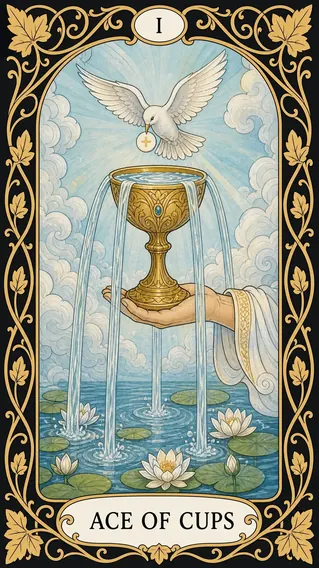
Regarding money, the card speaks not of a risky leap, but of balanced, calm management: income built on reputation and trust, rather than a gamble. Next to the Ace of Pentacles, it is a reliable, well-thought-out investment; next to the Five of Swords, it is a deal where the one who cooled down first wins.
Advice from the card in a work spread: do not make a decision under the pressure of the moment, but take a pause long enough so that the emotions of colleagues or your own frustration do not replace calculation.
King of Cups as a person: man and woman
When the card appears in the "what kind of person" position, it describes not the gender, but the role in the situation—an emotionally mature person who keeps themselves together and knows how to support others without losing their own footing. The gender of this person is determined by neighboring cards and the context of the question, not by the grammatical gender of the name.
King of Cups man—usually someone you go to for calm advice rather than for solving a problem by force: a therapist, mentor, senior colleague, or partner who is not afraid of someone else's tears and is in no hurry to stop them.
King of Cups woman—the same role without the "softer" adjustment: she maintains emotional balance in the family or team herself, knows how to listen, and does not get drawn into someone else's panic. In a spread, this is often the figure of a wise mentor with a steady, imperturbable style of support.
In any case, this is a person next to whom circumstances become less frightening simply because they are not the first to panic.
King of Cups in the thoughts position
In the thoughts position, the King of Cups represents a state where the storm has already been weathered, and you are now methodically sorting things out: not "what do I feel," but "what should I do about it." Thoughts flow calmly, but beneath this smooth surface may lie work that was not easy to accomplish.
Sometimes this is a healthy, adult processing of feelings. Sometimes, it is a habit of analyzing emotions instead of experiencing them, which leads to accumulated fatigue over time. Adjacent cards will suggest the difference: next to Swords, the thought is more cold and detached; next to the Star or the Sun, it is calm and truly healing.
What to do if you draw the King of Cups
The card's advice is direct: manage your feelings, don't suppress them or let them overwhelm everything around you. The King of Cups rarely appears when there are no emotions—more often, he appears when there are too many, and you need to decide what to do with them without breaking down or locking them away.
What you should actually do:
- Take a pause before responding. One honest minute of silence often prevents things you might regret for weeks.
- Don't confuse calmness with silence about important matters. Composure is needed for the form of the conversation, not to avoid it altogether.
- Make space for others' emotions. The ability to listen without judgment is stronger than advice no one asked for.
- Check if resentment is hiding under a calm tone. If so, it should be voiced rather than carried around for years.
If the question concerns a prolonged conflict, emotional burnout, or someone else's manipulation, the spread describes the mindset rather than providing a ready-made solution; in such situations, talking to a loved one or a professional works better than cards.
What is depicted on the card
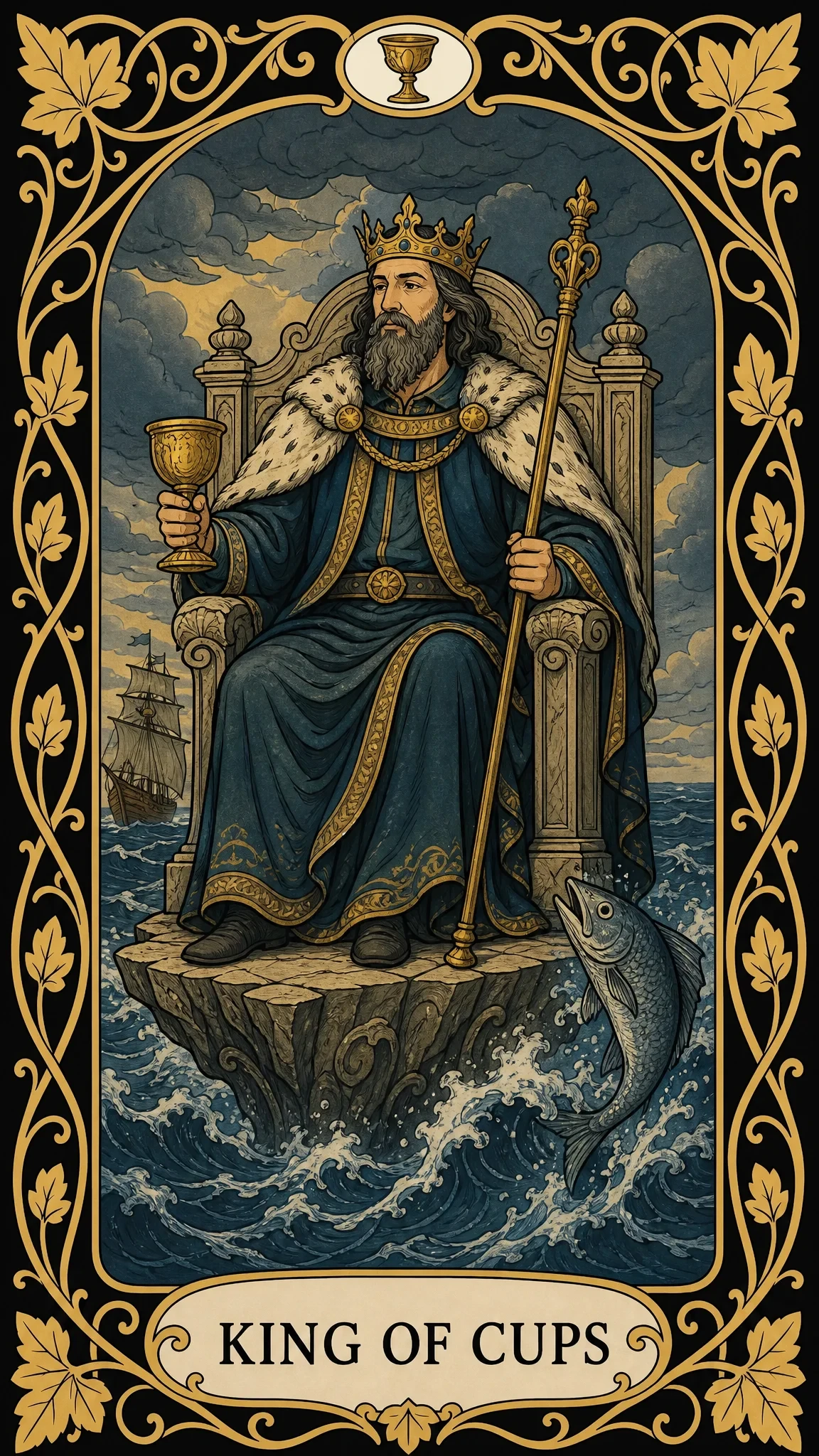
On our card, the King of Cups sits on a stone throne that seems to grow directly out of the sea: the platform beneath him is a narrow rocky ledge, while waves rage all around. In his left hand, he holds a golden cup; in his right, a long scepter with a lotus-shaped top. Over his dark blue robes, he wears a fur-trimmed cloak. On the horizon to the left is a sailing ship; to the right, a fish leaps out of the water near the waves.
This scene is interpreted as follows:
- Throne in the middle of the sea — the card's most recognizable image and its main meaning: the King does not flee from emotions to dry land, nor does he drown in them; he maintains his footing right in their epicenter. The waves at his feet are restless, but his face and posture remain steady.
- Cup and scepter in different hands — feeling and will are held together: one hand is occupied with the heart, the other with the ability to act without losing one's head.
- Ship in the distance — the path and movement that continue even when the elements rage nearby: life does not stop because of a storm.
- Fish leaping from the water — that which emerges from the depths unexpectedly: a feeling or thought that breaks through even when everything around looks controlled.
This scene almost literally repeats the classic Rider-Waite iconography — unlike cards where our deck diverges from tradition, there are no discrepancies here: the image of a king, imperturbable in the middle of a restless sea, conveys the essence of the card too accurately to change it. Above is an oval medallion with the cup symbol; below is the inscription KING OF CUPS.
King of Cups as the card of the day
The King of Cups as the card of the day is a signal to keep yourself in check today: a conversation might turn out to be emotionally charged, and the winner will be the one who doesn't give in to the first impulse.
A useful mindset for such a day: listen more than you speak, and don't make decisions in the heat of the moment, even if the reason for them seems convincing. It is a good day for reconciliation, a calm conversation about painful topics, and supporting someone who is having a harder time than you right now.
Frequently asked questions about the King of Cups card
Is it a Major or Minor Arcana?
Minor. The King of Cups belongs to the suit of Cups, element Water. There are 56 Minor Arcana cards in the deck in total — 14 cards in each of the four suits, and the King is the highest court card of his suit.
How does the King of Cups differ from the King of Swords?
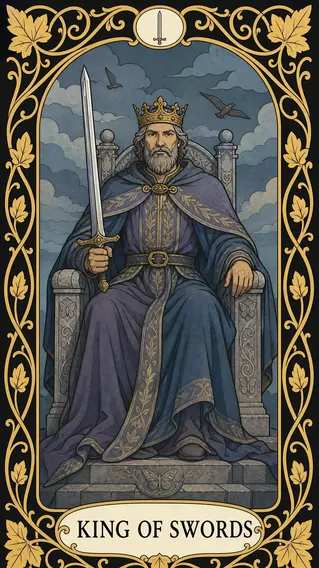
Both kings are about maturity and the ability to keep oneself in check, but they act differently. The King of Cups leads through empathy, tact, and the ability to feel; his element is Water. The King of Swords leads through logic, honesty, and cold calculation; his element is Air. One smooths over conflict with empathy, the other with a clear decision.
Is the King of Cups in a spread about a specific person or a character trait?
It can be both — the position in the spread clarifies this. In the "who is this person" position, the card describes a specific emotionally mature person near you. In the advice or thoughts position, it is more of a behavioral mode available to anyone: keeping feelings under control without suppressing them.
What does the reversed King of Cups mean?
The same composure without balance: calmness turns into a mask for manipulation, or accumulated emotions suddenly break through, or self-control turns into coldness and detachment. The card is read most negatively where feigned calmness is used to devalue someone else's feelings.
Is the King of Cups a "yes" or "no"?
More of a "yes," but with a condition: the result depends on whether you manage not to give in to the first emotional impulse. If the question requires a quick and decisive leap, the card does not answer as confidently; it is about a pause, not about rushing.