What the King of Swords means in Tarot
The King of Swords is the most senior of the four court characters of the suit of swords, and the most mature: if the Page of Swords is just curiosity about the truth, the Knight is a swift attack with words, and the Queen is the ability to see the essence without unnecessary emotions, then the King is the skill to apply this sober vision as authority. Swords in Tarot are responsible for the mind, speech, and decisions; their element is air — it does not warm or nourish, it clears the fog.
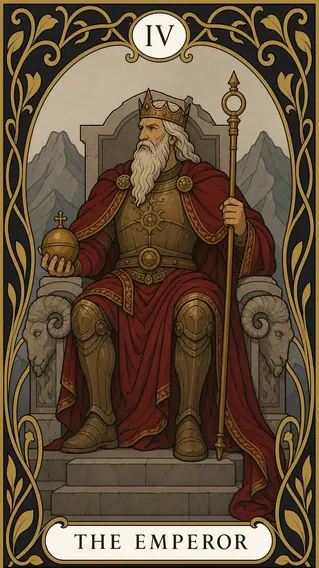
An important nuance often lost in retellings: the minor arcana describes an episode and a specific role, not a person's character for life. If the senior Emperor is about power as a structure in general, then the King of Swords in a spread is about the fact that here and now, a cold head is making the decision, not a hot heart: a judge, an expert, a leader, and sometimes just a sober voice in a conversation that finally said the obvious out loud.
The upright position is read unambiguously: clarity, objectivity, readiness to call things by their names, even if it is uncomfortable. The card does not promise softness — it promises precision. The closer the question is to facts, a contract, or a dispute that needs to be judged, the more confident the King of Swords sounds; the closer it is to feelings that just need to be experienced with someone, the less this card is in its place.
Reversed King of Swords: meaning
The reversed King of Swords is the same sharp mind, but turned in the wrong direction. Usually, the spread refers to one of three options, and the question helps to choose.
- Logic at the service of manipulation. Facts are selected to justify the desired conclusion rather than to find the truth; the argument is won not because one is right, but because one is better with words.
- Coldness instead of sobriety. The decision is made correctly in form but cruel in essence: it does not take into account that there is a living person nearby, not just a task.
- Power through pressure. Authority that relies on sharpness and the ability to put someone in their place, rather than on respect for them.
There is also a softer reading: sometimes the reversed King of Swords is not cruelty, but fatigue from the need to always be the one who decides and takes responsibility for others' mistakes. The difference is whether this fatigue is taken out on others or remains with the person.
King of Swords in a "yes or no" spread
In "yes/no" spreads, the King of Swords is read as yes — if the question can be solved by facts, calculation, or a sober conversation. "Will I win the argument if I present my arguments," "will they accept my proposal if it is logically justified" — here the card answers affirmatively.
The answer becomes cautious if the question is about feelings rather than decisions: "will they love me," "will they forgive me" — the King of Swords is not about an emotional outcome, but about whose position will prove more convincing. One should not blindly apply his "yes" to such questions.
The reversed King of Swords in this spread is "yes, but in a dishonest way": the argument will win only if it is abused, and after such a victory, one usually has to deal with the cost.
King of Swords in relationships and feelings
In a relationship spread, the upright King of Swords describes a partner or a situation where honesty is valued more than romance: a person who will say directly what they want and what they are not ready to tolerate, instead of hinting for years. This is not the warmest card for relationships, but one of the most reliable: there is less ambiguity with it.
In the position of feelings, the King of Swords is an attachment that relies on respect and conversation, not passion. It describes mature relationships well, where partners treat each other as equal interlocutors, and less so infatuation on the verge of madness, for which there are other cards in the deck.
The reversed King of Swords in relationships is criticism that pressures rather than helps; a partner who is always right in form and lonely in essence. Or a person who hides behind logic a reluctance to talk about what they really feel.
King of Swords in work and money
In career spreads, the King of Swords is a figure with real intellectual authority: a lawyer, an expert, a manager who makes decisions based on the merits of the case, not on sympathies. The card describes well the moment when exactly such a person is needed nearby — someone who will break down the situation by facts and will not let themselves be swayed by pity.
In money, the upright position is sober calculation instead of impulsive spending: a contract that should be reread before signing, an investment that should be checked with numbers, not intuition. This is not a card of quick profit — it is about decisions that one will not be ashamed to explain after the fact.
The reversed King of Swords at work is a boss or partner who is formally right and unbearable in manner; or one's own tendency to stifle any discussion with arguments instead of hearing the person opposite.
King of Swords as a person: man and woman
When the King of Swords appears in the "what kind of person" position, it does not necessarily describe a man — it is a role, not a gender: someone who, in a situation, becomes the voice of reason, a judge, the one people go to for a sober opinion, not for comfort.
A King of Swords man is direct, laconic, and does not tolerate empty talk; it is difficult to be evasive around him and easy to get an honest answer, even if it is unpleasant. A King of Swords woman is the same role without a discount for "softness": she formulates clearly, does not adapt, and does not soften the truth for the sake of someone else's comfort.
The downside for both is the same: it is difficult for such a person to be the first to speak about their vulnerability, and sometimes what is missing next to them is warmth, not intelligence.
King of Swords in the mindset position
In the mindset position, the King of Swords represents a clear, structured mind: a person who breaks down a situation point by point, separates facts from assumptions, and does not give in to initial emotional impulses. It is a state of sober analysis, not anxiety.
A weakness here is that such a mind sometimes invents logic where it would be better to simply feel. If Cups appear nearby in the spread, it is worth checking whether reasoning is replacing an honest conversation with oneself; next to Pentacles, the analysis will likely lead to a practical solution.
What to do if you draw the King of Swords
The upright card's advice: decide with your head, but don't forget that there are real people around. The King of Swords provides clarity and the ability to separate the essential from the trivial—it is important not to turn this clarity into a weapon against those who think more slowly or feel more deeply.
What you should actually do:
- State the situation with facts before making a decision—separate them from what you want to be true.
- Ask for an outside opinion if the decision affects more than just you: a sober view is easily mistaken for the only correct one.
- Soften the delivery without softening the essence. You can tell the truth without hurting a person more than necessary.
- Separate the decision from the emotions of the moment—the King of Swords is in his element when the head is cool, not when it is angry.
If the situation involves a conflict where not only logic but also the feelings of a loved one are affected, a sober analysis does not replace a heart-to-heart conversation, and sometimes the help of a third-party specialist is needed.
What is depicted on the card
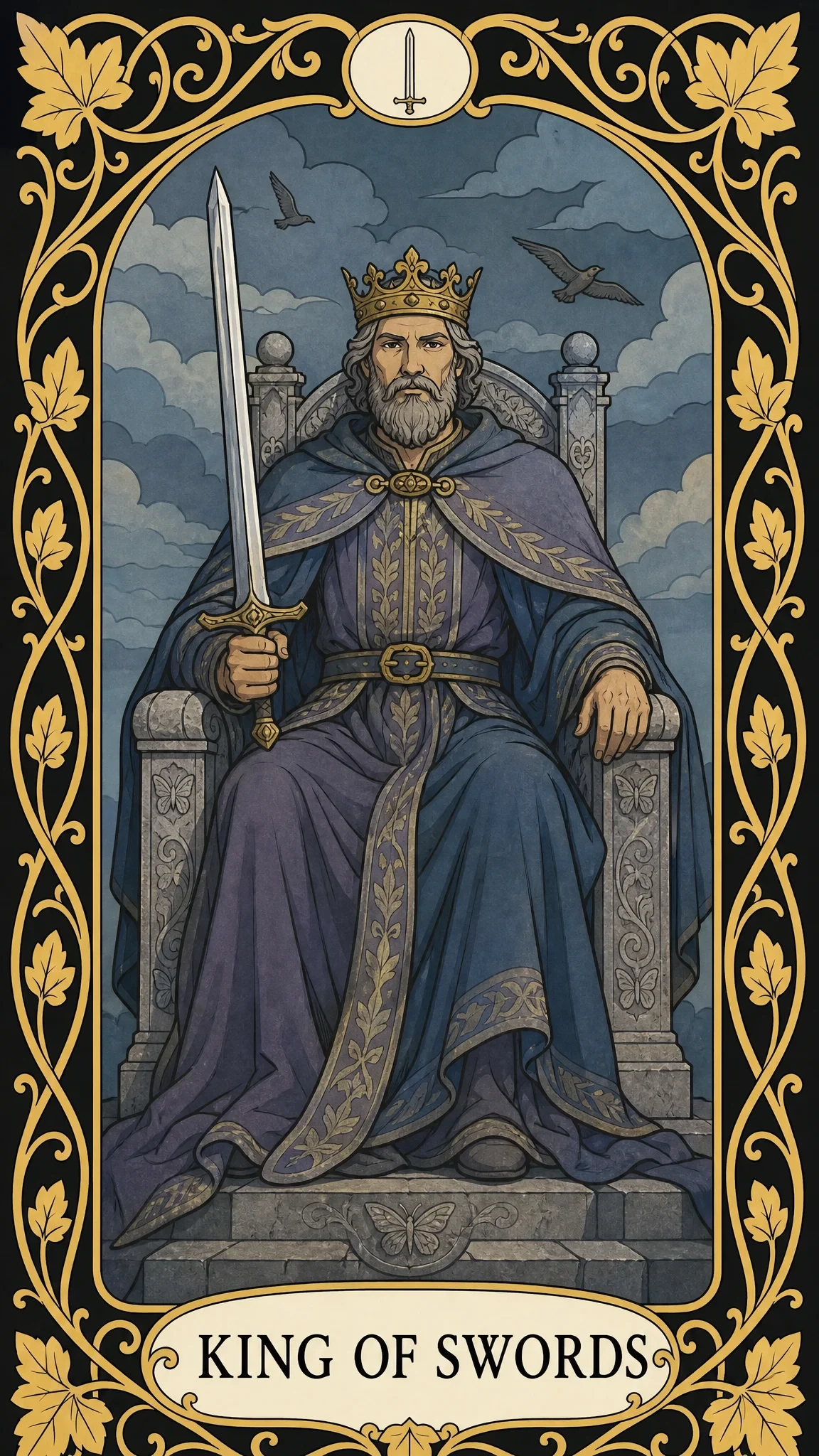
On our card, there is a gray-haired, short-haired, bearded man on a stone throne, wearing a bluish-purple robe with a golden floral ornament. On his head is a golden crown with lilies; in his raised right hand, he holds a naked, straight sword pointing upward, while his left hand rests calmly on the armrest of the throne. The background is a cloudy blue sky with two birds flying in it.
The scene is interpreted as follows:
- The raised sword is not a weapon for striking, but a symbol of judgment: the blade is held vertically, like scales, not poised for attack. This emphasizes that the King's power lies in judgment, not force.
- The free left hand—the King is not clutching the throne or clenching his fist: power is held without tension because it relies on clarity, not fear.
- Birds in the sky—the element of air in its purest form: thought that moves freely where earthly cards stand still.
- Carved butterflies on the throne stone—in classical sword iconography, the butterfly is a sign of transformation through thought: what began as a sharp judgment eventually turns into wisdom, rather than remaining just harshness.
At the bottom of the card is a plaque with the English name KING OF SWORDS, and at the top is an oval medallion with an image of a sword: our deck is drawn in the Rider-Waite tradition, where the court cards of swords are marked with this suit symbol.
The King of Swords as the card of the day
The King of Swords as the card of the day is a good day for decisions that have long been postponed due to awkwardness: settling a dispute, answering a question you've been avoiding, or reviewing a document or contract you were afraid to open.
If the card is drawn reversed, be careful with your tone: today it is easy to state the truth so sharply that it will be heard not as a fact, but as an attack. A useful mindset is to formulate your thought before the conversation, not in the heat of the moment.
Frequently asked questions about the King of Swords card
Is this a Major or Minor Arcana?
Minor Arcana, suit of Swords, element of Air. There are 56 Minor Arcana cards in a Tarot deck—14 cards for each of the four suits, and the King of Swords completes the count for the swords as the highest court card of the suit.
How does the King of Swords differ from the King of Pentacles?
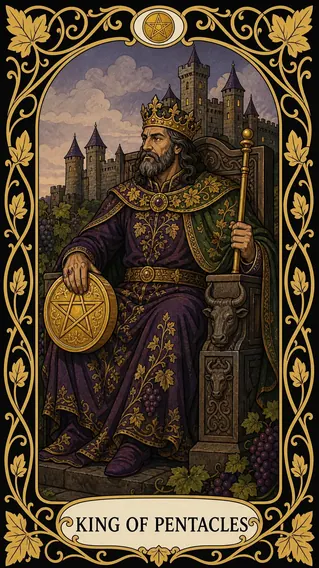
Both kings represent mature, established power, but of a different nature. Swords are the element of air, mind, and judgment: the King of Swords is about power through clarity, facts, and precise words. Pentacles are the element of earth, material results: the King of Pentacles is about power through accumulated wealth and practical acumen. If it is important in a spread who is right in essence or how to resolve a dispute, it is about swords; if it is important who is more financially stable or practical, it is about pentacles.
Is the King of Swords a yes or a no?
Likely yes, if the question can be solved with facts and a sober conversation: the card is about the victory of logic. If the question is about feelings or whether someone will forgive or love you, the King of Swords does not answer that directly; other cards are needed for that.
What does the reversed King of Swords mean?
The same sharp mind, but without respect for the person nearby: manipulation of facts, cold cruelty, or power held by pressure rather than trust. Sometimes it is simply the fatigue of someone who is forced to be the one who decides for others all the time.
Does the King of Swords necessarily mean a man?
No. Court cards describe a role and mindset, not a person's gender: the King of Swords can appear as a woman if she is the one taking on the role of the sober judge and voice of reason in the situation.