What the Queen of Swords means in Tarot
The Queen of Swords is one of the four court cards of the suit of Swords, the element of air in its mature, settled form: not a flash of clarity like the Ace, and not an exhausting dispute like the Five, but a mind that has already gone through difficult experiences and learned to see the situation without embellishment. If the Ace of Swords is a sudden insight, the Queen is about how sobriety and directness have become a habitual way of looking at the world.
An important nuance to mention right away: minor arcana, including court cards, describe a specific episode, the quality of the current moment, or a person's role in a situation, not their entire destiny. The Queen of Swords is not a verdict on character or a lifelong label: in a spread, she most often points to how one should act now, or to a person who is near the querent in this specific story.
The upright position is read as honest clarity without unnecessary emotions: the ability to separate fact from desire, to speak an uncomfortable truth without blaming anyone for the breakdown. This is a calm, not cold, card — the distance of the Queen of Swords goes hand in hand with respect for boundaries, both one's own and others', rather than performative indifference.
Reversed Queen of Swords: meaning
The reversed Queen of Swords is the same sobriety, but having lost its warmth. A reading usually implies one of several options, and a question helps to sort it out.
- Sharpness bordering on rudeness. Directness that was supposed to clarify the situation instead hurts and pushes away.
- Armor instead of boundaries. Distance that once protected from pain becomes a habit of not letting anyone in at all.
- Nitpicking over details. A sharp mind gets hung up on others' details and mistakes instead of solving the main issue.
- Old resentment dictates the tone. Past disappointment colors the current conversation more harshly than the situation requires.
There is also a softer reading: sometimes the reversed Queen of Swords is not callousness, but a signal that a person needs to be alone right now to recover from a difficult experience, rather than a diagnosis of a spoiled character.
Queen of Swords in a "yes or no" spread
In "yes/no" spreads, the Queen of Swords leans towards yes — but with a caveat: the answer is affirmative if the decision is based on facts, not hopes or others' persuasion. The card supports questions like "should I tell the truth," "is it time to set a boundary," or "will the situation become clearer if I look at it soberly."
If the question requires a soft, emotional answer — for example, "will they forgive me without explanations" — the Queen of Swords does not answer it because she thinks in facts, not comfort.
The reversed position in this spread is read as "no, there are too many emotions involved for now": it is too early to expect a sober answer; first, one should separate resentment from the objective picture of what is happening.
Queen of Swords in relationships and feelings
In a relationship spread, the upright Queen of Swords means honesty instead of games: a partner (or one's own state) who speaks directly, does not manipulate, and does not expect the other half to guess their feelings. This is a card of mature independence — intimacy without dissolving into another person.
For the question "what does the other person feel," the card often describes restraint not out of indifference, but out of caution: the person has already been burned and now chooses their words and trust more carefully. For a single position, it is a state where a person values their independence and is not ready to settle for relationships without clarity.
Reversed Queen of Swords in relationships is an emotional wall built after old pain, or a conversation where honesty turns into a way to sting more painfully. Sometimes it is also about a partner who keeps their distance for so long that intimacy ceases to be possible.
Queen of Swords in work and money
In career spreads, the Queen of Swords well describes professions where a sober mind and direct speech are valued: law, editing, analytics, management, consulting — everything where one needs to name a problem bluntly and not succumb to the pressure of emotions. The card speaks of authority earned through competence, not charm.
In money, the upright position is an honest, illusion-free look at the budget: refusing an unprofitable investment, a sober assessment of risk, talking about money without ambiguity. This is not a card of quick profit, but rather of financial independence built on sound calculation.
Reversed Queen of Swords at work is excessive criticism of colleagues, conflict due to directness delivered too sharply, or decisions made alone without considering others' opinions. In money, it is severe austerity dictated by anxiety rather than calculation.
Queen of Swords as a person: man and woman
Here, a general caveat about court cards is important: the Queen of Swords describes the manner of carrying oneself and the quality of the mind, not necessarily the person's gender in the spread. The Queen is a style of behavior (direct, independent, sober) that is found in both men and women in life; the gender of the card's character should not be taken literally.
A Queen of Swords person is someone you go to for an honest opinion, knowing they won't flatter you and won't comfort you with empty words. Usually, this is an independent person with a clear head who has already gone through difficulties and learned not to panic.
🔴 Important caveat: the card is not about an "evil woman," as it is sometimes simplified in retellings. It is about sobriety and the ability to maintain boundaries, not about hostility. The flip side of such a character is the difficulty of letting someone close after having had to cope alone once.
Queen of Swords in the mindset position
In the mindset position, the Queen of Swords represents a state of clear, slightly detached assessment: decisions are made through logic and experience rather than what one wants to hear. It is the ability to look at one's own situation from the outside, without self-deception.
The difficulty is that with such sobriety, it is easy to underestimate that another person needs not only the truth but also gentleness in its delivery. If Cups are nearby in the spread, it is worth softening the wording for a while; next to Pentacles, a sober assessment is more likely to receive a practical, action-oriented application.
What to do if the Queen of Swords appears
The card's advice is simple: stay sober, but do not confuse it with coldness. The Queen of Swords is about honest boundaries, not about rejecting intimacy—quality directness begins with respect, not with a desire to point out another's mistake.
What to do in practice:
- Separate facts from emotions before making a decision or voicing an opinion.
- Tell the truth once and to the point, rather than returning to it in every conversation like a reproach.
- Set a boundary calmly, without the need to justify it with a long list of reasons.
- Give yourself the right to distance if now is not the time to be available to everyone—sobriety sometimes means taking care of yourself.
If the reason for the question is a difficult breakup, betrayal, or a tough decision that will significantly affect other people, the spread does not replace a conversation with a specialist: the card shows the quality of thinking, not solving complex problems for a person.
What is depicted on the card
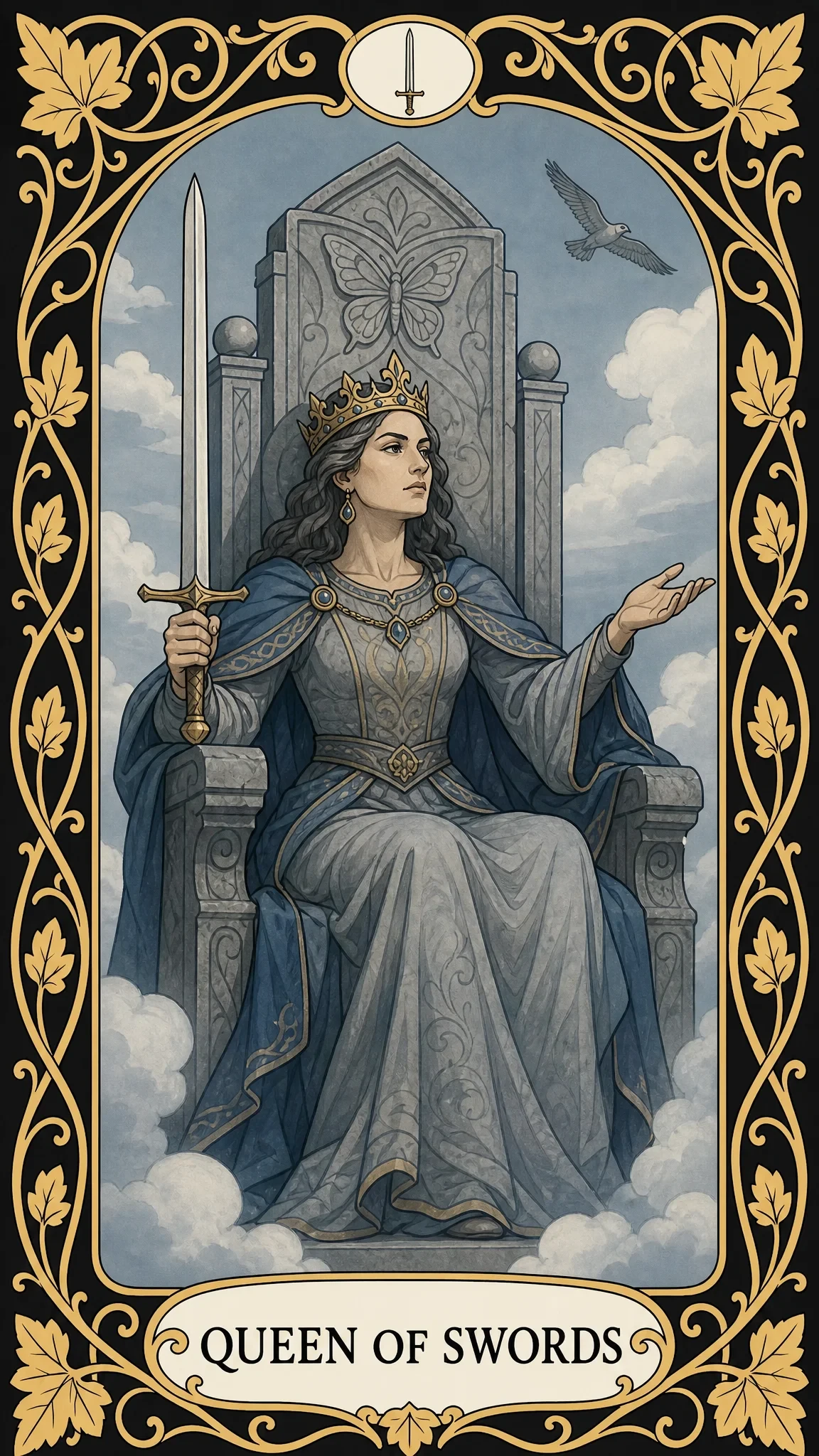
On our card, the Queen sits on a carved stone throne among the clouds: a gray sky, a habitable rocky elevation, clouds swirling at the foot of the throne as if it were hovering above the ground. In her left hand, she firmly holds a straight, naked sword pointing upward; her right hand is extended forward with an open palm—not in supplication or threat, but as an invitation to speak plainly. On the carved back of the throne behind her head is a butterfly relief, and a bird soars in the sky above her right shoulder.
The scene is interpreted as follows:
- The sword, pointed strictly upward, not to the side. The weapon here is not about attack, but about principle: the blade is held straight, just as one keeps their word—without trembling and without unnecessary displays of power.
- The open palm of the second hand. A gesture of invitation to conversation and simultaneously a gesture of judgment: the Queen is ready to listen, but also ready to say what she thinks, without softening.
- The butterfly on the throne. A classic symbol of transformation through experience—including through loss: the sobriety of this Queen is not groundless; it has been paid for.
- The bird on high and the clouds under the throne. Air in its purest form: a view from above, detachment from momentary passions, the ability to see the situation as a whole rather than from within one's own emotions.
At the bottom of the card is a plaque with the English name QUEEN OF SWORDS.
The Queen of Swords as the card of the day
The Queen of Swords as the card of the day is a good reason to look at the situation soberly: say what has been put off for a long time, give up what does not suit you, or simply not give in to emotional persuasion. The day is suitable for honest conversations and clear decisions, not for smoothing things over.
If the card appears reversed, the day is more about the risk of saying something sharper than necessary or shutting yourself off from everyone at once. A useful mindset: before answering, give yourself a second and ask: is this a fact, or is it irritation speaking?
Frequently asked questions about the Queen of Swords card
Is this a Major or Minor Arcana?
Minor Arcana, suit of Swords, element of Air. There are 56 Minor Arcana cards in the Tarot deck—14 cards for each of the four suits, and the Queen of Swords is one of the four court cards of this suit, along with the Page, Knight, and King.
How does the Queen of Swords differ from the Queen of Pentacles?
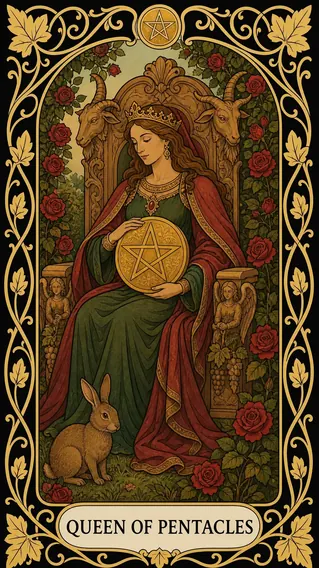
Both cards are about mature female energy on the throne, but of a different nature. Swords are the element of air, the mind: the Queen of Swords is about honesty, clear boundaries, and a sober view without illusions, even if the truth is uncomfortable. Pentacles are the element of earth, matter: the Queen of Pentacles is about practical care, stability, and the ability to provide prosperity. If a direct assessment of the situation is important in a spread, it is about Swords; if you need reliable, grounded support, it is about Pentacles.
Is the Queen of Swords necessarily about a woman in a spread?
No. Tarot court cards describe a manner of carrying oneself and the quality of the mind, not the literal gender of a person. The Queen of Swords can also point to a man if he is characterized by directness, independence, and a sober assessment of what is happening—it is not gender identity that is important, but the style of behavior.
What does the reversed Queen of Swords mean?
The same sobriety, but without warmth: sharpness bordering on rudeness, emotional armor instead of healthy boundaries, pickiness about details, or an old grudge that dictates the tone of the conversation. Often this is just a signal that a person needs time to be alone after a difficult experience, not a diagnosis of a spoiled character.
Is the Queen of Swords a bad card?
No, the common cliché about an "evil woman" does not apply here. The card is about sobriety, honesty, and the ability to maintain boundaries, not about hostility. In the upright position, it is actually one of the most mature and reliable cards in the deck—it's just that its warmth is expressed through directness, not softness.