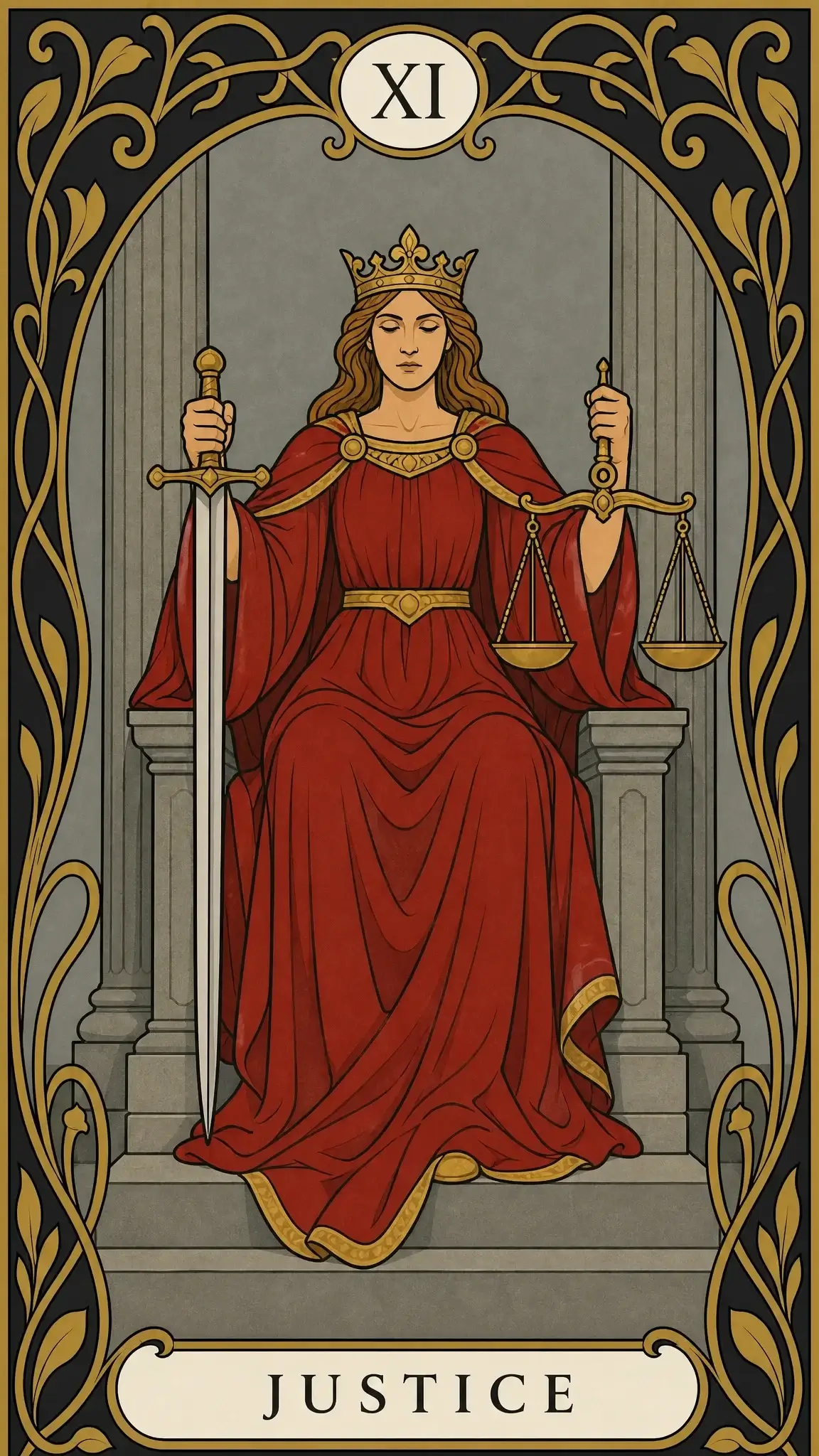
What Justice Means in Tarot
Upright Justice is the moment when it becomes clear what past actions have led to. Not punishment or reward: simply a balanced account. Good decisions brought good results, careless ones brought carelessness.
A crucial nuance often lost in retellings: Justice does not protect the righteous; it summarizes. It doesn't take sides or restore justice in a human sense — it states the proportion. Therefore, in readings, it can be an uncomfortable card: the outcome is deserved, but not what was hoped for.
The second aspect of the card is resolution. Justice often indicates a court, contract, official documentation, expert evaluation — any procedure where a situation is assessed by rules, not feelings.
Reversed Justice: Meaning
Reversed Justice is usually interpreted in one of three ways:
- Unfair decision. The outcome does not match the input: someone was overlooked, someone received undeservedly. The most common scenario.
- Bias. The assessment is not of the deed, but of the person; sympathies and connections interfere with the dispute.
- Avoiding responsibility. Someone refuses to acknowledge their part of the consequences, and the reckoning is postponed.
Neighbors help choose: next to the Seven of Swords — deception and manipulation, next to the Two of Swords — a delayed decision, next to the Five of Wands — a dispute where everyone is right in their own way.
Justice in a 'Yes or No' Spread
In 'yes/no' spreads, Justice is a conditional answer card: 'yes, if deserved.' It answers not according to the querent's desire, but according to the actual state of affairs.
Practically, this reads as follows: if you have honestly done your part, the answer is positive; if you expect an exception to the rules, it's negative.
Reversed Justice in a yes/no spread means no: either the decision will be unfair, or it will be postponed again.
Justice in Relationships and Feelings
In a relationship spread, upright Justice signifies honesty and equal contribution. A relationship where both parties contribute comparably and acknowledge it. The card often points to the official aspect: marriage, joint property, agreements.
In the position of feelings, Justice describes sober affection: a person loves, but doesn't close their eyes. There's little romance here, but no illusions.
A separate common theme is the moment when a couple sums up: who contributed what, what resulted, whether it's worth continuing. An unpleasant conversation, but usually useful.
Reversed Justice in relationships indicates an imbalance: one contributes significantly more, and this has become the norm. Or double standards, where one person is allowed what another is not.
Justice in Work and Money
In career spreads, Justice signifies an evaluation based on results: an appraisal, a report, a promotion decision, a project outcome. Also, direct legal matters: contracts, lawsuits, audits, taxes.
In financial matters, the card speaks of settlement: receiving what is due, repaying a debt, dividing property. It rarely brings more than what is owed and almost never less.
What Justice advises in a work spread: formalize in writing and speak directly. Its themes almost always fall apart where agreements were verbal and each party understood them differently.
Justice as a Person: Man and Woman
In the 'what kind of person' position, Justice describes someone who judges by deeds. Principled, steady, making no exceptions — neither in your favor nor against you.
A Justice woman in a spread is rational, demanding honesty, and intolerant of evasiveness. A Justice man is someone who keeps his word and expects the same from others; he is predictable and not always warm.
The weakness of such people is that they find it hard to forgive and easily shift relationships to a transactional level, leaving no room for feelings.
Justice in the position
In the position of thoughts, Justice is weighing and summing up. A person mentally reviews: what they invested, what they received, where they were wrong, what they are entitled to demand.
This also includes thoughts about honesty – their own and others'. A sign of the card in this position: the reasoning is cold, without emotion, even if the topic is sensitive. Neighbors clarify: next to the Two of Swords, it's getting stuck in evaluation, next to the Ace of Swords – a decision that has already matured.
What to do if it falls out
Justice's advice is to look at your part and put things in order. The card doesn't ask you to be good; it asks you to be accurate.
What is worth doing in essence:
- Check documents and agreements. Everything not formalized with this card will surface.
- State your share of responsibility. Not the whole situation, but exactly your part – this is its favorite proportion.
- Do not count on leniency. Requests for exceptions work worse than facts here.
- Do not delay the decision. A postponed settlement with Justice grows, it doesn't dissolve.
And separately: if the card falls on a real court or legal issue – the spread does not replace a specialist consultation. It describes the situation, not the legal position.
What is drawn on the card
On our Justice – a figure in red on a throne between two columns: in the right hand a raised sword, in the left scales, on the head a crown.
The scene is read as follows:
- Scales and sword together – first evaluation, then decision. One without the other doesn't work in this card: scales without a sword – endless weighing, a sword without scales – arbitrariness.
- Eyes are open – there is no blindfold, as in the Rider-Waite tradition: Justice looks at the one being judged and considers the circumstances.
- Sword point up – the decision is made and does not waver.
- Columns and veil – the same frame as for the High Priestess: the same threshold, but here behind it is not a mystery, but law.
Roman numeral XI at the top, the English name JUSTICE at the bottom. 🔴 In the Rider-Waite tradition, on which our deck is drawn, Justice is the eleventh arcana, and Strength is the eighth; in the Marseille tradition, they swap places.
Justice as the card of the day
Justice as the card of the day is a day when you will have to answer for what you did before. Not necessarily unpleasant: with the same success, it's a day when your work will finally be appreciated.
Useful attitude: sort out papers, return debts, answer emails you've been avoiding. And speak directly – evasiveness with this card backfires faster than usual.
Frequently asked questions about the Justice card
Does Justice mean I'm right?
Not necessarily. The card says that the outcome will correspond to the actual contribution, not expectations. It settles the score, it doesn't take sides with the querent. Sometimes its answer is unpleasant precisely because it is fair.
Justice – the eighth arcana or the eleventh?
In the Rider-Waite deck, on which ours is drawn, Justice is the eleventh (XI), and Strength is the eighth (VIII). In the Marseille tradition, it's the opposite, so you'll find different numbering in old sources.
What does reversed Justice mean?
Unfair or biased decision, double standards, or evasion of responsibility when the settlement is postponed. What's common in these interpretations is a broken proportion between contribution and result.
Does Justice mean a trial?
In direct legal matters – yes, it often indicates a proceeding, contract, or official registration. But in most spreads, it's broader: about cause and effect, not a court hearing.
What number arcana is it?
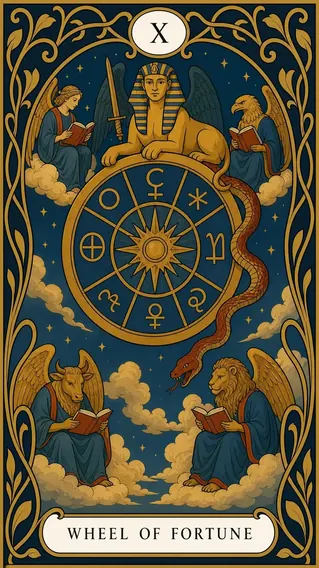
The eleventh major arcana in the Rider-Waite system, Roman numeral XI on the card. It follows the Wheel of Fortune (X) and precedes The Hanged Man (XII).