What does Judgement mean in Tarot
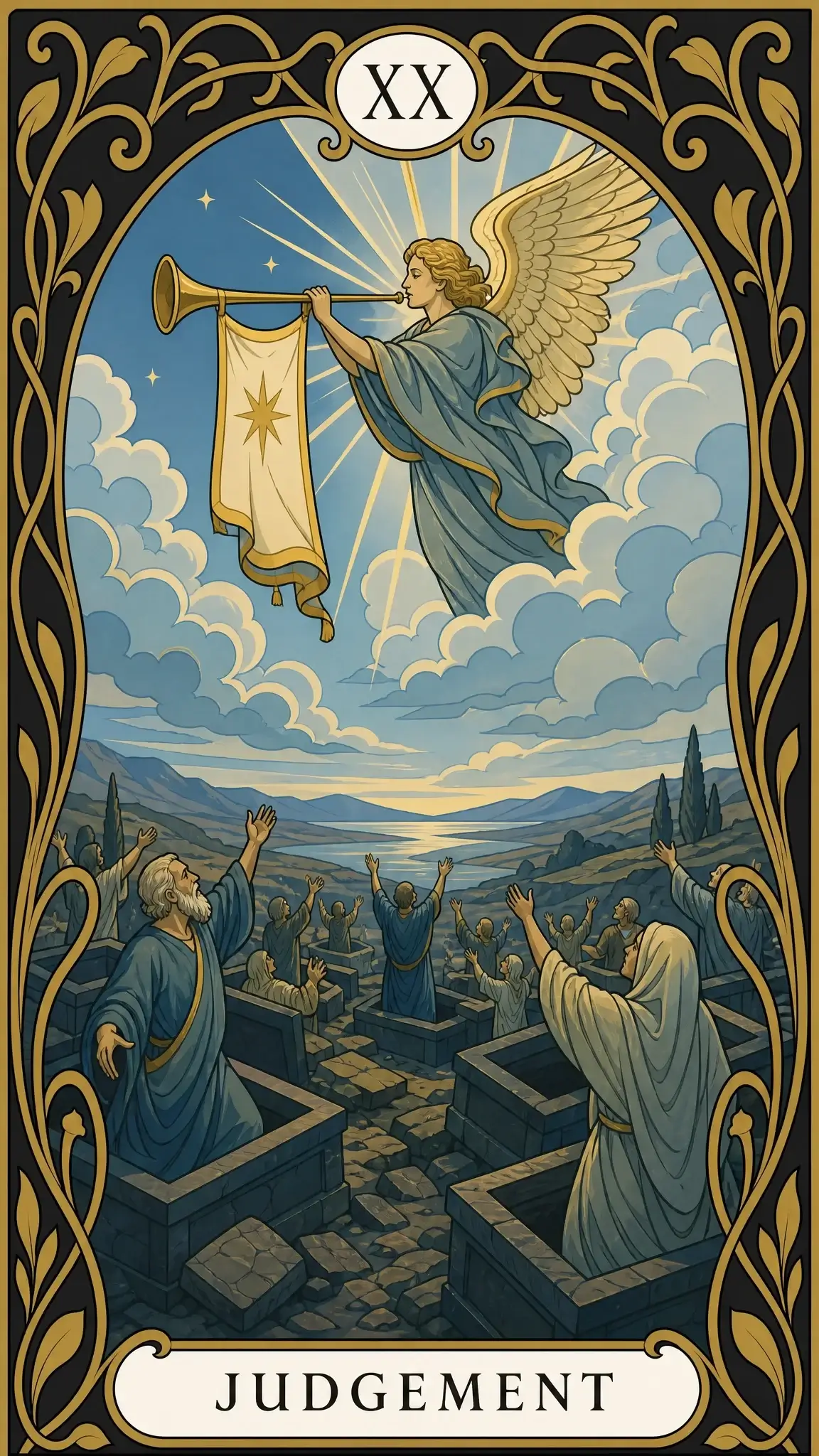
The upright Judgement is the twentieth Major Arcana of the deck: an angel with a trumpet, open graves, and figures rising below with raised hands. The frightening imagery is deceptive: the card is not about punishment, but about awakening—a moment when a person finally hears the call they were previously drowning out with daily routine.
An important nuance often lost in retellings: Judgement does not pass a verdict; it calls you to respond. What has been postponed for years—a conversation, a decision, an honest admission of the truth to yourself—requires an answer right now. The trumpet has already sounded; you cannot fail to hear it.
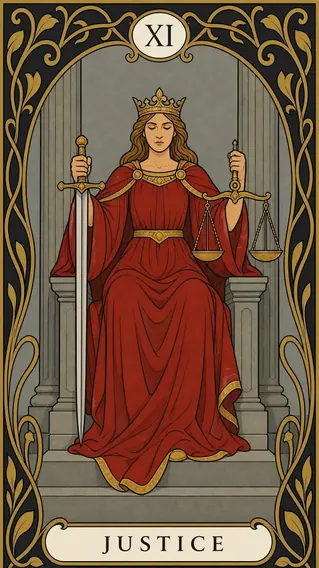
Judgement is often confused with Justice (XI Arcana), and the difference is fundamental. Justice is calculation: weighing what has already been done and reaching an honest conclusion about a specific matter. Judgement is about something else: an internal awakening that shifts your perspective from a single episode to the entire situation. Justice judges the action; Judgement awakens the person.
The second half of the meaning is a second chance. The figures on the card are not being punished; they are rising and reaching for the light. In spreads, Judgement often describes returning to something that was postponed or seemed buried: an old project, a forgotten talent, or a conversation that never happened.
Reversed Judgement: Meaning
Reversed Judgement is the same call, but either unheard or heard too harshly. It is usually read in one of three ways, and the question of the spread helps to choose.
- The call is ignored. The trumpet sounds, but the person buries themselves in routine to avoid responding: it is uncomfortable to hear, and even more uncomfortable to answer.
- Judgement turns inward and becomes self-condemnation. Instead of a sober assessment, there is an endless internal tribunal that decides nothing but only exhausts you.
- The decision is postponed out of fear of others' judgment. The person knows what to do, but fears not the result, but what others will say.
The reversed position almost always means that the cost of delay is growing, and the call is not getting quieter—only more persistent.
Judgement in a 'yes or no' spread
In 'yes/no' spreads, Judgement most often answers yes—but with a condition: the result does not come on its own, but in response to what the person is ready to do. The card is tied to action in response to the call, not passive waiting.
If the question is 'will it work out if I just wait'—the answer is likely no: without a response, Judgement does not work. If the question is about a decision that has long been overdue—'should I finally say, do, or admit it'—here Judgement almost always answers affirmatively, and often faster than it seems.
Reversed Judgement in this spread is read as 'no, because the call has not yet been heard'—the question is not closed on its merits, but because the person is not yet ready to answer it.
Judgement in relationships and feelings
In a relationship spread, the upright Judgement often describes a return: to a conversation that was not finished, to a person from the past, or to a topic that both were avoiding in silence. This is not a guarantee of reunion—it is a moment when the topic can no longer be ignored.
In the position of feelings, Judgement is a response that rises from within in reaction to something external: a letter, a chance meeting, a phrase. This card is never a neutral background—it is about the moment when a feeling that was thought to be buried turns out to be alive.
An important caveat: Judgement does not promise that the answer will be pleasant. It only promises that you will no longer be able to remain silent—and from there, it is up to the person to decide whether to answer honestly or postpone it again.
Reversed Judgement in relationships—the topic is raised, but it is suppressed: a conversation starts and breaks off, a letter is written but not sent.
Judgement in work and money
In career spreads, Judgement is a return to a task that was once postponed: an old project, a forgotten qualification, or an offer that was previously turned down. Often, the card describes a moment when past experience unexpectedly becomes relevant right now.
In money, Judgement speaks of taking stock: recalculating what has accumulated, paying off a debt—your own or someone else's—or closing an account that should have been closed long ago. It is not about sudden profit, but about an honest reckoning with what has already been done.
What Judgement advises in a work spread: do not ignore the signal, even if it is inconvenient. An offer that seems untimely, a call from an old client, a reminder of an unfinished task—here, these are not obstacles, but part of the card.
Judgement as a person: man and woman
In the 'what kind of person' position, Judgement describes someone who reminds you of the past: they return themselves or bring news about someone from your former life. This is not a random character—their appearance always brings something to the surface.
Judgement-man is someone who comes with a direct question or proposal that is long overdue to be answered; often, they themselves once waited for an answer and are finally receiving it or asking again. Judgement-woman is someone who honestly names what both parties preferred not to talk about and expects not excuses, but a decision.
This is not a description of a judge in the everyday sense. Such a person does not pass a verdict—they simply make it so that the topic can no longer be ignored.
Judgement in the thoughts position
In the thoughts position, Judgement represents internal reflection: a person mentally revisits episodes they considered closed and re-evaluates them. This isn't obsession, but a process of summarizing—it can be difficult, but it is usually productive.
Sometimes, this card is accompanied by obsessive anxiety about others' opinions, a fear of being judged in hindsight. Neighboring cards help distinguish this: next to Swords, it is more like self-criticism on the verge of exhaustion; next to the Sun or the Star, it is a sober and calm conclusion.
What to do if you draw Judgement
The advice of Judgement is direct: answer the call, rather than convincing yourself that you imagined it. The main energy here is spent not on the answer itself, but on trying to keep ignoring it.
What you should actually do:
- Name what is calling out loud — to yourself or to the person involved.
- Do not confuse the call with someone else's demand. You should answer what is important to you, not what is "expected."
- Give yourself an honest assessment, not a verdict. The difference between a sober summary and self-condemnation is whether you are looking for conclusions or punishment.
- Do not postpone the conversation out of fear that you won't like what you hear. After Judgement in the deck comes the World — a card of completion, not a card you can reach by bypassing this step.
And separately: if the card appears at a moment when something truly heavy is being re-evaluated, the reading does not replace a conversation with a specialist. The cards show well what is ripe, but they do not live through it for you.
What is depicted on the card
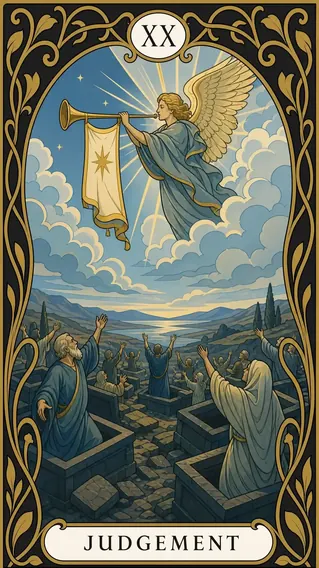
On our card, an angel with golden wings and wavy blonde hair floats in the blue sky among the clouds, blowing a golden trumpet; rays of light emanate from the figure, and several stars are visible high above. A light banner with a golden border and an eight-pointed golden star in the center hangs from the trumpet.
Below, on rocky ground among partially opened rectangular tombs, people stand with their hands raised—an old man with a gray beard in blue robes on the left, a fair-haired figure in a light cloak on the right, and several smaller silhouettes between them, also with raised hands. Further away is a lake or bay, mountains on the horizon, and cypresses by the shore.
The scene is interpreted as follows:
- The trumpet and rays of light from above — the call comes from outside and is immediately recognized; it cannot be mistaken for anything else.
- The eight-pointed star on the banner — for us, this is a symbol of awakening and a guide, not a religious sign; the star on this card does not punish, but points the way.
- Opened tombs from which figures are rising, not exiting — people are still standing waist-deep in the ground: the awakening has already happened, but the path out is still ahead.
- The raised hands of all figures, from the old man to the furthest silhouettes, is a gesture not of pleading, but of recognition: everyone heard the same signal at the same time.
- The calm landscape below — the lake, mountains, and cypresses — is not a battlefield or ruins: the place of awakening is ordinary; the call changes not the scenery, but the people themselves.
At the top of the card is the Roman numeral XX, and at the bottom is the English name JUDGEMENT: our deck is drawn in the Rider-Waite tradition, where Judgement is the twentieth, between the Sun and the World.
Judgement as the card of the day
Judgement as the card of the day rarely speaks of being called on the carpet. More often, it is a day when something from the past returns: an old message, a forgotten contact, a thought that pops up for no apparent reason.
A useful mindset for such a day: do not brush off what has reminded you of itself, even if the moment seems inappropriate. It is a good day to finally answer an email you have been putting off or to honestly close an issue that has been hanging without progress for a long time.
Frequently asked questions about the Judgement card
Is Judgement in Tarot about the Last Judgment?
The name and plot of the card refer to a biblical image, but in practice, Judgement is not about punishment or the end of the world. The Arcanum describes an internal awakening and a call to answer what has been postponed. The card does not predict events or pass verdicts — it is about a decision that a person makes themselves.
What does a reversed Judgement mean?
The same call, but unheard: the person either ignores the signal, turns a sober assessment into self-condemnation, or postpones the decision out of fear of others' opinions. The main difference from the upright position is that the call does not become quieter; the response to it is simply delayed.
How is Judgement different from Justice?
Justice (XI) is a calculation regarding a specific case: weighing what has already been done and reaching an honest conclusion. Judgement (XX) is about something else: an internal awakening that shifts the gaze from a single episode to the entire situation as a whole. Justice judges an action; Judgement awakens the person.
Is Judgement a "yes" or "no"?
Usually yes, but with a condition: the result does not come on its own, but in response to what the person is ready to do. If the question is about passive waiting, the answer is likely no; without a response, the card does not work. If the question is about a long-overdue decision, Judgement answers affirmatively.
Which Arcanum number is this?
The twentieth Major Arcanum; the card has the Roman numeral XX. In the Rider-Waite deck, which ours is based on, Judgement comes after the Sun (XIX) and before the World (XXI) — the last card before completing the entire journey.