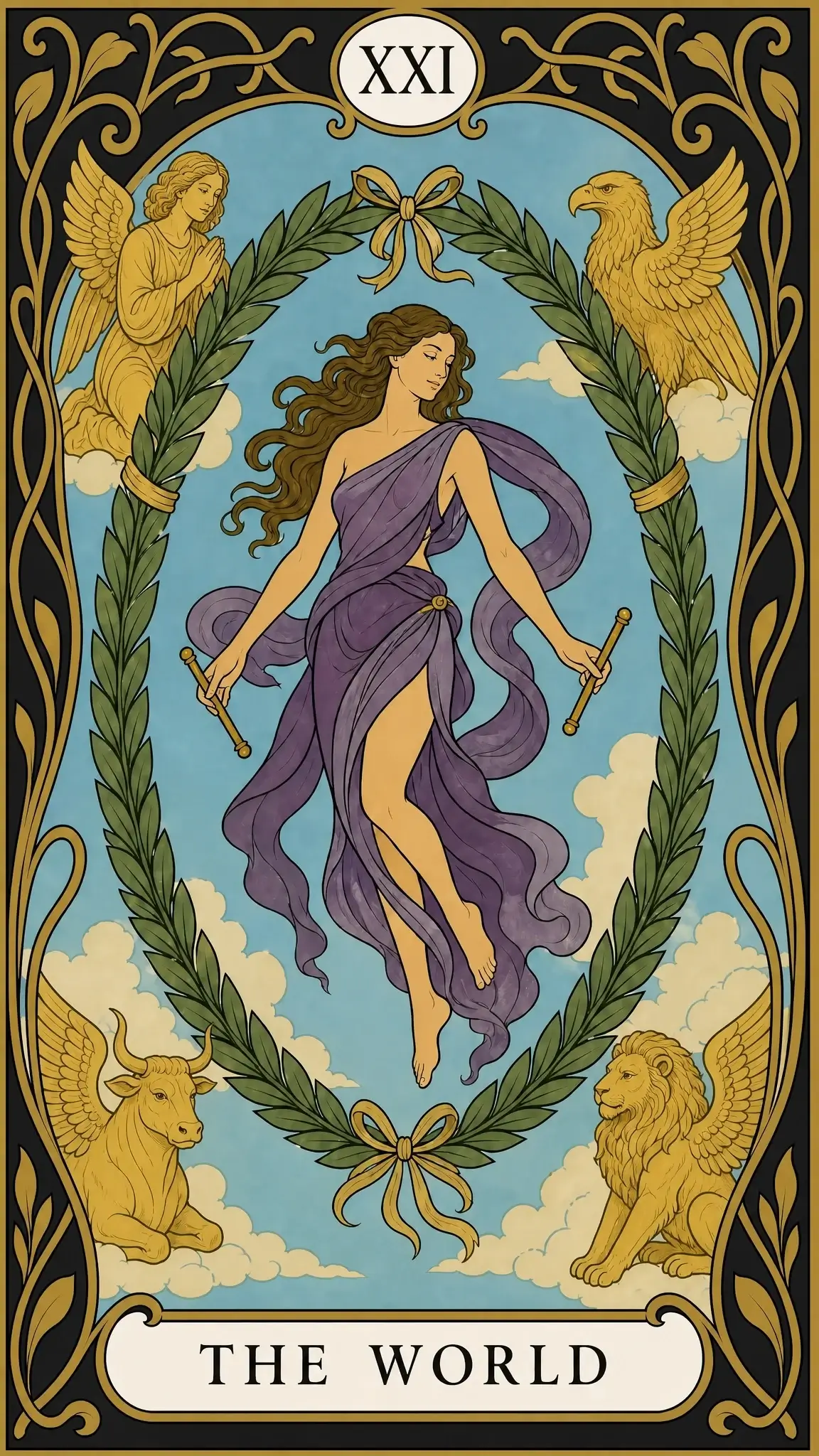
What The World means in Tarot
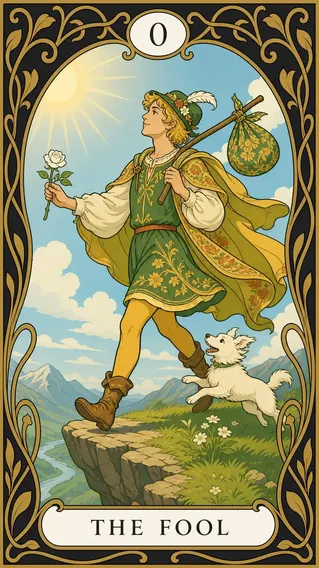
The World is the twenty-first and final Major Arcana: the card that ends the journey started by The Fool (number zero). It is not a reward for effort or an "end of the story," but the closing of a full cycle — a moment when the scattered parts of a task finally come together as a whole.
An important nuance often lost in retellings: The World is not "happily ever after." It is not an indefinite state of peace, but the closing of a specific stage — studies, a project, or a long internal process. Immediately after the twenty-first arcana, the deck returns to zero, The Fool, and a new circle begins. The World is the finish line of one lap, not the journey itself, which is why the card doesn't mean there won't be difficulties ahead: it means this specific segment has been fully completed.
A second layer of meaning is recognition and wholeness. The card rarely appears in the heat of the process; it more often describes the moment when efforts become visible to the person themselves, even if nothing special happened from the outside. The keyword here is not "success" in terms of scale, but "it worked" — regardless of whether the matter was big or small.
Reversed World: meaning
The Reversed World is the same cycle, but not brought to completion. It usually points to one of three meanings, and the question of the spread helps to choose.
- The task is almost done but abandoned at the last step. The remaining one percent requires a disproportionate amount of effort — and that is exactly where the person gets stuck. This is the most common scenario.
- A delay before the finish. Everything is ready, but circumstances or one's own indecision are dragging out the final point.
- Inability to let go of what is already finished. The stage is truly closed, but the person is holding onto it because they fear what comes next — that is, the new Fool.
The reversed position is not about failure, but about incompleteness: the circle has almost closed, but it hasn't quite shut.
The World in a "yes or no" spread
In "yes/no" spreads, The World is one of the most confident yes cards in the deck: what is being asked about will reach a logical conclusion.
Clarification is important where the question is about timing: The World answers "will it work out," not "exactly when." Often the finale is more distant than it seems at the moment of the question — the card describes the completion of a cycle, not an immediate event.
The Reversed World in this spread is yes, but not now: the matter is truly moving toward completion, but one step is being delayed. It is a pause before the final point, not a refusal.
The World in relationships and feelings
In a relationship spread, the upright World describes a stage that has reached fullness: a couple that has truly come together, or — if it concerns a breakup — a relationship that ended so cleanly that no unresolved questions remain. Which option it is will be shown by neighboring cards; what both have in common is the feeling that everything that was supposed to happen at this stage has happened.
In terms of feelings, The World is wholeness, not euphoria: a calm confidence that the feeling has been experienced fully, without anything left unsaid.
The Reversed World in relationships is an unresolved situation: a couple that has not formally broken up but hasn't moved forward either, or a person unable to put an end to a story that has essentially been over for a long time.
The World in work and money
In career spreads, The World is the completion of a project, the closing of a deal, or the recognition of work done: a diploma, an assessment, or a release that has finally launched. The card describes the moment when long-term labor receives a visible result.
In money, The World speaks of closing a financial cycle: a paid-off debt, a saved sum, or an achieved goal for which one was setting money aside. The card does not promise large new sums — the Ace or Ten of Pentacles would better describe growth; The World is specifically about the fact that a goal set earlier has been reached.
What is worth considering in a work spread: the completion of a stage is not a signal to stop forever. It is the end of a lap, not the end of the journey.
The World as a person: man and woman
When The World appears in the "what kind of person" position, it describes someone who has reached their fullness: experienced, self-sufficient, and not needing to prove anything through others. Often this is a person who has literally seen a lot — The World is historically associated with travel, distant countries, and a broad outlook, not just an internal state.
The World-man is someone with whom you feel calm precisely because he has nothing left to prove; he doesn't carry other people's unfinished business and doesn't fuss. The World-woman is someone who has already passed her stage and speaks of it without drama, as a fait accompli rather than a victory that needs to be shared.
The weak point of such people is that it can be difficult for them to start over: the completeness that keeps them stable easily turns into a reluctance to be The Fool again — a beginner who doesn't know what comes next.
The World in the position of thoughts
In the position of thoughts, The World represents the feeling that everything is finally coming together: the scattered pieces of a task form a clear picture, and for the first time in a long while, one sees the whole rather than just the parts.
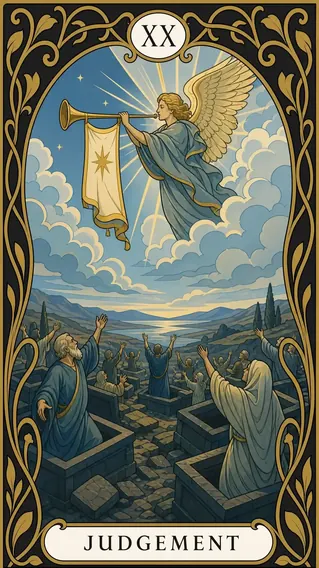
This also includes thoughts on summarizing—not an anxious audit, but a calm look back. The risk of this position is mistaking an intermediate result for the final one and stopping where there is actually one more step to take. Neighboring cards will provide clues: next to Judgment, it is truly the finale; next to The Fool, it is already the beginning of the next stage.
What to do if you draw The World
The advice of The World is simple but easily overlooked: acknowledge that a stage is finished before taking on the next one. A common mistake after this card is to undervalue what has been done and dive straight into a new task without letting yourself notice that the cycle is truly complete.
What you should actually do:
- Summarize out loud or on paper — not for a report, but to confirm to yourself: it worked.
- Do not confuse finishing a stage with stopping forever. After The World, The Fool follows in the deck — the journey continues, just from a clean slate.
- Let go of what is truly closed. If you feel the urge to hold onto a finished story, that is closer to the reversed version of the card.
- Give yourself a pause before the next turn, not every finale requires an immediate continuation.
And separately: if the card appeared regarding a topic that is emotionally difficult, the reading describes a state of mind, not a substitute for a conversation with a specialist.
What is depicted on the card
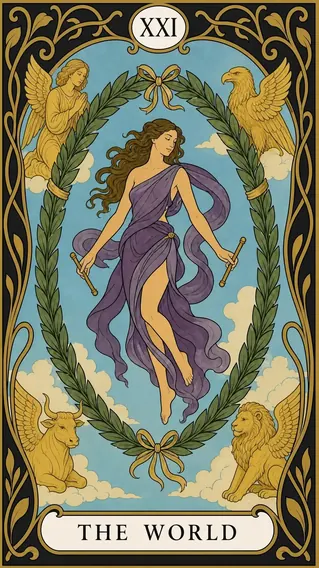
On our World card, there is a woman with long wavy hair, draped in purple fabric that wraps diagonally around her body, leaving one leg exposed; her eyes are closed, and her pose resembles a dance move suspended in the air. The figure floats against a blue sky with clouds, inside a large oval wreath of green leaves. In each hand, she holds a short golden wand.
The scene is interpreted as follows:
- The oval laurel wreath, tied with golden ribbons at the top and bottom, is the boundary of a completed cycle: what is inside the wreath is finished and has become whole, and the shape itself, without corners or breaks, is an image of wholeness without hierarchy, where there is no beginning or end.
- The dancing pose and closed eyes represent a state turned inward, not an action for an audience: the figure is not posing, she is dwelling in the moment.
- Two wands in her hands represent the same balance of opposites as the Magician at the beginning of the deck: the path has come full circle, the tools remain the same.
- Four winged creatures in the corners — the angel at the top left, the eagle at the top right, the bull at the bottom left, and the lion at the bottom right. This is the tetramorph: the four fixed signs of the zodiac, which are also the symbols of the four elements. The arrangement is the same as on the Wheel of Fortune (X), and this is no coincidence — the two cards hold the sequence at both ends: there the wheel is just starting, here the circle has closed. All aspects of experience are present at once, none are left out — hence the feeling of fullness that the card carries.
At the top is the Roman numeral XXI in an oval cartouche, at the bottom is the English name THE WORLD: our deck is drawn in the Rider-Waite tradition, where The World is the final, closing Major Arcana.
The World as the card of the day
The World as the card of the day usually signifies not a major event, but a sense of completion in small things: a closed task, a finished book, a conversation brought to an end.
A useful mindset for such a day: do not start something new immediately, but first notice that something has truly ended. It is a good day to close old obligations or reply to an email you have been putting off. For large-scale new endeavors, the day of The Fool is more suitable.
Frequently asked questions about The World card
Is The World the best card in the deck?
One of the most favorable, but not universally the "best": it is about completing a specific cycle, not about constant happiness. In a reading about a process that has not yet begun, The World is likely not a fit — The Fool or The Magician would be more appropriate there. Its power lies in the context: it answers "has the matter reached its end," not "will everything be good forever."
What does a reversed World mean?
Incompleteness: the task is almost done but abandoned at the last step, or the finale is being delayed. Less often, it indicates an inability to let go of something that has actually already ended. An upright World closes the circle; a reversed one shows a circle that has almost closed, but not quite.
Does The World mean the end of a relationship?
Not necessarily. The card describes the completion of a stage — it can appear for a couple that has finally come together, as well as for a story that has honestly reached its end. The difference is visible in the neighboring cards, not in The World itself.
Is The World a "yes" or "no"?
One of the most confident "yes" cards in the deck: what is being asked about will reach a logical conclusion. The card does not give exact dates — it is about the fact of the finale, not the date.
Which number arcana is this?
The twenty-first and final Major Arcana; the card features the Roman numeral XXI. In the Rider-Waite deck, which ours is based on, The World comes immediately after Judgment (XX) and closes the sequence; The Fool opens it at number 0.