What the Ace of Wands means in Tarot
Aces in Tarot are not events, but the pure potential of the suit: an inconspicuous spark from which anything can grow if there is someone to fan it. The Ace of Wands is the most obvious of the four: wands are responsible for will, initiative, and physical energy; their element is fire, and fire ignites immediately, without warning.
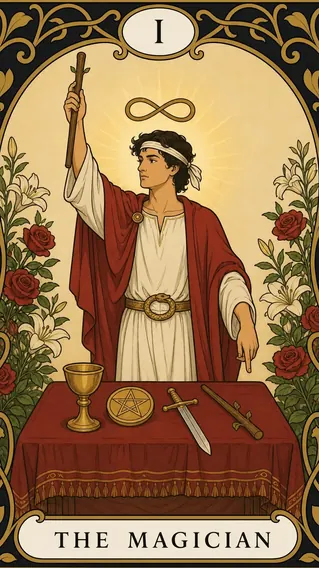
An important nuance often lost in retellings: the minor arcana describes an episode, not destiny. If the major Magician card speaks of a person's readiness to act in general, the Ace of Wands is about a specific Monday when an idea came, a job offer was made, or you suddenly wanted to start something that had been put off for months. The card is not about how everything will end, but only about the fact that a reason to start has appeared.
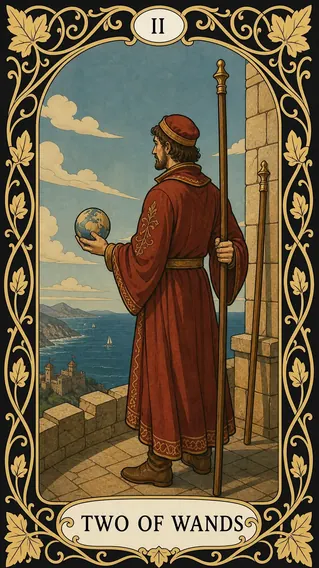
The upright position is read unambiguously: interest, excitement, a desire to try. The impulse is real, not invented out of politeness. But the card also has a flip side that is useful to keep in mind: a spark is not yet a bonfire. The Ace of Wands does not promise how far the venture will go; for that, one should look at neighboring cards in the spread, primarily the Two of Wands, which is about a plan, not just a burst of energy.
Reversed Ace of Wands: meaning
The reversed Ace of Wands is the same fire, but without traction. Usually, the spread refers to one of three options, and the question itself helps to choose.
- There is an idea, but it's impossible to start. The most frequent case: the plan is thought out, but the first step is constantly postponed until tomorrow.
- The spark flared up and went out. You started with enthusiasm, but the energy lasted for a week, and then things go by inertia or not at all.
- The internal brake is stronger than the desire. Fear of looking stupid, fear of wasting effort, fatigue at the very start — these are things that extinguish the spark before it has time to flare up.
There is also a softer reading: sometimes the reversed Ace of Wands is not a refusal to act, but a sober pause before rushing into a new business without preparation. The difference is whether the person feels this pause as a relief or as being stuck.
Ace of Wands in a "yes or no" spread
In "yes/no" spreads, the Ace of Wands is read as yes — but with a caveat that is easy to miss: the card does not answer about the outcome, but about the appearance of a chance. If the question sounds like "should I start," "will an opportunity appear," "will there be a push to act" — the answer is affirmative, and often faster than expected.
If the question is about the result ("will it work out," "will I finish it") — the Ace of Wands does not answer it at all, because it only shows the starting point. To answer such a question, other cards are needed in the spread.
The reversed position in this spread is "yes, but not now": the opportunity exists, but there is not enough enthusiasm for it yet, and the question should be reformulated: not "will it happen," but "what is preventing me from starting."
Ace of Wands in relationships and feelings
In a relationship spread, an upright Ace of Wands almost always describes a flash: sudden interest, attraction, a desire to take the first step. This is a card of the beginning of a feeling, not its depth — about that very spark between people that is talked about on first dates, not about long-term attachment.
In the position of feelings, the Ace of Wands is noticeably physical: wands are responsible for the bodily, not just emotional side of attraction, and the card often points specifically to this layer — attraction as energy, not just as sympathy. For existing relationships, an upright Ace of Wands can mean a new round of passion after a lull: a desire not to "talk about feelings," but to do something together, spontaneously.
Reversed Ace of Wands in relationships — there is attraction, but it is scary to act: they do not dare to write first, suggest a meeting, or confess. Or it is passion that was there but faded before it could become an attachment.
Ace of Wands in work and money
In career spreads, the Ace of Wands is a job offer, a project idea, an invitation to start your own business. The card well describes the moment when energy and a desire to take risks appear: to change direction, to take on what was previously postponed as "someday."
In money, the upright position is not ready-made profit, but a chance to create it: a new side job, an idea that can bring income if implemented. This is a card about a potential source of money, not about the amount in the account — not at all the same thing as, say, the Ace of Pentacles, which is closer to a material result.
Reversed Ace of Wands in work — an interesting offer that is postponed out of caution, or a project that started too hastily and is already stalling without a plan. There is only one piece of advice here: before grabbing an idea, it is worth cooling down for a minute and understanding if there are resources to carry it through.
Ace of Wands as a person: man and woman
When the Ace of Wands appears in the "what kind of person" position, it describes not the character as a whole, but the role of the initiator: the one who brings an idea, calls to start something, charges a company or project with energy. Usually, this is a bright, proactive person with whom it is never boring.
An Ace of Wands man is someone who acts before thinking, captivates on the fly, and does not like long warm-ups. An Ace of Wands woman is someone who is the first to suggest trying something new and is not afraid to start from scratch.
The flip side for both is the same: such a person is good at the start and does not always stay until the end. If the card is important in the spread specifically as a forecast for reliability, it is worth looking at whether there are cards nearby that speak of constancy, for example, the Four or Ten of the same suit.
Ace of Wands in the thoughts position
In the thoughts position, the Ace of Wands represents a restless but pleasant energy: your head is full of ideas, you want to take on several tasks at once, and your thoughts jump from one plan to another. This is a state of creative itch rather than anxiety: you are not afraid, but rather eager to act.
The difficulty is that with so many ideas, it is hard to choose one and see it through to the end. If Swords appear nearby in the spread, the excess of thoughts can turn into scattered focus; next to Pentacles, the idea is more likely to be put into practice.
What to do if you draw the Ace of Wands
The card's advice is simple: start while you have the spark, but don't get stuck in endless planning. The Ace of Wands is about acting in the moment, not about perfect preparation; the longer you delay the first step, the faster the spark fades.
What you should actually do:
- Take one concrete step in the coming days. Not the whole plan at once — just the first action that gets things moving.
- Don't confuse inspiration with a finished result. The card provides the energy to start, not a guarantee of success — other steps and other cards are responsible for developing the idea.
- Write down the idea while it's fresh. The creative impulse of Wands evaporates quickly if it isn't captured.
- Check if you have the strength to finish the task before investing heavily — especially if the decision involves money or a career change.
If the reason for your question is not an idea or a project, but a difficult life situation, the spread does not replace a conversation with a specialist: the card shows a surge of energy, not a solution to complex problems.
What is depicted on the card
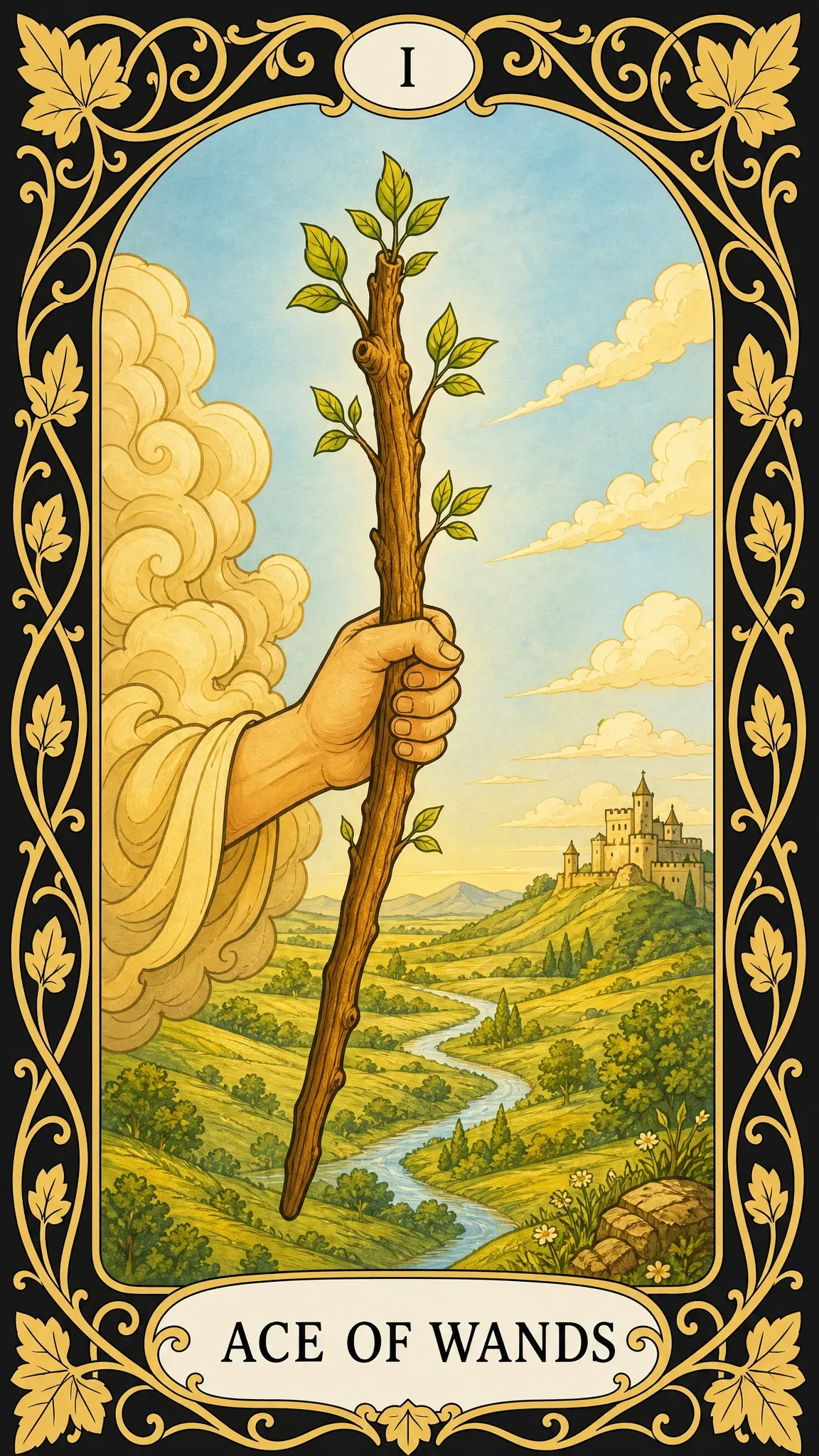
On our card, a hand emerging from a golden cloud firmly holds a wooden staff with young green leaves: the wand is literally sprouting like a branch that hasn't been fully cut. Behind the hand, on a rocky elevation, is a lived-in landscape: a winding river, green hills, and a castle in the distance on a hilltop.
The scene is interpreted as follows:
- Hand from the cloud — power that comes from outside, as an occasion or a push, rather than as a result of one's own long efforts: the wand is given, not grown over years.
- Living leaves on the staff — the idea of the endeavor itself is still alive, raw, and just released into the world; this distinguishes the Ace from, for example, the finished staff of a Knight or King of the same suit.
- River and castle in the distance — a lived-in, mastered world that you still need to reach: the goal is visible, but the path to it has not yet been traveled.
At the top of the card is the Roman numeral I, rather than the usual lack of a number for aces in the classic Rider-Waite deck: our deck emphasizes that this is formally the first, starting card of the suit. At the bottom is a plaque with the English name ACE OF WANDS.
Ace of Wands as the card of the day
The Ace of Wands as the card of the day is a good reason to do what you have been putting off for a long time: reach out first, propose an idea, or sign up for something you lacked the courage for. The day is suitable for starting, not for finishing — don't expect results from it, only a push.
If the card is drawn reversed, the day is more about internal resistance: the desire is there, but you are afraid to start. A useful mindset is to not take the whole step at once, but at least a small part of it, just to get moving.
Frequently asked questions about the Ace of Wands
Is it a Major or Minor Arcana?
Minor Arcana, suit of Wands, element of Fire. There are 56 Minor Arcana in the Tarot deck in total — 14 cards for each of the four suits, and the Ace of Wands starts the count for the Wands.
How does the Ace of Wands differ from the Ace of Cups?
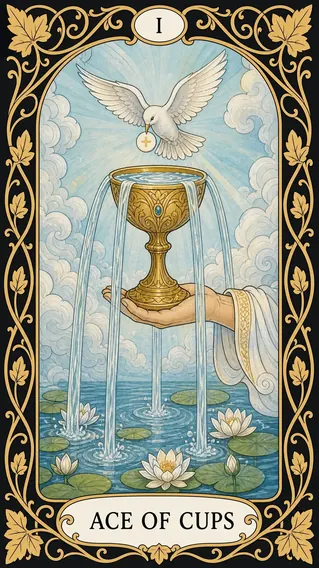
Both aces are about beginnings, but of a different nature. Wands are the element of fire, will, and initiative: the Ace of Wands is about the impulse to act, to take on a task, and physical and creative energy. Cups are the element of water, feelings: the Ace of Cups is about a new emotion, attachment, and openness of the heart. If the spread is about starting a project or the courage to decide — that's Wands; if it's about a new feeling or relationship at the heart level — that's Cups.
Is the Ace of Wands a yes or a no?
More likely yes: the card says that a chance to start will appear — but it doesn't promise a result. If the question is about the start itself, the answer is affirmative. If the question is about whether you will manage to see the task through to the end, the Ace of Wands does not answer that — you need the surrounding cards.
What does the reversed Ace of Wands mean?
The same impulse, but without momentum: the idea is there, but you can't get started, or the spark flared up and quickly went out. Sometimes it's just a pause before the start, not a refusal to act — the difference is whether it feels like a relief or like being stuck.
Can the Ace of Wands mean money?
Yes, but as a potential source of income, not as ready profit: a new side hustle, an idea for earning money, an offer to try something of your own. The card does not show the amount or the result — only that a chance to create it has appeared.