What the Ace of Cups means in Tarot
The Ace of Cups is the first card of the Minor Arcana suit of Cups, the suit of water and emotions. While the Major Arcana describe major life themes—calling, crisis, growing up—the Minor Arcana speak of episodes: a specific conversation, a meeting, a letter, a moment when the heart suddenly opens. It is not about fate for years to come, but the beginning of one specific feeling.
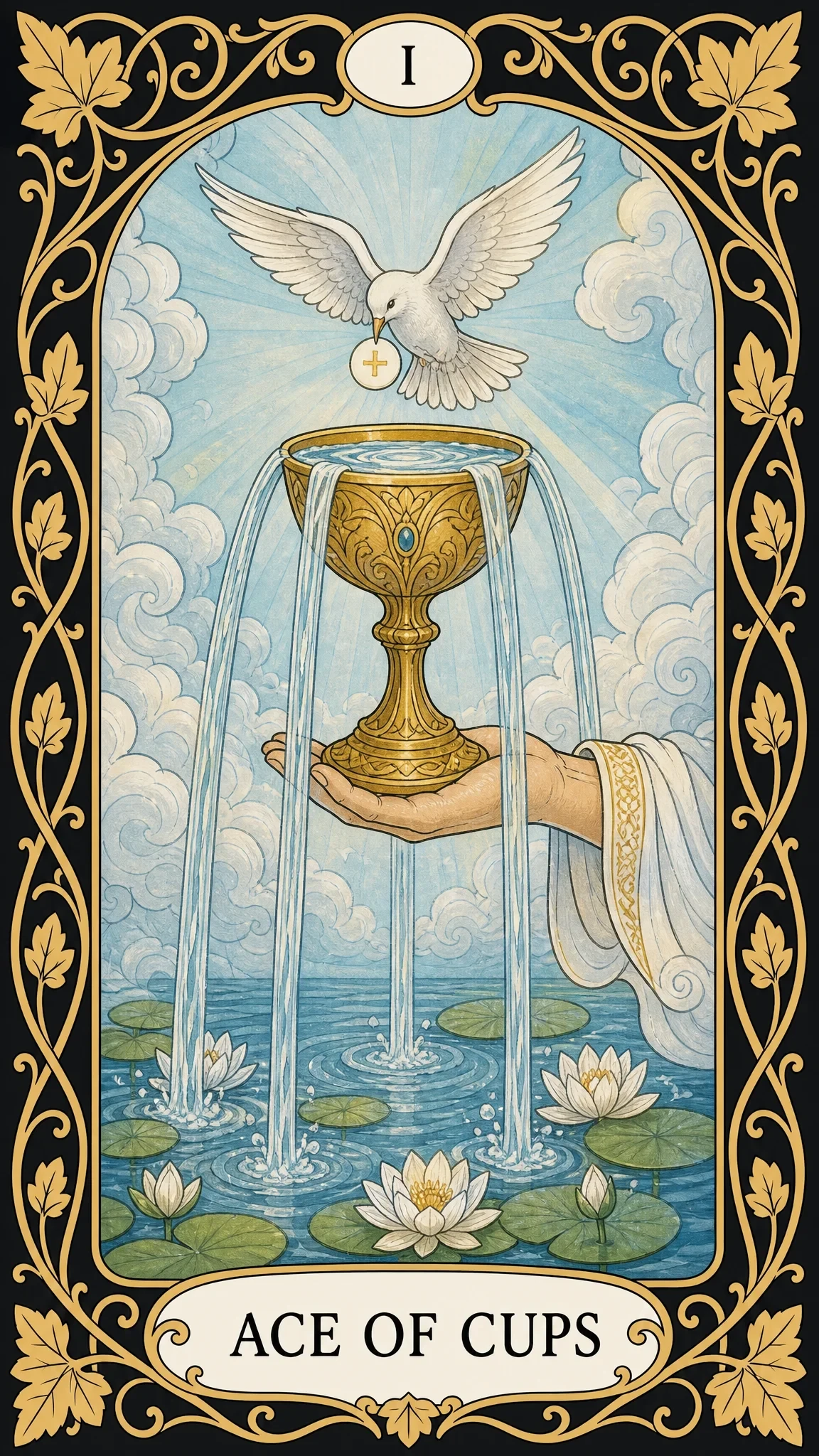
The main image of the card is an overflowing cup from which water pours over the edge. This depicts excess: feelings that are too much to keep inside. This could be falling in love, a surge of tenderness for someone you already know, inspiration that needs to get out, or simply a desire to trust after a long period of being closed off.
An important nuance often lost in retellings: The Ace is an offer, not a guarantee. The card shows the moment when a feeling is born and extended to a person, not what will happen with it in six months. Whether the person will reciprocate or whether the episode will develop into something more is decided by the following cards in the spread and the people themselves.
Reversed Ace of Cups: meaning
The reversed Ace of Cups is the same overflowing cup, but turned so that the water finds no outlet. Usually, the spread falls into one of three scenarios.
- The feeling is there, but it is not shown. The cup is full, but one does not dare to speak out loud—due to fear, pride, or the habit of hiding emotions.
- Disappointment after openness. A person has already reached out with a feeling, but it was not accepted or was not accepted as expected.
- Emotional stagnation. Nothing flows in or out: feelings have dulled, relationships or business are maintained by inertia, without the previous warmth.
The reversed position almost always means not the absence of a feeling, but its blockage. The difference from the upright Ace is that the water in the reversed card does not flow anywhere—and the first step of such a spread is usually about letting it out again.
Ace of Cups in a "yes or no" spread
In "yes/no" spreads, the Ace of Cups is read as one of the most confident yes cards in the deck if the question concerns feelings: will a relationship start, will the person reciprocate, should I open up. The card literally depicts an offer being extended—and it answers with consent.
The caveat concerns questions not about feelings, but about facts and deadlines: will the deal succeed, will the work issue be resolved. Here, the Ace of Cups is more of a "yes, but through an emotional component," meaning the outcome depends on whether personal sympathies are involved in the matter, not just calculation.
The reversed Ace in this spread is "not yet": the offer was either not voiced out loud or was not accepted the first time. This is not a final refusal, but a signal that the feeling has not yet been given a chance.
Ace of Cups in relationships and feelings
In a relationship spread, the Ace of Cups is one of the most favorable cards: a new feeling, the beginning of a romance, mutual sympathy that is just forming. If a relationship already exists, the card speaks of a fresh wave of tenderness—as if feelings have filled up again like a cup with water.
In the position of feelings, it describes exactly an excess: a person feels more than they show externally, or more than they are ready to admit even to themselves. Sometimes this is one-sided infatuation at an early stage, when the feeling is already overflowing, but a reciprocal step has not yet been taken.
If there are cards about doubts or the past nearby in the spread, the Ace of Cups shows that the new feeling is real but not yet tested by time. By itself, it does not guarantee a long relationship—only that the spark is there and it is honest.
The reversed Ace in this spread is a feeling that is kept to oneself: afraid of scaring someone off, afraid of being rejected, or simply not yet ready to say out loud what is already understood inside.
Ace of Cups in work and money
In work spreads, the Ace of Cups rarely speaks of money directly—this card is not about calculation, but about inspiration. More often, it describes a project that is started not for profit, but because it is truly liked: a change of profession to a favorite business, a creative idea, a team in which it is suddenly warm to work.
In terms of money, the card is more about an offer made from the heart: a gift, a bonus, unexpected support, rather than systemic income. Neighboring Pentacle cards will show whether this sincere initiative will turn into stable earnings.
The advice of the card in a business spread is to trust your first emotional response when choosing, but do not forget to check it with calculation a little later: the Ace of Cups is good at starting a business, but bad at keeping the books.
The reversed Ace here is work into which one has stopped putting their soul, or an offer made sincerely but not appreciated at its true value.
Ace of Cups as a person: man and woman
When the Ace of Cups appears in the "what kind of person" position, it does not describe the character as a whole, but a specific gesture—the moment when a person is the first to extend a feeling. This is someone who does not consider it necessary to hide sympathy and is the first to take a step forward.
The Ace of Cups man in a spread is someone who openly shows tenderness, speaks about feelings directly, sometimes even before it is expected of him. The Ace of Cups woman is someone who sincerely and without calculation shows that she is interested in a person, without playing at indifference.
This is not a description of being prone to falling in love as a permanent character trait—rather, it is a momentary state of an open heart that a specific person is experiencing right now, in connection with a specific situation from the question.
Ace of Cups in the thoughts position
In the position of thoughts, the Ace of Cups is a feeling that occupies the entire mind: a person keeps returning to the same individual or a recent warm moment. The thoughts are not anxious, but rather dreamy, slightly distracted by overwhelming tenderness.
Sometimes this is an early stage of infatuation, before logic has had a chance to intervene. Sometimes it is the anticipation of a reconciliation or a warm conversation that is about to happen. Adjacent Sword cards in this position will suggest whether the person is confusing a sincere feeling with an imagined image.
What to do if you draw the Ace of Cups
The advice of the Ace of Cups is simple: if the feeling is real, it should be allowed to flow rather than kept under wraps out of caution. The card rarely advises waiting for a convenient moment—the moment is already here, the cup is already full.
What you should actually do:
- Name the feeling out loud — to yourself or to the person it concerns. Until it is spoken, it remains only an internal state.
- Do not confuse intensity with reliability. A strong feeling now does not equal a long-term relationship in the future — it is just the beginning, not the end result.
- Make space for the other person. The Ace of Cups describes your offer, not a guaranteed response to it.
- Do not dilute the moment with calculation. Here, it is better to trust than to immediately count the risks — there are other cards in the spread for a sober assessment.
If the card appeared against the backdrop of a difficult breakup or a recent loss, remember that a new feeling does not have to replace the grief you have experienced, and a reading does not replace a conversation with a loved one or a professional.
What is depicted on the card
On our card, a hand in a white sleeve with gold trim reaches out from the clouds, holding a golden carved cup with a blue stone on the bowl. The cup is full to the brim and overflows in five thin streams that fall into a pool with white water lilies. Above, against a background of radiating light and clouds, a white dove descends toward the cup with a small round wafer marked with a cross in its beak.
This scene is interpreted as follows:
- Five streams of water — an excess of feeling: the cup is not just full, it is overflowing in several places, and it is no longer possible to keep it inside.
- Dove with a wafer — a sign that the feeling does not come from a desire to get something for oneself, but as a pure gift, without calculation.
- Water lilies in the water — the feeling does not fall into a void, but into an environment ready to receive it: life around is already blooming with this abundance.
- Rays of light behind the clouds — the source of the feeling is above the level of everyday calculations, hence the feeling that it is "from above" rather than planned in advance.
At the top of the card is the Roman numeral I, and at the bottom is the English name ACE OF CUPS: our deck is drawn in the Rider-Waite tradition, where the Ace opens the suit of Cups.
The Ace of Cups as the card of the day
The Ace of Cups as the card of the day usually foretells a day with an emotional surprise: an unexpectedly warm conversation, a message you didn't expect, or a moment of tenderness where you weren't looking for it.
A useful mindset for such a day is not to dampen the feeling with reason prematurely and not to be shy about showing it first. The card of the day is rarely wrong about the mood: if your soul feels lighter than usual in the morning, trust this state rather than looking for a logical explanation for it.
Frequently asked questions about the Ace of Cups card
Is it a Major or Minor Arcana?
Minor Arcana. The Ace of Cups opens the suit of Cups, the element of the card is Water. There are 56 Minor Arcana cards in the Tarot deck in total: 14 cards in each of the four suits.
How does the Ace of Cups differ from the Ace of Swords?
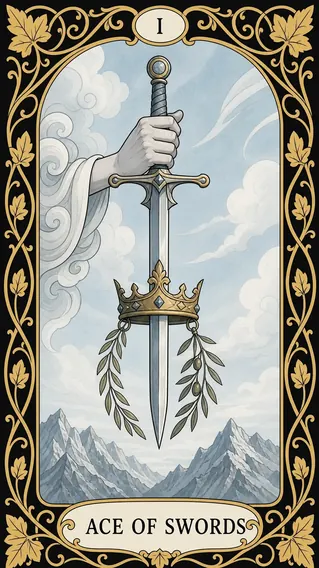
Both Aces are beginnings, but of a different nature. The Ace of Cups is about feeling: new love, tenderness, emotional openness. The Ace of Swords is about thought: clarity, honest decision-making, the victory of the mind, not the heart. If you confused these two cards in a spread, check whether it is about what is felt or what has been decided.
What does the reversed Ace of Cups mean?
A feeling that finds no outlet: it is hidden, feared to be shown, or has already been shown but was not accepted. Less often, it is emotional stagnation, when previous warmth has dulled. It is not an absence of feeling, but a blockage of it.
Is the Ace of Cups in love always a new romance?
Not necessarily a new person — sometimes it is a new turn of feeling in an existing relationship: a surge of tenderness that seems to start everything anew. If there are cards about the beginning of a journey nearby in the spread, it is more often about a new acquaintance.
Is the Ace of Cups a "yes" or a "no"?
In questions about feelings, it is a confident "yes": the card literally shows an offer being extended. In questions not about emotions, but about facts and deadlines, the answer is softer: "yes, if personal sympathy is involved," rather than cold calculation.