What the Ace of Swords means in Tarot
Aces in Tarot are not events, but the pure potential of the suit: the point from which the whole story unfolds. The Ace of Swords is the sharpest and most sudden of the four: swords are responsible for the mind, speech, and truth, and their element is air — fast, invisible, and intolerant of shades of gray.
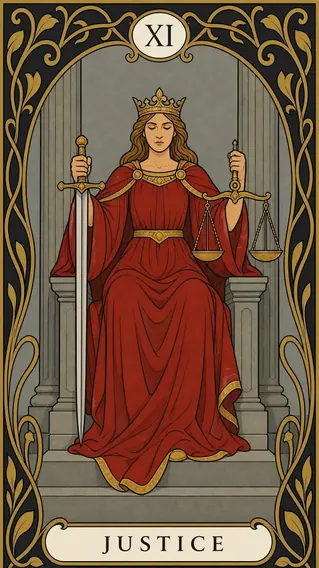
An important nuance often lost in retellings: the minor arcana describes an episode, not a destiny. If the major Justice card speaks of the principle of fairness in general, the Ace of Swords is about a specific moment when a picture suddenly forms in your head, the right words are found, or an uncomfortable truth has to be spoken aloud. The card is not about the outcome of a conversation, but only about the fact that clarity has emerged, which you now need to do something with.
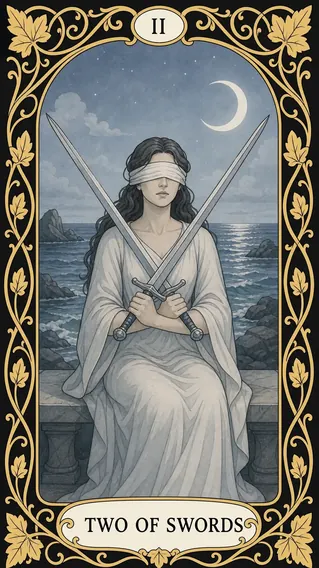
The upright position is read unambiguously: a sharp, almost physical sensation of "now I understand." A thought suddenly becomes precise, an argument becomes irrefutable, and a decision becomes obvious. But this clarity has a flip side that is worth keeping in mind: the sword cuts truth and the feelings of the person standing nearby with equal ease. What to do with this sharpness is a question for the neighboring cards, primarily the Two of Swords, which shows what happens when clarity needs to be translated into a choice.
Reversed Ace of Swords: meaning
The reversed Ace of Swords is the same sharp mind, but without the precise strike. Usually, the spread refers to one of three options, and the question itself helps to choose.
- Thoughts are tangled, clarity is not visible. There is a lot of information, but it is impossible to assemble it into a clear conclusion.
- The truth is there, but it is spoken as a weapon. Sharpness turns into rudeness, and honesty into a way to hurt more deeply.
- The decision was made too quickly. The mind grabbed the first convincing argument without checking the others.
There is also a softer reading: sometimes the reversed Ace of Swords is not chaos, but a necessary pause before acting impulsively. The difference is whether this pause feels like relief or helplessness.
Ace of Swords in a "yes or no" spread
In "yes/no" spreads, the Ace of Swords is usually read as yes — but with a caveat that is easy to miss: the card promises clarity, not a comfortable answer. If the question sounds like "will I finally understand what is going on," "should I speak directly," or "will a solution appear" — the answer is affirmative, and often faster than seems possible.
If the question is about a soft outcome ("will it go without conflict," "will the interlocutor like my truth") — the card does not answer it, because it describes only the moment of insight, not its consequences.
The reversed position in this spread is "not yet, there is a mess in the head": clarity will appear, but not this time, and the question should be reformulated — not "what to decide," but "what is preventing me from seeing the whole picture."
Ace of Swords in relationships and feelings
In a relationship spread, the upright Ace of Swords almost always means a frank conversation: words finally spoken, an honest confession, clarity about what a person really wants. This is a card of the head, not the heart — it shows the moment when it becomes clear what to do, even if feelings are not yet ready for this understanding.
For new relationships, the card often describes attraction through conversation: interest is born not from mystery, but from the fact that you can talk to a person directly. For existing relationships — the moment when a couple finally calls a problem by its name instead of avoiding it.
The reversed Ace of Swords in this position is understatement or words spoken too sharply: the truth is there, but it is spoken in a way that hurts more than necessary. Or the opposite option — clarity is replaced by nitpicking, when a reluctance to talk about the main thing hides behind sharp words.
Ace of Swords in work and money
In career spreads, the Ace of Swords is an idea that has finally formed into a working plan: a clear project formulation, a successful phrase in negotiations, a solution that previously seemed impossible. The card well describes the moment of an intellectual breakthrough — when a complex task suddenly becomes solvable.
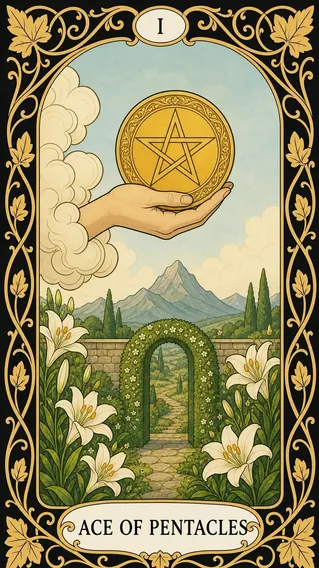
In money, the upright position is a sober decision, not luck: breaking an unprofitable contract, refusing unnecessary expenses, seeing numbers without illusions. This card is not about income, but about an honest look at the financial situation — this is its difference, say, from the Ace of Pentacles, which is closer to material opportunity rather than understanding.
In work, the reversed Ace of Swords is a decision made in a hurry without all the data, or an argument in which arguments are used to crush an opponent rather than find the truth. The advice here is simple: before acting on the results of an "epiphany," it is worth checking it with a fresh head.
Ace of Swords as a person: man and woman
When the Ace of Swords appears in the "what kind of person" position, it describes not the character as a whole, but a role — someone who calls things by their names, cuts to the quick where others remain silent, and brings clarity to a controversial situation. Usually, this is a sharp-tongued, quick-thinking person with whom it is difficult to have empty conversations.
An Ace of Swords man is someone who speaks directly and does not mince words for the sake of politeness. An Ace of Swords woman is someone who is the first to name a problem aloud when others prefer not to notice it.
The flip side for both is the same: such directness is good for solving a problem and not always good for relationships with the person to whom this truth was reported. If the card is important as a forecast about the softness of communication, it is worth looking to see if there are Cups cards nearby that soften the sharpness of the swords.
Ace of Swords in the position of thoughts
In the position of thoughts, the Ace of Swords is a rare state for the Swords suit: it's not anxious overthinking, but a sudden silence and clarity where everything finally falls into place. Your mind works quickly and precisely, and arguments form on their own.
The challenge is that with such mental sharpness, it's easy to overestimate your own rightness and fail to notice that someone else's point of view also has merit. If Cups appear nearby in the spread, this clarity risks devaluing feelings; next to Pentacles, the idea is more likely to receive a practical, grounded manifestation.
What to do if you draw the Ace of Swords
The card's advice is simple: use the clarity while you have it, but don't confuse honesty with cruelty. The Ace of Swords provides a precise answer to a long-overdue question—but how that answer is delivered depends on the person, not the card.
What you should actually do:
- Formulate your thought in one sentence. If the idea or decision doesn't fit into a short phrase, the clarity isn't quite real yet.
- Separate the fact from the way you present it. You can tell the truth harshly, or you can tell it directly—these are different things.
- Don't act on the first impulse regarding important matters. A sharp thought is often correct, but it's worth sleeping on it for at least one night before making any major changes based on it.
- Write down your decision before a difficult conversation so you don't lose the precision of your wording under the pressure of emotions.
If the reason for your question is a difficult conflict, a breakup, or a decision that will significantly affect other people, the spread does not replace a conversation with a specialist: the card shows a flash of clarity, not a ready-made solution for all consequences.
What is depicted on the card
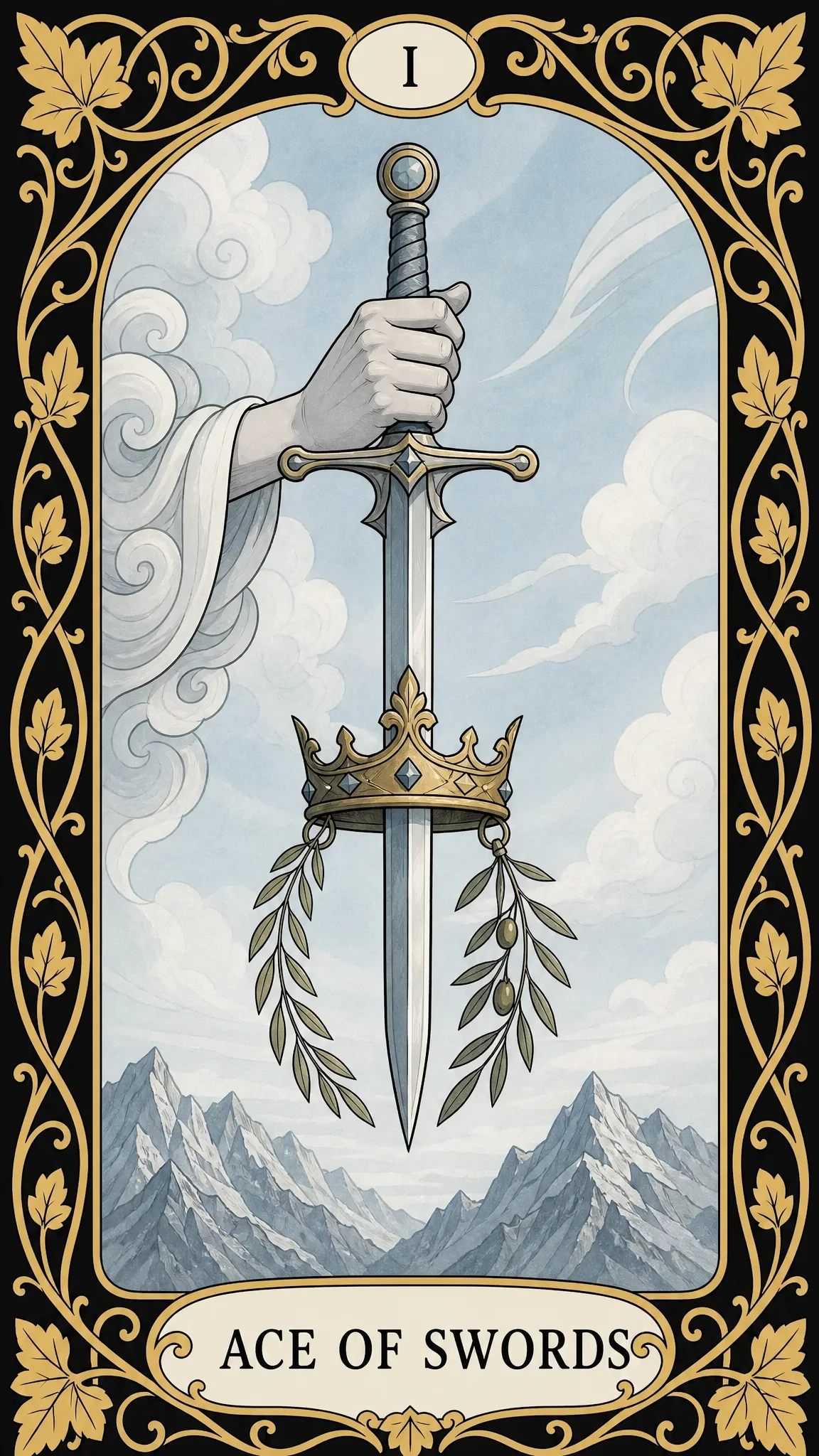
On our card, a hand emerging from swirling clouds firmly grips the hilt of an upright, naked sword: the blade points strictly upward, as if slicing through the very fabric of the sky. A golden crown adorned with gemstones is set upon the blade, and two branches hang from its sides: on one side, smooth oblong leaves; on the other, a branch with round fruits resembling olives. Below, under the tip of the sword, lies a harsh ridge of gray, snow-capped mountains.
The scene is interpreted as follows:
- Hand from the cloud — clarity comes from outside, like a sudden flash of insight rather than the result of long deliberation: the thought is given to us, not built brick by brick.
- Crown on the blade — the power of reason over chaos: whoever wields this sword gains a brief moment of clarity and the right to speak the truth, not just the power to attack.
- Two branches on the sides — peaceful symbols worn on a weapon: a hint that sharp truth can bring not only victory but also reconciliation, if not misused.
- Bare mountains below — the path after the epiphany has not yet been traveled: the thought is clear, but the road through the harsh terrain is just beginning.
At the top of the card is the Roman numeral I, and at the bottom is a plaque with the English name ACE OF SWORDS, just like the other aces in our deck.
Ace of Swords as the card of the day
The Ace of Swords as the card of the day is a good reason to say what has been put off for a long time: name a problem out loud, ask a direct question, or make a decision that has been spinning in your head for weeks. The day is suitable for honesty, not for diplomatic evasiveness.
If the card is drawn reversed, the day is more about noise in your head, where it's hard to distinguish a real thought from an anxious one. A useful guideline is not to make irreversible decisions on such a day, but simply give yourself time to think things through.
Frequently asked questions about the Ace of Swords card
Is it a Major or Minor Arcana?
Minor Arcana, suit of Swords, element of Air. There are 56 Minor Arcana cards in the Tarot deck in total—14 cards for each of the four suits, and the Ace of Swords starts the count for the Swords.
How does the Ace of Swords differ from the Ace of Pentacles?
Both aces are about beginnings, but of a different nature. Swords are the element of air, mind, and truth: the Ace of Swords is about sudden clarity, a precise decision, and an honest conversation. Pentacles are the element of earth, matter: the Ace of Pentacles is about a concrete opportunity to earn money or start a project with your hands. If you are interested in understanding a situation or making a difficult decision in a spread, it's about Swords; if you are looking for a new source of income or a practical endeavor, it's about Pentacles.
Is the Ace of Swords a yes or a no?
More likely yes: the card promises that clarity will appear, but it does not promise an easy or pleasant answer. If the question is about whether you will finally understand the situation, the answer is affirmative. If the question is about a comfortable outcome, the Ace of Swords does not answer that.
What does the reversed Ace of Swords mean?
The same sharp mind, but without the precise strike: thoughts get tangled, or the truth is spoken too harshly and turns into a way to hurt someone. Sometimes it's just a pause before a decision, not chaos—the difference lies in whether it feels like relief or helplessness.
Can the Ace of Swords mean a conflict or a breakup?
On its own, no: the card is about a moment of clarity, not a breakup. It can show an honest conversation that has been brewing for a long time, including a difficult one. The card does not predict a specific outcome—for difficult decisions, it is a reason to discuss the situation with a specialist rather than relying on a spread.