What the Two of Swords means in Tarot
The Two of Swords continues the count of the suit of swords — the element of air, representing thoughts, words, and decisions. After the Ace, which provided the very idea of conflict or a difficult topic, the Two shows the first reaction to it: not action, but a halt. Two hands cross two blades in front of them — not to attack, but to keep everyone out, including oneself, from the truth that is currently too scary to see.
An important nuance often lost in retellings: the Minor Arcana describes an episode, not a destiny. The Two of Swords is not a diagnosis of "eternal indecision," but a specific point: a specific question to which one does not want to answer yes or no right now. Usually, this is not due to laziness or stupidity, but the understanding that either of the two answers will cost something important.
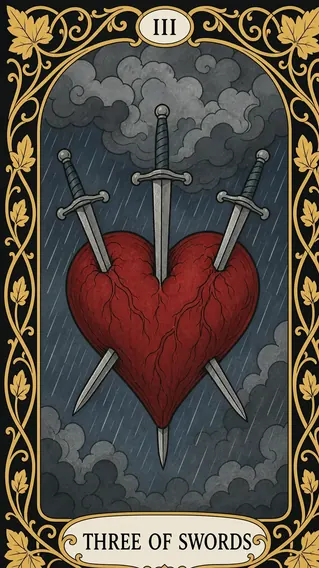
The upright position is read as a conscious pause: the person sees both options but intentionally does not choose because the choice currently causes pain. This is not a permanent state — the Two maintains balance only as long as there is strength, and then the Three of Swords enters, showing what happens when the balance collapses.
Reversed Two of Swords: meaning
The reversed Two of Swords is the same deadlock, but on the verge of resolution. A spread usually implies one of three options.
- The decision has finally matured. There is nothing left to weigh — it is time to put down the swords and take a step, whatever it may be.
- The truth can no longer be ignored. What was hidden behind crossed arms has surfaced on its own — through words, an event, or someone else's direct question.
- Prolonged indecision has turned into overload. Weighing pros and cons for too long without taking a single step has turned the pause into an anxious state from which one wants to escape at any cost.
There is also a harsh interpretation: the removed blindfold sometimes means that the decision was not made by the person themselves — circumstances or another person made the choice for them. This is not a catastrophe, but a reason to ask oneself: is this outcome acceptable?
Two of Swords in a "yes or no" spread
In "yes/no" spreads, the Two of Swords is more of a no, but of a special kind: not a refusal, but a deferred answer. The card clearly states that a decision has not yet been made and the question was asked prematurely — either to oneself or to the cards.
If the question is "should I wait" or "should I not choose yet" — the answer is likely yes: a pause is more appropriate now than haste. If the question is about the outcome of a specific decision that has long been overdue, the Two of Swords hints that one should not drag it out any longer: the longer the crossed swords are held, the heavier they become.
The reversed position in this spread is read as "yes, the answer is already there, it's just that one is afraid to say it out loud yet."
Two of Swords in relationships and feelings
In a relationship spread, the upright Two of Swords almost always speaks of emotional distance that is maintained consciously: one does not want to break the relationship or move forward in it, so it is easier to stay on the defensive and not discuss painful topics. The conversation is postponed not because the topic is unimportant, but because any honest answer seems risky.
The card often describes a situation where two people are literally avoiding one topic — everything is calm out loud, but between the lines, it is felt that a decision is overdue and is not being made only out of caution. Sometimes this is also an internal conflict of one person: being drawn to closeness while simultaneously wanting to protect oneself.
The reversed Two of Swords in relationships means the silence is ending: either through an honest conversation or because the truth comes out on its own, without preparation.
Two of Swords in work and money
In career spreads, the Two of Swords describes a decision that is hanging in the balance: whether to change jobs or stay, take a project or decline, invest or wait. Both sides of the choice look justified, and that is exactly why the decision is not moving forward — it is not a lack of arguments, but a lack of readiness to take a risk.
In money matters, the upright position often points to a financial issue that is being postponed: not counting expenses, not looking at the balance, not sorting through documents because the result might not be pleasant. This is a card of avoiding numbers, not money itself.
The reversed Two of Swords in work means a decision has been made, and it is often long overdue: quitting, declining a project, finally opening the expense spreadsheet. The advice here is simple: since the truth has surfaced anyway, it is better to deal with it immediately rather than postpone it again.
Two of Swords as a person: man and woman
When the Two of Swords appears in the "what kind of person" position, it does not describe the entire character, but a state: someone who maintains neutrality, does not show their cards to anyone, and prefers not to choose a side until they have to. From the outside, this can be read as restraint or even coldness.
A Two of Swords man is someone who closes off from conversations about feelings and decisions, preferring to "not think about it yet." A Two of Swords woman is someone who maintains emotional distance consciously to avoid making a hasty decision under pressure.
The downside for both is the same: such a position is convenient until the question requires an urgent answer. If the card is important in the spread specifically as a forecast, it is worth looking at the neighboring sword cards — they usually show what will happen when the balance is finally broken.
Two of Swords in the thoughts position
In the thoughts position, the Two of Swords represents a state of intentional detachment: your mind knows a decision is needed, but you are deliberately avoiding thinking about it to prevent premature anxiety. It is not a void in your thoughts, but a conscious suppression of them.
Next to Cups, such a pause is often related to feelings one is afraid to acknowledge; next to Pentacles, it relates to a practical decision being postponed out of caution. In any case, the card does not point to the absence of an answer, but to the fact that one does not want to voice it, even to oneself.
What to do if you draw the Two of Swords
The card's advice is simple: take off the blindfold before circumstances do it for you. The Two of Swords does not judge the pause—sometimes it is truly necessary to avoid deciding in the heat of the moment—but when dragged on indefinitely, it turns from wisdom into stagnation.
What you should actually do:
- Name the issue directly instead of dancing around it in conversations and thoughts. Until a problem is formulated, it cannot be solved.
- Give yourself a specific deadline for the pause rather than leaving the question open-ended—a week of reflection is more useful than months of anxious avoidance.
- Check what you are actually afraid of—the decision itself or the consequences of one of the options. These are different fears, and they need to be handled differently.
- Do not wait for someone else to make the choice—circumstances may indeed decide for you, but the result is rarely as satisfying as your own decision.
If the pause is related to a difficult topic—a breakup, a diagnosis, an addiction—the reading does not replace a conversation with a specialist: the card shows a state of paralysis, not the path through it.
What is depicted on the card
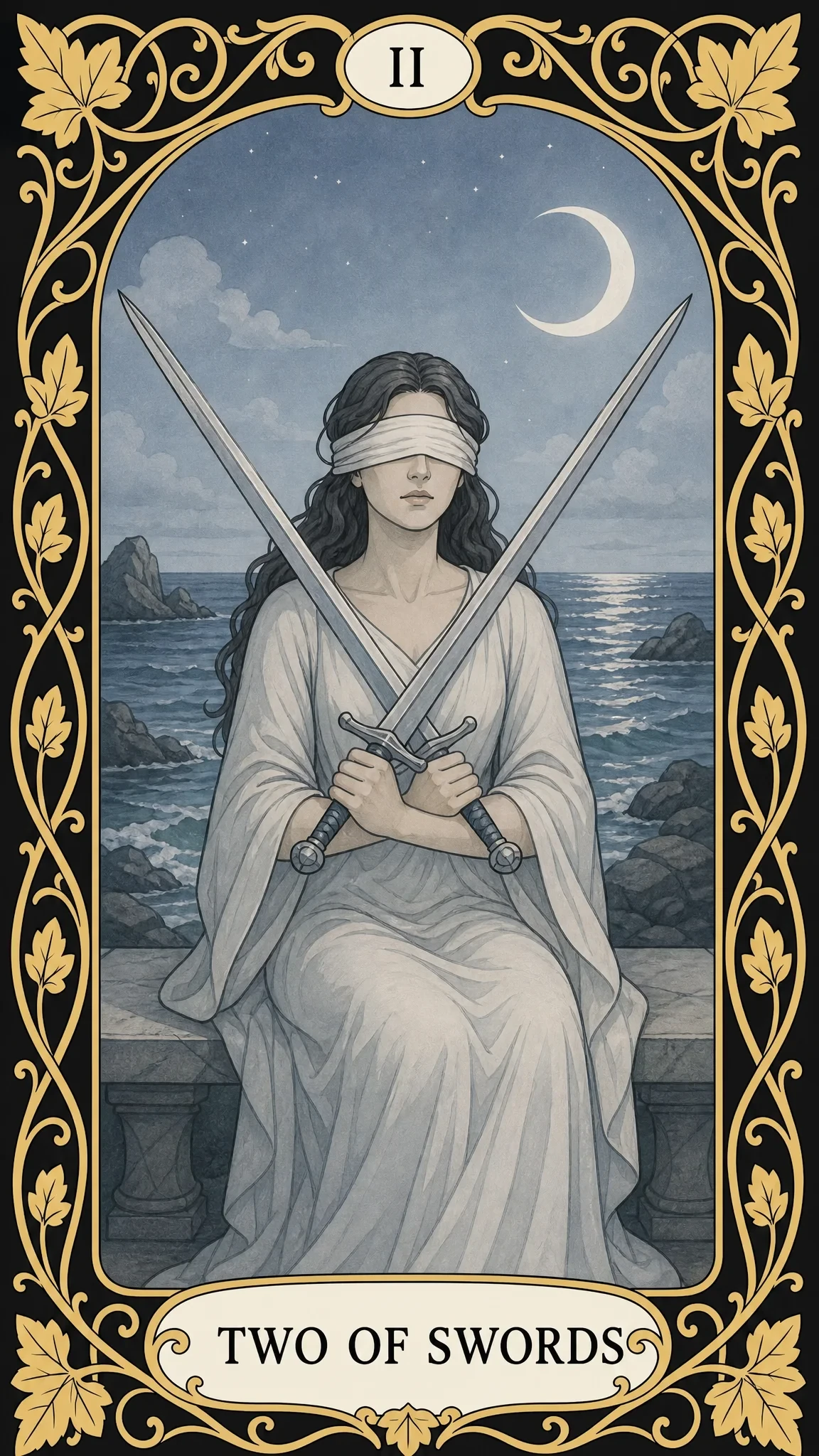
On our card, a woman in light, airy clothing sits on a stone parapet by the night sea. Her eyes are covered by a thick white blindfold, and her long dark hair falls over her shoulders. Her arms are crossed over her chest, each holding a naked sword; the blades are crossed with their points upward, right in front of her face.
The scene is interpreted as follows:
- Blindfolded eyes — a conscious refusal to look at the situation, not blindness: the person has decided not to see what is already visible.
- Crossed swords at the chest — defense, not attack: the blades are not pointed outward at someone, but held close to the body like a shield.
- Night sea and crescent moon — a state between the tide of feelings and their suppression: the water looks calm at first glance, but it is at night, in the dark, that it is easier not to notice what is actually happening.
- Rocky shore behind — a firm foundation underfoot, despite the external balance: the pause is not based on emptiness, but on real, albeit harsh, ground.
Unlike many interpretations of this card featuring a stormy, restless sea, our water is almost mirror-like—the focus is not on a hidden storm, but on the external calm behind which a decision is hiding. At the top of the card is the Roman numeral II, and at the bottom is a plaque with the English name TWO OF SWORDS.
Two of Swords as the card of the day
The Two of Swords as the card of the day is a signal that you don't necessarily have to make a final decision today, but you should at least honestly name the issue you are putting off. The day is suitable for a pause with a clear boundary, not for indefinite avoidance.
If the card is drawn reversed, the day is more likely to bring a resolution: a conversation that has been brewing for a long time, or news after which the previous balance can no longer be maintained. A useful mindset is to meet this not as a catastrophe, but as a relief: the deadlock is finally being resolved.
Frequently asked questions about the Two of Swords
Is it a Major or Minor Arcana?
Minor Arcana, suit of Swords, element of Air. There are 56 Minor Arcana cards in the Tarot deck—14 cards for each of the four suits, and the Two of Swords is the second in the count of swords after the Ace.
How does the Two of Swords differ from the Two of Pentacles?
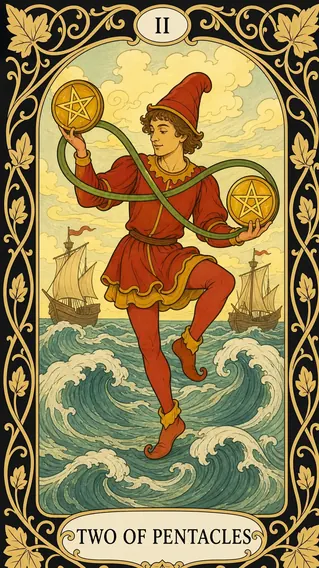
Both cards are about balance, but of a different nature. Swords are the element of air, intellect, and decisions: the Two of Swords is about an emotional pause and a reluctance to choose between two options. Pentacles are the element of earth, practice, and resources: the Two of Pentacles is about juggling tasks and money when there is too much going on, but you are managing to cope. If the reading is about a difficult choice or avoiding the truth, it is about Swords; if it is about a lack of time and money while trying to keep up with several tasks at once, it is about Pentacles.
Is the Two of Swords a yes or a no?
More likely no, or more precisely—not yet: the card says that a decision has not been made and the question was asked prematurely. If it is about the appropriateness of a pause, the answer is yes; if it is about the outcome of a decision that has long been overdue, you shouldn't drag it out any further.
What does the reversed Two of Swords mean?
The deadlock is resolved: a decision is finally made, or the truth that was being avoided has become apparent on its own. Sometimes this is someone else's choice made for the person by circumstances—it is worth checking if such an outcome is satisfactory.
Can the Two of Swords mean a breakup?
Not as a prediction, but as a description of a state: if a difficult conversation is already brewing in a relationship, the card shows the phase where it is being avoided. It does not say how everything will end—whether people will break up or finally talk things out—that is decided not by the card, but by the conversation that is being postponed within it.