What the Two of Pentacles means in Tarot
Pentacles are the most grounded suit in the deck: they are responsible for money, the body, material objects, and daily life, and their element is Earth. The Two of Pentacles is the second card of the suit, and it no longer has the stillness of the Ace: the spark has become at least two tasks at once, and from this moment on, they must be held together somehow.
An important nuance often lost in retellings: the card describes controlled instability, not chaos. The upright Two of Pentacles is not about everything falling apart, but about the fact that a person has already learned to keep several balls in the air at once and is managing for now. Work and study, two side jobs, repairs and current bills, taking care of yourself and a loved one — the specific set will be shown by neighboring cards.
This card should be immediately distinguished from a catastrophe: the Minor Arcana speaks of a weekly episode of juggling tasks, not a life-altering breakdown as seen in Major Arcana cards like The Tower. The Two of Pentacles almost never says "too much"; it says "it's working for now, but there is no room for a pause."
Reversed Two of Pentacles: meaning
The reversed Two of Pentacles is the same juggler, but one of the balls is already falling. A spread usually refers to one of three options, and the question itself serves as a hint.
- Balance is lost. There are more tasks than can be managed: something is being postponed, forgotten, or done in a rush.
- Financial confusion. Expenses and income are out of sync, the budget is hard to balance, and you have to patch one thing at the expense of another.
- Fatigue from constant maneuvering. The person has been juggling for a long time and is simply exhausted from holding everything at once, even if nothing has technically fallen yet.
There is a softer interpretation: sometimes the reversed position is a signal that it is time not to hold onto everything, but to honestly set priorities and temporarily give something up. The difference from the upright position is that there, the balance is still being held, while here, it already requires a reassessment.
Two of Pentacles in a "yes or no" spread
In "yes/no" spreads, the Two of Pentacles is one of the few cards where the honest answer is "both yes and no", and this is not an evasion, but its essence: the card is about combining, not about a definitive choice. If the question is "will I be able to handle both tasks at once," the answer is likely yes, but without room for relaxation.
If the question involves choosing one of two options, the Two of Pentacles hints that the decision can be postponed and you can try to hold onto both — at least for a while. It rarely advises acting impulsively.
The reversed position in this spread is read more harshly: "no, not in the current form" — trying to hold onto everything at once is no longer working, and the question should be reformulated not as "will it work out," but as "what can be given up."
Two of Pentacles in relationships and feelings
In a relationship spread, the upright Two of Pentacles usually speaks of a balance between the relationship and the rest of life: work, study, other people, and personal plans. It is not about a lack of feelings, but about a lack of time — the partner has to share attention with tasks that also cannot be abandoned.
In the position of feelings, the card shows a slight duality: the person is not torn between two people in a dramatic sense, but rather is trying to combine the feeling with other obligations without sacrificing either. Relationships at this stage are alive but require flexibility and agreements about time, rather than grand gestures.
The reversed Two of Pentacles in relationships is usually a signal that the balance has shifted: one person is carrying more than they can handle, and the relationship begins to suffer not from arguments, but from a simple lack of energy for them.
Two of Pentacles in work and money
In career spreads, the Two of Pentacles describes combining: two jobs, a project and a side gig, full-time employment and a personal initiative in parallel. The card does not judge such multitasking — it simply records it as the current state of affairs that requires organization.
Regarding money, the upright position speaks of an uneven but manageable budget: income and expenses do not arrive synchronously, and money has to be redistributed between categories rather than saved indiscriminately. This is a card about financial flexibility, not about growth or a drop in income — it does not show specific amounts or dates.
The reversed Two of Pentacles in work and money means an overload of commitments or a budget that no longer adds up: expenses are outpacing planning, and there are more work tasks than can be completed on time. The advice of the card in both positions is the same: consolidate your to-do list and expenses in one place instead of keeping them in your head.
Two of Pentacles as a person: man and woman
When the Two of Pentacles appears in the "what kind of person" position, it does not describe the entire character, but the role of a juggler in someone else's life: someone who handles several tasks at once, flexibly adapts to circumstances, and knows how to find time where there formally is none.
The Two of Pentacles man is a person with several projects and side jobs simultaneously, easy-going, but not always punctual precisely because of his workload. The Two of Pentacles woman is someone who combines work, family, and personal affairs and does so seemingly easily, although constant rescheduling of plans lies behind it.
The flip side for both is the same: it is difficult for such a person to take on anything else, even if they really want to — first, they will have to unload what they already have.
Two of Pentacles in the thoughts position
In the thoughts position, the Two of Pentacles represents a mind occupied with juggling: what to do first, what can be postponed, and how to manage everything. It is not anxiety in its pure form, but a constant internal time management that drains energy on its own, even without external problems.
If Swords appear nearby in the spread, this mental juggling can escalate into overwhelming anxiety and sleepless calculations; next to calmer cards, such as Cups, it is more of a functional, non-exhausting process of switching between tasks.
What to do if you draw the Two of Pentacles
The card's advice is practical: do not try to hold everything equally well at the same time — prioritize, don't drop the balls. The Two of Pentacles is not about giving up multitasking, but about preventing it from turning into chaos.
What you should actually do:
- Write down all current tasks and expenses in one place. As long as the list is only in your head, it is impossible to assess the real workload.
- Determine what can be rescheduled. Not everything requires the same speed — some tasks can wait without consequences.
- Build in a buffer of time and money for the unexpected. The card is all about variability, and a safety net makes juggling easier.
- Periodically check your balance instead of relying on memory. What held up yesterday might stop adding up tomorrow.
If the reason for your question is not everyday overload, but serious financial difficulties or burnout from constant multitasking, this reading does not replace a professional consultation: the card shows the state of your balance, not a solution for the person.
What is depicted on the card
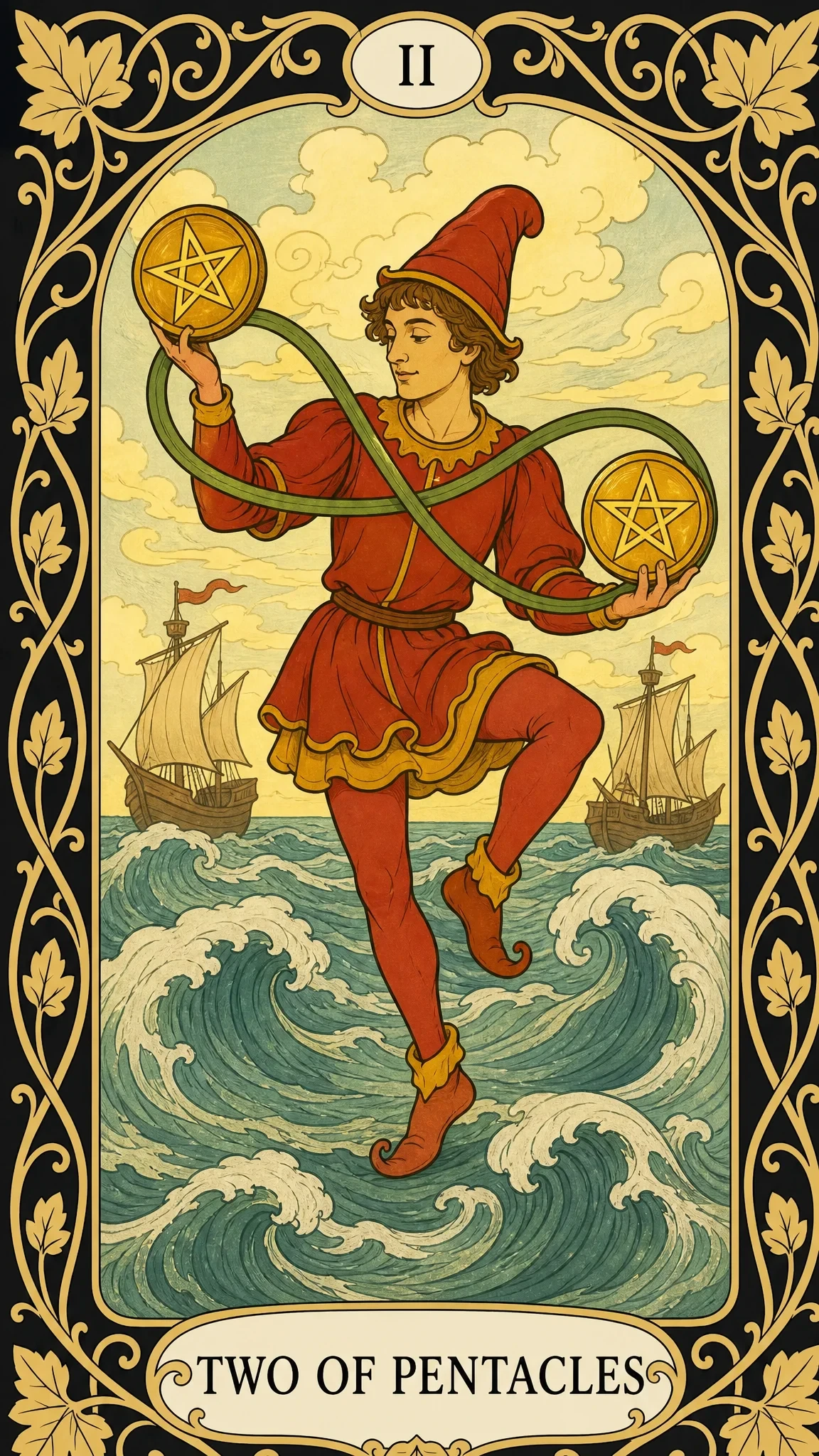
On our card, a young man in a bright red jester's costume with a cap stands on one leg against the backdrop of a turbulent sea. In his hands, he holds two golden pentacles with a five-pointed star inside, connected by a green ribbon that curves between them in the shape of an infinity sign. Behind him, two sailing ships rock on high waves.
This scene is interpreted as follows:
- The one-legged pose — not a loss of balance, but a demonstration of it: balance is maintained in motion, not in stillness, and that is how it should be understood in this card.
- The infinity-shaped ribbon between the pentacles — both tasks are interconnected and flow into each other in a cycle, rather than existing separately: attention constantly flows from one to the other.
- The stormy sea and rocking ships — changing external circumstances that cannot be influenced but must be taken into account when planning.
- The jester's outfit — the lightness and artistry with which the juggler maintains balance: from the outside, it looks like a game, although it requires constant concentration.
At the top of the card is the Roman numeral II, and at the bottom is a plaque with the English name TWO OF PENTACLES: the deck is drawn in the Rider-Waite tradition, where this scene with the juggler and the stormy sea is one of the most recognizable cards of the suit of Pentacles.
Two of Pentacles as the card of the day
As the card of the day, the Two of Pentacles is a warning that the day will be busy: several things at once, switching between tasks, and the need to prioritize on the fly. This is not a bad sign in itself — it's just a day not for one big task, but for several medium ones.
A useful mindset for such a day is to decide in advance what exactly needs to be done and what can be postponed, and not to start anything new until at least part of the current work is finished. If the card is drawn reversed, be especially careful with deadlines and money: this is the kind of day where it is easy to overlook something.
Frequently asked questions about the Two of Pentacles
Is it a Major or Minor Arcana?
Minor Arcana, suit of Pentacles, element of Earth. There are 56 Minor Arcana cards in the Tarot deck in total — 14 cards for each of the four suits, and the Two of Pentacles follows the Ace, opening the theme of combining several tasks.
How does the Two of Pentacles differ from the Two of Wands?
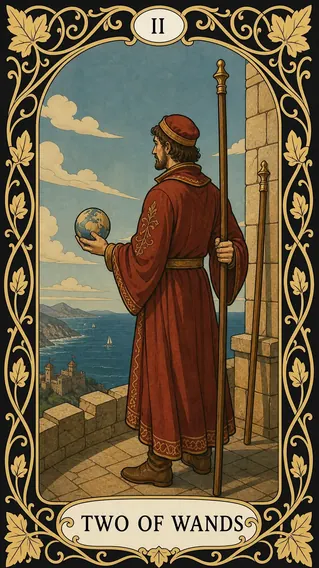
Both twos are about choice and combination, but of a different nature. Pentacles are the element of earth, practice, and everyday life: the Two of Pentacles is about juggling current tasks and money here and now. Wands are the element of fire, will, and planning: the Two of Wands is about choosing a direction and deciding where to move next. If the reading is about everyday multitasking, it's about Pentacles; if it's about a strategic choice of path, it's about Wands.
Is the Two of Pentacles a yes or a no?
More often both yes and no at the same time: the card is about combination, not a definitive choice. If the question is whether you will manage to hold both tasks at once, the answer is likely yes, but without the right to relax. The reversed position is read more harshly — as "no, not in its current form."
What does the reversed Two of Pentacles mean?
The same juggler, but one of the balls is already falling: balance is lost, the budget doesn't add up, or fatigue from constant maneuvering between tasks has accumulated. Sometimes this is not a catastrophe, but a signal to honestly prioritize and temporarily give something up.
Does the Two of Pentacles mean money?
Yes, but as a fluctuating, not growing or falling income: the card is about the fact that income and expenses have to be constantly redistributed, not about a specific amount. It does not show exact figures or dates — only the state of your financial balance.