What the Three of Pentacles means in Tarot
Threes in Tarot are cards of the first visible result: the spark of the Ace and the cautious step of the Two add up to something that is already visible from the outside. In Pentacles, the element of earth and the material world, this looks most concrete: not an idea or a plan, but a piece of work that can be touched and evaluated.
An important nuance that is lost in retellings: The Three of Pentacles is about work that is evaluated by others, not by the worker themselves. There is not one person on the card, but three: skill does not exist in a vacuum; it is confirmed by a client, mentor, or colleague who looks at what has been done and nods. The Minor Arcana does not promise recognition forever — it describes a specific moment when someone's work was noticed and approved.
The upright position is almost always read positively: work is going according to plan, quality is up to par, and there is someone to verify the result with. But this is not yet the completion of the project or payment of the invoice — there is still work ahead, it is just now being done with confirmed trust, rather than alone and by guesswork.
Reversed Three of Pentacles: meaning
The reversed Three of Pentacles is the same work, but without coordination. A spread usually refers to one of three options, and the question itself helps to figure it out.
- The work is done, but it is not valued. There is labor, but no recognition or payment for it.
- The team is not on the same page. Everyone sees the task in their own way, and the result suffers from inconsistency, not laziness.
- Quality is sacrificed for speed. Haste, unfinished work, a desire to close the issue faster than the craft allows.
There is also a calmer reading: sometimes the reversed card simply means solo work without co-authors — not necessarily bad, but work where there is no one to check with. The difference is whether the lack of a team is felt as a problem or as a conscious choice.
Three of Pentacles in a "yes or no" spread
In "yes/no" spreads, the Three of Pentacles is read as yes — but with a caveat: the positive answer relies on coordinated work with someone else, not on acting alone. If the question sounds like "will it work if we do it together," "will my work be appreciated," "should I show the result to a master" — the answer is affirmative.
If the question implies a solo effort without anyone else's participation or opinion, the card answers more reservedly: the mechanism of this card is precisely in checking with others, and without it, the meaning of the answer changes.
The reversed position in this spread is "yes, but not alone": the result is possible if you find someone who will appreciate the work and help verify it, instead of continuing to do everything on your own.
Three of Pentacles in relationships and feelings
In a relationship spread, the upright Three of Pentacles describes a couple or a group of people who are building something concrete together: shared household, renovations, a joint project, raising children — things that require coordinated efforts, not just feelings. The card fits well with a partnership where each other's contribution is valued and tasks are shared.
In the position of feelings, the Three of Pentacles is not about passion, but about respect for how a partner handles their part of the common cause. This is a warm, but not romantic feeling: more like appreciation for a master's work than being in love.
The reversed Three of Pentacles in relationships means partners are pulling the common cause in different directions, or one makes a contribution and the other does not notice it. A useful question for such a situation: are the roles clearly distributed, or is everyone acting according to their own judgment?
Three of Pentacles in work and money
In career spreads, the Three of Pentacles is one of the most favorable cards: a joint project moving according to plan, work under the guidance of someone who can give an honest assessment, the first signs that qualifications have been noticed. It often appears during a period when a person is still learning or growing in their profession but is already showing a solid result.
In money, the card is not about the amount in the account, but about work that will eventually convert into income: an advance for a project, payment by stages, a raise after a probationary period. Neighboring cards will suggest the scale — with the Ten of Pentacles, it is stable earnings; with the Five, it is a period when you still have to fight for the work.
The reversed Three of Pentacles in work means a misunderstanding with the team or client: what has been done does not match expectations because the task was not discussed in advance.
Three of Pentacles as a person: man and woman
When the Three of Pentacles appears in the "what kind of person" position, it describes not the character as a whole, but the role of a master whose work is evaluated by others. This is someone who is growing in their profession before our eyes, who still consults with elders, but is already capable of showing a result that is nothing to be ashamed of.
A Three of Pentacles man is diligent, neat, calmly accepts comments on his work, and knows how to use them. A Three of Pentacles woman is someone who builds joint work without unnecessary arguments and values the opinion of specialists nearby.
This is a person for whom the approval of others is important not out of vanity, but as a way to understand if they are moving in the right direction. Next to cards of senior masters, for example, the Hierophant, such a person most often acts as a student, not an equal.
Three of Pentacles in the thoughts position
In the thoughts position, the Three of Pentacles represents a focus on the quality of one's work and how others will perceive it. The person dwells on the details, mentally checking against what a client or colleague might say, and looking for ways to improve precision.
This is a productive but not entirely calm state: concern for external opinion can either spur better results or turn into constant anxiety about "what if they don't approve?" Next to Pentacles, this thought is practical and task-oriented; next to Swords, it easily slips into excessive self-criticism.
What to do if you draw the Three of Pentacles
The card's advice is simple: don't work alone where you can consult with someone who knows better. The Three of Pentacles is about the benefits of collaboration, not about competing to see who can do it all by themselves.
What you should actually do:
- Show intermediate results to someone whose opinion carries weight. Don't wait until the very end to get feedback.
- Discuss roles before starting work, rather than figuring them out as you go—this eliminates half of future misunderstandings.
- Don't confuse criticism of your work with an assessment of yourself. A remark about the work is not a verdict on the master, but a part of growth.
- Give yourself time to learn. Mastery in this card is still being formed, not fully manifested.
If the question concerns not a project, but a more serious difficulty—in money, health, or relationships—the spread does not replace a specialist's consultation: the card shows the benefit of teamwork, not a solution to a specific problem for the person.
What is depicted on the card
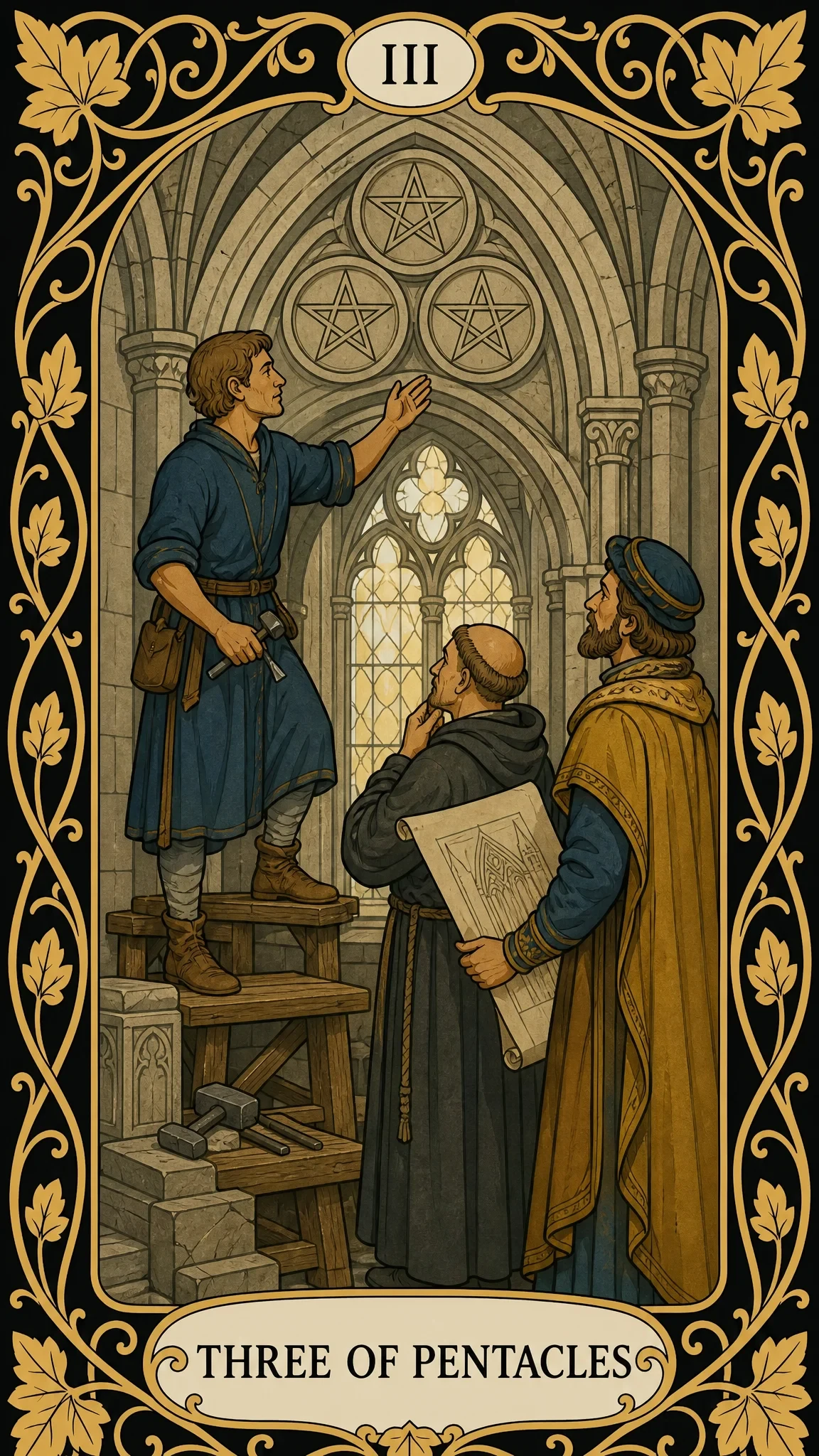
On our card, a young master in blue work clothes stands on wooden scaffolding inside a Gothic cathedral. In one hand, he holds a hammer, with a tool bag on his belt; with his free hand, he points upward to three pentacles carved into the stone vault above a lancet window. Below, at the foot of the scaffolding, two people listen to him: a monk in a dark hood holding a blueprint and a richly dressed man in a golden cloak and beret.
The scene is interpreted as follows:
- Three pentacles in the vault — not coins in hand or a finished reward, but the result of labor built directly into the structure: mastery is visible in what has already been done, not in what is promised.
- Monk with a blueprint — someone who checks the work against the plan: quality control and knowledge of how things should be.
- Richly dressed man — a client or patron whose approval carries weight and often determines whether the work will continue.
- Scaffolding and tools below — the work is not yet finished; the master stands on a temporary support, not on a completed building.
Traditional iconography of the Three of Pentacles usually shows the master inside a cathedral wall, not on open scaffolding overlooking a stained-glass window—our version makes the Gothic architecture more prominent, emphasizing the scale of the task the master has undertaken. At the bottom of the card is a plaque with the Roman numeral III and the English name THREE OF PENTACLES.
Three of Pentacles as the card of the day
As the card of the day, the Three of Pentacles is a good day to show your work to someone whose opinion matters: submit a project, send a draft for review, or ask an experienced colleague for advice. The day is better suited for checking and feedback than for a solo sprint.
If the card appears reversed, it is worth clarifying expectations in advance with those you will be working with to avoid redoing work due to misunderstandings.
Frequently asked questions about the Three of Pentacles card
Is it a Major or Minor Arcana?
Minor Arcana, suit of Pentacles, element of Earth. There are 56 Minor Arcana cards in a Tarot deck—14 cards for each of the four suits, and the Three of Pentacles is the third in the suit of pentacles.
How does the Three of Pentacles differ from the Three of Cups?
Both cards are about three participants and a first noticeable result, but of a different nature. Pentacles are the element of earth, material labor: the Three of Pentacles is about mastery confirmed by a client or mentor. Cups are the element of water, feelings: the Three of Cups is about joy and friendly intimacy shared with others. If the spread is about work or professional recognition, it's about pentacles; if it's about a celebration and emotional support from a group, it's about cups.
Is the Three of Pentacles a yes or no?
Likely yes, if it concerns teamwork: the card promises that your work will be noticed and appreciated if there is someone to check it with. If the question is about a result achieved alone, without outside participation or opinion, the card's answer is not as clear-cut—the mechanism of the Three of Pentacles is precisely in checking with others.
What does the reversed Three of Pentacles mean?
The same work, but without coordination: the work is not valued, the team disagrees, or quality is sacrificed for speed. Sometimes it is simply working alone without co-authors—not necessarily bad, but a situation where there is no one to consult with.
Does the Three of Pentacles mean money?
Indirectly—as labor that eventually converts into income: an advance for a stage of work, payment upon completion, or a raise after a probationary period. The card does not show a ready-made large sum; for that, you should look at the higher pentacle cards, such as the Ten.