What does the Hierophant mean in Tarot
The upright Hierophant represents a situation where a proven method works. Don't reinvent the wheel; do as is customary: go study, consult a specialist, follow official procedures.
An important nuance often lost in retellings: The Hierophant is not about faith, but about passing on experience. The religious imagery on the card is just one form; in spreads, it much more often signifies a teacher, mentor, institution, or rule that exists for a reason.
The second side of the card is belonging. The Hierophant describes being part of a whole: family, team, profession, or community. Its strength is that you are not alone; its price is that you have to abide by common rules.
Reversed Hierophant: Meaning
The reversed Hierophant is usually read in one of three ways:
- Formality without substance. Rules are followed, but the meaning has long been lost: everything is done just because it's required. This is the most common interpretation.
- Your own path. A person rejects the accepted way and goes against tradition — sometimes with good reason, in which case the card is favorable.
- A bad mentor. Someone who teaches the wrong things; an authority figure who turned out to be hollow.
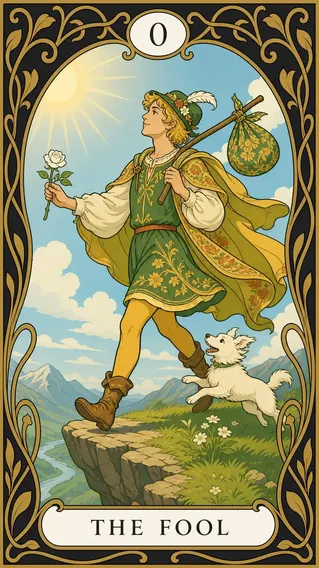
Neighboring cards help clarify: next to the Fool, it's justified rebellion; next to the Devil, it's an abused authority; next to the Eight of Pentacles, it's training that is worth continuing despite the boredom.
The Hierophant in a "yes or no" spread
In "yes/no" spreads, the Hierophant answers yes — through the usual path and within the usual timeframe. No shortcuts: it will turn out exactly as it does for everyone else.
The card answers particularly confidently on questions about education, official registration, marriage, and anything related to institutions. It answers negatively to questions about non-standard solutions.
The reversed Hierophant in a yes/no spread is ambiguous: it says "no" to the usual path, but sometimes "yes, if you do it your own way."
The Hierophant in relationships and feelings
In a relationship spread, the upright Hierophant signifies official relationships or those moving toward official status. Engagement, marriage, meeting the family, public recognition of the couple. This is a card of status and reliability, not passion.
In terms of feelings, the Hierophant describes traditional and calm attachment: the person values loyalty, commitment, and predictability more than excitement.
A frequent theme is relationships judged by others: what will parents say, how it looks, is it considered acceptable. The Hierophant points directly to this.
The reversed Hierophant in relationships is either a marriage that has become a formality or a couple that consciously lives against conventional rules.
The Hierophant in career and money
In career spreads, the Hierophant represents work in an established structure: a large company, a government institution, teaching, or an expert role. It also involves learning and mentorship — both as a student and as a teacher.
Regarding money, the card speaks of stable income according to the rules: salary, contracts, pensions, official payments. There is no quick or non-standard money here.
What the Hierophant advises in a work spread: do as required and ask someone who knows. Its scenarios collapse for people who, on principle, invent their own way where a working procedure has long existed.
The Hierophant as a person: man and woman
In the "what kind of person" position, the Hierophant describes a mentor or a keeper of rules. They know what is customary and explain it to others; people turn to them for advice and validation.
A male Hierophant in a spread is a teacher, a senior colleague, or a person of status and principles. A female Hierophant is someone who preserves the order and passes it on; often the eldest in the family or profession.
The weakness of such people is difficulty with exceptions. They usually do not approve of anything that does not fit into the order they know, even when it works.
The Hierophant in the thoughts position
In the thoughts position, The Hierophant represents reflection on doing things the right way. A person checks: what is customary, what will people say, what does the experience of elders suggest, and does their choice align with their own principles.
This also includes the need for advice — the desire to hear from someone authoritative that a decision is correct. Neighbors clarify: next to the Two of Swords, it is a reluctance to take responsibility; next to the Hermit, it is an honest search for guidance.
What to do if you draw The Hierophant
The Hierophant's advice is to use a proven method. Don't reinvent the wheel; find out how it's done and do the same.
What you should actually do:
- Ask someone who has been there. A mentor in this card is a direct tool, not a sign of weakness.
- Make it official. Anything that can be put into a document is better off being documented when The Hierophant appears.
- Go study. A course, a specialist, literature — the card favors systematic learning.
- Check if the rule is still alive. The only trap of The Hierophant is following something that has long lost its meaning.
And separately: if a rule is frankly harmful to you, the card does not require you to obey. It requires you to understand why the rule exists — and then decide consciously.
What is depicted on the card
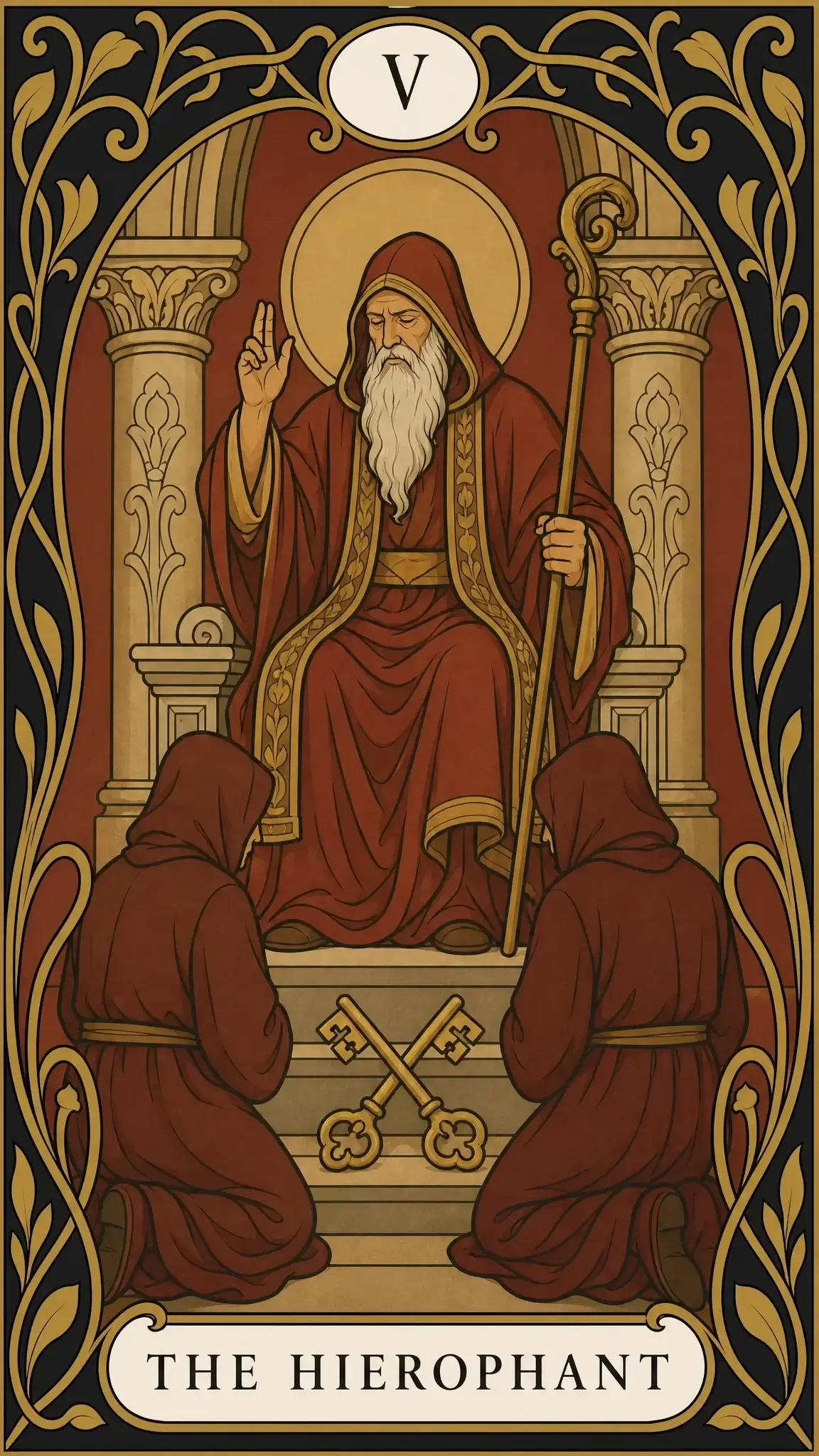
On our Hierophant, there is a figure in red robes on a throne between two pillars, the right hand raised in a gesture of blessing, and a staff in the left. Below are two hooded listeners, with crossed keys at their feet.
The scene is read as follows:
- Two people below — students. The Hierophant is never alone: the card is about transmission, not solitary knowledge.
- Crossed keys — access to what is closed to the uninitiated. Knowledge here is not secret, but it is not public either: it must be obtained according to the rules.
- Two pillars — the same frame as the High Priestess. She has a secret behind the pillars; he has a charter.
- Raised hand — a blessing and at the same time permission: he is the one who approves.
Above is the Roman numeral V, below is the English name THE HIEROPHANT: our deck is drawn in the Rider-Waite tradition, where The Hierophant is the fifth arcanum.
The Hierophant as the card of the day
The Hierophant as the card of the day means a day that will go according to plan. Nothing unusual, but everything is predictable; dealings with institutions, documents, or education are likely.
A useful mindset: do not invent anything and do not argue with procedures — today they work faster than workarounds. A good day for consultations, study, and paperwork, and a bad one for experiments.
Frequently asked questions about The Hierophant card
What does The Hierophant mean in Tarot?
Tradition, a proven method, and the transmission of experience: learning, mentoring, official registration, accepted rules. The religious image on the card is just one form; in spreads, it is more often about institutions and teachers.
Does The Hierophant mean a wedding?
In relationship spreads, it often points to the official side: engagement, marriage, or the couple's recognition by others. But it does not guarantee the event itself — conclusions are drawn based on the combination of cards.
What does a reversed Hierophant mean?
A formality that has lost its meaning, a bad mentor, or a conscious refusal to follow the generally accepted path. The latter interpretation can be favorable — for example, next to The Fool, it is a justified step outside the box.
How is The Hierophant different from The Emperor?
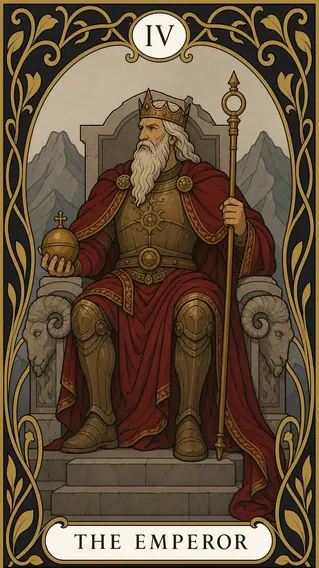
The Emperor sets rules by his own will and is responsible for the result. The Hierophant does not invent rules — he preserves and transmits them. One relies on power, the other on tradition.
Which arcanum number is this?
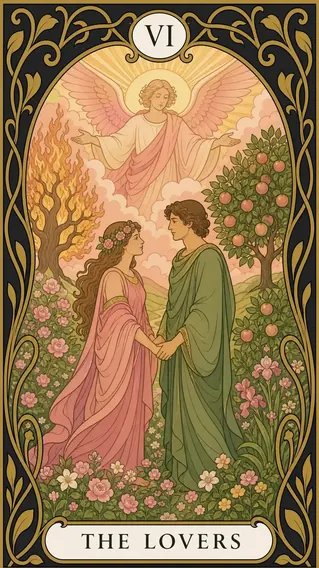
The fifth major arcanum, with the Roman numeral V on the card. In the Rider-Waite deck, which our deck is based on, The Hierophant comes after The Emperor (IV) and before The Lovers (VI).