What the Four of Pentacles means in Tarot
Fours in Tarot are cards about structure and what happens to what has been achieved when it needs to be secured: the Four of Wands celebrates success, the Four of Cups describes emotional satiety, and the Four of Swords describes a forced pause. The Four of Pentacles secures what has been achieved in the most tangible sense: money, property, status, the habitual order of life — and it does so more firmly than any other four.
An important nuance often lost in retellings: frugality and greed are not the same thing, although the card is almost always interpreted as greed. The difference lies in the motive. A frugal person saves because they remember what it is like to be without a reserve; a greedy person wants more even when they have enough. The Four of Pentacles more often describes the former: not an appetite for more, but a fear of being left without support again. In itself, this is not a vice — the question is whether caution is turning into a prison you don't want to leave, even when the threat has long since passed.
And, as with any minor arcana, this is not about destiny as a whole, but about a specific segment: a week when you don't want to spend extra, a conversation about a budget, a decision not to share what has been hard-earned. Neighboring cards will show whether this caution is justified by circumstances or is already hindering your life.
Reversed Four of Pentacles: meaning
The reversed Four of Pentacles loosens the grip, but not always voluntarily and not always for the better. The meaning is chosen by the question of the spread.
- The grip loosened against one's will. Money or things leave against your desire: an unplanned expense, a forced change in the budget, or something that was being saved suddenly needs to be given away or spent.
- Caution taken to the limit. The opposite option: control does not let go, but intensifies — saving becomes not reasonable, but anxious; a person is afraid to spend even on necessities.
- The grip is released consciously. The rarest but occurring reading: a decision to stop keeping everything to yourself — to share, invest, trust, and for the first time in a long time, not count every penny.
Neighboring cards help distinguish these options: next to anxious Swords, it is more likely an intensification of control; next to the Star or the Ten of Cups, it is more likely a conscious release.
The Four of Pentacles in a "yes or no" spread
In "yes/no" spreads, the Four of Pentacles is most often read as no — but specifically as "not now and not through movement": the card describes retention, not action, so it answers questions about change, risk, or new investments with a restrained refusal.
The answer changes if the question is phrased differently. "Will what I have be preserved?" — here the Four answers yes, and more confidently than many other cards: it is specifically about preservation, not growth.
The reversed position in this spread is read as "no, and it will become harder to hold on": either the resource will have to be given away against your will, or the effort to keep everything as it is will become noticeably heavier.
The Four of Pentacles in relationships and feelings
In a relationship spread, the upright Four of Pentacles describes not emotional coldness, but a reluctance to risk what is already there. A person holds onto the relationship tightly, sometimes too tightly: they are afraid to open up first, share vulnerabilities, or allow changes that might shake the established order.
In the position of feelings, the card often points to caution instead of warmth: the feelings are there, but there is a fear of showing them in full force — what if it is used or devalued? Again, it is important not to confuse this with stinginess of character: it is more often a consequence of past experience where openness came at a high price.
For one person in a couple, the Four of Pentacles may mean a desire to control the dynamics: who contributes how much, who makes concessions first. This is not a love of power, but an attempt not to end up without support again if something goes wrong.
The reversed position is either the grip loosening and a readiness to trust appearing, or, conversely, control turning into jealousy and a reluctance to let the partner go even in small things.
The Four of Pentacles in work and money
In career spreads, the Four of Pentacles is a stable but inflexible position: holding onto the current job, not agreeing to the risk of changing jobs, avoiding projects with uncertain results. Often this is a justified strategy in an unstable period, but sometimes it is a missed opportunity because any movement begins to seem like a threat.
In money, the card speaks of accumulation and expense control, not a specific amount or deadline: the desire to save, not spend extra, and have a reserve for a rainy day. This is a state, not a forecast — the Four of Pentacles does not show how much will be accumulated and when, only the mode of frugality itself.
The advice of the card in money and work is one: it is useful to ask yourself, is saving now a reasonable preparation or a way to avoid facing a larger decision that has long been overdue?
The Four of Pentacles as a person: man and woman
When the Four of Pentacles appears in the "what kind of person" position, it describes someone who keeps resources to themselves: not necessarily stingy, but cautious to the limit — they count carefully, do not like to share what they have worked hard for, and are wary of others' requests for help.
The Four of Pentacles man is reliable but closed off: he keeps his word and money under control, does not like spontaneous spending or risky partnerships. The Four of Pentacles woman is someone who has built her own stability and protects it, sometimes too zealously.
This is not a description of a greedy person, but rather someone who was once left without support and has not wanted a repeat since. Neighboring cards will show whether this person is ultimately ready to trust and share, or if the grip will remain their main trait.
The Four of Pentacles in the position of thoughts
In the position of thoughts, the Four of Pentacles is an obsessive focus on preservation: thoughts revolve around the budget, property, and how not to lose what has already been achieved. This is a state of anxious bookkeeping, not calm planning.
Next to Pentacles, it is more likely sober calculation; next to Swords, it is anxiety that inflates the risk of loss more than it actually is.
What to do if you draw the Four of Pentacles
The advice of the Four of Pentacles is not to "let everything go" or "hold on tighter" — it is much more specific: check where your grip comes from before loosening or tightening it.
What you should actually do:
- Distinguish between reasonable savings and anxious penny-pinching. The former brings peace of mind, the latter brings constant tension even when you have enough.
- Identify what your holding on is afraid of. Often, it is not greed, but a specific fear: being left without money, support, or control over the situation again.
- Check one thing you are afraid to let go of. You don't have to let it go now — it is enough to honestly see if it is truly under threat.
- Do not confuse frugality with self-punishment. Saving makes sense when it serves a purpose, not when it turns into denying yourself everything.
If the card appears in the context of real financial hardship, debt, or anxiety that interferes with your life, the reading does not replace a consultation with a financial advisor or psychologist: the card describes a state, it does not solve material difficulties.
What is depicted on the card
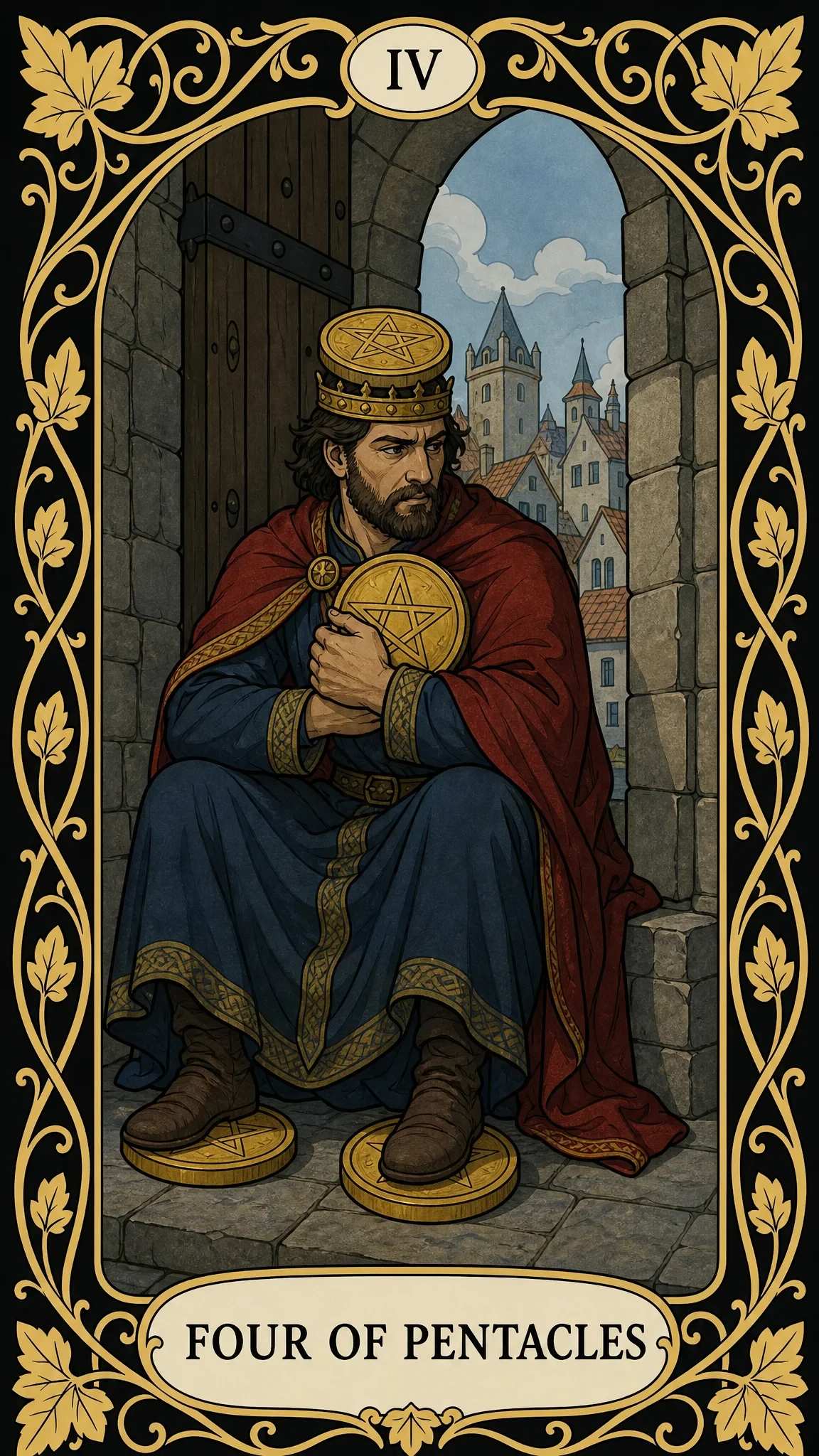
On our card, a man in dark blue robes and a scarlet cloak sits in the stone doorway of a fortress. On his head is a crown with a gold pentacle instead of a gemstone; he holds another pentacle tightly to his chest with both hands, and two more lie under his feet — he is literally standing on them.
Behind him is a tightly locked door with massive black hinges, and beyond the doorway, a city is visible: tiled roofs, stone towers, and the inhabited world outside. The man himself is not looking at this city or the viewer, but to the side, tense and wary.
The scene is interpreted as follows:
- The door behind him is bolted shut — he has walled himself off from the world left outside; he keeps everything he needs with him, inside.
- The pentacle on the crown — control has become part of his self-image: not just "I have money," but "I am the one who keeps everything under control."
- The pentacle pressed to his chest — the most personal and vulnerable of his possessions, the one he least wants to risk.
- Two pentacles under his feet — the foundation on which the whole structure stands; the man literally will not move an inch so as not to disturb it.
The cityscape in the distance is life continuing outside, while the hero of the card remains in the doorway between home and the street, unable to decide whether to let something new in or to step out himself.
The Four of Pentacles as the card of the day
The Four of Pentacles as the card of the day is a signal to slow down on major expenses and not give in to the urge to make sudden changes in your finances or property. The day is better suited for tidying up what you already have than for risking something new.
If the day feels particularly anxious due to money, it is worth distinguishing between justified caution and panic: it is useful to look at the numbers honestly once, rather than avoiding them. The Four of Pentacles describes the desire to maintain control, but it does not show whether the cause for anxiety is justified — this should be checked with facts, not feelings.
Frequently asked questions about the Four of Pentacles
Is it a Major or Minor Arcana?
Minor Arcana, suit of Pentacles, element of Earth. There are 56 Minor Arcana cards in the Tarot deck — 14 cards for each of the four suits, and the Four of Pentacles is the fourth card of the pentacles suit.
How is the Four of Pentacles different from the Four of Wands?
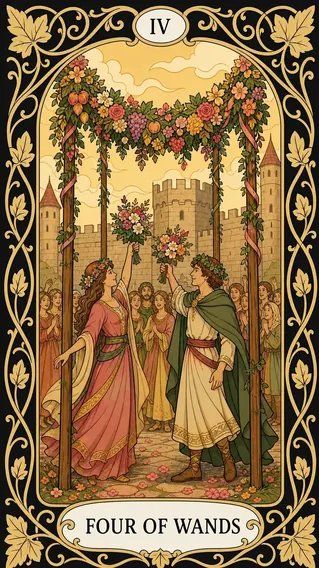
Both cards are about stability, but of different kinds. Wands are the element of fire: the Four of Wands is about the joy of achievement, a stability you want to celebrate with others. Pentacles are the element of earth: the Four of Pentacles is about holding onto what you have achieved alone, without celebration or a desire to share. If the joy of the result is important in the reading, it is more about Wands; if the anxiety about preservation is, it is about Pentacles.
Is the Four of Pentacles a yes or no?
Usually no: the card is about maintaining the current position, not about moving forward. If the question is "will what I have be preserved?" — the answer is yes; if you are asking about changes or new investments — it is likely negative.
What does the reversed Four of Pentacles mean?
Your grip changes: it either loosens against your will — money or resources are slipping away — or, conversely, it intensifies into anxious control. Less often, it is a conscious decision to let go and finally trust someone. Neighboring cards help to figure it out.
Is the Four of Pentacles about greed?
Not exactly. The card more often speaks of the fear of being left without support again, rather than the desire to get even more when you already have enough. Frugality out of caution and greed out of insatiability look similar on the outside, but these are different states, and this distinction should be taken into account when interpreting.