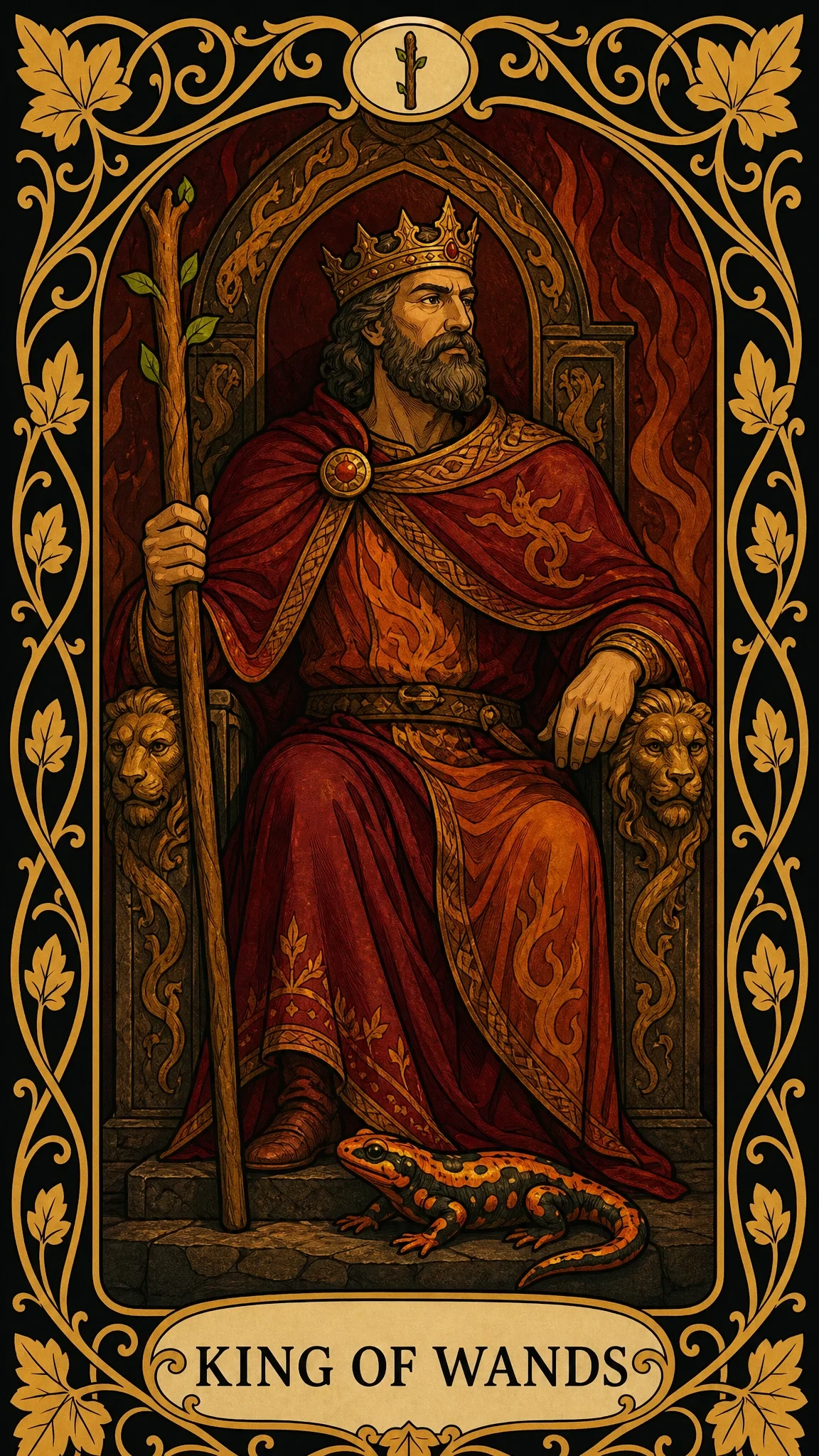
What the King of Wands means in Tarot
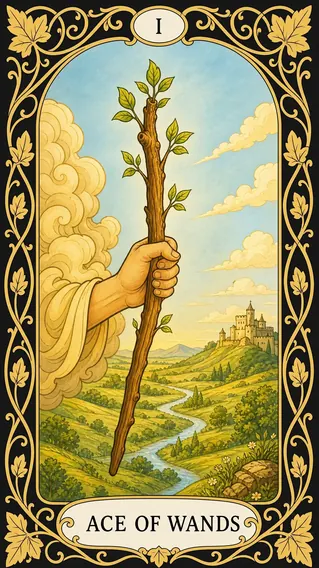
The King of Wands completes the court cards of the Wands suit: after the Ace of intent and the entire journey of the cards, a figure arrives who brings what was started to a result. If the Queen of Wands holds the fire for the pleasure of the burning itself, the King uses it as a tool—igniting a project, conversation, or team and not letting go until things start moving.
An important caveat for the minor arcana: this card is not about fate or a lifelong character trait, but about a specific episode—negotiations, a decision, or a week where you need to take responsibility and lead. It doesn't make grand conclusions about a person; it simply shows that a mode of confident leadership is available right now—the question is whether it will be used.
In the upright position, the King of Wands signifies confidence that needs no proof, a readiness to take charge, and a natural ability to inspire people to move. The flip side is not immediately apparent: the same fire that ignites others can, when overheated, turn into intolerance for others' pace and objections.
Reversed King of Wands: meaning
The reversed King of Wands is the same character, but without balance. Usually, the card is read in one of three directions, and the context of the spread helps to choose.
- Power without listening. Decisions are made alone, objections are perceived as sabotage, and the tone becomes sharper than the situation requires.
- Performative confidence. The person displays force, behind which there is actually insecurity and a fear of appearing weak.
- Leader burnout. The fire that has been carrying everything for a long time begins to fade—irritability instead of decisiveness, breakdowns instead of inspiration.
There is also a milder version: the leadership skills are there, but the person is not yet risking using them—they keep the idea to themselves, waiting for a more suitable moment. Neighboring cards will suggest which of the options is closer to the essence of the question.
King of Wands in a "yes or no" spread
In "yes/no" spreads, the King of Wands usually means yes, if you act decisively and without looking for others' approval. The card is not about a lucky turn of events, but about the fact that the result depends on the courage of the querent themselves—don't wait for the outside world to agree, you will have to create it yourself.
The answer becomes cautious if the question is about patience, compromise, or a joint decision: here, the King of Wands is more about a monologue than a dialogue, and it doesn't pair well with someone else's pace.
The reversed position in this spread is read as "yes, but not now": the determination is there, but it is being spent in the wrong direction—on stubbornness or performative pressure rather than on the task itself.
King of Wands in relationships and feelings
In a relationship spread, the King of Wands describes a partner with whom things are never dull: they take the initiative, invite you on a trip the day after tomorrow rather than "sometime," speak openly about their feelings, and expect the same in return. A steady, quiet feeling is not what this card is about; here, it is more about strong attraction and clear leadership within the couple.
In the position of feelings, the King of Wands is confidence in one's choice that does not need constant confirmation. A person with this card in the feelings position is more likely to decide for themselves that the relationship is important than to ask for permission to feel it.
The flip side manifests when there is too much fire: the partner gets used to deciding for both, and the opinion of the other half is perceived as a formality. The reversed card in this position often speaks of jealousy due to wounded pride—not because there is a serious reason, but because their ego was bruised.
King of Wands in work and money
In career spreads, this is one of the strongest cards for one's own business, a leadership role, or launching a new direction. The King of Wands describes well the moment when it is time not to wait for an appointment, but to take responsibility yourself: propose your project, lead negotiations, or take an initiative that was previously postponed.
Regarding money, the card speaks not of accumulation, but of earning through a bold decision: a new client found by yourself, a direction launched ahead of competitors, or betting on yourself instead of a stable but cramped position. Next to the Ace of Pentacles, it is a confident start; next to the Five of Swords, it is a risk into which more passion than calculation was invested.
Advice from the card in a work spread: trust yourself with a decision that has long been postponed precisely out of caution, rather than because of real obstacles.
King of Wands as a person: man and woman
When the card appears in the "what kind of person" position, it describes not the gender, but the role in the situation—a confident leader who takes responsibility and leads others. The gender of this person is decided by neighboring cards and the context of the question, not by the grammatical gender of the name.
The King of Wands man is usually an entrepreneur, manager, or mentor to whom people go for a solution, not for sympathy: he is direct, charismatic, and not afraid of risk, but handles it poorly when his initiative is challenged.
The King of Wands woman is the same role without any "softer" adjustments: she heads the project herself, makes decisions herself, and does not ask for permission to be bold. In a spread, this is often the figure of a mentor or boss with a direct, energetic leadership style.
In any case, this is a person around whom circumstances change faster because they do not wait for a convenient moment, but create it themselves.
King of Wands in the thoughts position
In the thoughts position, the King of Wands represents a readiness to act that has already formed but has not yet been translated into action. The person has mentally made a decision and is thinking through how to announce it, who to tell first, and where to start.
Sometimes this is healthy determination that just lacks a trigger. Sometimes it is irritation looking for an outlet in the form of a sharp action rather than a measured step. Adjacent cards will reveal the difference: next to Swords, the thought is more impatient and prickly; next to the Star or the Sun, it is confident and creative.
What to do if you draw the King of Wands
The card's direct advice: take the initiative that you have been putting off precisely out of caution. The King of Wands rarely appears when there is truly nothing to offer—more often, he appears when there is something to offer, but there is a lack of resolve to voice it first.
What you should do in practice:
- State the decision out loud. As long as an idea stays in your head, it doesn't move; once spoken aloud, it is already half-done.
- Take responsibility for the outcome, not just the idea. A leadership role is not just the right to decide, but the willingness to answer for the result.
- Check your tone. Confidence easily turns into sharpness—it is worth asking the other person once if it sounds like an order instead of a suggestion.
- Do not confuse courage with excitement. The decision is made for the sake of the result, not for the feeling of risk itself.
If the question concerns a serious breakup, resignation, or a large sum of money, the spread describes the mindset, not a guaranteed outcome; the decision and its consequences remain with the person.
What is depicted on the card
On our card, the King of Wands sits on a throne with carved lion heads on the armrests—the lion here is not a decoration, but a direct symbol of the fire element and open, unmasked power. A crown with a crimson stone, dark orange and red robes with a pattern of flames, and behind his back, instead of the usual landscape, are stylized waves of fire.
You can read this scene as follows:
- Lion armrests—power that does not hide and does not apologize for itself; a classic attribute of the fiery court.
- Staff with green sprouts—the same wand that the Page and Knight of this suit had, but here it is no longer just a weapon or a travel tool: living shoots are breaking through the dry wood—the suit's intent has grown into a result.
- Salamander by the throne—a creature that, according to legend, lives in fire without burning. This is a direct sign of the card's element and a hint that the King feels at home in tension and risk, rather than enduring them out of necessity.
- Flames in the background instead of the sky—unlike the Page and Knight of Wands, who are usually drawn on the road in an open landscape, the King is no longer wandering: the element around him has become the backdrop of his own power.
At the top of the card is an oval medallion with the wand symbol, and at the bottom is the label KING OF WANDS: our deck is drawn in the Rider-Waite tradition, where this card completes the court cards of the Wands suit.
The King of Wands as the card of the day
The King of Wands as the card of the day is a signal to take a leading role rather than waiting for it to be offered: lead a meeting, be the first to propose a solution, or take the floor where others usually go second.
A useful mindset for such a day: act boldly, but check your tone before speaking—confidence is easily read on this day, but sharpness can be interpreted as rudeness. It is a good day for initiative, negotiations, and launching things that have long been delayed out of caution.
Frequently asked questions about the King of Wands card
Is this a Major or Minor Arcana?
Minor. The King of Wands belongs to the Wands suit, element Fire. There are 56 Minor Arcana in the deck—14 cards in each of the four suits, and the King is the highest court card of his suit.
How does the King of Wands differ from the King of Cups?
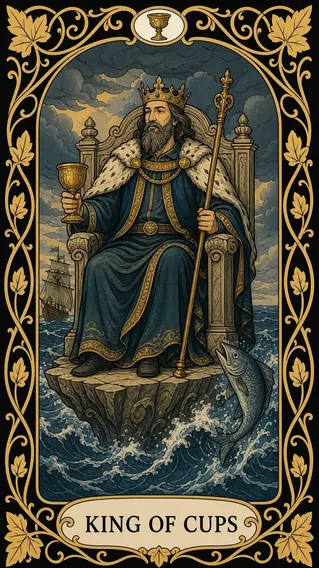
Both kings are about mature power and the ability to see things through, but they act differently. The King of Wands leads through drive, risk, and open initiative; his element is Fire. The King of Cups leads through calmness, empathy, and the ability to smooth over conflict; his element is Water. One ignites the team, the other sustains it.
Is the King of Wands in a spread about a specific person or a character trait?
It can be both—the position in the spread clarifies it. In the "who is this person" position, the card describes a specific confident leader near you. In the advice or thoughts position, it is more of a behavioral mode available to anyone: taking the initiative and leading others.
What does the reversed King of Wands mean?
The same character without balance: decisions are made without considering others' opinions, drive turns into pressure, and sometimes performative confidence masks burnout or self-doubt. The card is read most negatively where leadership replaces dialogue with its complete absence.
Is the King of Wands a "yes" or "no"?
More likely "yes," but with a condition: the result depends on the querent's own resolve, not on a lucky turn of events. If the question requires patience, compromise, or the agreement of others, the card does not answer as confidently.