What does The Fool mean in Tarot
The upright Fool is the starting point where nothing is decided yet. A new job, moving, meeting someone, an idea you haven't told anyone about yet. There is no experience, no plan, and that is exactly why everything is possible.
An important nuance often lost in retellings: The Fool is not reckless, he is free. He has no obligations, reputation, or investments—things other arcana risk. He can afford a step that others would consider unreasonable because he truly has almost nothing to lose.
The second side of the card is trust. The Fool doesn't go because he has calculated the route, but because he believes the road will carry him. In spreads, this is often the most accurate description of a state before a big decision—when it is scary, unclear, and you still want to do it.
Reversed Fool: meaning
The reversed Fool is usually read in one of three ways:
- Fear of starting. A person stands at the same line and doesn't take the step; there is freedom, but no resolve. The most common scenario.
- Recklessness. The step is taken, but where there was something to lose: the card turns into a warning about the cost.
- Avoiding responsibility. Less common: "starting over" is used as a way to avoid dealing with what has already been started.
Neighboring cards help to choose: next to the Two of Swords—stuck on the threshold, next to the Tower—a leap that will be regretted, next to the Eight of Cups—a justified departure.
The Fool in a "yes or no" spread
In "yes/no" spreads, The Fool answers yes—but it is a "yes" without guarantees. You can start, but the card does not report how it will go: it is about the start, not the result.
To questions like "should I take a risk" or "should I try something new," the answer is affirmative. To questions about stability and reliability—negative: The Fool promises nothing for the long term.
The reversed Fool in a yes/no spread is no or "not in this form": either the person will not decide, or the step will be more expensive than it seems.
The Fool in relationships and feelings
In a relationship spread, the upright Fool is the very beginning. Meeting, lightness, interest without obligations; everything is possible and nothing is defined.
In terms of feelings, it is infatuation without depth—for now. Not indifference, but freshness: the person doesn't know yet what this will grow into and isn't trying to decide in advance.
A common separate plot is a relationship where one person is not ready to commit. The Fool is honest here: he doesn't deceive, he just doesn't make promises, and it is pointless to wait for them.
The reversed Fool in relationships is either a fear of intimacy or a frivolity that is already causing pain to the other person.
The Fool in work and money
In career spreads, The Fool is a change of direction, a start from scratch, a transition to a field where a person has no experience. It often appears to those who are leaving an established profession and describes not a risk, but an opportunity.
In money, the card speaks of unpredictability: income is irregular, investments are made without calculation, spending is impulsive. Neighboring cards will show the outcome: with the Ace of Pentacles, it is a successful start; with the Five of Pentacles, it is frivolity that will have to be paid for.
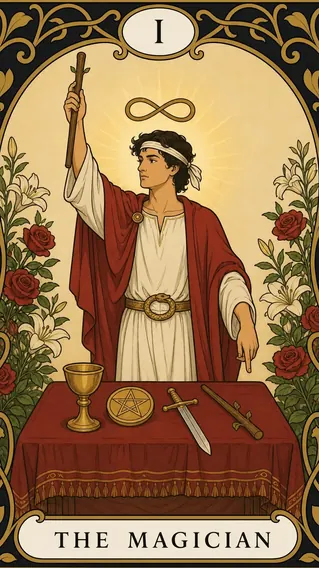
What The Fool advises in a work spread: start without waiting to be ready. His plots die not from mistakes, but from endless preparation—with a full plan, it is no longer The Fool, but The Magician.
The Fool as a person: man and woman
In the "what kind of person" position, The Fool describes someone who cannot be tied to obligations. Not necessarily unreliable—just someone living for today and changing plans easily.
The male Fool in a spread is light, charming, and enthusiastic; it is interesting with him, but impossible to plan anything. The female Fool is someone who does not cling to stability and surprises with decisions that seem rash to others.
This is not a description of irresponsibility. Often, such people simply did not make the promises that are expected of them—and that is their honesty.
The Fool in the thoughts position
In the thoughts position, The Fool is all about "what if." A person considers options they hadn't thought of before: moving away, leaving, starting something new. Thoughts are unstructured but alive.
A typical sign of this card in this position is a lightness that scares the person themselves: they catch themselves ready to drop many things, unsure if it's serious or just a whim. Neighbors clarify: next to the Ace of Wands, it's a real plan; next to the Seven of Cups, it's a fantasy that won't go anywhere.
What to do if you draw The Fool
The Fool's advice is to take the first step without mapping out the entire journey. The card doesn't require courage in a heroic sense; it requires you to stop waiting for total clarity, which won't come.
What you should actually do:
- Make the step manageable. Not "change careers," but "go to one interview."
- Check if there is anything to lose. The Fool is good where the cost of a mistake is low; where it is high, his advice should be applied with caution.
- Don't ask for approval. The themes of this card don't handle validation from others well.
- Leave a way back. The Fool's freedom includes this.
And separately: if the card appears regarding a decision that affects other people—children, family finances, health—apply its lightness carefully. The Fool is not responsible for the consequences, but you are.
What is depicted on the card
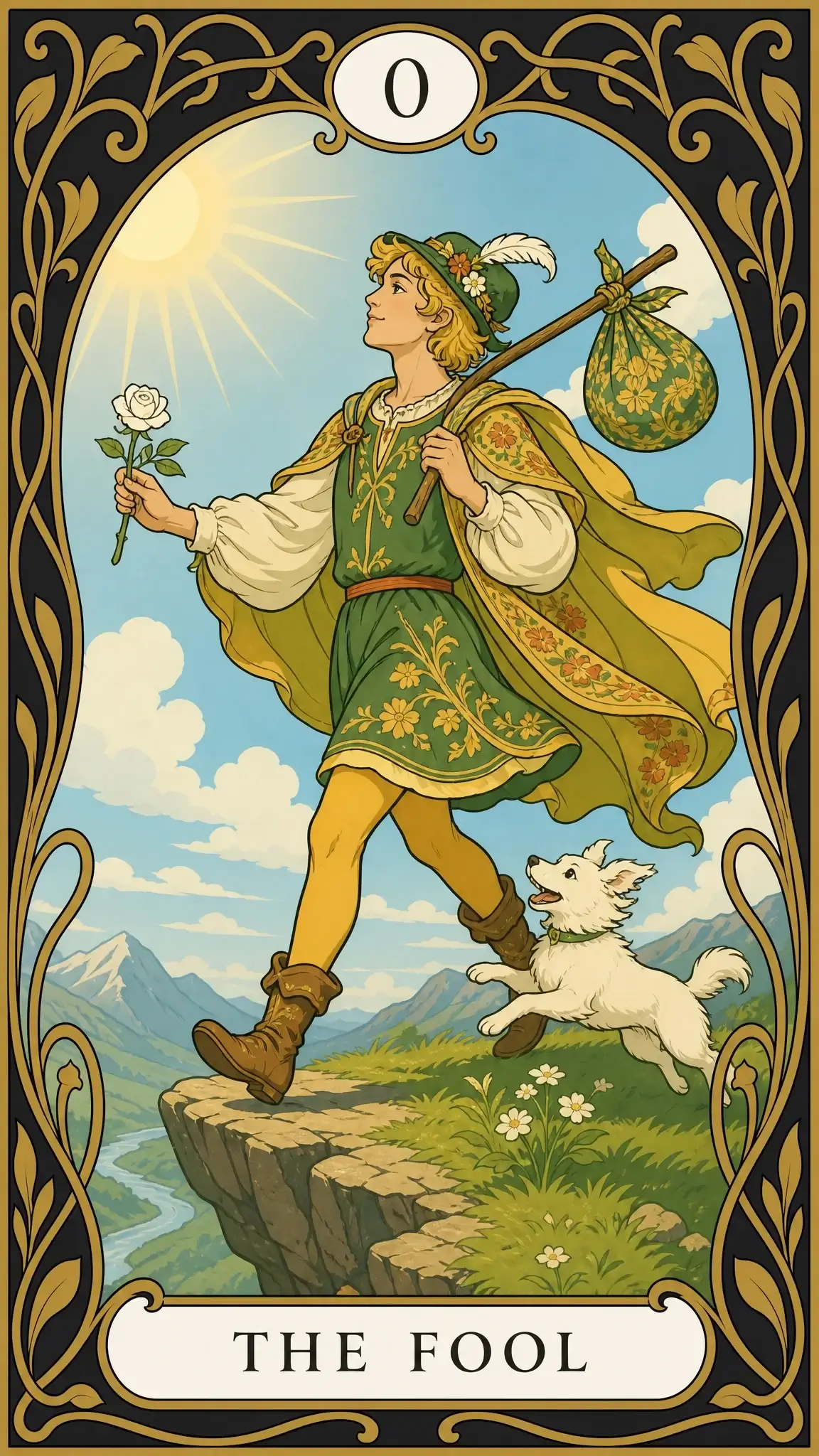
Our Fool is a young man in a green cloak on the edge of a cliff, with a white rose in his hand and a knapsack on a staff over his shoulder. A small white dog jumps at his feet, the sun shines ahead, and mountains are below.
The scene is read as follows:
- The edge of the cliff — the most controversial element of the card: he isn't falling or jumping, he just isn't looking where he's going. There is danger, but no fear.
- The small knapsack — all his luggage. Little experience, but nothing holding him back.
- The white rose — purity of intent: The Fool doesn't act out of calculation.
- The dog — instinct and a warning at the same time; in tradition, it is read both as a companion and as an attempt to stop him.
At the top of the card is 0, at the bottom is the English name THE FOOL. Zero means that The Fool is outside the numbering: he doesn't take a place in the sequence, but opens it—the path of the other arcana is his path.
The Fool as the card of the day
The Fool as the card of the day means a day that is better not planned too tightly. He loves the unplanned: a chance meeting, a spontaneous decision, a trip you didn't think about in the morning.
A useful mindset: leave some breathing room in your schedule and agree to unexpected offers. And don't sign long-term commitments on this day—they won't survive tomorrow's mood.
Frequently asked questions about The Fool card
Is The Fool in Tarot a bad card?
No. It describes beginnings and freedom, not stupidity. The name "The Fool" is misleading: it refers to a person without experience and without the burden of the past, not to an unwise action. The card becomes a warning where the stakes are high.
Why is The Fool numbered 0?
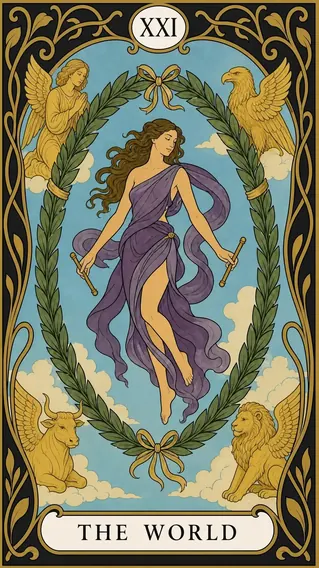
He is outside the sequence: he doesn't take a position between other arcana, but opens the entire sequence. The path from The Magician to The World is traditionally read as the path of The Fool himself. In some decks, he is placed at the end, but more often—at the very beginning.
What does a reversed Fool mean?
Most often, it's the fear of taking a step: the person stands at the same line and doesn't move. Less often, it's recklessness where there was something to lose, or using "starting over" as a way to avoid dealing with what has already begun.
Does The Fool mean the relationship is not serious?
It means they are at the very beginning and nothing is defined yet. This is not a verdict: much of what The Fool describes grows into something more. But this card makes no promises, and you shouldn't expect them from it.
Which arcanum is this?
The zeroth. The card has the number 0 on it. In the Rider-Waite deck, which ours is based on, The Fool opens the Major Arcana and precedes The Magician (I).