What the Page of Wands means in Tarot
The Page of Wands is a Minor Arcana card of the most "fiery" suit in the deck: Wands represent ideas, action, and inner drive, and the Page, in the hierarchy of court cards, is someone just beginning to learn the ropes. On the card, they hold a long staff vertically and look at it from below—not as a tool, but as a curiosity they have just received.
An upright position describes a moment when an idea or offer appears that sparks genuine excitement: a new project, an invitation to try something unfamiliar, or a sudden interest in a topic you hadn't thought about before. An important caveat for a Minor Arcana card: The Page of Wands is not about the future success of this venture or how it will end in a year—it is about the moment of ignition, the spark before serious work begins.
The second layer of meaning is news. In the classical tradition, Wands court cards are often read as messengers: someone brings news, an invitation, or a proposal—verbally, by letter, or by message. The Page is the most inexperienced of the four messengers of the suit, so their news is more of a rumor or an initial proposal than a final decision.
Reversed Page of Wands: meaning
The reversed Page of Wands is the same surge of enthusiasm, but one that either finds no outlet or is implemented clumsily. There are three common interpretations, and the question asked in the spread helps to choose the right one.
- The idea is there, but there are no hands to do it. The person is bursting with plans, telling everyone about them, but never takes the first real step.
- Attention is jumping. Started one thing, got carried away by another, abandoned both—a typical reversed story for this card, where there is plenty of fire but no focus.
- News is delayed or distorted. The messenger is either slow or confuses the details: the answer arrives later than expected or in the wrong form.
The reversed position rarely speaks of bad news as such—it more often points to immature handling of a good impulse: talking about the plan too early, reacting too sharply to initial criticism, or cooling down too quickly.
Page of Wands in a "yes or no" spread
In "yes/no" spreads, the Page of Wands is usually read as yes, but it is too early to celebrate—the card captures a moment of enthusiasm and initial agreement, not a guaranteed outcome. Things have moved off the ground, the interest is sincere, and someone is ready to try—but this is only the beginning, and there is no confirmation yet.
If the question is "should I start," the answer is likely positive: the card supports the first step precisely when the excitement has not yet faded. If the question is about the result ("will it work out," "will I finish it"), the Page honestly warns that they have no way of knowing: they know how to ignite, but not how to bring things to the finish line.
The reversed position in this spread is closer to no, because it is too early: the desire is there, but the readiness, resources, or clarity are currently lacking.
Page of Wands in relationships and feelings
In a relationship spread, an upright Page of Wands is the very beginning of interest: a spark that has not yet grown into anything serious, but is absolutely sincere. A message you want to reply to immediately; a person you think about more often than you planned; a readiness to suggest a meeting without much thought.
In terms of feelings, the card describes not deep attachment, but lively, almost childlike curiosity about another person: wanting to learn, surprise, and try something new together. There is no steadiness or stability here yet—there is excitement, and that is normal for the stage the card shows.
For established relationships, the Page of Wands is a signal to bring back a little playfulness and spontaneity: a planned sudden trip, a new shared activity, or a conversation started for no reason.
The reversed position in this spread is interest that cools as quickly as it flared up, or a message that was meant to be sent but never was.
Page of Wands in work and money
In career spreads, the Page of Wands is an offer to try your hand at something new: a change of direction, an internship, a first project in an unfamiliar field, or an invitation to a meeting from which a collaboration might grow. The card well describes the moment of an interview or a pitch—before a formal answer is received.
In money matters, the Page of Wands rarely speaks of large sums: it is more likely a small income from a new venture, a first order, or the first payment for something you previously did only for yourself. Neighboring cards will show the scale—with the Ace or Ten of Wands, the venture could grow seriously; with the Five, there is a risk that enthusiasm will face competition and you will have to defend your idea.
Practical advice from the card in a work spread: do not be afraid to voice a new idea, but do not count on enthusiasm alone being enough without further work on the details.
Page of Wands as a person: man and woman
The Page of Wands in the "what kind of person" position is not about age, but about character: you are dealing with someone who treats a task as a student, not a master, even if they are formally an adult. Such a person easily gets excited about new things, asks many questions, is not shy about admitting they don't know something yet, and is genuinely happy for any opportunity to try.
A male Page of Wands in a spread is enthusiastic, a bit impatient, and prone to grabbing an idea before thinking through the details; they quickly get bored where everything is already clear and predictable. A female Page of Wands is the one who is the first to suggest trying something unusual, easily infects others with her excitement, but just as easily switches to the next idea.
Both variants share one thing: with such a person, things get moving precisely at the "let's try it" stage, but bringing it to the end or maintaining interest after the first difficulties is not this character's strong suit. This is not a flaw, but a stage: the card describes the beginning of a journey, not mastery.
Page of Wands in the thoughts position
In the thoughts position, the Page of Wands is a head full of new ideas that appear faster than you can process them. You've mentally launched the project, imagined the conversation, and played out the scenario—even though you haven't taken a single step in reality.
This state is productive as a source of options, but it doesn't help much with choosing: too many directions seem equally tempting. Alongside more grounded cards (like Pentacles), you should treat this spark of ideas as a draft rather than a finished plan—selecting one or two thoughts and following through with them is a separate task.
What to do if you draw the Page of Wands
The card's advice is simple and requires exactly what the Page finds most difficult—not losing the spark while you still have it.
- Write down the idea while it's hot. The enthusiasm of this card is short-lived: what seems obvious today might be forgotten in a week.
- Take a small but real step. Not a year-long plan, but one concrete action: send a message, ask a question, sign up for a trial class.
- Don't promise more than you're ready to do now. The Page of Wands easily gets carried away talking about the future—it's safer to talk about what has already been started.
- Don't judge the idea on the first day. The first flash of interest is not an indicator of whether the task will be completed; there are other cards in the deck for that.
Good news: the card itself answers the question "is it worth starting"—yes, it is, while the fire is burning.
What is depicted on the card
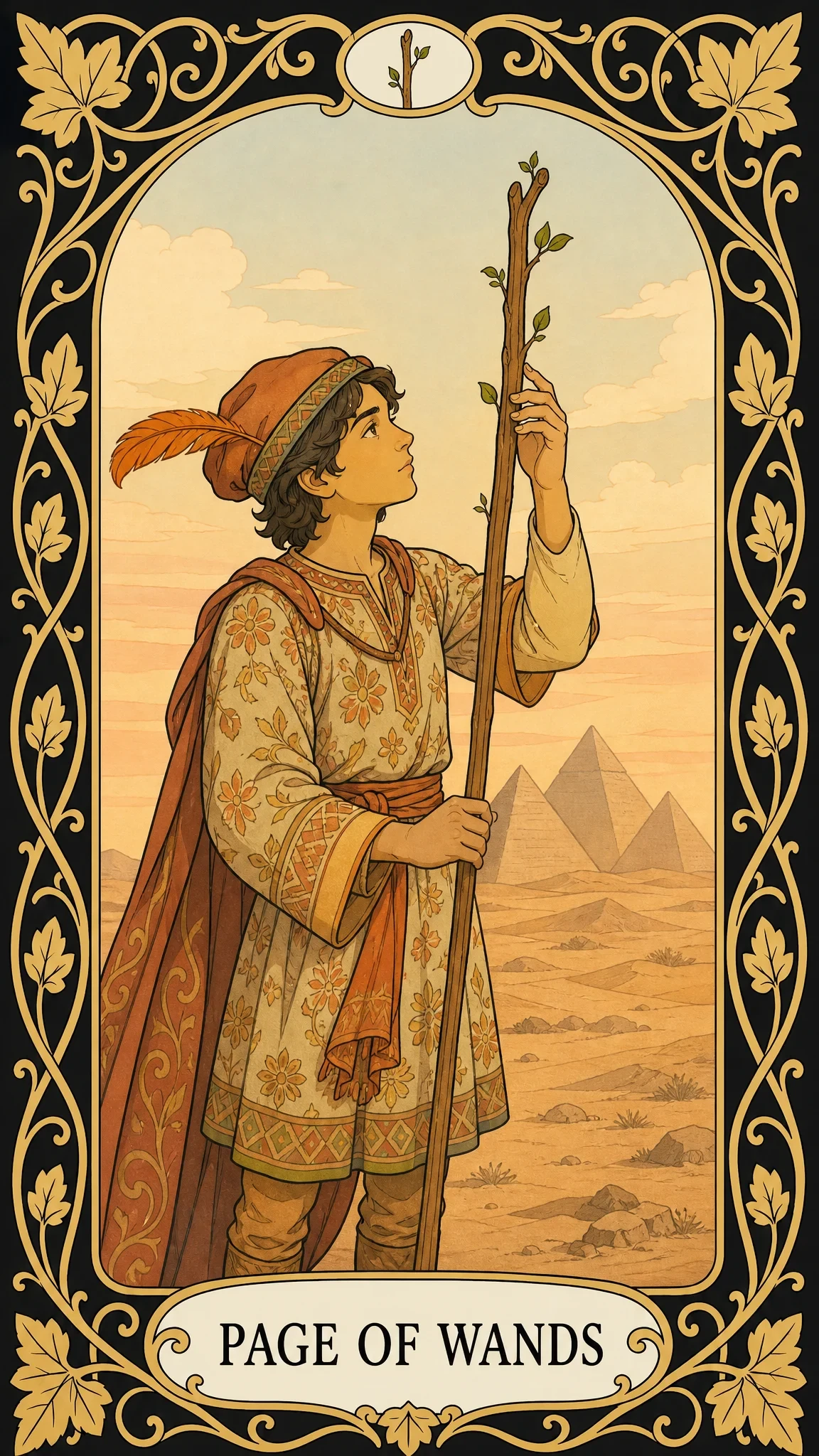
On our card, there is a young page in a patterned brocade tunic with floral ornaments, wearing a hat with a long red feather and a ribbon headband. He stands against a desert backdrop, with the silhouettes of the Giza pyramids in the hazy sunset in the distance. In his raised hand, he holds a long wooden staff with fresh green sprouts and leaves, pointing vertically upward, and looks at it from below with clear curiosity—not like the master of a tool, but like someone who has just discovered something alive in their hands.
Several details are worth reading separately:
- Staff with sprouts — a classic symbol of this card: a wand that is sprouting, not just a stick in hand. It shows that the idea is still alive, growing, and not solidified into a finished plan.
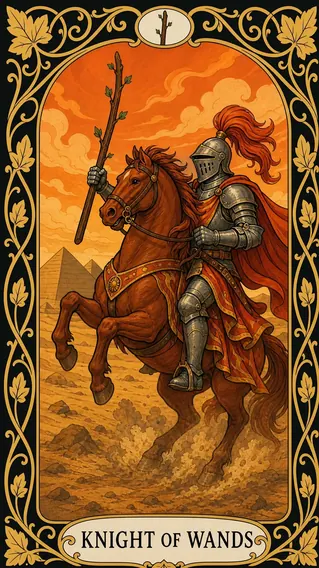
- Looking up, not forward — the page is not looking at the road or the pyramids in the distance, but at his own staff. This is the difference between the Page and the Knight of the same suit: the Knight is already looking at the goal, while the Page is still examining what he has to work with.
- Feather on the hat — a detail that is almost always present in the classic iconography of this card: lightness and flair; the task is approached with enthusiasm rather than calculation.
- Pyramids in the background — a hint at the scale of ambitions: the horizon is vast, but the page is still standing in the foreground, not yet on his way to them.
In the upper medallion of the card, there is no Roman numeral, but the emblem of the suit: the same green sprout on the staff as in the page's hand, so the suit of the court cards is readable at a glance, without a label. Below is the inscription PAGE OF WANDS. The tunic ornament in our deck is floral, rather than the classic salamanders of the Rider-Waite tradition: the focus is on the "sprouting" of an idea rather than a direct symbol of the fire element, but this does not change the meaning of the card.
Page of Wands as the card of the day
The Page of Wands as the card of the day is a good reason to give yourself permission for childlike curiosity: try something you previously lacked the courage for, ask a question that seemed silly, or respond to an offer immediately without weighing all the pros and cons for a week.
Be prepared that today's excitement doesn't have to turn into a permanent commitment—and that's okay. A useful mindset for such a day: allow yourself to get fired up, but don't impulsively promise things you aren't ready for yet.
Frequently asked questions about the Page of Wands card
Is it a Major or Minor Arcana?
Minor Arcana, suit of Wands, element of Fire. There are 56 Minor Arcana in the deck—14 cards for each of the four suits, and the Page is the youngest court card of its suit.
How does the Page of Wands differ from the Page of Cups?
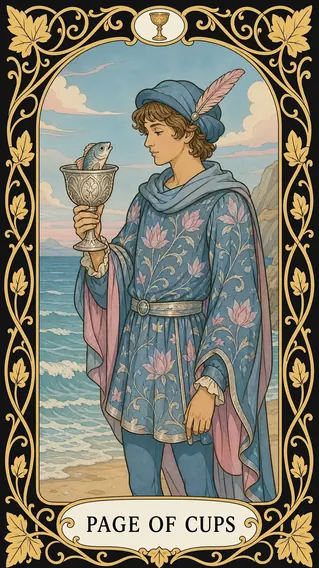
Both cards are the youngest court cards, but the suit changes the subject of interest: the Page of Wands gets fired up by an idea, a task, or a new beginning, while the Page of Cups is moved by feelings, sympathy, or a creative impulse. The first brings news of a deed, the second—news of the heart.
Is the Page of Wands about a child or age?
No, age has nothing to do with it. The card describes a character and a stage: a youthful, student-like approach to a task that a person of any age can have—someone who tries new things with the excitement of a beginner.
What does the reversed Page of Wands mean?
The same surge of enthusiasm that either finds no application or is implemented unsystematically: many words and plans with almost a complete lack of real steps, scattered attention, or news that arrives late.
Is the Page of Wands a good card in a work reading?
Yes, generally positive: it's about the readiness to try something new and an initial interest in a task. But the card does not guarantee a result—it's about the beginning, not about how everything will end.