What the Page of Cups means in Tarot
Pages in Tarot are students of their suit: the youngest, most open, and not yet fully formed representatives. The Page of Cups is about emotions and feelings in their pure, not yet tested form: the element of cups is water, and water in this card does not rage or drown, but gently carries the first, still surprised reaction of the heart.
An important nuance often lost in retellings: the minor arcana describes an episode, not a whole character. The Page of Cups is not a diagnosis of an "infantile person," but a state: a moment when a feeling catches you off guard, when an idea comes not from calculation but from intuition, when someone takes the first awkward step forward. It is about a flash of sensitivity, not a destiny.
In the upright position, the card is read as good news that touches the feelings: a confession, pleasant news, a creative idea that came from nowhere. The Page of Cups is the most dreamy of the four pages, and this is both his strength and his weakness: he notices what others pass by, but easily confuses a premonition with a fact. How real the news turns out to be will be shown by the surrounding cards — the Page of Cups himself only reports that it has arrived.
Reversed Page of Cups: meaning
The reversed Page of Cups is the same sensitivity, but without support. Usually, a spread refers to one of three options, and the question itself helps to choose.
- The feeling is there, but you can't talk about it. The most common case: a person carries the emotion inside, is afraid of looking ridiculous, and prefers to remain silent.
- The news turned out not to be what it seemed. A promise, flirtation, or idea that turned out to be a beautiful gesture without substance.
- Emotional immaturity comes to the fore. Touchiness, moodiness, a desire to be comforted without a readiness to deal with the cause.
There is also a gentle reading: sometimes the reversed Page of Cups is not pretense, but simply fatigue from one's own sensitivity, a desire to temporarily wall oneself off from others' and one's own emotions. The difference is whether it feels like protection or like getting stuck in resentment.
Page of Cups in a "yes or no" spread
In "yes/no" spreads, the Page of Cups is read as yes — but it concerns not the fact itself, but news about it: most likely a call, message, confession, or proposal will arrive that will touch your feelings. If the question sounds like "will they let me know," "will there be a reason for joy," or "will good news arrive," the answer is affirmative, and often sooner than expected.
If the question is about the outcome of a relationship or a matter in general, the Page of Cups does not answer it: it only shows the moment of the news itself, not what follows it.
The reversed position in this spread is "yes, but don't rush to rejoice": the news will arrive, but it will turn out to be exaggerated, understated, or not as good as you would like.
Page of Cups in relationships and feelings
In a relationship spread, the upright Page of Cups almost always means the first step: a confession, a compliment, an awkward but sincere proposal to meet. This card is not about the depth of a feeling, but about its beginning — shy, touching, not yet tested by time.
Often the card also means news about feelings from someone else: someone is letting you know about their sympathy, albeit clumsily. The Page of Cups well describes correspondence that shows clear warmth, or a person who is about to decide to write first.
In established relationships, the upright Page of Cups is a return of tenderness after a dry period: you want not to sort things out, but simply to do something touching.
Reversed Page of Cups in relationships — feelings are hidden: you are afraid of appearing vulnerable, you make jokes instead of confessing, or you receive a sign of attention whose sincerity you doubt.
Page of Cups in work and money
In career spreads, the Page of Cups is pleasant work news: praise, a proposal that you will like not for the money but for the essence of the matter, an invitation to a project where imagination is important, not just diligence. The card well describes creative professions and any work where sensitivity to people is valued.
In money, the upright position is a small but joyful surprise: a gift, a bonus, payment for something done more for pleasure than for profit. This is not a card for a large sum — for that, you should look at pentacles.
Reversed Page of Cups in work — a promise that is not backed by action, or disappointment that an inspiring idea turned out to be empty. The advice here is not to confuse a beautiful presentation with content.
Page of Cups as a person: man and woman
When the Page of Cups appears in the "what kind of person" position, it is important to clarify immediately: the court card describes a manner of behavior, not necessarily the gender of the person in the spread. The Page of Cups is someone who expresses feelings openly and a bit childishly: they are surprised, dream out loud, and bring news that touches the heart, not the head. Such a manner can be shown by both a man and a woman, and it is not tied to biological age — "page" here means not young years, but unprotected, not yet hardened sensitivity.
A man in the role of the Page of Cups is dreamy, sensitive, easily touched, and easily inspired; he is not ashamed of his sentimentality. A woman in this role is someone who will be the first to speak aloud about her sympathy and will not hide joy or resentment behind restraint.
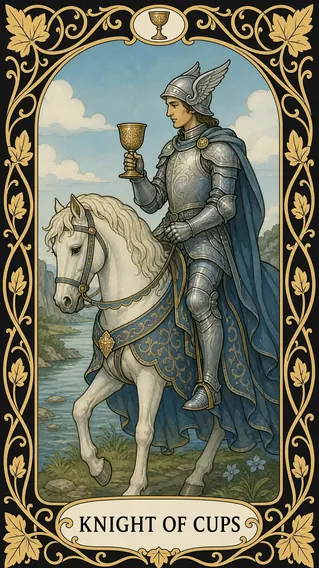
The flip side for both is the same: it is easy for such a person to confuse fantasy with fact, and resentment with tragedy. If the card is important as a forecast of reliability, it is worth looking at the older cards of the suit of cups — the Knight or the King, which speak of an established feeling, not the first reaction.
Page of Cups in the position of thoughts
In the position of thoughts, the Page of Cups is a dreamy, slightly scattered work of imagination: thoughts flow not in a logical chain, but through images, associations, and sudden insights. This is a state where creative ideas are born, but precise calculations are difficult.
If Swords appear nearby in the spread, fantasy may mix with anxious overthinking; next to Pentacles, the dream is more likely to find practical realization rather than remaining just a beautiful picture in your head.
What to do if you draw the Page of Cups
The card's advice is simple: listen to your first feeling, but don't take it as a final conclusion immediately. The Page of Cups is about sensitivity, not a ready-made solution; an insight that seems to come out of nowhere is worth noticing and verifying, rather than discarding or swallowing whole.
What you should actually do:
- Say what you feel out loud, even if it feels awkward — the card encourages the first step, not the perfect phrasing.
- Don't confuse inspiration with a finished plan. An idea is good as a reason to start, not as a guarantee of a result.
- Verify news before relying on it — especially if it concerns money or promises.
- Give yourself permission to be sensitive, without considering it a weakness.
If the reason for your question is not light news but a heavy experience, the spread does not replace a conversation with a specialist: the card shows sensitivity, not a solution to complex problems.
What is depicted on the card
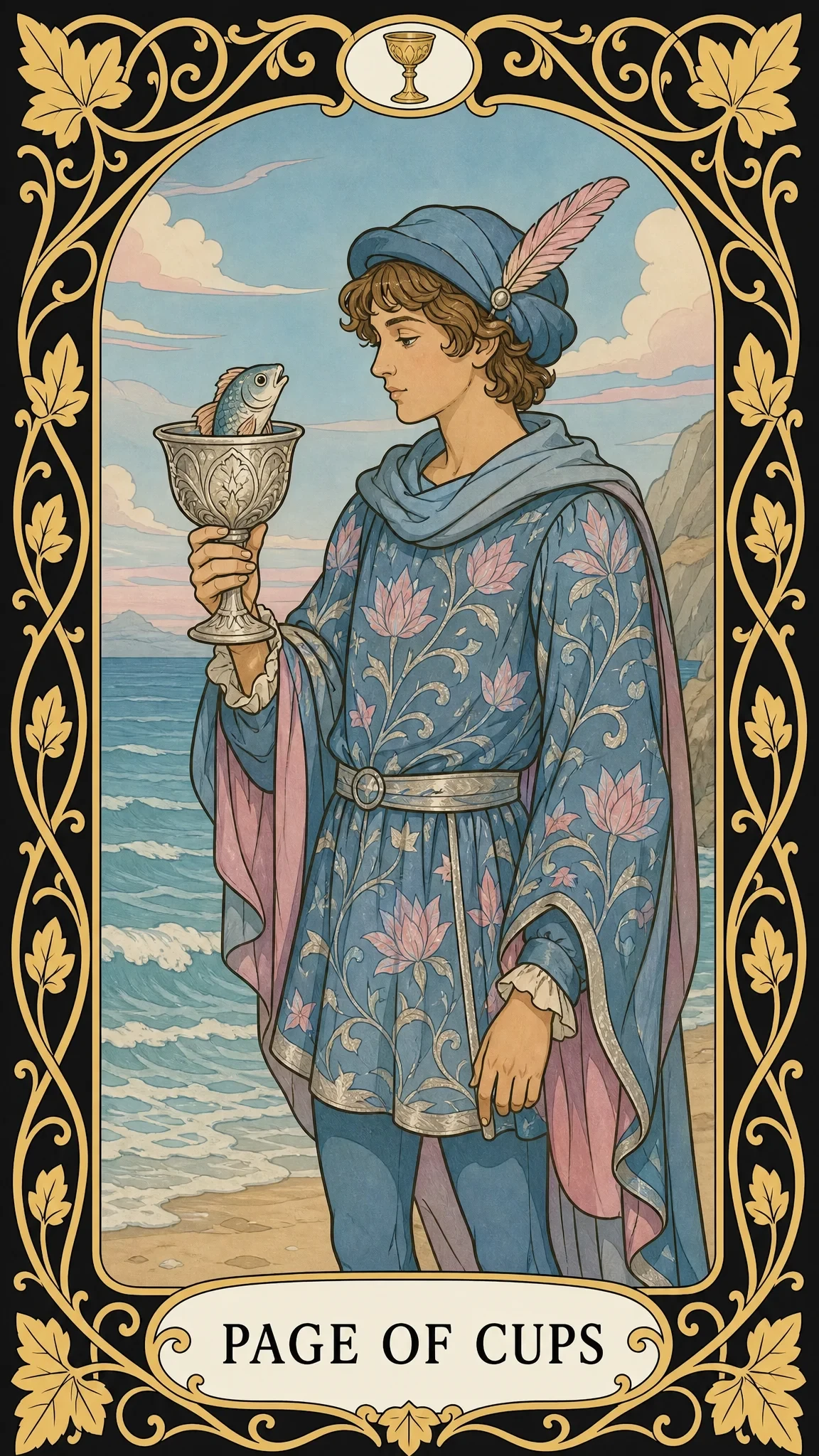
On our card, a young page stands on a sandy seashore, wearing a long blue robe with a pink floral pattern and silver embroidery, cinched with a silver belt. He wears a blue beret with a pink feather on his head, and a scarf with a pink lining is draped over his shoulders. In his raised hand, he holds a massive silver cup with a patterned bowl — and a blue fish peeks out from the cup, curving its body, which the page watches calmly and attentively, without fear.
The scene is interpreted as follows:
- The fish peeking out of the cup — an unexpected thought or feeling that has surfaced from the depths, just as intuition surfaces: it is not forced, it simply appears if sensitivity is not stifled.
- A calm, not surprised look — an important difference in our version from the usual iconography, where the page is more often depicted as confused. Here, he is already accustomed to feelings and insights coming on their own and accepts this as a normal part of his nature, rather than a shock.
- The sea and rocky shore behind — the element of water in its calm, not stormy state: the feelings of this card are soft, fluid, and not yet tested by a storm.
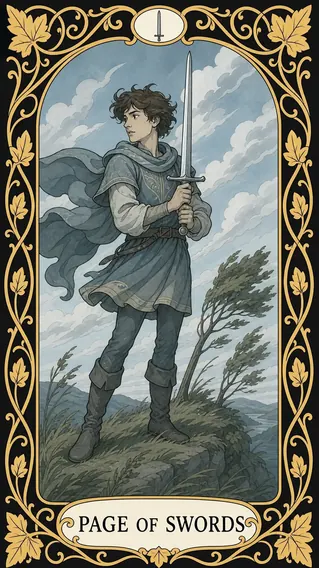
- Floral pattern on the clothing — the tenderness and softness of character inherent to Cups as the suit of the heart, in contrast to the stricter costumes of the Pages of Swords or Pentacles.
At the bottom of the card is a plaque with the English name PAGE OF CUPS, and at the top is a cup emblem in an oval frame, marking the card's suit.
Page of Cups as the card of the day
The Page of Cups as the card of the day is a good reason to trust your first emotional impulse: write what you have wanted to say for a long time, notice someone else's sign of attention, or allow yourself to dream about something pleasant. The day is suitable for sensitivity, not for strict calculations.
If the card is drawn reversed, the day is more about holding feelings in longer than you should. A useful mindset is not to overthink for the other person, but to ask or say it directly, even if briefly.
Frequently asked questions about the Page of Cups
Is it a Major or Minor Arcana?
Minor Arcana, suit of Cups, element Water. There are 56 Minor Arcana cards in the Tarot deck in total — 14 cards for each of the four suits, and the Page is the first of the four court cards of Cups, preceding the Knight, Queen, and King.
How does the Page of Cups differ from the Page of Swords?
Both pages are the youngest representatives of their suits, but of a different nature. Cups are the element of water, feelings: the Page of Cups is about sensitivity, creative insight, and news that touches the heart. Swords are the element of air, thought: the Page of Swords is about intellectual curiosity, a fresh idea, or news that requires analysis rather than an emotional response. If an emotional response or creative inspiration is important in a spread, it's about Cups; if a sharp observation or unexpected information is needed, it's about Swords.
Is the Page of Cups a yes or no?
More likely yes: the card says that news will come that will touch your feelings, but it does not guarantee its content. If the question is about the fact of receiving news, the answer is affirmative. If the question is about the outcome of a relationship or a matter, the Page of Cups does not answer that — you need neighboring cards.
What does the reversed Page of Cups mean?
The same sensitivity, but without support: feelings are kept to oneself, there is a fear of speaking out, or the news turns out not to be as good as it first seemed. Sometimes it is simply fatigue from one's own sensitivity, rather than pretense — the difference lies in whether the pause feels like protection or like getting stuck in resentment.
Does the Page of Cups always mean a young man?
No. The Page is a court card, and it describes a manner of feeling and behaving, not the gender or age of a specific person in the spread. It refers to a dreamy, open, and not yet hardened sensitivity — this can manifest in a man, a woman, or a person of any age.