What the Page of Swords means in Tarot
The Page of Swords is a minor card of the most "airy" suit in the deck: Swords represent thought, word, truth, and conflict, and their element is air—fast, changeable, and cutting when necessary. In the hierarchy of court cards, the Page is the most inexperienced, so their sword is raised not for battle, but for defense: they keep the weapon ready because they don't yet know what the next gust of wind will bring and prefer to be prepared in advance.
An important nuance often lost in retellings: the Minor Arcana describes not a whole character or fate, but a specific moment — a conversation, news, or a sudden idea that catches you off guard and requires an immediate reaction. While the higher Swords cards speak of the results of a dispute or the price of principles, the Page is about the very second when something made you alert and forced you to gather your thoughts.
The upright position is read as a burst of curiosity and attentiveness: a desire has emerged to get to the truth, ask a direct question, or look into a topic that previously seemed unimportant. The second layer of meaning is the same as for pages of other suits: a messenger bringing news. With Swords, this news doesn't have to be pleasant, but it is usually accurate — something you really need to know, even if it's uncomfortable to learn.
Reversed Page of Swords: meaning
The reversed Page of Swords is the same sharpness of mind, but directed the wrong way. There are three common readings, and the question of the spread suggests which one is closer.
- Curiosity turns into suspicion. Looking for hidden meanings where there are none, and vigilance works in vain, without a real reason.
- Words turn into a weapon. Sharpness, sarcasm, nitpicking — what started as honesty sounds like an attack.
- Information is used dishonestly. Gossip, rumors, half-truths, retelling others' words in a way they weren't intended.
There is also a softer reading: sometimes the reversed Page of Swords is not malicious intent, but fatigue from constant vigilance. Being on guard every minute is exhausting, and the mind at some point simply becomes overloaded with incoming information.
Page of Swords in a "yes or no" spread
In "yes/no" spreads, the Page of Swords is most often read as yes, but look closer first — the card supports the desire to investigate, ask questions, and verify facts, rather than guaranteeing a specific outcome. If the question is "should I find out the truth" or "should I ask directly," the answer is affirmative, and often one short conversation decides the matter.
If the question is about the result of a conflict or dispute ("will I win," "will I prove I'm right"), the Page of Swords does not answer that: it is about gathering information, not the outcome of a clash. For such a question, other cards are needed in the spread, most often neighboring higher Swords.
The reversed position in this spread is closer to no, because there is not enough data yet: the information is distorted, incomplete, or intentionally hidden.
Page of Swords in relationships and feelings
In a relationship spread, the upright Page of Swords describes the beginning of communication based on an interesting conversation: sympathy that grows not from romantic gestures, but from the fact that it is easy and interesting to talk, argue, and exchange opinions with the person. This is a card of lively curiosity about each other, not ready-made depth.
In terms of feelings, the Page of Swords is noticeably straightforward: they ask uncomfortable questions out loud and say what they think, sometimes without the necessary softness — not out of malice, but because for them, honesty is more important than tact. For established relationships, this card is a signal to clarify what has been left unsaid: to discuss what has been put off for a long time and to ask directly instead of guessing.
The reversed Page of Swords in relationships means nitpicking over trifles, a sharp word spoken without thinking, or distrust that results in monitoring messages and attempts to catch a partner in insincerity.
Page of Swords in work and money
In career spreads, the Page of Swords is new information that changes the balance of power: an unexpected detail in an interview, fact-checking before signing a contract, or the start of a small investigation or analysis. The card well describes the role of a person who notices what others have missed and is not afraid to say it out loud.
In money matters, the Page of Swords rarely speaks of a sum — more often of an important detail in the terms: a clause in a contract that is easy to overlook, a commission that wasn't warned about, or fine print that is worth reading twice. The practical advice of the card is not to be lazy about looking into the details right now, before it becomes a problem later.
The reversed Page of Swords at work means rumors about changes that are not yet confirmed, rushing to conclusions before the facts are fully gathered, or a heated conversation where a single clarifying question would have sufficed.
Page of Swords as a person: man and woman
A court card describes not the gender of a person in a spread, but their manner of behavior — the Page of Swords appears just as often for a man as for a woman if the style of behavior corresponds to this energy: observant, quick-witted, and not afraid to tell the truth to one's face. The gender of the person is usually suggested by the context of the question and neighboring cards, not by the grammatical gender of the name.
A male Page of Swords is someone who asks uncomfortable questions first, notices inconsistencies in others' words, and is not shy about pointing them out out loud, sometimes before it is appropriate. A female Page of Swords is someone who is the first to recognize that something is wrong and speaks about it directly, without choosing softer words.
A common trait for both: tact is not the strongest side of this archetype — they can hurt with their directness without meaning to. However, it is rare to remain in the dark around such a person: if something important is happening, they will be one of the first to say so.
Page of Swords in the position of thoughts
In the position of thoughts, the Page of Swords represents a restless, alert mind that is constantly scanning the environment for new information or hidden traps. Thoughts jump from one detail to another, latching onto inconsistencies and trying to piece together a whole picture from fragments.
This state is helpful for analysis but offers little peace: a mind that never lowers its guard tires quickly. Next to other Swords, the anxiety of this card can intensify into obsessive rumination; next to Cups or Pentacles, it softens into simple attention to detail.
What to do if you draw the Page of Swords
The card's advice is simple: stay curious, but don't turn it into suspicion. The Page of Swords rarely errs when seeking to understand something — the mistake begins when vigilance turns into a readiness to see a threat in every little thing.
What you should actually do:
- Check the facts before acting. The first impression of this card is sharp but not always complete — it's worth clarifying rather than reacting immediately.
- Speak directly, but choose your moment. The honesty of this card is a strength, provided it isn't turned into unnecessary harshness.
- Distinguish vigilance from combat readiness. Being on guard doesn't mean attacking first.
- Let your mind rest. Constant scanning of the environment is as exhausting as physical exercise.
If your wariness has grown into constant anxiety or distrust of everyone, talking to a loved one or a professional helps more than trying to deal with it alone.
What is depicted on the card
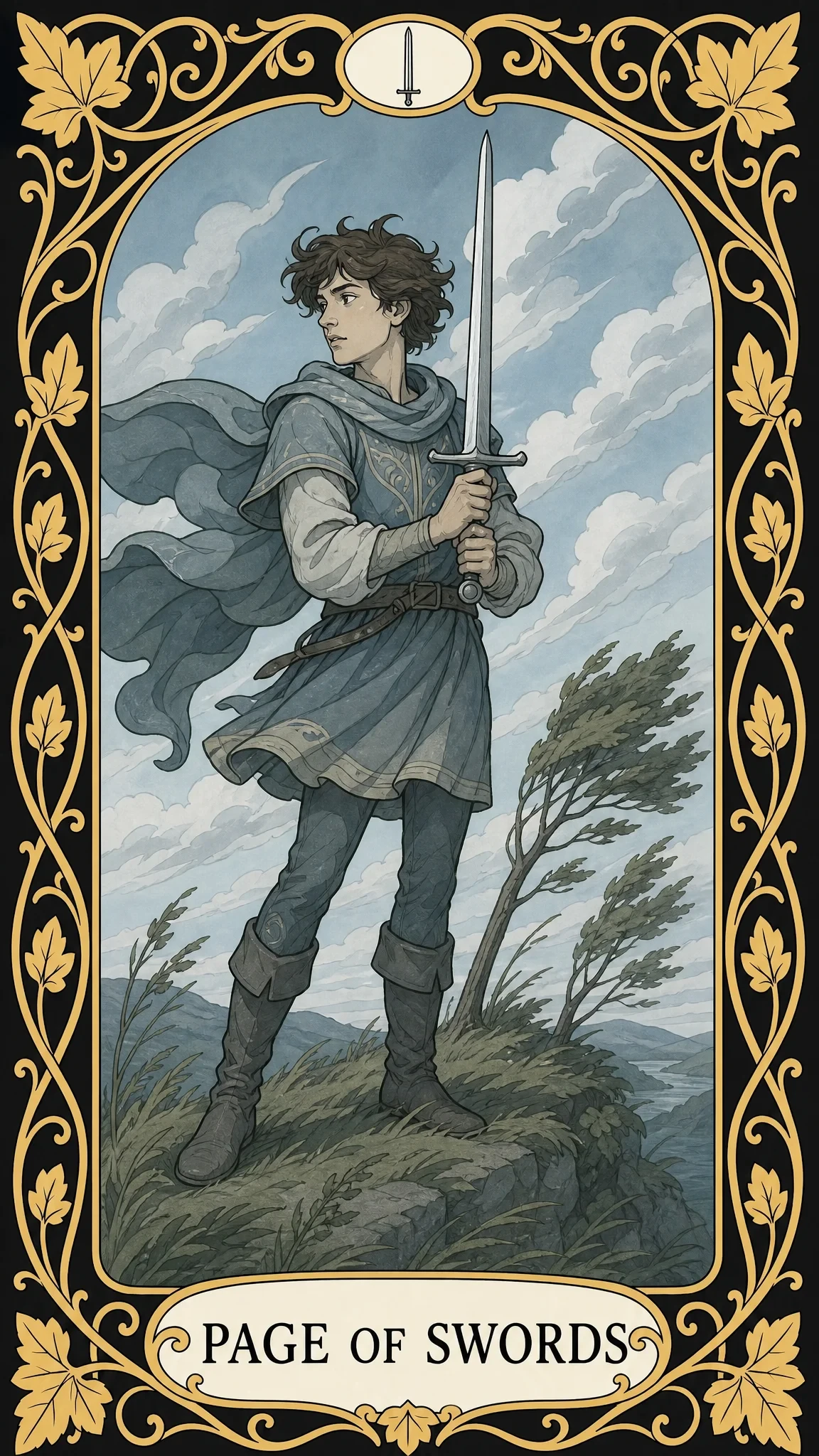
Our card features a young page on an open, grassy hill, with a river and distant hills visible. The wind ruffles his dark, curly hair and whips his long blue-green scarf into a wide banner; nearby, a lone tree bends under the same wind. He stands half-turned, head tilted toward something off-frame, holding a sword raised vertically in one hand — not poised to strike, but held at the ready.
Several details are worth reading separately:
- The wind and the bending tree — the element of Air in its pure, almost literal form: changeability, constant movement, nothing stands still.
- The fluttering scarf — the same restless movement, but transferred to the hero himself: thoughts that cannot settle.
- The sword raised vertically, not poised — a gesture of vigilance, not aggression: the page is ready, but not yet attacking.
- Looking away, not at the viewer — attention is directed outward, toward something beyond the scene, which is the essence of the card: constant scanning of the environment.
- Open hill with a view of the river and hills — a good, unobstructed view, which echoes the meaning of the card: clarity of vision is more important than secrecy.
In the upper medallion of the card, there is no Roman numeral, but the emblem of the suit: a narrow sword blade, the same as in the page's hand, so the suit of court cards is read immediately without a label. At the bottom is a plaque with the English name PAGE OF SWORDS.
Page of Swords as the card of the day
The Page of Swords as the card of the day is a good reason to ask a direct question you've been putting off, or finally check the facts instead of guessing. The day is suitable for sorting out details: re-reading a document, clarifying terms, or asking for clarification if something remains unclear.
Be careful with the flip side of this energy: don't react sharply to a first impression and don't take rumors for facts. A useful mindset for such a day is to remain vigilant without turning it into a readiness to argue with everyone you meet.
Frequently asked questions about the Page of Swords
Is it a Major or Minor Arcana?
Minor Arcana, suit of Swords, element of Air. There are 56 Minor Arcana cards in the deck — 14 cards for each of the four suits, and the Page is the youngest court card of its suit.
How does the Page of Swords differ from the Page of Pentacles?
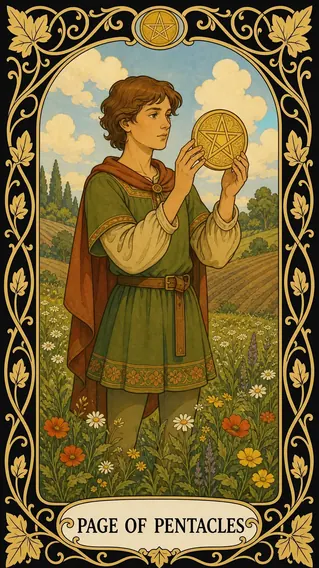
Both cards are the youngest court cards and both represent the apprentice stage, but the suit changes the subject of interest: the Page of Swords is ignited by new information, questions, and ideas — his element is air, and his tool is the mind. The Page of Pentacles is interested in the practical: how things work, how much they cost, and what can be made with one's hands — his element is earth. The first brings news, the second brings a plan.
What does the reversed Page of Swords mean?
The same sharpness of mind, but misdirected: groundless suspicion, harsh words, gossip, or retelling someone else's information in a distorted way. Sometimes it's not malicious intent, but simple fatigue from constant wariness.
Is the Page of Swords a yes or no?
More of a yes, but with the caveat "look closer first": the card supports the desire to figure things out and ask a direct question, but it does not guarantee the outcome of a dispute or conflict. If the question is about the fact itself — it is worth finding out the truth; if it is about the result of a confrontation — other cards are needed.
Does the Page of Swords mean conflict?
Not necessarily. The card is more about vigilance and honesty than the dispute itself: the page's sword is raised at the ready, but not poised to strike. Conflict is possible if other Swords appear nearby, but on its own, this card is about attentiveness and direct speech, not confrontation.