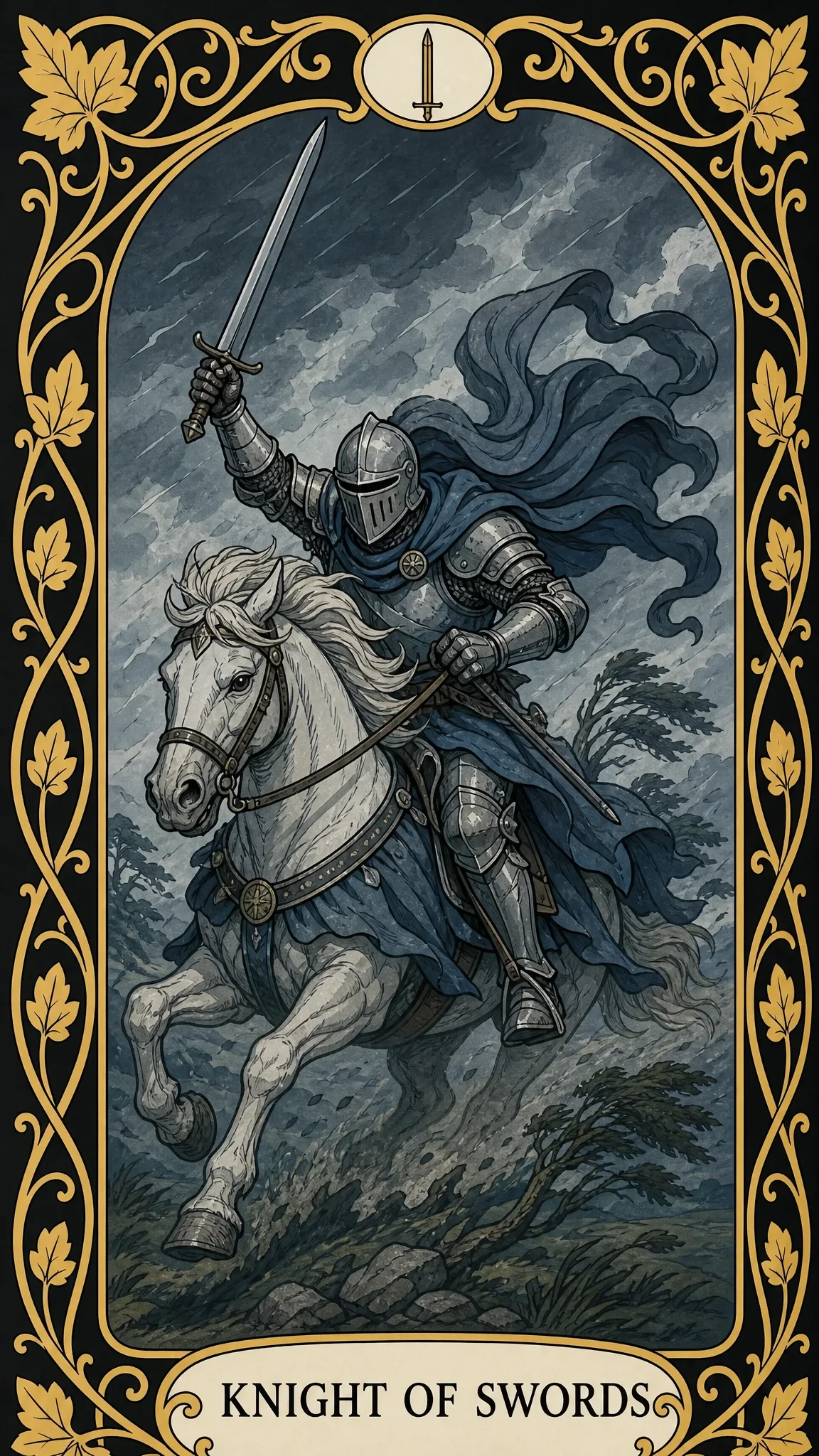
What the Knight of Swords Means in Tarot
The Knight of Swords is a court card of the Suit of Swords, and it is primarily about the speed of thought that immediately translates into action. If this were a person in a conversation, the Knight of Swords would be the one who finds the counterargument first and says it aloud, without waiting for the other person to finish speaking.
A crucial caveat that applies to any minor arcana: the card describes an episode, not a lifelong character trait, as the major arcana do. It's about a specific dispute, decision, or short burst of activity this week, not about what kind of person someone will always be. The Knight of Swords isn't about 'you are always so blunt,' but rather 'this is how fast and forcefully you need to act now' or 'this is who burst into the situation and what they brought with them.'
Essentially, the card describes a surge of mental and volitional energy: the desire to cut the knot in one move, to say directly what others avoid, to win through argument or speed of reaction. The element of air is read literally here — fast, sharp, sometimes without regard for others' feelings. The Knight of Swords rarely stops to check if their onslaught will hurt someone along the way: other cards in the deck are responsible for caution and tact, not the Knight.
Reversed Knight of Swords: Meaning
The Reversed Knight of Swords is the same onslaught, but it either misses the target or turns against the person themselves. Usually, the reading boils down to one of three scenarios.
- Aggression without cause. Bluntness that seeks a reason rather than solving a real problem — an argument for the sake of arguing, a conflict where no one remembers how it started.
- Words spoken before they should have been. A sharp remark, a letter sent in haste, a decision announced before it could be thought through — and now the consequences have to be dealt with.
- The onslaught has exhausted the carrier. Too much speed at the limit is draining: irritability, nervous overstrain, the feeling of fighting everyone.
The difference from the upright position is simple: the upright card is about a precise, justified strike, the reversed one is about a strike that is delivered in the wrong place or at the wrong time.
Knight of Swords in a 'Yes or No' Reading
In 'yes/no' readings, the Knight of Swords is usually interpreted as a decisive yes — but with a condition: you must act quickly and directly, without lengthy negotiations. The card is not about compromise or the ideal diplomatic option; it's about the direct path working better than an indirect one.
If the question is 'should I speak directly' or 'should I act quickly' — the answer is likely positive, but without a guarantee that there won't be friction: the Knight of Swords isn't about everyone being happy, but about procrastination costing more.
The reversed position in this reading shifts the answer towards 'yes, but not so sharply' — the idea is correct, but the chosen tone or timing will only spoil things.
Knight of Swords in Relationships and Feelings
In a relationship reading, the upright Knight of Swords signifies a direct explanation that has long been brewing: a no-holds-barred conversation, an honest 'we need to talk,' a confession or breakup, said without preparation, but without any unspoken words. The card well describes the moment when silence becomes worse than speaking an uncomfortable truth.
In the position of feelings, the Knight of Swords signifies clarity rather than warmth: the person knows exactly what they want and doesn't intend to beat around the bush. This can be interpreted as exciting directness at the start of a relationship or as cool sharpness if the card describes an existing couple.
There's also a flip side: the same drive easily turns into tactlessness — telling the truth doesn't mean saying it gently, and the Knight of Swords doesn't care about gentleness. An important nuance that gets lost in retellings: they don't want to hurt intentionally, it's just that their speed of thought outpaces their concern for how their words will sound.
The reversed position in relationships signifies a quarrel that started from nothing, or sharpness that is later regretted; or, conversely, an important conversation that is postponed to avoid being too direct.
Knight of Swords in Work and Money
In career readings, the Knight of Swords represents decisive negotiations, a short and tough conversation with management, a dispute won through speed of reaction and precise arguments. The card well describes situations where the winner is the one who first and most clearly articulated their position.
In financial matters, the Knight of Swords signifies a quick, risky decision: closing a deal without lengthy bargaining, entering into conflict over money because delaying further is more costly. Neighboring cards will show whether the speed pays off: with the Ace of Swords or the Sun — a precise and successful move, with the Five of Swords or the Tower — a victory that comes at too high a price.
The reversed position in work signifies a conflict that flared up due to haste or an incorrectly chosen tone: bluntness where patience was needed, and now relationships with colleagues or partners have to be restored.
Knight of Swords as a Person: Man and Woman
When the Knight of Swords appears in the 'what kind of person' position, it describes a type, not a literal hint at age or gender. This is someone who enters a situation as a tension reliever: bringing clarity, a direct question, or a direct answer — where others have been circling the topic for years.
A male Knight of Swords is sharp, intelligent, impatient with others' slowness; he says what he thinks and doesn't always soften his wording. A female Knight of Swords is someone who names the problem first and isn't afraid to enter into an argument if she believes she is right.
This type has a downside: it's easy to feel offended around them — not because they intended to hurt, but because tact is not part of their toolkit. A good ally in a fight or dispute, but not always in a conversation where delicacy is required.
Knight of Swords in the mindset position
In the mindset position, the Knight of Swords represents a state where a decision has been instantly made, and the mind is occupied not with doubt, but with formulating what to say and how to do it faster. Thought outpaces feeling: the argument comes first, and only then how it will sound to another person.
Sometimes this is a useful clarity – it's time to stop weighing and call things by their names. Sometimes it's nervous aggressiveness, when a person is mentally preparing for a dispute that hasn't happened yet. Adjacent cards help distinguish: next to the Ace of Swords or the Sun, it's more sober determination; next to the Five of Swords or the Tower, it's anxious readiness for a fight.
What to do if the Knight of Swords appears
The card's advice is direct: act quickly and speak directly, but don't confuse honesty with rudeness. The Knight of Swords rarely fails with reaction speed – he fails by forgetting to choose his words before saying them.
What's worth doing in essence:
- Formulate the main point in one sentence. If a thought requires five paragraphs of justification – it's not yet ready to be expressed sharply.
- Give yourself a pause before sending. One minute between 'wrote' and 'sent' often changes the tone of the message, but not the decision.
- Separate a dispute about the matter from a dispute for the sake of winning. The first is worth seeing through, the second is better stopped before it involves extra people.
- Check who will be affected by the sharpness. A quick decision is no reason to forget about those it concerns.
And separately: if the situation concerns a serious conflict, health, or breakup – a sharp step is not always the best advice. The cards show the energy of the moment, but the considered decision still rests with the person.
What is depicted on the card
On our card, the Knight of Swords is a warrior in silver armor with a fully closed visor, riding a light gray horse galloping sharply through a thunderstorm. The sword in his raised hand is pointed vertically upwards, his dark blue cloak tears almost horizontally in the wind, the sky is streaked with diagonal lines of rain, and the trees on the right are bent almost to the ground by the gust.
The scene reads as follows:
- The horse at full gallop – unlike the rearing horse of the Knight of Wands, here the force is not gathering but flying forward: movement, not a burst at the starting point. Swords are the element of air, and the horse literally cuts through the air in front of it.
- Closed visor – the face is not visible: in this card, the speed and direction of the strike are more important than who is delivering it.
- Sword raised strictly upwards – not a defense or a side strike, but readiness to chop at any moment: the decision has been made, execution is pending.
- Thunderstorm and bent trees – environmental resistance that does not stop the Knight of Swords: he rushes not into calm, but directly into bad weather, and this also characterizes the suit in its own way.
At the top of the card is an oval medallion with a sword image, a sign of belonging to the suit; at the bottom is a plaque with the English name KNIGHT OF SWORDS.
Knight of Swords as the card of the day
The Knight of Swords as the card of the day is a signal not to postpone a direct conversation or a quick decision that has already ripened: say what you think, answer immediately, instead of composing a formulation for a week. This is a day when speed and directness work for a person more than cautious diplomacy.
A useful mindset for such a day: say the main thing – yes, but don't turn every phrase into an attack. It's worth choosing one issue where clarity is important, resolve it briefly and to the point, rather than scattering sharpness at everyone. And keep in mind that not everyone around is ready for such a pace – what is normal speed for the Knight of Swords may sound like an attack to the interlocutor.
Frequently asked questions about the Knight of Swords card
Is it a Major or Minor Arcana?
Minor Arcana, a court card of the Swords suit, element of Air. In a Tarot deck, there are 56 Minor Arcana – 14 cards in each of the four suits, and the Knight is one of the four court figures within the Swords suit.
How does the Knight of Swords differ from the Knight of Pentacles?
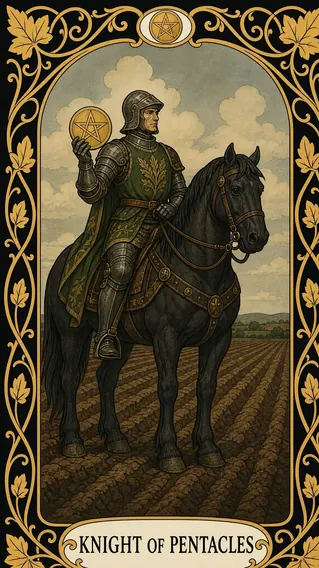
Both are court cards of the Knight rank, but their elements are opposite. Swords are the element of air, speed of thought and word: the Knight of Swords is about sharp decisions, directness, and drive. Pentacles are the element of earth, slow and steady movement: the Knight of Pentacles is about methodicalness and perseverance without haste. If the Knight of Swords appears in a reading, the emphasis should be on speed and directness, not on thoroughness.
Is the Knight of Swords a yes or no?
More likely yes, but with the condition to act quickly and directly, without lengthy approvals. The card doesn't promise it will be without friction – it's about procrastination in this situation costing more.
What does the reversed Knight of Swords mean?
The same drive, but it misses the target: aggression without real reason, harsh words spoken in haste, or exhaustion from maintaining speed at the limit for too long. Another option is an important direct conversation that is deliberately postponed.
Is the Knight of Swords in relationships about conflict?
Not necessarily about conflict, but definitely about directness: an honest conversation without beating around the bush, a confession or decision made without preparation. Whether this is good or bad depends on whether the other person is ready for such speed – the card itself doesn't promise care in the wording.