What does The Chariot mean in Tarot
The upright Chariot is about victory taken with your own hands, not received as a gift. It is not luck that brings a person to their goal, but the decision to bring together what pulls in different directions and force it to move in one direction.
An important nuance often lost in retellings: the charioteer on the card holds the sphinxes not by force, but by will — in the classic scene, the chariot has neither reins nor a bridle, only a wand in one hand and confidence in the other. This card is about control where there is almost nothing to physically control: a pair of opposing forces — black and white, instinct and reason, desire and duty — moves forward only because the one standing between them decided they are moving forward.
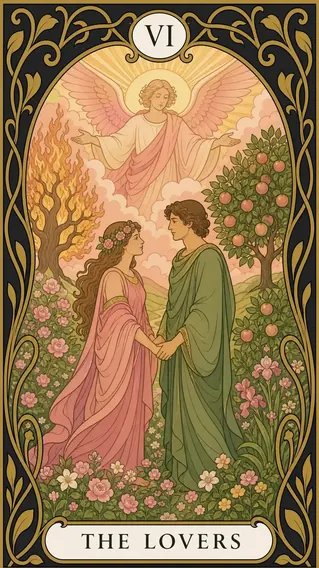
The second part of the meaning is speed itself. The Chariot is not about contemplation, but about a burst: the decision has already been made (usually on The Lovers card, which precedes it in the deck), and now it must be carried through to the end without getting distracted along the way.
Reversed Chariot: meaning
The reversed Chariot is usually read in one of three ways, and the question of the spread helps to clarify it.
- Loss of control. Forces that should have moved together have diverged: one pulls in one direction, the other in another, and the matter is stalled or going in circles.
- Movement without a goal. There is speed, but no direction — the person is pressing the gas without deciding where they are going, scattering efforts across several fronts at once.
- Pressure instead of control. Instead of maintaining balance, the person forces their way through — and either gets a result at the cost of something important or meets resistance.
Common to all three options is not a lack of energy, but a lack of direction. The upright Chariot knows where it is going; the reversed one spends the same energy without having decided that question.
The Chariot in a "yes or no" spread
In "yes/no" spreads, The Chariot answers yes — with a condition: the result will come through effort, not on its own. The card does not promise an easy road; it promises that the road is passable if you travel it yourself, keeping both hands on the controls.
It answers especially confidently to questions like "will it work if I try" and "should I act now." To questions about luck and favorable circumstances, The Chariot answers evasively — this is not a card about gifts of fate.
The reversed Chariot in this spread is read as no, until the forces are gathered in one direction — not a refusal, but an indication that they are currently pulling in different directions.
The Chariot in relationships and feelings
In a relationship spread, the upright Chariot is active movement toward someone: a confession you finally decided to make, a step you long delayed, moving in with a partner. It is the card of someone who stopped waiting and started acting.
In the position of feelings, it describes a strong, determined attraction — more of a hunt than calm affection. The person knows what they want and is not ready to wait for it to happen on its own.
If two conflicting feelings appear in the spread simultaneously — for example, affection for one person and attraction to another — The Chariot often describes this very duality, rather than a ready choice in favor of one person.
The reversed Chariot in relationships is an attempt to pull a partner where they are not ready to go, or a relationship spinning its wheels: both want to move, but in different directions.
The Chariot in work and money
In career spreads, The Chariot is advancement gained through your own drive: a promotion you achieved rather than one you were offered; a project brought to completion through the resistance of circumstances. The card well describes a competitive environment where the one who does not stop wins.
In money, it speaks of income brought by active effort, not a passive source: a deal closed personally, rather than money that came by itself.
What The Chariot advises in a work spread: choose one direction and do not scatter your efforts on two fronts at once. Its themes are about a concentrated burst, not about pulling in different directions simultaneously, like its own sphinxes.
The Chariot as a person: man and woman
In the "what kind of person" position, The Chariot describes someone who achieves their goals decisively and alone. Such a person rarely waits for help and does not like to share control — it is easier for them to do everything themselves and at their own pace.
The Chariot-man is determined, competitive; it is important for him not just to get a result, but to get it specifically through his own efforts. The Chariot-woman is one who takes control in a situation where others hesitate or doubt, and moves forward without waiting for general consensus.
The flip side of this type is the difficulty in sharing control with someone else and a tendency to perceive someone else's pace as an obstacle rather than a different path.
The Chariot in the thoughts position
In the thoughts position, The Chariot represents such intense focus on a single goal that everything else fades into the background. You aren't dwelling on doubts, but rather on a plan of action: how to get there, what to do first, and where to push harder.
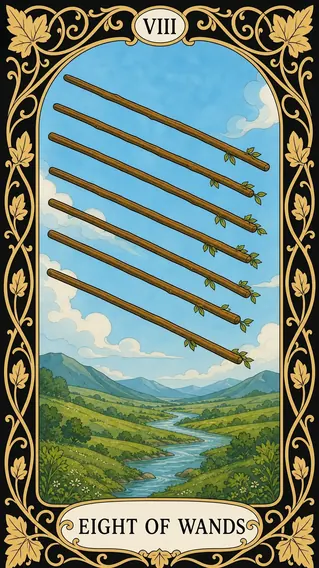
Sometimes this is a healthy sense of focus before a breakthrough. Other times, it's an internal tug-of-war between two desires that you haven't yet acknowledged as equal. Neighboring cards suggest the direction: next to the Two of Swords, it indicates an unresolved internal conflict; next to the Eight of Wands, it signifies a decision already made and pure momentum.
What to do if you draw The Chariot
The advice of The Chariot is to choose a direction before hitting the gas. The card almost always possesses speed; what might be missing is alignment between your own conflicting desires.
Practical steps to take:
- Identify both forces pulling in different directions. Until they are named, you cannot manage them.
- Choose one goal for the immediate future. The Chariot struggles when pulled in two directions at once.
- Act instead of waiting for the perfect moment. This is a card of decision, not preparation.
- Check if your drive is turning into forcefulness. Managing is not the same as forcing.
And a note: if the reading describes a prolonged internal conflict or burnout from constant pressure, this card does not replace a conversation with a specialist—it describes the dynamic, it does not provide therapy.
What is depicted on the card
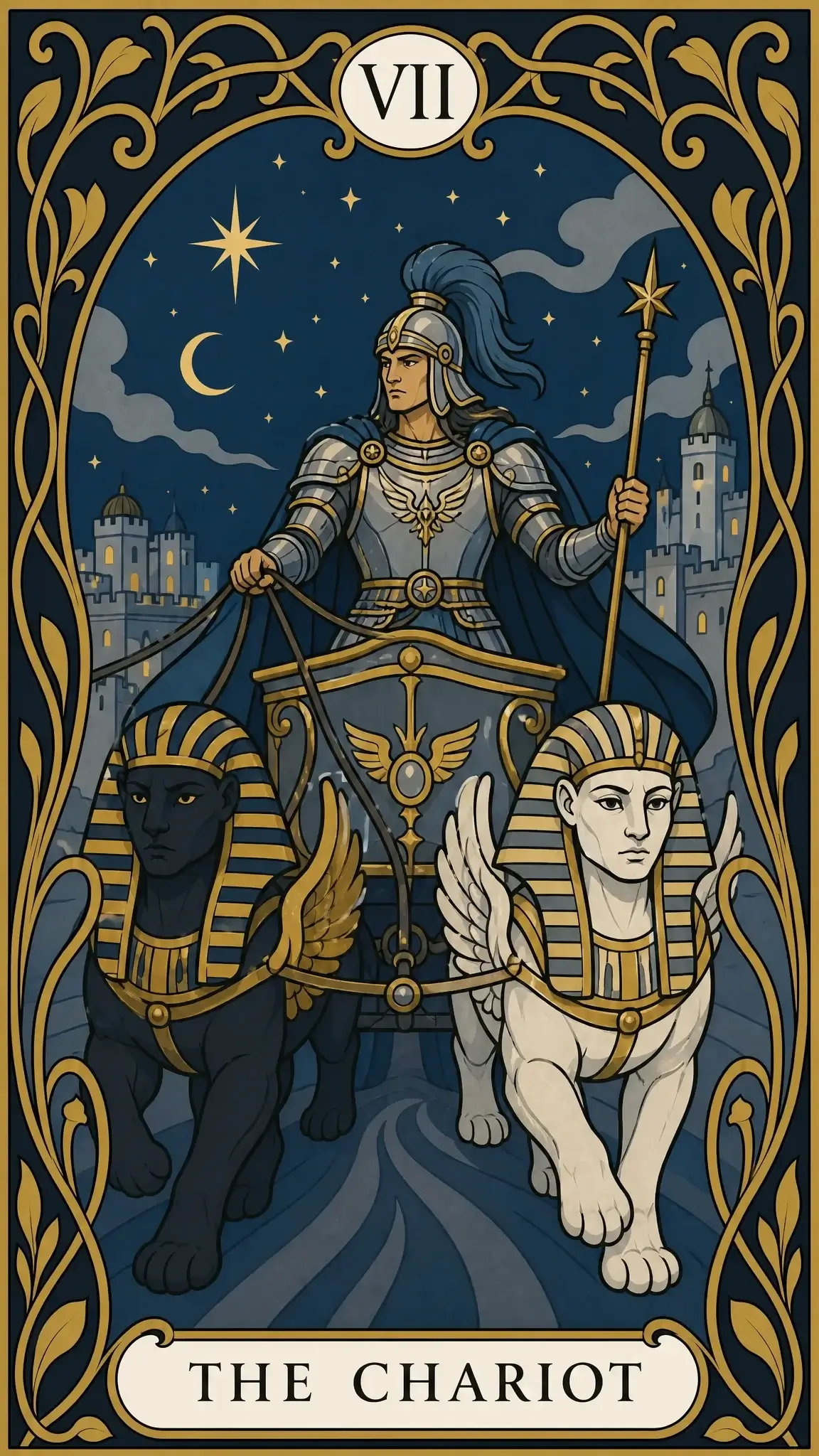
On our Chariot, there is a warrior in silver-gray armor with gold trim, a blue plume on his helmet, and a blue cloak; he stands in a chariot against a night sky filled with scattered stars, a large eight-pointed star, and a crescent moon in the upper left corner. Behind him, on both sides, are dark fortress towers.
The scene is interpreted as follows:
- Two sphinxes, black and white — in our version, both are winged and wearing striped golden headdresses, like Egyptian statues. They are not rigidly harnessed: straps connect them to the chariot, but in the narrative, they are controlled not by the harness, but by the charioteer's will—a classic paradox for this card.
- A golden wand with a star in the right hand — a sign of direction and determination, similar to a scepter: not a weapon for battle, but a tool used to point the way.
- Fortress towers in the background — what has been left behind: the inhabited, familiar place from which one has departed.
- Night sky with a star and crescent — the path is traveled neither by daylight nor by a ready-made map; one navigates by their own landmarks, not by someone else's signs.
At the top of the card is the Roman numeral VII, and at the bottom is the English name THE CHARIOT—our deck is drawn in the Rider-Waite tradition, where The Chariot is the seventh card.
The Chariot as the card of the day
The Chariot as the card of the day signifies a time to act rather than weigh options. It is a good time for a decisive step you have been putting off: scheduling a meeting, sending a resume, or saying something you have been meaning to say for a long time.
A useful mindset for such a day: choose one task and see it through to the end without spreading yourself across multiple directions at once. It is not the best day for compromises and concessions—The Chariot works through your own decision, not through aligning with someone else's pace.
Frequently asked questions about The Chariot
What is The Chariot in Tarot specifically about?
It is about a victory achieved through personal effort and control, rather than luck. The card describes a situation where you need to bring conflicting forces together and lead them toward a single goal—through will, not physical coercion.
What does a reversed Chariot mean?
Most often, it signifies a loss of control: forces that should be moving together are pulling in different directions, and things are at a standstill. It can also mean movement without a clear goal or pressure that forces a result instead of finding balance.
Is The Chariot a "yes" or a "no"?
In yes/no readings, The Chariot answers "yes," but with a condition: the result will come through effort, not on its own. The reversed position is read as "no, not until the forces are gathered in one direction."
Does The Chariot mean luck or fortune?
No, quite the opposite. This card is not about a gift of fate, but about a result achieved by your own hands and will. When the question is specifically about luck, The Chariot gives an evasive answer.
Which arcana number is this?
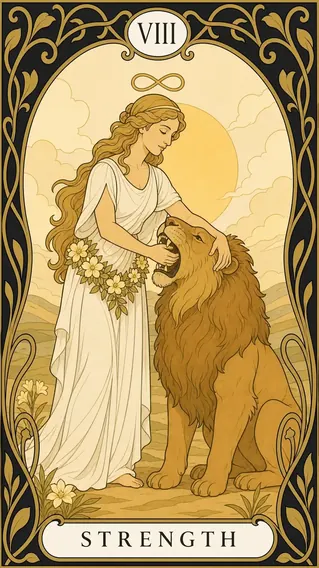
The seventh Major Arcana; the card bears the Roman numeral VII. In the Rider-Waite deck, which ours is based on, The Chariot follows The Lovers (VI) and precedes Strength (VIII).