What Strength means in Tarot
Upright Strength is the ability to cope without using force. It is not about defeating an opponent, but about not letting a situation throw you off balance; not suppressing a feeling, but finding common ground with it.
An important nuance often lost in retellings: the lion on the card is not defeated, it is tamed. It is not about suppression: what growls within a person—anger, fear, desire—does not go away and should not. The relationship with it changes. That is why Strength often appears when a person has stopped fighting themselves.
The second side of the card is courage. It is not loud: it is the ability to keep going in an unpleasant situation, to speak calmly when you want to scream, and not to retreat without making a scene.
Reversed Strength: meaning
Reversed Strength is usually read in one of three ways:
- Patience has run out. You held on for a long time and snapped. This is the most common scenario, and the breakdown usually happens over a trifle, not the main issue.
- Pressure instead of endurance. A person gets their way through force and shouting; they get the result but lose the relationship.
- Insecurity. There is not enough strength even to try: the fear is greater than the person, and they retreat in advance.
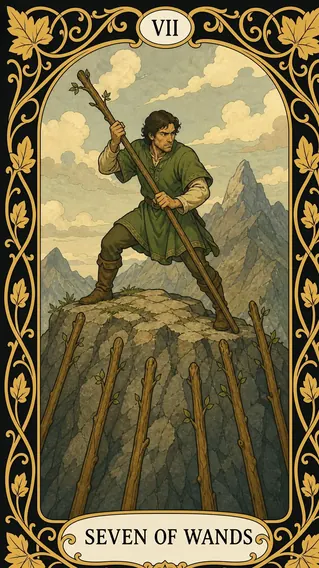
Neighboring cards help to choose: next to the Ten of Wands—exhaustion, next to the Five of Wands—conflict with raised voices, next to the reversed Star—decline and lack of self-belief.
Strength in a "yes or no" spread
In "yes/no" spreads, Strength answers yes—with the condition "if you have enough endurance." It does not promise a quick result: its "yes" is about the fact that you will cope, not that it will be easy.
It answers especially confidently to questions like "will I endure," "will I cope," "is it worth continuing." It answers negatively to questions about a quick victory: nothing is achieved here by force.
Reversed Strength in a yes/no spread is no: either you won't have enough patience, or the price will be paid in relationships and nerves.
Strength in relationships and feelings
In a relationship spread, upright Strength is the ability of a couple to go through difficulties without destroying each other. It is not an idyll: rather, it is the skill of not hitting a sore spot during an argument and returning to conversation afterward.
In the position of feelings, Strength describes a deep, stable emotion that contains both passion and self-control. A person wants, but does not demand; they are distressed, but do not make scenes.
A separate common theme is relationships where one person patiently waits for the other to cope with their issues. As long as this is a choice, not a sacrifice, the card is favorable; when patience turns into martyrdom, it flips.
Reversed Strength in relationships is accumulated irritation that breaks through, or, conversely, a person who has completely lost confidence next to their partner.
Strength in work and money
In career spreads, Strength is the ability to work under pressure and with difficult people. A tough client, a conflict-ridden team, a long-term project: the card says you can pull through, but only with endurance.
In money matters, it indicates gradual improvement through discipline: debts are paid off, savings grow, but slowly. There is no quick money in this card.
What Strength advises in a work spread: do not raise your voice and do not slam the door. In its scenarios, the winner is the one who stayed calm, not the one who responded most sharply.
Strength as a person: man and woman
In the "what kind of person" position, Strength describes someone who does not raise their voice yet gets their way. Calm, stable, you don't want to argue with them.
A Strength-woman in a spread is someone who carries a difficult situation on her shoulders and does not complain; soft on the outside and very firm on the inside. A Strength-man is someone who knows how to control himself in a conflict and does not assert himself at someone else's expense.
The weak point of such people is that they endure for a long time and rarely ask for help, so their exhaustion is noticed too late.
Strength in the position of thoughts
In the position of thoughts, Strength represents an internal dialogue with one's own anger or fear. A person does not suppress the feeling nor let it take control; they examine it and decide what to do with it.
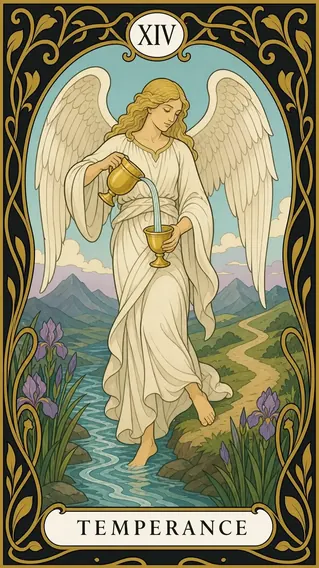
This also includes composure before a difficult conversation: the mental "I can handle this, just don't lose it." Adjacent cards provide clarification: next to the Nine of Swords, it is a struggle with anxiety; next to Temperance, it is a balance already found.
What to do if you draw Strength
The advice of Strength is neither to push nor to give up. Both extremes are equally losing: both pressure and retreat.
What you should actually do:
- Take a pause before responding. Don't refuse the conversation, but postpone it for an hour or two.
- Name the feeling, don't suppress it. "I am angry" works better than trying to pretend you aren't.
- Act gently and persistently. Repeating a request calmly for the second and third time is the most effective technique of this card.
- Notice how much you have left. Patience is finite; reversed Strength comes to those who didn't keep count.
And separately: endurance is not the same as tolerating mistreatment. Strength tames the lion, it does not allow itself to be eaten; where there is pressure or abuse, its advice does not apply.
What is depicted on the card
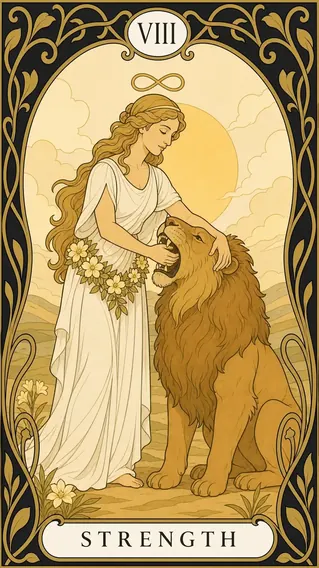
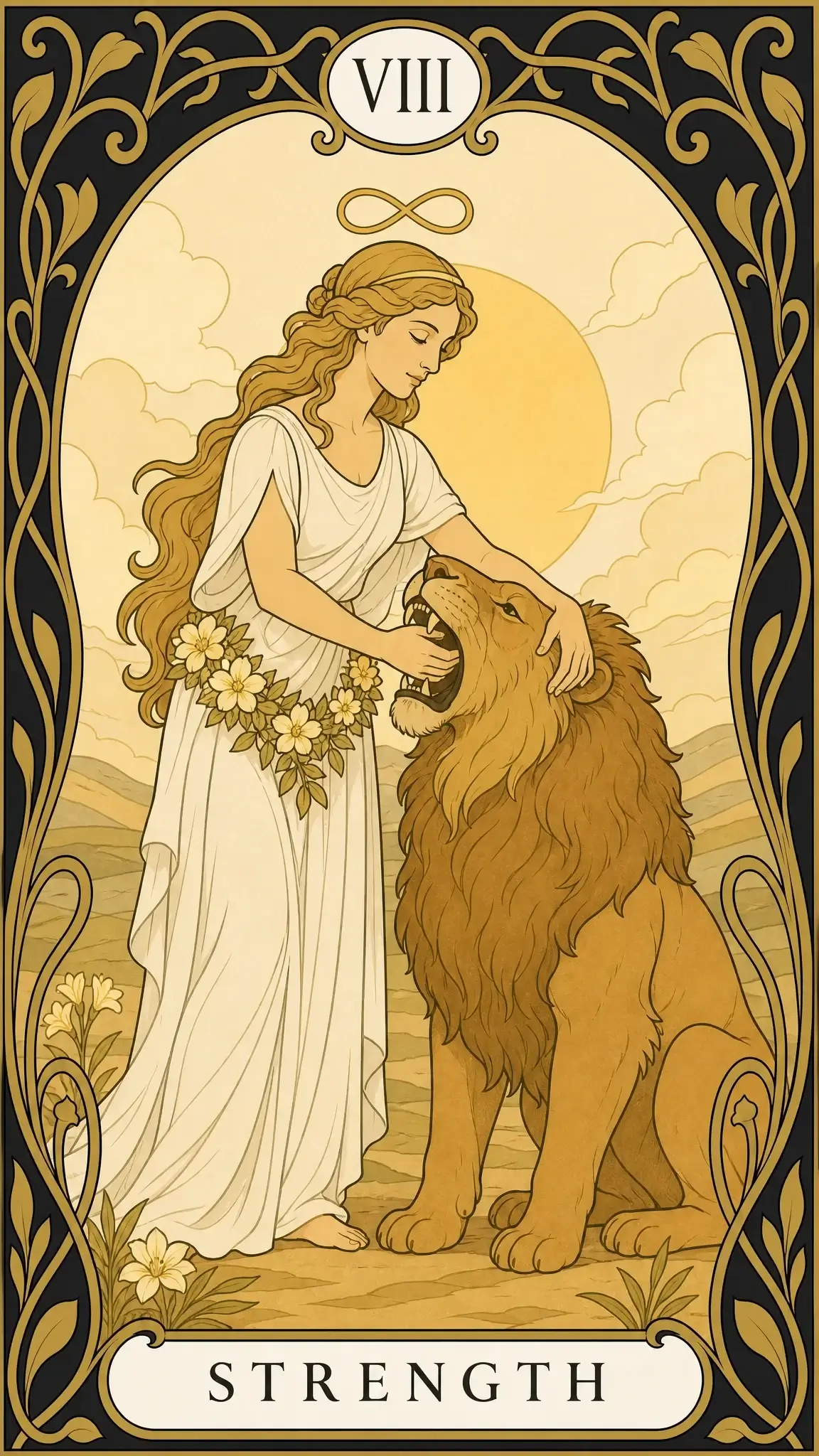
On our Strength card, there is a woman in white next to a large lion; she calmly holds its head, and the lion does not resist. Above her head is the infinity symbol, surrounded by flowers and golden light.
The scene is read as follows:
- Hands without tension — she is not fighting. If you look closely, the lion could break free: it stays voluntarily.
- The Lion — instinct, anger, desire. It is not killed or banished, which is fundamental for this card.
- White dress — intention without aggression: strength here has no intent to suppress.
- Infinity symbol — the same as the Magician's: a stable, renewable capacity, not a one-time effort.
At the top is the Roman numeral VIII, at the bottom is the English name STRENGTH. 🔴 In the Rider-Waite tradition, which our deck is based on, Strength is the eighth arcanum, and Justice is the eleventh. In the Marseille tradition, they are swapped, so in old books, Strength sometimes appears as XI.
Strength as the card of the day
Strength as the card of the day is a day when you will have to hold on. Most likely, someone will be annoying, something will not go according to plan, and the main event will be how you react to it.
A useful mindset: do not respond immediately, do not make decisions based on emotions, and set aside time for recovery in advance. It is a good day for difficult conversations if you conduct them calmly — and a bad one for ultimatums.
Frequently asked questions about the Strength card
Is Strength in Tarot about physical strength?
No. It is about endurance and self-control: the ability to cope with your anger or fear and not give in to someone else's pressure. On the card, the lion is not defeated, but tamed — this is the essence of the arcanum.
Is Strength the eighth or eleventh arcanum?
It depends on the tradition. In the Rider-Waite deck, which ours is based on, Strength is the eighth (VIII), and Justice is the eleventh (XI). In the Marseille tradition, it is the opposite, so in old sources, you may find different numbering.
What does reversed Strength mean?
Most often, it means exhausted patience and a breakdown — usually over a minor issue after long suppression. It also means pressure instead of endurance, when one gets their way through force, or insecurity where a person retreats in advance.
Does Strength mean I have to endure?
It means endurance, not submission. The card is about the ability not to lose it and to keep going, not about being ready to tolerate mistreatment. Where there is pressure or abuse, this advice does not work.
Which arcanum number is it?
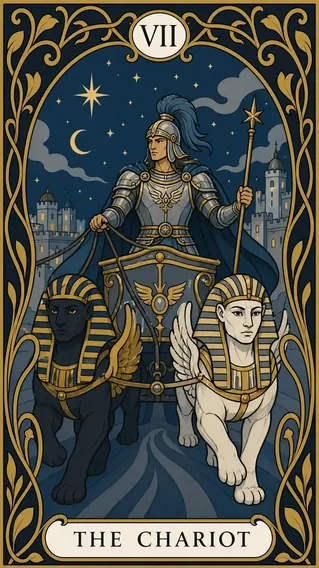
The eighth Major Arcana in the Rider-Waite system; the card has the Roman numeral VIII. It comes after the Chariot (VII) and before the Hermit (IX).