What does The Hermit mean in Tarot
The upright Hermit is a conscious step aside. A person steps out of their usual routine and conversations not because they are offended or tired, but because they cannot hear their own thoughts amidst the noise.
An important nuance often lost in retellings: The Hermit is not running away, he is searching. His solitude is meaningful: he is dealing with a question that cannot be solved in conversation — who to be, what to do, what is true for him. Therefore, in spreads, the card often signifies not loneliness, but work that can only be done alone.
The second side of the card is knowledge gained through experience. The Hermit often points to a mentor: someone who has walked this path before and can offer guidance. Or it indicates that the querent themselves is becoming such a person.
Reversed Hermit: meaning
The reversed Hermit is usually read in one of three ways:
- Solitude has dragged on. A pause was needed but turned into a lifestyle: the person has grown unaccustomed to people and is not returning. This is the most common scenario.
- Involuntary loneliness. It wasn't their choice to leave — others drifted away, and it is felt deeply.
- Refusal of help. Someone is ready to offer guidance, but the person stubbornly tries to figure it out alone and wastes time.
Neighboring cards help clarify: next to the Four of Cups — withdrawing due to boredom and apathy, next to the Five of Pentacles — forced isolation, next to the Three of Pentacles — a missed opportunity to learn from others.
The Hermit in a "yes or no" spread
In "yes/no" spreads, The Hermit answers "not now". This is not a refusal: the card says it is too early to make a decision until the person understands what they want.
To questions like "should I take a break" or "was it right to distance myself," the answer is affirmative. To questions about quick results or a fast meeting, it is negative: The Hermit does not accelerate anything.
The reversed Hermit in a yes/no spread is also no, but for a different reason: not because it is too early, but because the person is stuck and has isolated themselves.
The Hermit in relationships and feelings
In a relationship spread, the upright Hermit signifies a need for distance. One of the two is stepping back: not because they have fallen out of love, but because they need silence to understand themselves. To the other person, this almost always looks like cooling off, and that is the main difficulty of the card.
In the position of feelings, The Hermit describes reserve and caution. The feeling may be deep, but the person does not show it and is in no hurry to get closer.
A common scenario is a conscious period without relationships. Here the card is favorable: it is not loneliness, but time to figure out what is desired from the next relationship.
The reversed Hermit in relationships is either distance that has become a wall, or a person who has been alone for so long that getting close seems impossible.
The Hermit in work and money
In career spreads, The Hermit represents working alone and deep immersion: research, study, expertise, or a project that needs to be done without distractions. It is poorly suited for team hustle and sales, but excellent for tasks requiring focus.
Regarding money, the card speaks of a modest but stable period: no growth, but no losses either. It often points to a conscious reduction in spending.
What The Hermit advises in a work spread: step out of the flow and figure out what you are actually doing. His themes are almost always about people who have been running on inertia for a long time and have never stopped to check if they are heading in the right direction.
The Hermit as a person: man and woman
In the "what kind of person" position, The Hermit describes someone who keeps to themselves. Taciturn, self-sufficient, often older or more experienced; people come to them for advice, but not for company.
The Hermit man in a spread is reserved, calm, and lives by his own rules; getting close to him takes time, but he is honest. The Hermit woman is someone who does not need constant presence and does not tolerate intrusiveness well.
The weak point of such people is that they rarely ask for help and almost never complain, so their difficulties are noticed last.
The Hermit in the position of thoughts
In the position of thoughts, The Hermit represents reflection on meaning and direction. It is not about anxiety regarding tomorrow, but rather bigger questions: am I living correctly, am I doing the right thing, what do I actually want?
This also includes the need for silence. A person catches themselves wanting to turn off their phone and not answer anyone — and this is not apathy, but work happening within. Surrounding cards clarify: next to the Four of Swords, it is fatigue and a need for rest; next to the Ace of Swords, it is a maturing decision.
What to do if you draw The Hermit
The Hermit's advice is to step out of the noise and ask yourself an honest question. Do not decide, but figure things out; the answer will come from silence, not from another discussion.
What is worth doing in practice:
- Take a break with an end date. Solitude without a deadline turns into the reversed position of the card.
- Formulate the question in words. The Hermit is productive when there is something to think about, and fruitless when a person simply withdraws.
- Find someone who has already been through this. A mentor is a legitimate part of the card, not a sign of weakness.
- Do not resolve conflicts during this period. Everything said from the state of The Hermit sounds colder than intended.
And separately: if the solitude drags on for months and the desire to see anyone has disappeared along with it, this is no longer a break, and it is better not to deal with this alone.
What is depicted on the card
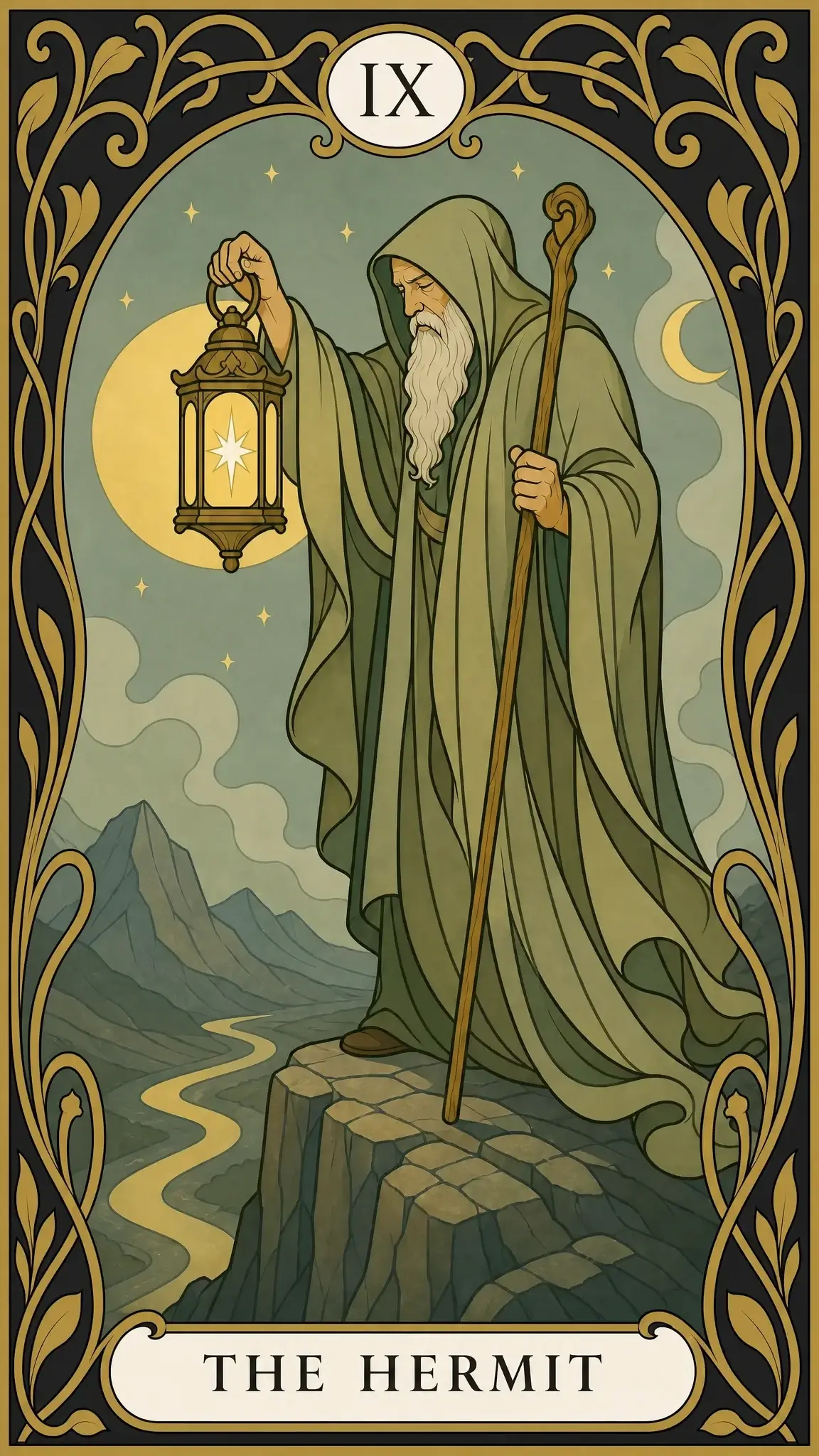
Our Hermit features a figure in a gray hooded cloak on a peak, holding a lantern with a star inside in one hand and a staff in the other. There are mountains around, a path leading down below, and a thin crescent moon in the sky.
The scene is interpreted as follows:
- The lantern — the light he carries himself. It is small and illuminates only the step ahead: The Hermit does not see the whole road and does not claim to.
- He is standing, not walking — the card is about stopping. Movement is secondary here.
- The staff — support and experience: the same wand as the Magician's, but here it is not a tool, but support.
- The path down — the way to people, which remains open. The Hermit has not left forever.
Above is the Roman numeral IX, below is the English name THE HERMIT: our deck is drawn in the Rider-Waite tradition, where The Hermit is the ninth arcanum.
The Hermit as the card of the day
The Hermit as the card of the day is a quiet day without events. There will be less communication than usual, and that is for the best: there will be time to think about things you have been putting off for a long time.
Useful mindset: do not schedule meetings where you need to be in top form, and do not force yourself to be in company. A good day for solo work, a walk, sorting out your thoughts — and a bad one for noisy places and new acquaintances.
Frequently asked questions about The Hermit card
Does The Hermit mean loneliness?
It means solitude by choice, not forced loneliness. It is a break taken to figure yourself out. Loneliness against one's will is usually shown by the reversed position or neighboring cards — the Five of Pentacles, the Four of Cups.
What does the reversed Hermit mean?
Most often, it is prolonged solitude that has become a lifestyle: the person has grown unaccustomed to people and is not returning. Also — forced isolation or stubborn refusal of help when a hint is nearby, but the person is wasting time alone.
Is The Hermit in relationships a sign of a breakup?
Not necessarily. More often, it speaks of one partner's need for distance: they haven't fallen out of love, but they need to be in silence. For the other, it looks like cooling off, and the main danger of the card is mistaking a break for a rejection.
Is The Hermit a "yes" or "no"?
It answers "not now." This is not a refusal, but an indication that it is too early to make a decision: first, you need to understand what you want yourself. For questions about breaks and solitude, the answer is affirmative.
Which arcanum number is this?
The ninth major arcanum, the card has the Roman numeral IX. In the Rider-Waite deck, which ours is based on, The Hermit comes after Strength (VIII) and before the Wheel of Fortune (X).