What the Four of Swords means in Tarot
Swords in Tarot are the suit of mind and conflict: arguments, decisions, difficult conversations, sharp thoughts. Almost all cards in this suit are about movement and tension, and against this background, the Four stands out sharply — it is the only sword card where a person is not acting or arguing, but lying motionless.
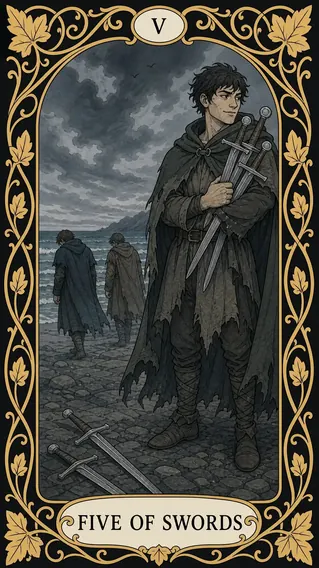
An important nuance to state immediately: the Minor Arcana describes an episode, not destiny. If the major Death card is about a large, irreversible transition, the Four of Swords is about a specific week or month when you need to lie low after a blow, not the end of the story. In the sequence of the suit, the card stands after the Three of Swords — acute pain and breakup — and before the Five of Swords, where the conflict resumes with new strength. The Four is exactly what happens between them: the body and psyche take a break because they cannot endure without it.
The number four in Tarot is about structure and stability, like the Emperor among the Major Arcana. In the fiery suit of Wands, it means celebration and a completed stage, but in the airy suit of Swords, it is stability of a different kind: the ability to endure a pause without falling apart or pretending that everything is fine. The upright position is read unambiguously as a well-deserved, not forced, rest — a case where stopping means acting wisely, not giving up.
Reversed Four of Swords: meaning
The reversed Four of Swords is the same need for a pause, but without the pause itself. Usually, the spread implies one of three options, and the question provides the hint.
- Returning to work sooner than you should have. The rest was interrupted by someone else's demands, circumstances, or your own guilt for "just lying around."
- Exhaustion that is not acknowledged. A person continues to work and solve problems to the limit, even though their resources have long been depleted — and this most often looks not like laziness, but like a stubborn drive to hold on until the end.
- There is rest, but no peace. Formally, a pause has been taken: vacation, sick leave, weekends — but the head is still running the same thoughts, and no recovery occurs.
There is also a softer reading: sometimes the reversed card means the end of prolonged stagnation — a person is finally ready to get up and return to business after a long downtime. The difference is visible from the context: if the spread previously spoke of forced immobility, the reversed Four of Swords can be a relief rather than an alarming sign.
Four of Swords in a "yes or no" spread
In "yes/no" spreads, the Four of Swords is usually read as not now: the card does not deny the event, but asks not to rush into it until strength is restored. If a decision is being made under duress — tired, sleep-deprived, still angry after an argument — the card directly advises postponing it until a pause is taken, rather than acting immediately.
If the question is "do I need a rest now" or "should I take a break" — the answer is a confident yes, and often faster and more obvious than it seems to a person who is used to not stopping.
The reversed position in this spread is a warning: a decision made without rest will likely have to be reconsidered. It is worth rephrasing the question not as "should I," but as "what will change if I rest first."
Four of Swords in relationships and feelings
In a relationship spread, the upright Four of Swords most often means not a breakup, but necessary distance: one or both partners take a pause after an argument or a difficult conversation so as not to say too much in the heat of the moment. This is a time-out card, not a breakup card — and this is its fundamental difference from much harsher cards of the suit, like the Three of Swords.
In the position of feelings, the card describes a state where there are temporarily no strong emotions at all — not because they have passed, but because the psyche has taken a break from experiencing them. For a person who has recently come out of a difficult relationship, the Four of Swords can mean a conscious pause in new acquaintances: not a rejection of feelings altogether, but time to recover before the next step.
The reversed Four of Swords in relationships means the couple is being forced to reconcile or talk before either of them is ready, or one partner is silently continuing to experience the conflict while the other is already demanding to move on.
Four of Swords in work and money
In career spreads, the Four of Swords is sick leave, vacation, a conscious pause in a project or negotiations after an intense push. This is a card of recovery after a rush, not about being fired or failing: a break is taken precisely because the work was important and required effort.
In money, the card advises not on earnings, but on preservation: do not make financial decisions in a state of exhaustion, postpone large expenses and contracts until your head is clear again. This is not about poverty — it is about the fact that a tired mind easily makes mistakes in calculations and deal terms.
The reversed Four of Swords at work is overwork from which you are not allowed to exit: vacations are postponed, you are returned to work before recovery, and rest is perceived by the team as weakness. The result is usually the same — the body or psyche takes a break on its own, already in the form of illness or a breakdown, if it is not given in time.
Four of Swords as a person: man and woman
When the Four of Swords appears in the "what kind of person" position, it describes not the character as a whole, but the state: someone who has currently closed off to recover and is not ready to argue, decide, or explain. This is not coldness or indifference — rather, it is a protective silence after overload.
The Four of Swords man is someone who withdraws into himself after a conflict or heavy workload and is unavailable even to loved ones for a while, not because he is offended, but because he has run out of energy to talk. The Four of Swords woman is someone who honestly takes a pause instead of proving her involvement through force, and temporarily drops out of her usual circle of affairs.
It is important not to confuse this state with a permanent character trait: the card is about the current moment. As soon as resources are restored, the person will likely return to their usual pace — the only question is whether they will be given time for it.
Four of Swords in the thoughts position
In the thoughts position, the Four of Swords represents a conscious attempt to quiet the internal dialogue: there are too many thoughts, you've been pushed to the limit for too long, and your mind is finally begging for silence instead of new solutions. This isn't confusion or emptiness, but a genuine need for a pause to process what has already been accumulated.
If other Sword cards appear nearby in the spread, your thoughts are likely still anxious and rest is proving difficult; if it appears near Cups or Pentacles, the state is closer to calm, restorative peace, where the mind is truly resting rather than just pretending to.
What to do if you draw the Four of Swords
The card's advice is simple, but difficult for those used to doing everything themselves and all at once: stop for a set period, not indefinitely by default. The Four of Swords isn't about giving up on tasks entirely, but about taking a pause with a clear end date, after which you return with a clear head.
What you should actually do:
- Set a deadline for your pause. Don't say "I'll rest until I feel better"; pick a specific day or week. This is what distinguishes recovery from endless stagnation.
- Stop making decisions for this period. Major conversations, contracts, and purchases can be postponed without loss—that sense of urgency is usually just burnout talking.
- Don't view the pause as a defeat. Resting after stress is part of the work, not its opposite; the card and its neighbors in the suit are read the same way.
- Check if it's truly rest or escapism. If the pause doesn't bring relief after a reasonable amount of time, the issue might not be fatigue, but exhaustion that requires professional help rather than just another weekend off.
If the reason for the reading isn't fatigue, but a more serious health or mental situation, the card does not replace a doctor's visit: it only shows that your body is asking for a pause, not what to do about it next.
What is depicted on the card
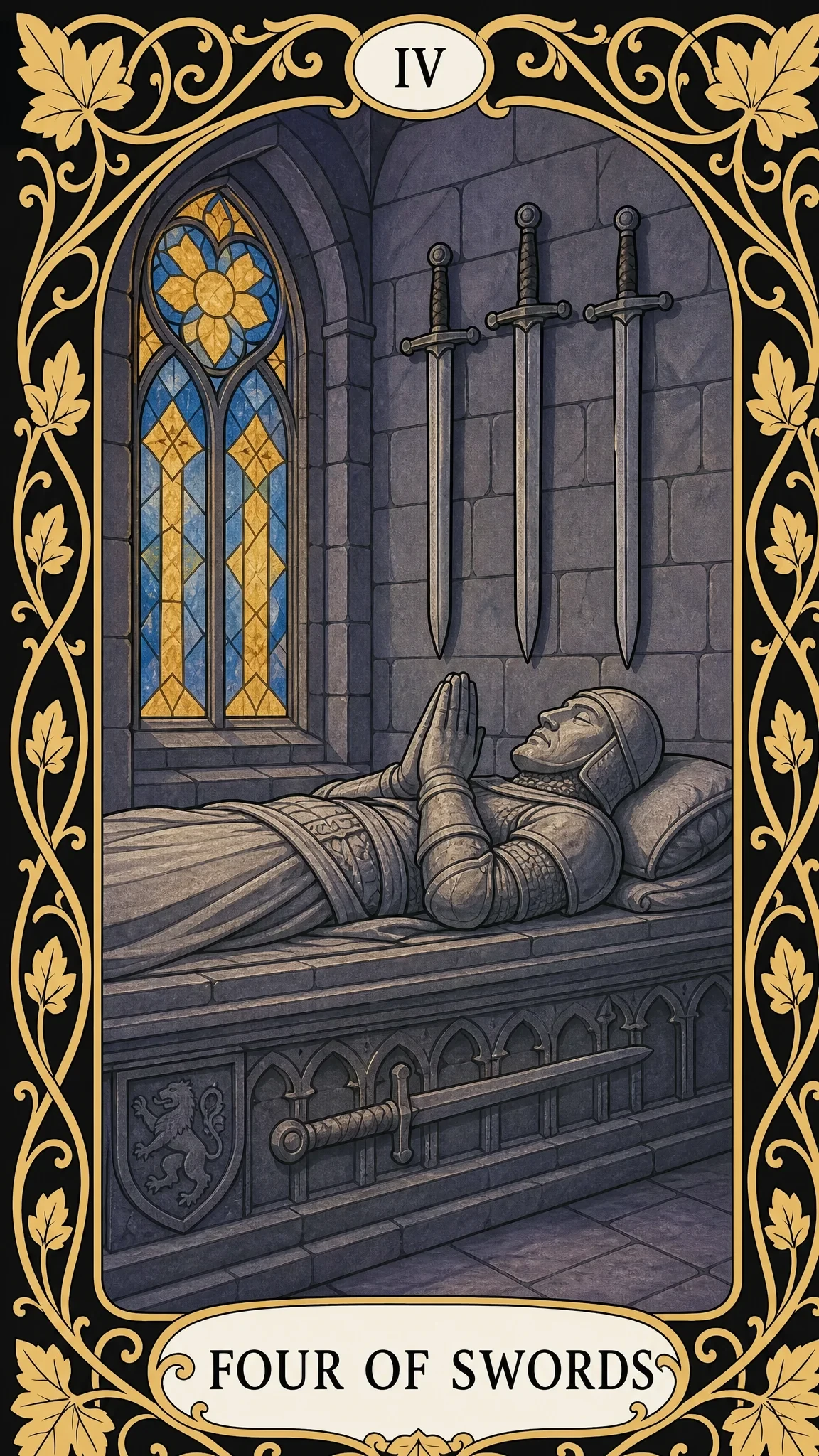
On our card, there is a stone effigy of a knight in armor and a chainmail hood: he lies on a pedestal with his hands folded on his chest in a gesture of prayer, his head resting on a pillow. Above him, on the chapel wall, three swords hang vertically with their points downward; a fourth sword lies horizontally at the very edge of the pedestal, beneath the figure. To the left is a narrow lancet window with stained glass in yellow and blue tones; to the right, a heraldic shield with a lion is visible on the pedestal.
It is important to state clearly: this scene is not about death, even though it looks like a tomb. In classical Tarot iconography, a tomb effigy is a stable symbol of temporary, not final, rest: sculptures of this kind depict people "sleeping" in stone, not the deceased. The prayerfully folded hands are a pose not of a funeral, but of focused, almost meditative stillness.
Here is how the scene is read:
- Three swords on the wall — conflicts and decisions haven't disappeared; they have simply been temporarily set aside and put where they won't interfere with rest.
- The fourth sword under the figure — the very tension the knight hasn't awakened yet: it is nearby, but not in his hand, and he can return to it at any moment when the pause ends.
- Stained glass with soft light — a quiet, almost sacred environment that a person enters intentionally, rather than falling into by accident.
- The folded hands pose — not surrender, but composure: the body is still, but not lifeless.
At the top of the card is the Roman numeral IV; at the bottom is a plaque with the English name FOUR OF SWORDS.
The Four of Swords as the card of the day
The Four of Swords as the card of the day is a direct hint to slow down: reschedule non-essential meetings, avoid unnecessary conversations, and give yourself at least a few quiet hours without screens or arguments. The day is better suited for recovery than for making new decisions.
If the card is drawn reversed, the day will insistently demand the same pause you've been putting off. A useful mindset is not to wait for a total breakdown before finally stopping, but to take a short break in advance while it's still a choice, not a necessity.
Frequently asked questions about the Four of Swords
Is this a Major or Minor Arcana card?
Minor Arcana, suit of Swords, element of Air. There are 56 Minor Arcana cards in a Tarot deck—14 cards for each of the four suits—and the Four of Swords describes not a twist of fate, but a specific period of pause and recovery after tension.
How does the Four of Swords differ from the Four of Pentacles?
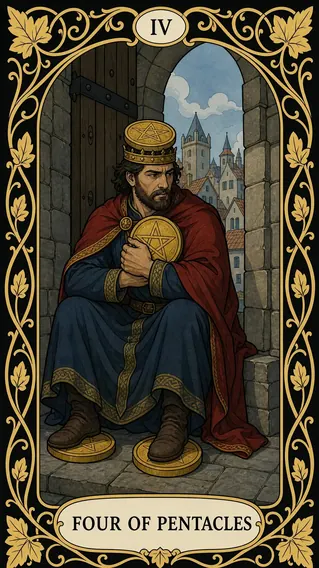
Both cards are about the number four—stability—but they rely on different elements. The Four of Swords (Air) is about a pause of the mind and body, a voluntary rest after conflict or stress. The Four of Pentacles (Earth) is about holding onto material things: money, property, control, often out of anxiety about losing them. If the reading is about fatigue and recovery, it's about Swords; if it's about a tight grip on resources, it's about Pentacles.
The card shows an effigy on a tomb—is it a card about death?
No. This is a classic Tarot image of a stone sculpture of a "sleeping," not dead, figure—a symbol of temporary, deep rest, not an end. The three swords are put away on the wall, not broken, and the fourth lies nearby, ready: the conflict is postponed, not finished forever. The card is about a pause and recharging, not a finale.
Is the Four of Swords a yes or no?
More like "not now": the card doesn't deny the event, but advises not to rush into it until your strength is restored. If the question is about the rest or pause itself, the answer is a confident yes.
What does the reversed Four of Swords mean?
The same necessary rest, but without it: the pause was interrupted too early, exhaustion continues to be ignored, or formal rest doesn't bring peace due to anxious thoughts. Less often, it signifies the end of a prolonged downtime and a readiness to return to work.