What the Seven of Wands means in Tarot
The upright Seven of Wands describes a specific episode rather than a lifelong theme — and this is worth noting immediately, because the image on the card is intimidating in its scale. In reality, the card is about one situation: you have already achieved a certain position — a job, an idea, a reputation, a decision — and now you need to defend it from several sides simultaneously.
An important nuance often lost in retellings: many are attacking on the card, but only one is defending. This is not an equal fight, but the position of a person who has ended up above the rest and is now in everyone's view. Criticism, doubts, competition — all this comes not because the position is weak, but because it is visible.
The second part of the meaning is that the defense itself is quite successful. The hero of the card stands firm; they have the advantage of height and initiative: they see where the blows are coming from and strike first. The Seven of Wands is not about defeat or retreat; it is about the fact that defending what is yours requires effort — and that effort is justified.
Reversed Seven of Wands: meaning
The reversed card is most often read in one of three ways, and the question of the spread helps to figure out which one.
- Defense has exhausted you. You have had to fight back for so long that there is no energy left for the position itself — the person is holding on by inertia.
- Position surrendered. Under pressure from several sides at once, it is easier to retreat than to continue the argument; sometimes this is reasonable, sometimes it is just fatigue disguised as a compromise.
- Defending where no one is attacking. A person perceives ordinary questions and remarks as an attack and defends themselves even against well-meaning interlocutors.
Neighboring cards help distinguish these options: next to Swords cards, the third scenario is more common — anxiety and a defensive reaction without a real cause; next to the Ten of Wands or the Tower — the first, physical and emotional exhaustion from a prolonged struggle.
Seven of Wands in a "yes or no" spread
In "yes/no" spreads, the Seven of Wands is read as yes, but with effort: the event will work out in your favor if you are ready to defend your position, rather than counting on everything to resolve itself. The card does not promise an easy victory — it promises victory on the condition that you stay put and do not yield at the first objection.
If the question is "will it work out without a fight" — the answer is likely negative: the card explicitly speaks of resistance from the outside.
The reversed position in this spread is read as no or as "yes, but at a cost you didn't count on": either the position has already been surrendered, or the strength to defend it ran out before the outside resistance did.
Seven of Wands in relationships and feelings
In a relationship spread, the upright card often describes a situation where feelings or the choice of a partner must be defended against outside opinions: family, friends, exes, or a social circle that doubts these relationships out loud. This is not about infidelity or a rival within the couple — it is more about external pressure.
In the position of feelings, the Seven of Wands is a readiness to defend what is important, even when it would be easier to stay silent: to speak out about your boundaries, to disagree with someone else's assessment of the relationship, to insist on your own way when everyone around is suggesting another.
The reversed position here means two opposite things. Either the person gives in under the weight of others' opinions and stops defending a relationship that is actually dear to them. Or, conversely, they defend themselves against a partner who meant no harm — defending in a conversation where there was no one to defend against.
Seven of Wands in work and money
In career spreads, this is one of the most recognizable cards: a new position, project, or idea for which there are immediately several applicants or critics. You have to explain the decision to different people in turn, fend off questions of "why not otherwise," and hold your ground in negotiations where you are being pressured from several sides at once.
In money matters, the card speaks not of loss, but of a dispute over a resource: for a client, for a share, for deal terms, for a place in the budget that someone else considers their own. The good news is that in the classic image of the card, the defender stands above the attackers — the position is stronger than it seems in the moment of the dispute.
Reversed Seven of Wands in work is either burnout from constant explanations and justifications, or the loss of a position to a more persistent competitor who simply didn't stop for longer.
Seven of Wands as a person: man and woman
When the card appears in the "what kind of person" position, it describes not the character as a whole, but behavior in a specific situation: someone who has taken a prominent place and is now defending it, often alone and against several opponents at once.
A Seven of Wands man in a spread is direct, not inclined to yield at the first objection, and ready to argue for his rightness longer than others expect. A Seven of Wands woman is someone who firmly holds her boundaries and does not change her decision just because several people are pressuring her at once.
This description is not about aggression, but about persistence: such a person rarely attacks first, but does not retreat when attacked.
Seven of Wands in the mindset position
In the mindset position, the card describes a state of constant inner readiness for an argument: a person mentally rehearses arguments and thinks through how to respond to objections that may not have even been voiced yet.
This state can be justified—if pressure is genuinely coming from several sides, thinking through a defense in advance is useful. But it can also be excessive: the feeling that one needs to be ready to defend against everyone arises even when no one has attacked yet. Next to Swords cards, it is more of an anxious anticipation of conflict; next to the King or Knight of Wands, it is a sober preparation for a real dispute.
What to do if you draw the Seven of Wands
The card's advice is simple, though not always easy to follow: choose which position to defend rather than fighting off everyone at once.
- Identify the main line of attack. Not all objections are equally important—some can be ignored without wasting energy on them.
- Stick to facts, not the emotions of the argument. A position is stronger when it is backed by a concrete argument rather than a desire to prove yourself right at any cost.
- Do not confuse defense with offense. Standing your ground is not the same as attacking everyone who expresses doubt.
- Acknowledge fatigue if it exists. If you have no strength left to defend yourself, it is more honest to say so than to hold your ground out of principle.
If the situation has been dragging on and defense has become a constant state, it is worth checking not only the validity of your position but also the price you are paying for it—sometimes an honest conversation with the one who is "attacking" solves more than another round of arguing.
What is depicted on the card
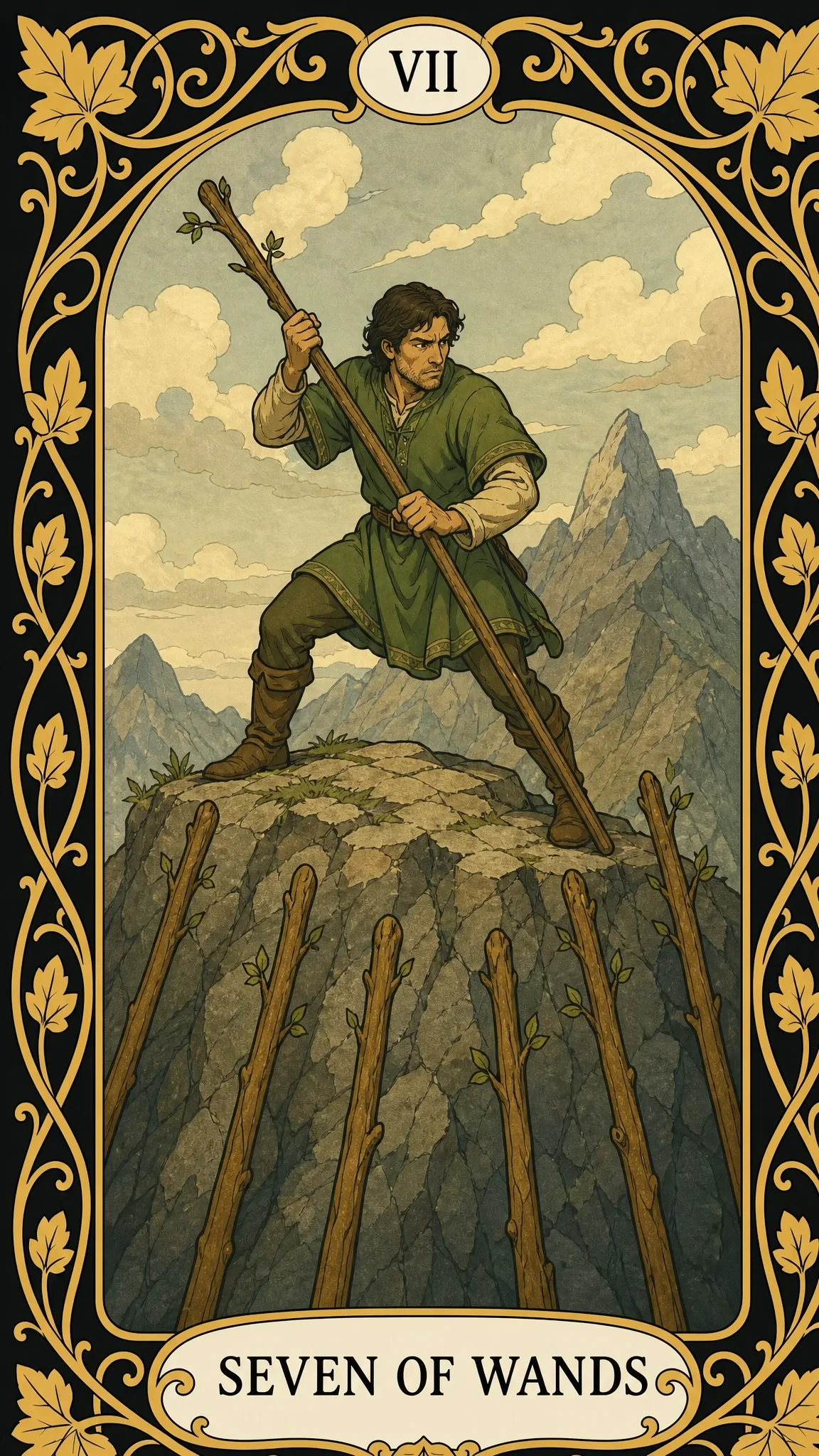
On our Seven of Wands, a young man in a green tunic stands atop a rocky cliff, holding a long wand at the ready with both hands, bracing its lower end against the stones in front of him. His body is turned sideways, one foot on a lower ledge and the other on an upper one, as if turning sharply to face danger rather than waiting calmly. His face is tense, and his gaze is directed downward and to the side—toward where the threat is coming from.
The scene reads as follows:
- Six wands protruding from the slope below—a steady row that is easy to count: they rise from the foot of the mountain toward the defender, but the people holding them are not visible on the card—only the weapons.
- The seventh wand in the hero's hands—the one the defender himself holds: he is alone with the initiative against six lines of attack, but he stands higher on the slope and sees the opponents first.
- The rocky ledge under his feet, with grass pushing through—an uneven but solid footing: the position looks precarious, yet it is already occupied and has not been surrendered.
- Mountains and a cloudy sky in the background—an open space with no cover: one has to defend in plain sight, without the ability to hide from what is happening.
At the top of the card, in an oval medallion, is the Roman numeral VII; at the bottom on a ribbon is the English name SEVEN OF WANDS: our deck is drawn in the Rider-Waite tradition, where the minor arcana have the card number in the medallion rather than the suit emblem.
Seven of Wands as the card of the day
As the card of the day, the Seven of Wands rarely foretells a major conflict—more often, it is a day when you will have to explain your opinion, decision, or merit not just once, but several times, to different people and perhaps at different times.
A useful mindset for such a day: decide in advance which position you are definitely ready to defend, and do not get drawn into an argument over every minor remark. Firmness is appropriate where the issue is truly fundamental; otherwise, it is easier to listen and not waste energy on defense where there was no real attack.
Frequently asked questions about the Seven of Wands
Is it a Major or Minor Arcana?
A Minor Arcana card of the Wands suit, Fire element. There are 56 Minor Arcana cards in the deck in total—14 cards for each of the four suits. Unlike the Major Arcana, which describe major life themes, the Minor Arcana speak of specific, more localized episodes: one argument, one decision, one work situation.
How does the Seven of Wands differ from the Seven of Cups?
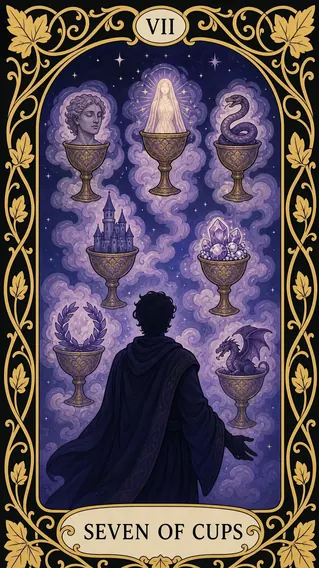
Both cards are the seventh in their suit, but they speak of different things. The Seven of Wands is the Fire element, which is about real action: a specific position that needs to be defended here and now. The Seven of Cups is the Water element, about an excess of options and illusions that are difficult to choose from. One card is about defending a fact, the other is about confusion in fantasies and desires.
Is the Seven of Wands a "yes" or "no"?
More of a "yes," but with a condition: the event will turn out in your favor if you are ready to actively defend your position rather than waiting for everything to resolve itself. If the question is specifically about an easy outcome without resistance, the answer is closer to "no"—the card explicitly speaks of pressure from the outside.
What does the reversed Seven of Wands mean?
Most often one of three options: exhaustion from a long defense, surrendering a position under pressure from several sides at once, or, conversely, a defensive reaction where there was no real attack. Which one it is is suggested by the surrounding cards in the spread.
Does the Seven of Wands mean conflict or victory?
Both, but not at the same time: the card describes a moment of conflict whose outcome is still open. In the classic image, the defender stands higher than the attackers and holds the initiative—this is more of an advantage than a defeat, but it is not the card itself that confirms it, but what you do next.