What the Six of Wands Means in Tarot
The Six of Wands signifies a moment when effort is finally seen: you're praised, noticed, and made to understand that your hard work wasn't in vain. The card's scope isn't as grand as the Chariot or the Sun – it's not a change of destiny, but specific recognition for a specific deed: a closed deal, a passed exam, a completed project, or public praise from someone whose opinion matters.
A crucial nuance to address upfront: the card requires that effort was genuinely made. The Six of Wands isn't about luck or a gift from fate, but about a deserved outcome that has finally been noticed. If cards of labor are present in the reading, such as the Eight of Pentacles or the Chariot, it confirms that success stemmed from work, not random chance.
🔴 Like any Minor Arcana card, this card represents an episode, not a whole destiny. It doesn't promise that recognition will last forever or that one victory will automatically lead to another: what happens next will be shown by the surrounding cards.
Reversed Six of Wands: Meaning
The Reversed Six of Wands most often signifies not defeat, but recognition that didn't materialize as hoped. It has several typical interpretations, and the context of the reading helps choose the right one.
- Work noticed by the wrong people or in the wrong way. The effort was real, but the response was absent – the boss didn't say thank you, the audience didn't react, the expected praise didn't come.
- Success exists, but the person doesn't acknowledge it. Classic imposter syndrome: the result is good, but internally there's a feeling of 'I just got lucky' or 'anyone could have done it'.
- Over-reliance on approval. The person does what will earn praise, not what's important to them; without external validation, they lose their footing.
- Someone else's achievements are claimed. Less common, but it happens: a victory was attributed to someone who didn't actually achieve it.
The difference from the upright position is simple: the upright card signifies the alignment of effort and recognition, while the reversed card indicates their disconnect.
Six of Wands in a "Yes/No" Reading
In "yes/no" readings, the Six of Wands almost always answers yes – but with a clarification: if effort has already been invested. The card isn't about luck from scratch; it's about the result of invested labor, so it doesn't support the question 'Will it work out if I do nothing?'
The reversed position softens the answer to 'yes, but later and without fanfare': the matter itself might resolve, but recognition, applause, or public approval won't be present this time. This is worth considering in questions like 'Will I be noticed?' or 'Will my efforts be appreciated?' – the reversed card here leans towards a negative answer.
Six of Wands in Relationships and Feelings
In a relationship reading, the upright Six of Wands describes a couple that is seen and admired – public recognition of the union: an engagement everyone knows about, a reconciliation that close ones are talking about, or a partner who is a source of pride. It's a card of relationships that aren't hidden.
In the position of feelings, it reads as pride and pleasant confidence: the person has been chosen, valued, and preferred over others – and this feels deserved, not like random luck.
The Reversed Six of Wands in relationships signifies a feeling that you're trying for your partner, but not receiving a response: your efforts go unnoticed within the couple, even if everything appears fine externally. Another interpretation is jealousy of other couples' public recognition, a desire for the same acknowledgment you currently lack.
Six of Wands in Work and Money
In career readings, the Six of Wands represents a promotion, public praise from a supervisor, a successful presentation, a won tender, or a project that has finally been completed and is known to the entire team. The card well describes the moment of result announcement, rather than the work itself.
In financial readings, it signifies income received for specific, recognizable effort: a bonus, a fee, a closed deal, rather than passive or random earnings. Neighboring cards will indicate the scale: next to the Three of Pentacles, it suggests team recognition; next to the Ace of Wands, it signifies the beginning of a new wave of interest in the person.
The reversed position here indicates a delayed bonus, a postponed promotion, or recognition that went to someone other than the person who actually did the work. The card's advice in this case is simple: document your authorship in advance, rather than relying on justice to prevail on its own.
Six of Wands as a Person: Man and Woman
When the Six of Wands appears in the 'what kind of person' position, it describes not the entire character, but the current role: this is someone who is currently in the spotlight and on the rise, who is supported and favored without unnecessary disputes.
A Six of Wands man is self-assured and charismatic, naturally finding himself in the center of attention and not shying away from it; others trust him and readily acknowledge his rightness. A Six of Wands woman is noticeably successful, her achievements are evident without reminders, and her authority is earned, not assigned from above.
This is not a permanent assessment of personality, but a snapshot of the moment: the person is currently riding a wave of recognition, and this should be considered when reading the spread, rather than turning it into a permanent label.
Six of Wands in the thoughts position
In the thoughts position, the Six of Wands signifies attention focused on how others perceive you. You're mentally replaying potential reactions: how people will respond to news, whether your effort will be noticed, if you'll receive thanks. Often, these are pleasant anticipations, but sometimes it's an anxious dependence on external approval, where your own assessment of the outcome loses meaning without external validation.
Neighboring cards will hint at which scenario is closer: alongside confident Wands cards, it's healthy anticipation of deserved praise; alongside Swords or reversed cards, it's an obsessive thought about "what if they don't notice."
What to do if the Six of Wands appears
The card's advice is simple: allow yourself to accept recognition, don't downplay it. Many, at the moment of success, immediately look for a reason to say "it's nothing" or "I just got lucky"—thereby devaluing what was truly earned.
What's worth doing practically:
- Separate the result from the applause. Praise is pleasant, but the card is fundamentally about the completed task—keep your focus there, not solely on the audience's reaction.
- Name those who helped. If a team or a specific person was involved in the success, acknowledging them aloud doesn't diminish your own achievement.
- Don't chase repeated approval at all costs. One success doesn't have to immediately become a habit of constantly proving yourself anew.
- Use the moment, don't just enjoy it. Recognition is a good time to ask for something you've been putting off: a raise, a new task, trust.
If recognition doesn't come, and the waiting becomes exhausting—it's a reason to talk to someone who can provide honest feedback, rather than guessing the reasons alone.
What is depicted on the card
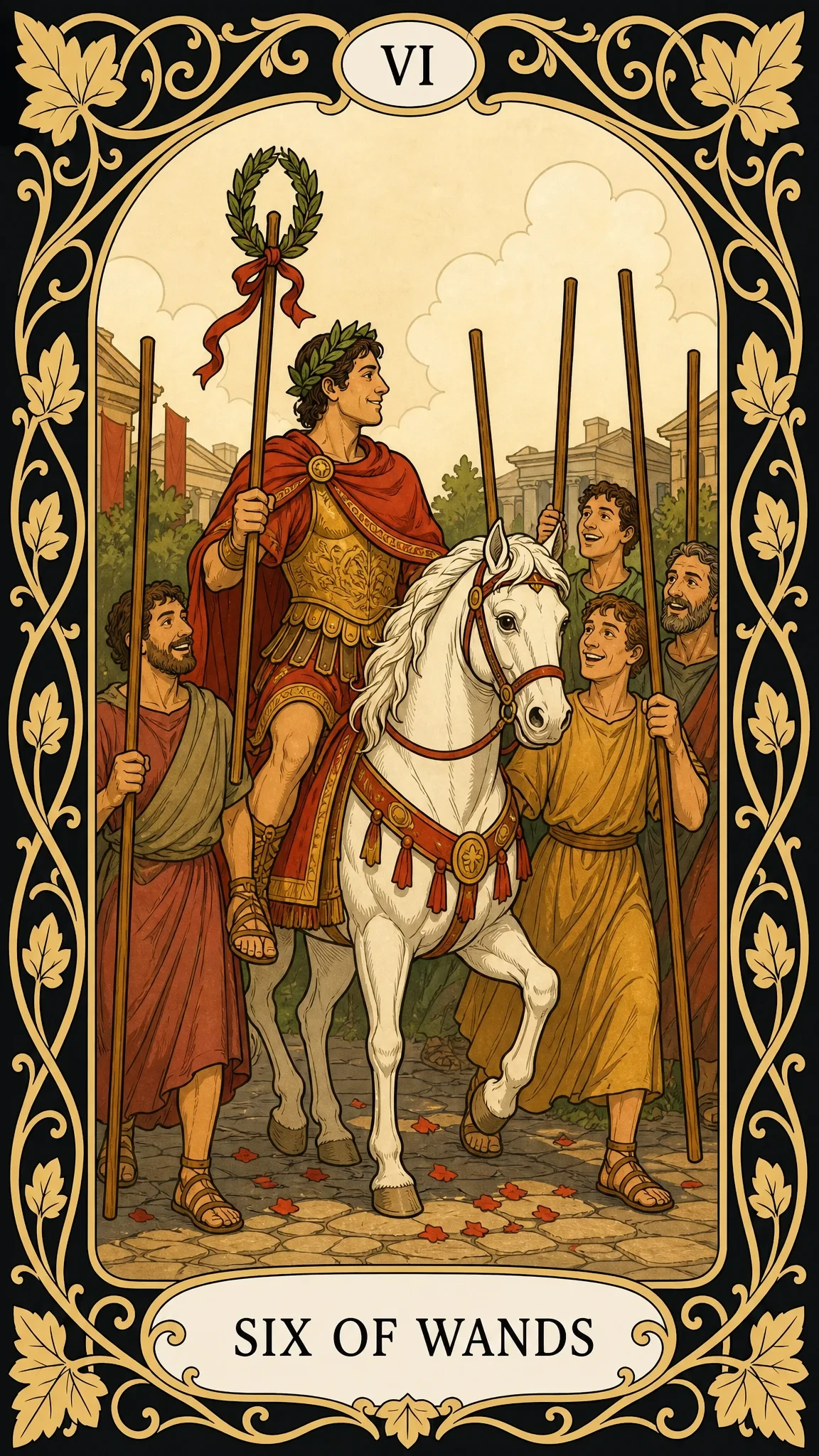
Our Six of Wands depicts a triumphant procession in the spirit of an ancient Roman general: a young rider in golden armor and a scarlet cloak, with a laurel wreath on his head, rides a white horse through a crowd of comrades. In his hand, he holds a tall wand, topped with a laurel wreath and a red ribbon—this is the only decorated wand in the entire scene. The comrades around carry five plain staffs without adornments, one per person: a total of six wands on the card.
The scene is interpreted as follows:
- The rider in the center—the one whose effort is recognized first, the face of victory.
- The white horse—the confidence and ease with which recognition is accepted, without strain or struggle.
- The wreath only on his wand—recognition is specific: victory has a name, and the crowd knows whose it is.
- The five plain staffs held by those nearby—those without whom the procession wouldn't have happened. They are present and noticeable, but the laurels aren't theirs today: the card is as much about someone else's recognized success as it is about your own.
- The scarlet cloak and golden armor—status and visibility: the person on this card is seen from afar, they can't hide, and there's no need to.
At the top of the card is the Roman numeral VI, and at the bottom—the English name SIX OF WANDS: in our deck, the suit of Wands retains the traditional numbering of the Minor Arcana.
Six of Wands as a Day Card
The Six of Wands as a Day Card usually heralds a day when a small effort receives a response: someone publicly acknowledges your work, good news arrives regarding something done long ago, or you manage to perform or showcase results in front of others.
A useful mindset for such a day: accept praise without immediately dismissing it as "oh, it was nothing," but also don't let it consume the entire day to the detriment of other tasks. If recognition doesn't happen—don't consider it a failed day: the card indicates the probability of a response, not a guarantee, and the outcome still depends on the specific situation.
Frequently asked questions about the Six of Wands card
Is it a Major or Minor Arcana?
A Minor Arcana of the suit of Wands, element Fire. There are 56 Minor Arcana cards in the Tarot deck—14 cards in each of the four suits—and the Six of Wands is one of them.
How does the Six of Wands differ from the Six of Cups?
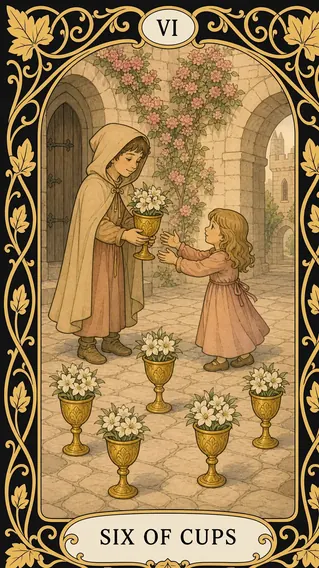
Both cards are about the sixth stage of their suit, but the themes are different. The Six of Wands looks forward and outward: public recognition, success that others see. The Six of Cups looks backward and inward: nostalgia, childhood memories, a warm personal past without an audience. One is about the stage, the other—about memory.
Is the Six of Wands always about public success?
Not necessarily in the sense of worldwide fame, but the element of "someone recognized and appreciated it" is almost always important. It could be one person whose opinion matters, not a crowd—the essence of the card is the response to effort, not the scale of the audience.
What does the reversed Six of Wands mean at work?
Most often—delayed recognition: a bonus or promotion is postponed, and credit is given to someone other than the person who actually did the work. Less often—the devaluation of one's own success by the person themselves. The card's advice in this position is to document your authorship in advance, rather than waiting for justice to be restored on its own.
Is the Six of Wands a yes or no in a reading?
More likely yes, if it's about a task to which effort has already been invested. The card does not support expecting success out of thin air. In the reversed position, the answer softens to "yes, but without immediate recognition and possibly later than desired."