What the Seven of Cups means in Tarot
The Seven is a mid-journey card within the suit of Cups: the spark of the Ace has already passed through the Two, Three, and Six, and now feelings are facing the reality of choice. Cups represent emotions and imagination; their element is water, and water easily takes any shape — including the shape of an impossible dream.
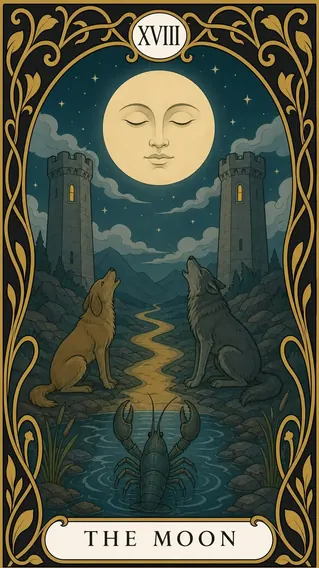
An important nuance often lost in retellings: the Minor Arcana describes an episode, not a destiny. While the major Moon card speaks of illusion as a constant state of consciousness, the Seven of Cups is about a specific moment when a person is faced with several tempting options at once, and it is unclear which one is real and which is just a pretty picture.
The upright position is read as an excess of choice without criteria: the options are tempting, but none have been truly tested for durability. The card is not about dreaming being bad, but about decisions being constantly postponed while fantasies replace action.
Reversed Seven of Cups: meaning
The reversed Seven of Cups is the moment when the fog finally clears. Usually, the spread refers to one of the options, and the question itself helps to choose.
- The choice is finally made. After much hesitation, one option has become clearer than the others, and the unnecessary has been discarded.
- The illusion has shattered. What seemed like an ideal option turned out, upon closer inspection, not to be what it appeared.
- Reality has sobered you up. There is a realization of how much energy is spent on dreams instead of steps, and frustration with oneself for the delay has emerged.
There is also a less pleasant reading: sometimes the reversed card is not clarity, but disappointment in a decision already made. The difference lies in whether the new sobriety brings relief or bitterness.
Seven of Cups in a "yes or no" spread
In "yes/no" spreads, the upright Seven of Cups is more likely read as no or "too early to answer": the card describes a state where a decision has not yet crystallized and there are too many options to choose one. If the question is "should I take this step right now," the answer is more likely "figure out what you really want first."
If the question is different — "do I have options," "will new opportunities appear" — then the card is more likely yes, and in abundance: there will be many opportunities, the question is which one you can bring to a result.
The reversed position in this spread is closer to yes: the illusions have dissipated, and it has become clear which option is real. The question should be rephrased not as "will it work out," but "which of the options am I actually choosing."
Seven of Cups in relationships and feelings
In a relationship spread, the upright Seven of Cups often describes falling in love with an image rather than a person: the partner is imagined as one wants to see them, not as they are. This can be a period when you like several people at once, and it is difficult to understand who your feelings are real for, and who is just an interest born of boredom.
For existing relationships, the upright position sometimes points to a gap between the fantasy of an ideal couple and everyday reality: comparing a partner to an imaginary ideal rarely benefits a relationship.
The reversed Seven of Cups in feelings is a sober look at a person without embellishment: both strengths and weaknesses are visible, and this helps decide whether to continue the relationship or not. If the topic is heavy — codependency, deception, toxic attachment — the card does not replace a conversation with a specialist; the decision here is made only by the person themselves.
Seven of Cups in work and money
In career spreads, the Seven of Cups is a scattering of tempting offers, none of which have been tested by action yet: several projects, vacancies, or business ideas, each looking promising on paper. The card warns not to refuse to choose altogether, but not to grab everything at once.
In money, the upright position is often about financial fantasies: calculations that look beautiful but are not backed by real steps — investing, buying, trying to earn from a trendy idea without proper verification. It is not at all the same as, say, the Ten of Pentacles, which is about a stable result, not potential.
The reversed position in work and money is the moment when it is time to stop browsing options and choose one, bringing it to concrete action instead of another comparison of offers.
Seven of Cups as a person: man and woman
When the Seven of Cups appears in the "what kind of person" position, it describes not a character as a whole, but the role of a dreamer: someone who easily gets carried away by new ideas but rarely sees them through to the end. Usually, this is a creative, charming person with a rich imagination, with whom it is interesting to fantasize about the future.
The Seven of Cups woman is someone who sees the best potential in people and situations first, sometimes confusing it with reality. The Seven of Cups man is someone who keeps several plans in his head at once and chooses between them for a long time, unable to decide on one.
The flip side for both is the same: it is easy to get lost in conversations about the future with such a person and not notice that no real steps have been taken yet. If reliability is important in the spread, it is worth looking at neighboring cards, for example, the Eight of Pentacles, which is about painstaking work, not dreams.
Seven of Cups in the thoughts position
In the thoughts position, the Seven of Cups represents a scattered, slightly dreamy state: several future scenarios are spinning in your head at once, and it's hard to focus on one task because your imagination keeps throwing up more interesting options.
Such a state is pleasant in itself, but it doesn't help with decision-making: the more fantasies you have, the harder it is to choose which one to grab first. If Swords appear nearby in the spread, an excess of dreams can turn into anxiety from indecision; next to Pentacles, one of the ideas is more likely to be put into practice.
What to do if you draw the Seven of Cups
The card's advice is simple: choose one option and test it with action, not imagination. The Seven of Cups isn't about dreaming being bad, but about the fact that endlessly cycling through options doesn't move things forward on its own.
What you should actually do:
- Make a short list of all options and honestly cross out those that you only like in theory.
- Choose one item and take a real step toward it — not a plan, but a verifiable action.
- Separate facts from fantasy: what is known for sure about the option, and what is just imagined.
- Give yourself a specific deadline for a decision so that the process of weighing options doesn't drag on forever.
If the reason for your question is an addiction to illusions, a heavy attachment to the unattainable, or another difficult situation, this reading does not replace a conversation with a specialist: the card shows a state of mind, not a solution to complex problems.
What is depicted on the card
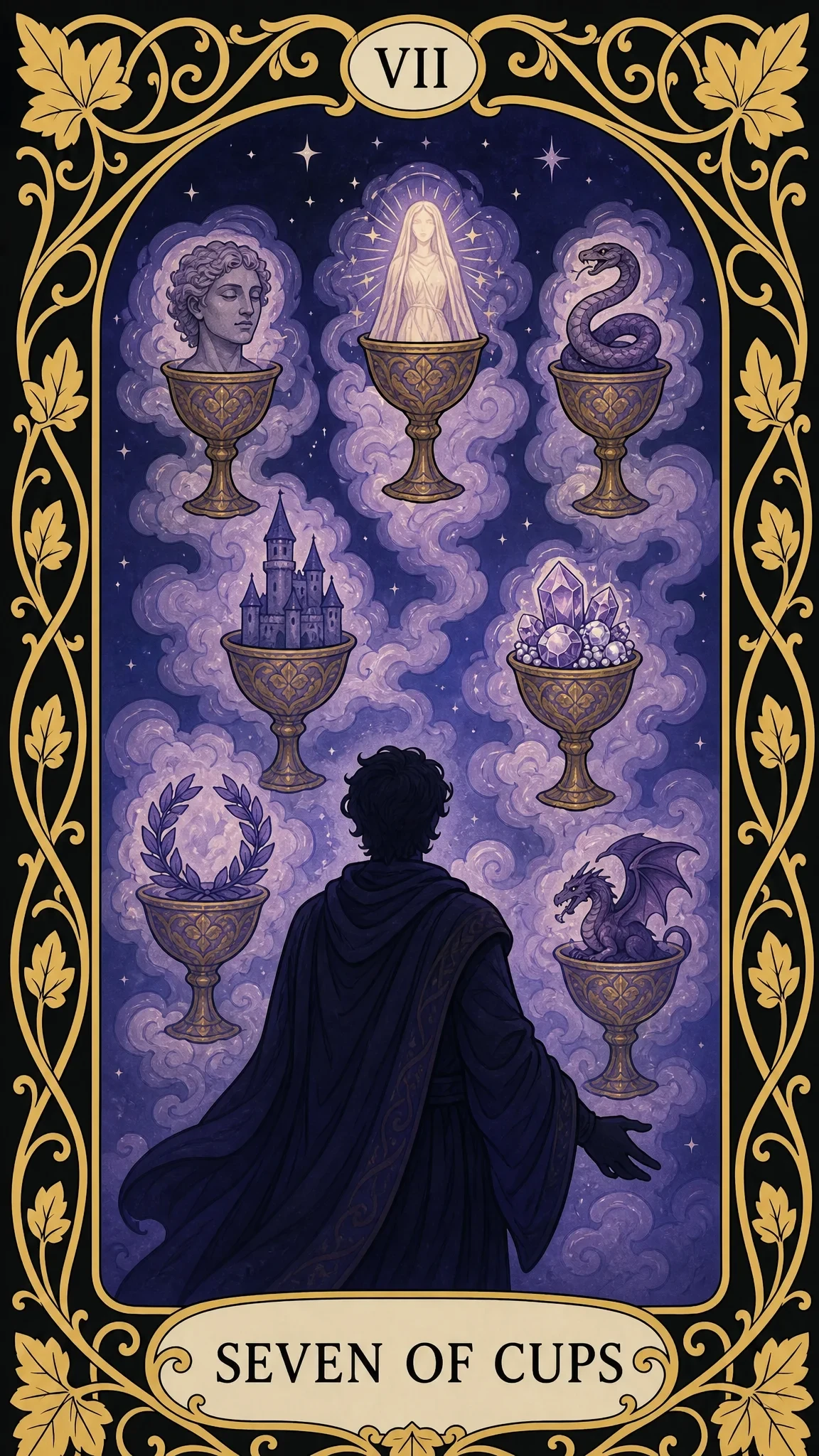
On our card, a dark hooded figure stands with their back to the viewer against a backdrop of a night sky and swirling purple clouds strewn with stars. Before them, seven golden cups float in the air, each containing a different image.
- A marble bust — vanity and an idealized image of a person who is easy to get carried away by, but hard to truly know.
- A glowing figure in a crown of rays — an unattainable ideal, an almost ghostly vision of what one aspires to.
- A snake — temptation and hidden danger behind a beautiful facade.
- A castle with towers — a dream of wealth, status, and power that has yet to be reached.
- A cluster of crystals and gems — material wealth that lies on the surface but hasn't been earned.
- A laurel wreath — fame and victory that beckon but have not yet been won.
- A small winged dragon — a guarded treasure and the risk that comes with it.
The set of images almost literally repeats the classic Rider-Waite version — a rare case where our deck doesn't reinvent the symbolism but carefully preserves it: this arcana is too recognizable in the original set of cups to change. The difference is in the atmosphere: instead of gray clouds, we have a deep purple mist, and instead of a featureless silhouette, a dark figure with a barely discernible face reaches out to one of the cups, as if about to make a choice. At the top of the card is the Roman numeral VII, and at the bottom is a plaque reading SEVEN OF CUPS.
Seven of Cups as the card of the day
The Seven of Cups as the card of the day is a signal to notice how much time is spent today on fantasies instead of concrete tasks. The day is suitable for honestly sorting through options rather than piling up new ideas on top of unresolved ones.
If the card appears reversed, the day is more about clarity: what seemed like a confusing choice may finally become clear if you don't rush and look at the options soberly, without embellishment.
Frequently asked questions about the Seven of Cups
Is it a Major or Minor Arcana?
Minor Arcana, suit of Cups, element of Water. There are 56 Minor Arcana cards in a Tarot deck in total — 14 cards for each of the four suits, and the Seven of Cups is the seventh in the suit of cups.
How does the Seven of Cups differ from the Seven of Swords?
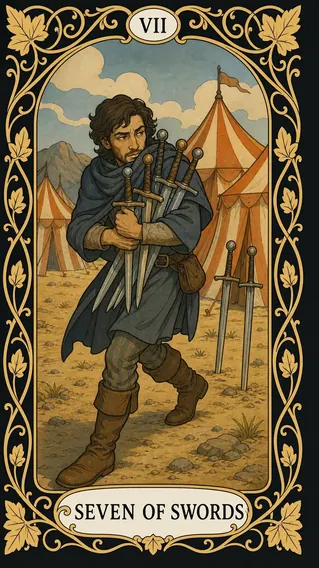
Both sevens are about multiple paths at once, but of a different nature. Cups are the element of water, feelings, and imagination: the Seven of Cups is about an excess of tempting dreams and the difficulty of choosing between them. Swords are the element of air, strategy, and cunning: the Seven of Swords is about calculated deception or an evasive maneuver, not dreams. If the reading is about fantasies and indecision, it's about cups; if it's about secrecy and a cunning plan, it's about swords.
Is the Seven of Cups a yes or no?
More likely no or "too early": the card says there are too many options and the decision hasn't matured yet. The reversed position is closer to yes — the illusions have dissipated, and the choice has become obvious.
What does the reversed Seven of Cups mean?
Clarity: either the choice has finally been made, or the illusion that was believed in has collapsed upon closer inspection. Sometimes this is a relief, and sometimes it is a disappointment in what had already been chosen.
Can the Seven of Cups mean money?
Yes, but as a warning: the card is about financial fantasies and tempting offers that haven't been tested by action. Before investing, it's worth separating real calculations from a pretty picture.