What the Eight of Cups means in Tarot
Cups in Tarot represent feelings and satisfaction, not willpower or material results: if Wands ask "did you start?" and Pentacles ask "did you receive?", then Cups ask "does what you have fulfill you?". The Eight of Cups is a card where the answer is honest and uncomfortable: no, it does not fulfill you, even if everything is formally done correctly.
An important nuance often lost in retellings: the minor arcana describes an episode, not an entire destiny. The Eight of Cups is not a diagnosis that "life is empty," but a specific evening when a person admits to themselves that they no longer want to drag on with the familiar, even if there seem to be no external reasons to leave.
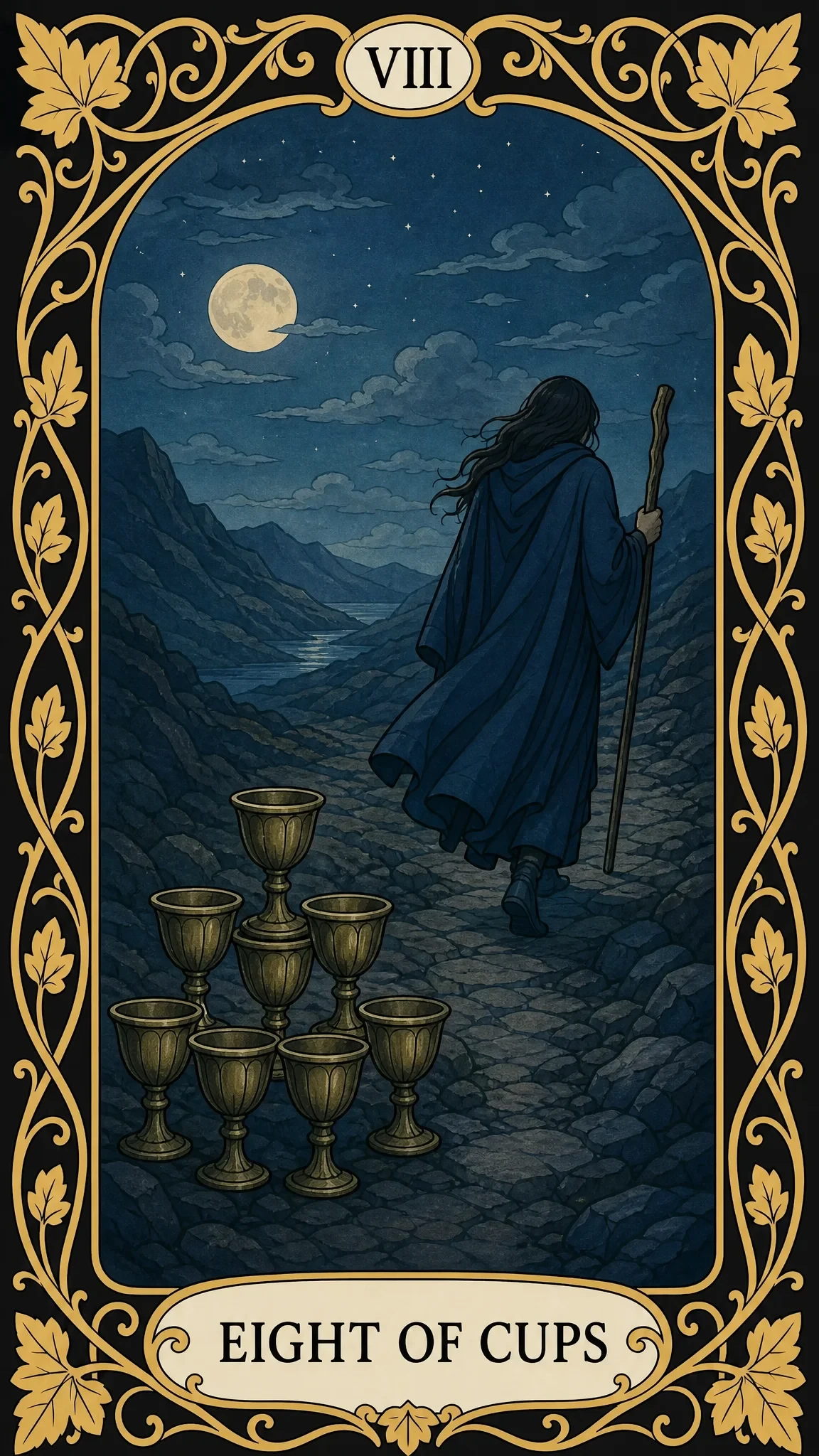
On the card, there are eight full cups — not broken or overturned — and a figure turning away and walking into the darkness toward distant mountains. This fundamentally distinguishes the Eight of Cups from the Five of the same suit: there, one mourns a loss; here, one consciously leaves what is still whole because it has ceased to be enough.
Reversed Eight of Cups: meaning
The reversed Eight of Cups is the same impulse to leave, but stuck halfway. Usually, the spread refers to one of three options, and the question itself helps to figure it out.
- The decision is made internally, but the step is not taken. The person has mentally said goodbye to the situation but continues to stay in it — out of fear, habit, or a sense of duty.
- Departure without direction. They have left the old, but haven't decided where to go; hence the feeling of darting between options rather than moving forward.
- Returning to what is no longer liked. After a failed attempt to start over, the person returns to their former lifestyle — not because it has become better, but because it is familiar.
There is also a softer reading: sometimes the reversed card is not about being stuck, but a pause before making a final decision, and it is no worse than the upright position if the person uses it to weigh things rather than to hide.
Eight of Cups in a "yes or no" spread
In "yes/no" spreads, the Eight of Cups is usually read as no — but specifically no to the question "should I stay, continue, or keep things as they are?" If the question is "should I leave" or "is it time to change something," the card is, on the contrary, confirming, often with a nuance of "it's high time."
If the question is about a specific outcome ("will they return," "will it work out if I stay"), the Eight of Cups does not answer it: it is about the decision to leave, not about what happens afterward. Other cards are needed in the spread for that.
The reversed position in this spread means "not yet, but internally yes": the person is ready for change but does not give themselves permission to act. The question should be rephrased not as "will it happen," but "what is holding me back from taking the step."
Eight of Cups in relationships and feelings
In a relationship spread, the upright Eight of Cups almost always describes emotional cooling despite external well-being: the relationship looks stable, the partner has done nothing wrong, but there is no warmth or response inside anymore. This is not a card of betrayal or scandal, but a quiet admission that feelings have changed.
In the position of feelings, the card shows not an absence of love in general, but a shift: the person is looking not for less caring relationships, but for deeper ones — where they are seen and heard in a way that is no longer possible here. For a single person's spread, the upright Eight of Cups often means a conscious refusal of light, casual connections in search of something real.
The reversed Eight of Cups in relationships means the person is staying, even though everything is decided inside: they maintain the familiar lifestyle, fearing loneliness more than they fear unhappiness. Or, conversely, they have already left emotionally but cannot formally close the chapter.
Eight of Cups in work and money
In career spreads, the Eight of Cups represents leaving a stable position for something that does not yet bring money or recognition, but resonates with one's sense of purpose. The card well describes the moment when a successful project suddenly stops bringing joy: the goal is reached, but there is no satisfaction, and this is more troubling than failure.
In money, the upright position is not a loss of income, but a voluntary refusal of part of one's earnings in exchange for meaning: changing fields, leaving a profitable but draining job. This distinguishes the card from, for example, the Five of Pentacles, where money is lost against one's will.
The reversed Eight of Cups in work means holding onto a position or business that has long ceased to bring joy because it is scary to start over without guarantees. The advice here is simple: before quitting everything, it is worth honestly understanding if there is a resource for a transition period, rather than acting solely out of exhaustion.
Eight of Cups as a person: man and woman
When the Eight of Cups appears in the "what kind of person" position, it does not describe the entire character, but the role of the seeker: someone who has outgrown their circumstances and is not ready to pretend that everything is fine just to avoid changing the familiar. Usually, this is a person who is calm on the outside but has an internal compass that pulls them beyond their current situation.
The Eight of Cups man is someone who can leave a seemingly successful life without scandal or explanation because internal resonance is more important to him than status. The Eight of Cups woman is someone who is the first to admit to herself that what has been achieved no longer fulfills her and is not afraid to start the search anew.
The downside for both is the same: it is difficult to count on stability with such a person if they have not yet found what they are looking for. If stability is important in the spread, it is worth checking if there are other cards nearby that speak of a completed cycle, such as the Ten of the same suit.
Eight of Cups in the thoughts position
In the thoughts position, the Eight of Cups represents a quiet but persistent feeling that "this is no longer it." Thoughts revolve around the question of why all this was done if the result brings no joy; the person mentally rehearses leaving long before they actually decide to do so.
This state is not one of anxiety, but rather of contemplation and turning inward. If Swords appear nearby in the spread, doubts can turn into exhausting self-reflection; with Pentacles, thoughts are more likely to land on a concrete plan of where and how to leave.
What to do if you draw the Eight of Cups
The card's advice is simple: give yourself permission to admit that what you have achieved is not enough, without waiting for an external reason to leave. The Eight of Cups does not demand an immediate break from everything at once — it requires honesty with yourself about what has stopped fulfilling you.
What you should actually do:
- Name specifically what is missing. Not just "everything is bad," but what exactly has stopped resonating — otherwise, the search for something new will lead you to the same place.
- Do not confuse fatigue with a meaningless goal. Sometimes it's not about leaving, but about taking a pause and recovering — it's worth checking this before making rash decisions.
- Make the departure gradual, if possible. The Eight of Cups does not require burning bridges — you can prepare the ground while looking for something new.
- Check what is holding you in place — fear, obligations to others, or a real lack of resources for the transition.
If the departure is driven not by a search for meaning, but by prolonged apathy, loss of interest in everything, or a depressed state that has lasted for weeks — the spread is not a substitute for talking to a specialist: the card shows the movement of a feeling, not a diagnosis or a solution to a complex condition.
What is depicted on the card
Our card features a night scene: a lonely figure in a dark blue cloak with long, flowing hair walks along a rocky path away from the viewer, leaning on a wooden staff. Behind, at their feet, eight golden cups are stacked on the ground — all intact, none overturned or broken. Ahead lies a mountain valley with a river, and a full moon hangs high in the starry sky.
The scene is interpreted as follows:
- The cups are left behind intact — the departure is not related to loss or punishment: the person leaves exactly what they had, it has simply exhausted itself.
- Night and a starry sky instead of the usual twilight — our version of the card emphasizes that the decision is made not in a panic, but in silence, alone with oneself, without witnesses or advisors.
- A staff in hand — the support the person takes with them: they are not running away empty-handed in despair, but consciously equipping themselves for the journey.
- River and mountains ahead — the path is not shown to the end, the goal is not yet visible, but the road has already been chosen.
At the top of the card is the Roman numeral VIII, and at the bottom is a plaque with the English name EIGHT OF CUPS: the deck follows the Rider-Waite tradition, where the night silence here is read as an emphasis on the internal, rather than the performative, nature of this departure.
Eight of Cups as the card of the day
The Eight of Cups as the card of the day is a reason to honestly ask yourself if what you are busy with today still fulfills you, or if you have been doing it out of inertia for a long time. The day is not suitable for sharp breaks, but for a sober review: what is worth leaving behind, and what is too early to bury.
If the card is drawn reversed, the day is more about the fact that the decision has already matured inside, but you are afraid to voice it. A useful mindset is not to demand an immediate step from yourself, but at least to honestly name out loud or to yourself what exactly is missing.
Frequently asked questions about the Eight of Cups card
Is it a Major or Minor Arcana?
Minor Arcana, suit of Cups, element of Water. There are 56 Minor Arcana in the Tarot deck in total — 14 cards for each of the four suits, and the Eight of Cups continues the count of the journey within the suit of feelings.
How does the Eight of Cups differ from the Eight of Swords?
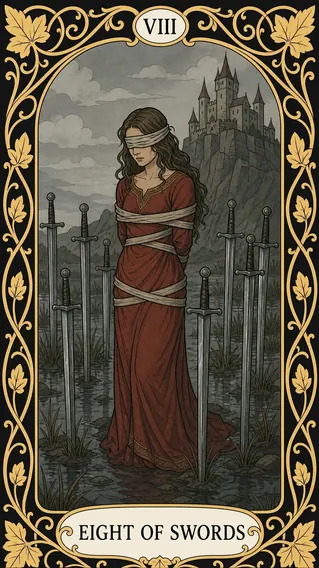
Both cards are about the feeling of a dead end, but of a different nature. Cups are the element of water, feelings: the Eight of Cups is about a voluntary departure when the decision has already been made and the path is clear. Swords are the element of air, the mind: the Eight of Swords is about the feeling of a trap, when a person feels bound by their own thoughts, even if they can objectively leave. If the conscious choice to leave what has been achieved is important in the spread, it's about Cups; if the feeling of constraint and an internal prohibition to act is important, it's about Swords.
Is the Eight of Cups a yes or no?
Probably no, if the question is about whether you should stay and continue as is. If the question is about whether you should leave or change something, the answer, on the contrary, is affirmative — the card is specifically about the timeliness of leaving, not about maintaining the status quo.
What does the reversed Eight of Cups mean?
The same impulse to leave, but without a completed step: the decision has matured inside, but you are afraid to act, or the departure has already happened, but without a clear direction. Sometimes it is just a pause before a final decision, not a refusal of it.
Does the Eight of Cups mean a breakup?
Not necessarily a dramatic breakup — more often it is an acknowledgment that feelings have changed in an otherwise outwardly prosperous relationship. This can later turn into a parting, or into an honest conversation that changes the relationship itself for the better. The card shows the moment of realization, not a finished outcome.