What the Seven of Swords means in Tarot
Swords in Tarot represent the mind, words, and strategy, not brute force, and their element is air: fast, cold, and calculating. The Seven of Swords is a card about the moment when the direct path seems too long, too risky, or too public, and a person chooses to bypass it.
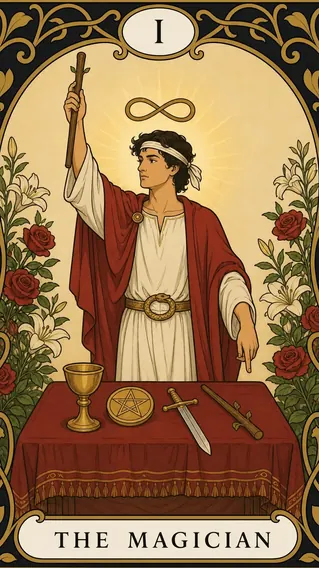
An important nuance often lost in retellings: the minor arcana describes a specific maneuver, not a person's entire character. While the Magician speaks of dexterity and mastery of tools in general, the Seven of Swords is about a single move: resolving an issue quietly, without approvals, and without attracting unnecessary attention. This can be resourcefulness — bypassing bureaucracy, getting out of a dead end without a scandal, or handling things yourself while others argue. Or it can be corner-cutting — taking what isn't yours or staying silent when you should have spoken up.
The card does not pass moral judgment on its own: it shows a maneuver, and its nature — whether it is honest or not — is determined by surrounding cards and the situation itself. The upright position is read unambiguously as acting indirectly rather than head-on. How justified this is, the Seven of Swords does not judge — for that, you should look at the cards nearby in a reading, primarily at who pays the higher price for this maneuver.
Reversed Seven of Swords: meaning
The reversed Seven of Swords is the same maneuver, but at a stage where it is either being revealed or is no longer satisfying the person themselves. Usually, the reading points to one of three options, and a question helps to choose.
- The hidden has become obvious. What was done quietly has come to light — not necessarily with a catastrophe, but explanations will be required.
- The person is tired of playing a double game. Keeping track of who was told what and what was left unsaid turned out to be harder than taking one direct step.
- The maneuver didn't work. The detour led to the same place a direct path would have, only with a loss of time and trust.
There is also a calmer reading: the reversed card often signifies a decision to return to honesty — not because one was forced, but because it became easier to live that way. The difference is whether this decision came on its own or was forced by circumstances.
Seven of Swords in a "yes or no" reading
In "yes/no" readings, the Seven of Swords answers yes, but not in the way you have in mind. The direct path is likely closed or too expensive, but a detour is quite viable: negotiate on the side, approach from a different angle, or do it yourself instead of waiting for permission.
If the question is "will it be possible to negotiate openly" or "will everything be resolved honestly and immediately" — the answer is likely negative. If the question is broader, "will it work out at all" — the answer is affirmative, it's just that the path to it won't be the most direct one.
The reversed position in this reading is "not yet": the maneuver is either already revealed, or it is safer to abandon it and look for an honest option, even if it is slower.
Seven of Swords in relationships and feelings
In a relationship reading, the Seven of Swords most often speaks of things left unsaid rather than infidelity — and this is an important distinction: the card describes omission, not a specific event. Someone in this story decides not to resolve the relationship directly but to bypass an uncomfortable conversation. This could be a partner, but it could just as easily be the person pulling the cards — the card alone does not allow you to assume who exactly.
In the position of feelings, the Seven of Swords is caution, a reluctance to open up completely, and a habit of keeping something to oneself "just in case." This is not necessarily a warning sign: sometimes this is how a person looks who has once been burned by complete honesty and is now consciously rationing it.
If the reading directly asks about trust, it is more honest to ask the person in question rather than the card: the Seven of Swords shows a tendency toward maneuvering, but not the fact of specific deception.
The reversed card in relationships is a moment when the unsaid surfaces or when one of the two finally decides to say what they have been silent about.
Seven of Swords in work and money
In career readings, the Seven of Swords is about solving a task by bypassing the usual order: without a meeting, without a manager's permission, without disclosure to the team. Sometimes this is resourcefulness that saves everyone's nerves, sometimes it is a risk if bypassing the rules is discovered at the wrong time.
In money, the upright position often points to an expense or a deal that not all interested parties know about: a hidden purchase, an agreement bypassing an intermediary, or income that one is in no hurry to report. The card does not say whether this is legal or not — only that the operation was carried out quietly.
The reversed Seven of Swords in work is a detour that didn't work: the plan was exposed, colleagues found out ahead of time, or the person themselves decided not to risk their reputation for a shortcut. A reasonable conclusion from this card is one: before acting indirectly, it is worth estimating the price of exposure, not just the benefit of the maneuver.
Seven of Swords as a person: man and woman
When the Seven of Swords appears in the "what kind of person" position, it does not describe the entire character, but the manner of acting: someone who prefers to solve an issue themselves without consulting or explaining in advance, and who does not like it when their plan is discussed before it has worked.
A Seven of Swords man is reserved, keeps to himself, and acts quickly and without fanfare; his plans are usually found out after the fact. A Seven of Swords woman is someone who knows how to resolve an uncomfortable issue quietly, bypassing conflict rather than engaging in it.
This is not a default description of a dishonest person — rather, a person who does not consider it necessary to report every step. You should judge their reliability by the surrounding cards: next to trustworthy Swords, like the Ace of Swords, the maneuver is likely direct and justified; next to heavy cards of the same suit, it is worth being more careful.
Seven of Swords in the thoughts position
In the thoughts position, the Seven of Swords is about calculating a move in advance: how to bypass an obstacle without attracting attention, whether it is worth explaining one's actions or if it is easier to just do it and tell later if asked. This is not necessarily anxiety — sometimes it is just the cold calculation of a person who does not like to ask for permission.
If other Swords appear nearby in the reading, the calculation can turn into excessive suspicion and sleepless worrying about "what if they find out." Next to warmer suits, it is more likely calm planning rather than hidden anxiety.
What to do if you draw the Seven of Swords
The card's advice isn't to abandon all cunning—sometimes a detour is more honest and smarter than a direct confrontation. The advice is to check the cost of the maneuver for others before committing to it.
What you should actually do:
- Ask yourself why you need a detour instead of a conversation. Saving time and nerves is one thing, but avoiding hearing "no" is quite another.
- Estimate the cost of exposure. If the plan is revealed tomorrow, would you be ashamed of the act itself or just uncomfortable about the extra conversation? These are different situations.
- Don't build your entire strategy on silence. One quiet step is a useful tool; constant secrecy is a way to exhaust yourself.
- Where the maneuver directly affects another person, assess whether it would be simpler to call things by their names—not out of principle, but because it carries less risk.
If the question concerns a serious conflict or trust that has already been broken, the reading does not replace a direct conversation with the person or, if the situation is severe, with a psychologist: the card shows a tendency toward maneuvering, not a solution for you.
What is depicted on the card
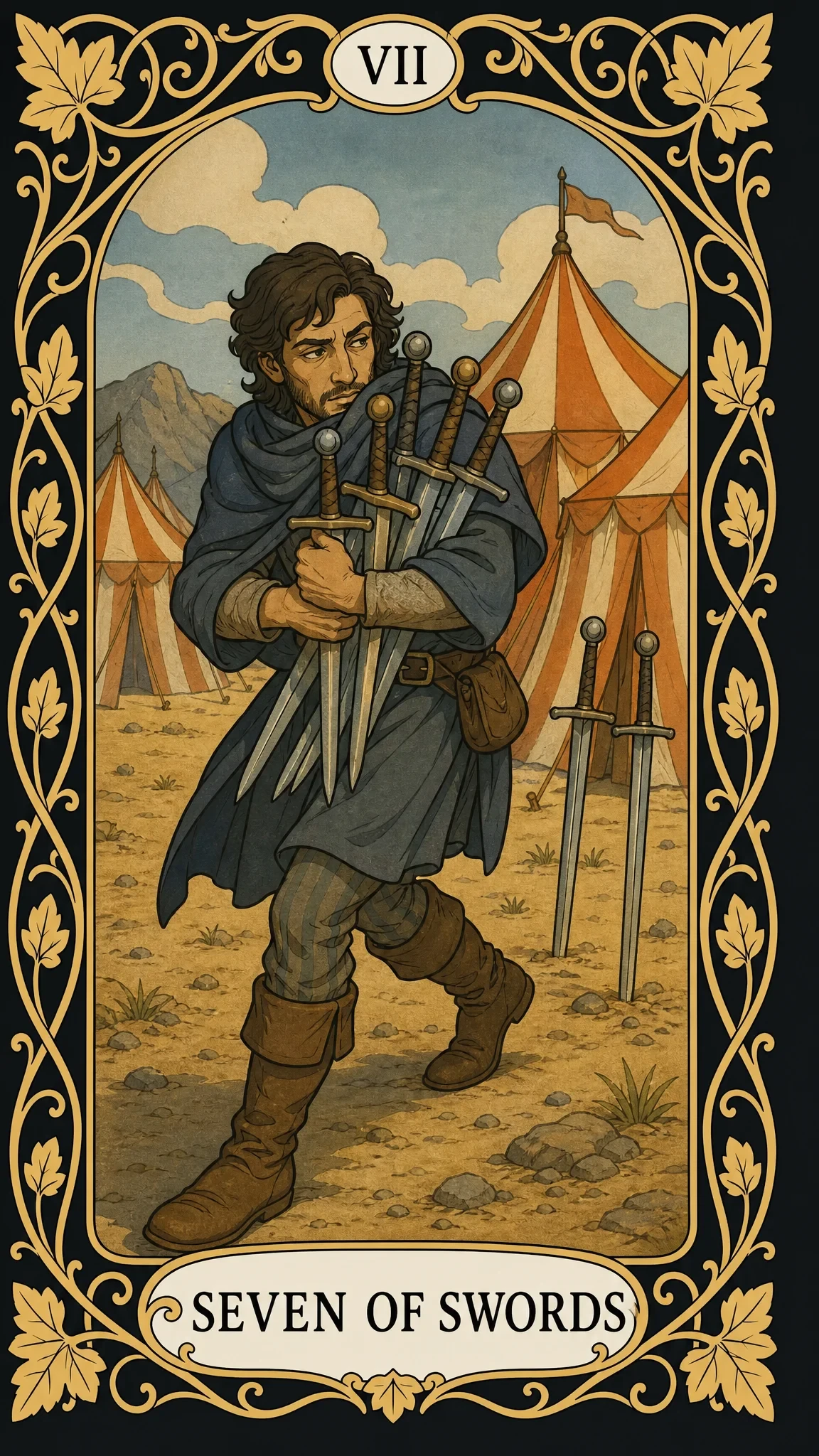
Our card features a young man with wavy brown hair and a short beard, wrapped in a blue cloak draped widely over both shoulders; beneath the cloak, light quilted fabric of an under-tunic is visible on his forearm. His pants, with vertical blue-gray and olive stripes, are tucked into high brown boots with wide cuffs, and he wears a leather belt with a small pouch on his side. He walks with a quick, stealthy step, firmly clutching five swords to his chest with both hands—the five round pommels of the hilts are visible above his palms. His head is turned to the side: his gaze is wary, looking from under his brow—not so much frightened as attentive, as if he is checking to see if he has been noticed. Behind him, on the sandy ground near striped orange-and-white tents with a flag atop the tallest one, two more swords are stuck into the ground—together with those in his hands, there are exactly seven, as the card requires. Around him is dry, rocky ground with sparse bushes, and on the horizon to the left, a low mountain range is visible.
The scene is interpreted as follows:
- A wary glance to the side — the central detail of the card: the person is not running away in a panic; he is controlling the situation, assessing the environment, and checking if he has been noticed. This is more composure than fear.
- Five swords in hand versus two in the ground — the maneuver is only half-finished: part of the loot is already with him, part is left behind because he couldn't carry it all at once.
- Striped camp tents in the background — foreign territory, foreign rules, from which the person is leaving without permission or announcement.
- Open terrain ahead — the path is clear, but not for long: the scene is captured at the exact moment when the maneuver can still be thwarted.
At the top of the card is the Roman numeral VII, and at the bottom is the label SEVEN OF SWORDS: the deck is drawn in the Rider-Waite tradition, where the Seven of Swords is the seventh in this suit.
The Seven of Swords as the card of the day
The Seven of Swords as the card of the day is a good day to decide something independently and quickly without waiting for general consensus: to close an issue that would have bogged down in discussions, or to clear up a task alone while others are still deliberating.
The flip side of such a day is the temptation to do it too quietly where you should have given a warning. A useful mindset: before acting without asking, take a second to consider if you will have to explain yourself later—and if so, it is better to say so in advance, not after.
Frequently asked questions about the Seven of Swords
Is it a Major or Minor Arcana?
Minor Arcana, suit of Swords, element of Air. There are 56 Minor Arcana cards in a Tarot deck—14 cards for each of the four suits, and the Seven of Swords is the seventh in the suit of swords.
How does the Seven of Swords differ from the Seven of Pentacles?
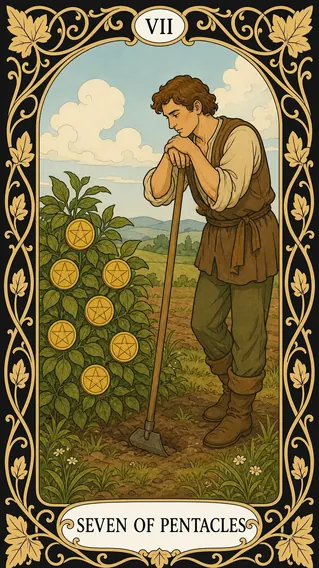
Both cards are about an intermediate result, but of a different nature. Swords are the element of air, intellect, and strategy: the Seven of Swords is about maneuvering, bypassing rules, and deciding to act without publicity. Pentacles are the element of earth, labor, and resources: the Seven of Pentacles is about a pause and evaluating invested efforts, not about cunning. If the method of action is important in the reading, look at the Swords; if the result of years of work is important, look at the Pentacles.
Is the Seven of Swords always about deception?
No. The card shows a maneuver bypassing the direct path, not a specific fact of deception, and certainly not the guilt of a specific person. Sometimes it is resourcefulness: solving an issue quietly and without scandal. Whether the maneuver is honest or not should be judged by the situation and surrounding cards, not by this card alone.
Is the Seven of Swords a yes or a no?
More likely yes, but not in the way implied by the question: the direct path is closed or disadvantageous, but the detour is viable. If the question is specifically about an honest and open solution to the issue, the answer is likely negative.
What does the reversed Seven of Swords mean?
The same maneuver, but at the stage of exposure or abandonment: the secret comes out, the detour doesn't work, or the person decides to stop being cunning and speak directly. The difference from the upright position is that hiding it further is no longer possible or desired.