What the Six of Swords Means in Tarot
The Sixes in Tarot represent a point of alignment after the difficult blow of the previous card, the Five. In the suit of Swords, this alignment is very literal: not philosophical enlightenment, but a physical move from a place where things were hard to a place where it's easier to breathe. The Six of Swords is about the road away: changing cities, a pause after an argument, the decision to finally leave a place where things have been bad for a long time.
A crucial nuance often lost in retellings: the card doesn't promise that the problem is solved – it shows that distance from it has increased. The swords in the boat haven't disappeared; they are being carried along: the conflict, anxious thoughts, unspoken words from the previous situation are still with the person, but now there is water between them and the present moment. This is not surrender or flight in a negative sense – sometimes the only effective way to deal with something difficult is to first step away from it.
The Minor Arcana describes an episode, not a destiny: not 'life will get better,' but a specific move, conversation, trip, or decision to leave a job, after which things will feel easier in the coming weeks. How stable the new calm will be will be shown by other cards in the spread – what's important here is the act of moving forward, not the final outcome.
Reversed Six of Swords: Meaning
The Reversed Six of Swords signifies the same transition, but one that has stalled. Usually, the spread implies one of three scenarios, and the question itself helps to choose.
- You want to leave, but you can only stay. Circumstances, money, obligations, or fear keep you where you should have left long ago.
- The departure happened, but the problem didn't. You've changed jobs, cities, or partners, but you carry the exact same conflict within you because you haven't resolved it, just moved away from the scenery.
- A return to what you were moving away from. A situation you thought you'd left behind is pulling you back in – often because the transition was initiated before you were truly ready for it.
There's also a gentler interpretation: sometimes the Reversed Six of Swords isn't a refusal to move, but an honest pause before a departure that is still too soon to make abruptly.
Six of Swords in a Yes/No Reading
In 'yes/no' readings, the Six of Swords is interpreted as yes, but not immediately: change is possible and likely to happen, but it won't be instant or easy – it will require time, effort, and probably some intermediate discomfort before things start to feel noticeably better.
If the question is about leaving, changing your environment, or exiting a difficult period – the answer is affirmative. If the question is about whether the problem will be definitively resolved – the card doesn't answer that: it's about distance from the difficulty, not its disappearance.
The reversed position in this reading leans towards no, not yet, conditions aren't right: the transition being asked about is postponed – either because circumstances aren't ready, or because the person is still clinging to the old ways more than they admit.
Six of Swords in Relationships and Feelings
In relationship readings, the upright Six of Swords most often signifies moving out of a difficult period together: a couple is going through a conflict or crisis and gradually, step by step, moving towards a calmer phase – sometimes literally changing their environment to make it easier to start anew.
In the position of feelings, the card isn't about passionate intensity, but about quiet, slightly melancholic stabilization: the person hasn't fully let go of the pain yet, but is already able to look forward, not just backward. It's a suitable card for describing a breakup after which both sides gradually calm down, rather than a sharp rupture – that would be more akin to the Ten of Swords.
The Reversed Six of Swords in relationships indicates an attempt to hold onto something that no longer works, or a departure that brought no relief because old grievances traveled with the person.
Six of Swords in Work and Money
In career readings, the Six of Swords often indicates a move, a change of job or department for more peaceful conditions: leaving a toxic environment, relocating, transitioning to a project with less stress. The decision is not impulsive but a logical next step after accumulated fatigue.
In terms of finances, the upright position signifies gradual recovery after a difficult financial period: debt is slowly being paid off, income is stabilizing, not with a surge, but little by little. It's a card of moving in the right direction, not sudden luck.
The Reversed Six of Swords in work signifies being stuck in a place you should have left long ago, or a transition that brought no improvement because it carried the same problems to the new position.
Six of Swords as a Person: Man and Woman
When the Six of Swords appears in the 'what kind of person' position, it describes not the entire character, but the role of a guide through a difficult period: someone who remains composed while others around them are going through hardship, and steers the situation towards a calmer course, even when they are just as tired.
A Six of Swords man is reserved, speaks little, and takes charge while others are still recovering from a blow. A Six of Swords woman is one who silently carries the burden of past experiences and protects those around her, without showing how much it costs her.
What they both have in common is fatigue that they don't display: there's no drama around such people, but also not much lightness yet.
Six of Swords in the thoughts position
In the thoughts position, the Six of Swords signifies a gradual calming of the inner storm: anxious thoughts are still present, but they no longer overwhelm as they did before. The person begins to mentally distance themselves from the conflict or upheaval, assessing what happened more calmly.
This is a state of 'not quite let go, but already feeling better.' If other Swords appear in the spread nearby, anxiety may return stronger; near Cups or Pentacles, the transition to calmness is likely to solidify.
What to do if the Six of Swords appears
The card's advice is simple: keep moving forward, even if the burden hasn't been fully processed. The Six of Swords doesn't demand immediate resolution of everything—it allows you to first step back to a safe distance and then, from a calmer place, reflect on what you've experienced.
What to do in practice:
- Take a step back, even a small one. A change of scenery, a pause in communication, a break from the usual routine—it doesn't have to be a drastic decision.
- Don't expect instant relief. The transition with this card is gradual: you'll feel better not on the first day, but after some time.
- Don't confuse leaving with solving the problem. If the conflict or anxiety has moved with you, it's worth addressing them separately, with a clear head.
- Acknowledge fatigue, don't hide it. The burden of the Six of Swords is real, and pretending it doesn't exist is not the same as truly dealing with it.
If the reason for the reading is a heavy loss, a prolonged crisis, or a situation that's difficult to navigate alone, the card doesn't replace talking to a specialist: it describes the movement towards calmness, not the path to achieving it.
What is depicted on the card
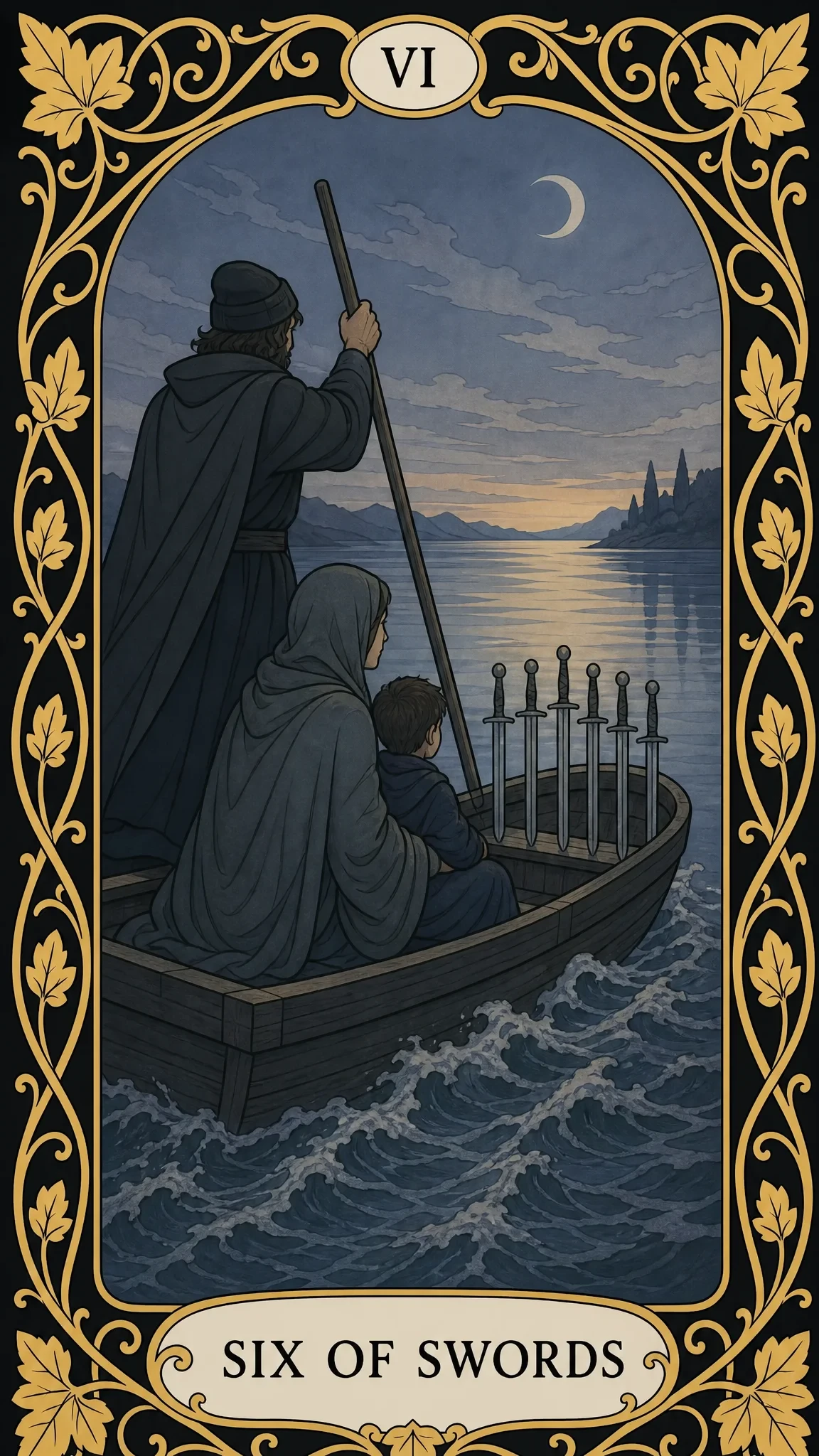
Our card depicts a wooden boat on the water at dusk: a man in a dark cloak stands at the stern, pushing the boat with a long pole. In front of him, with their backs to the viewer, sit a woman wrapped in a hood and a child nestled close to her. Between the passengers and the bow of the boat, six swords are stuck into the side, hilts up—they are traveling with the people, not left behind.
The scene is interpreted as follows:
- Turbulent water behind and smooth water ahead—the most direct image of the card: a turbulent, stormy stretch of the journey is left behind, and ahead lies a calm surface reflecting the evening light.
- Six swords in the boat—a burden not thrown overboard: experiences, anxieties, unresolved issues travel with the passengers, not disappearing with departure.
- The cloaked figures of the woman and child—the part of a person that is tired and needs protection; they are not rowing themselves but are guided by someone who can still hold the direction.
- Crescent moon and twilight sky—the transition occurs at dusk, under the light of a thin crescent moon: a time when the journey has begun, but the destination is not yet reached.
- Dark shore in the distance with silhouettes of mountains and pointed trees—the destination is not yet discernible in detail, but it is visible and closer than the place from which the boat departed.
At the top of the card is the Roman numeral VI, and at the bottom is a plaque with the English title SIX OF SWORDS. The entire composition is framed by a golden pattern of grapevines on a black background.
Six of Swords as the card of the day
The Six of Swords as the card of the day is a good reason to step away from what has exhausted you: change your surroundings for at least an hour, postpone a difficult conversation until a calmer moment, physically leave a place where tension has accumulated. The day is not about solving the problem entirely, but about moving to a safe distance from it.
If the card appears reversed, the day is more about getting stuck: you want to move forward, but you keep returning to the same point. A useful mindset is not to demand a sudden leap from yourself, but to take one small step towards peace.
Frequently asked questions about the Six of Swords card
Is it a Major or Minor Arcana?
Minor Arcana, suit of Swords, element of Air. There are 56 Minor Arcana cards in a Tarot deck—14 cards for each of the four suits, and the Six of Swords is the sixth in this row.
How does the Six of Swords differ from the Six of Pentacles?
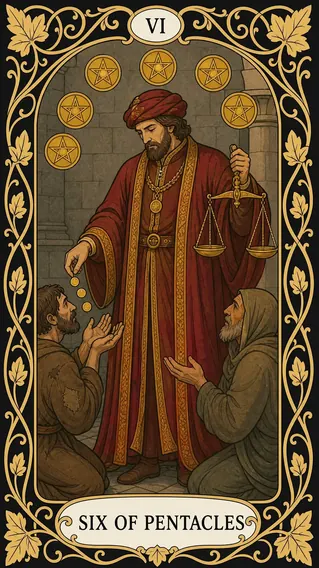
Both cards are about alignment after difficulties, but of different natures. Swords—element of air, thoughts and words: the Six of Swords is about transitioning from a storm to calmness through departure, distance, and change of scenery. Pentacles—element of earth, material: the Six of Pentacles is about balance in finances, help, and resource exchange. If the reading concerns moving or exiting a difficult period—it's about Swords; if it's about distributing money or support—it's about Pentacles.
Is the Six of Swords a yes or no?
More likely yes, but not immediately: a change for the better is possible, but it will take time and likely involve intermediate discomfort. If the question is about the fact of the transition itself—the answer is affirmative. If it's about whether the problem will be fully resolved, the card does not answer that.
What does the reversed Six of Swords mean?
Getting stuck in a place you should have left, or a departure that brought no relief because the old problem moved with the person. Sometimes it's just a pause before a transition for which conditions are not yet favorable.
Can the Six of Swords signify moving or parting?
Yes, this is one of its most frequent interpretations: changing cities, jobs, or relationships for a calmer life. However, the card does not specify details or promise a specific outcome—it only indicates the direction of movement, from difficult to more peaceful.