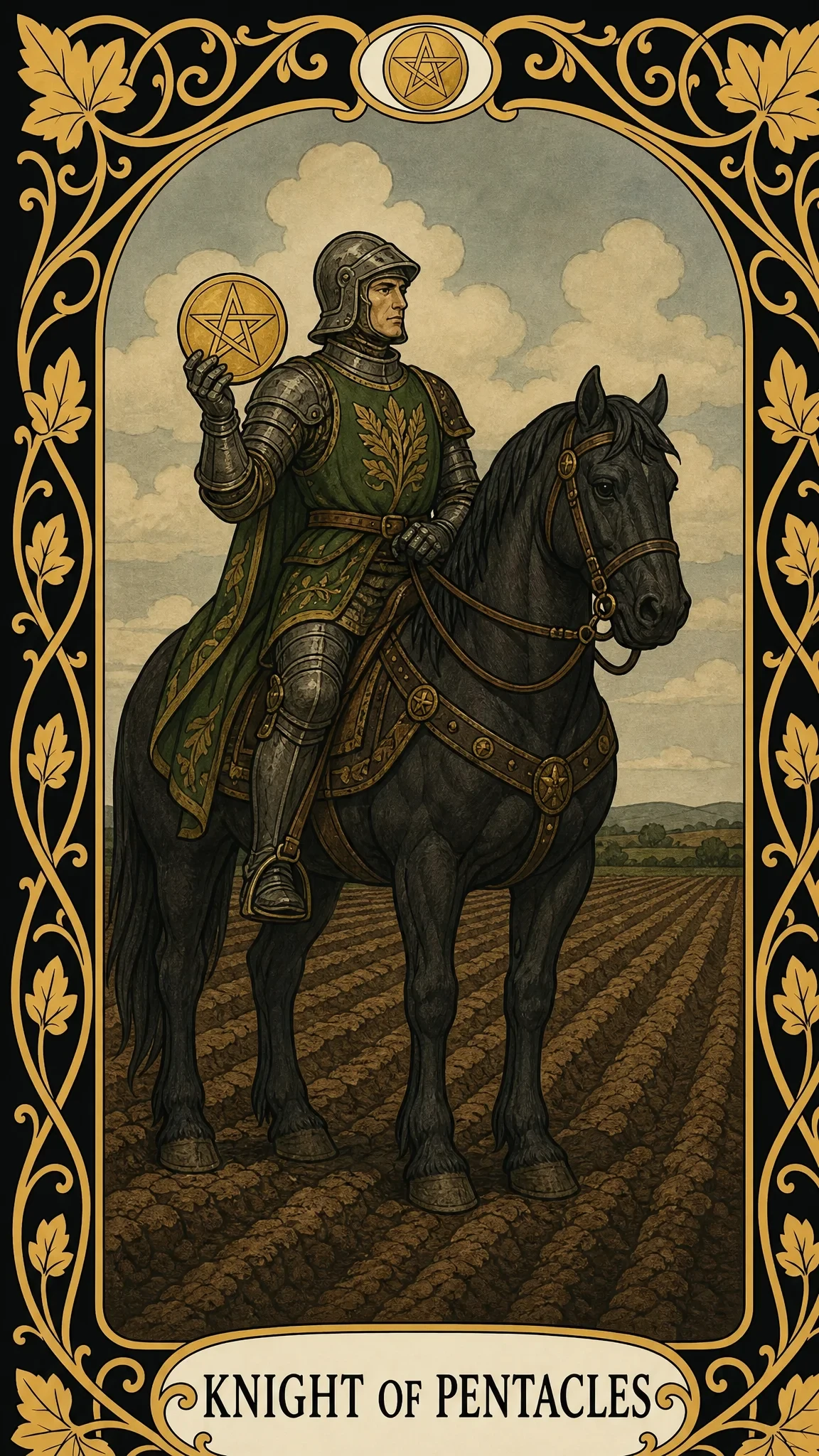
What the Knight of Pentacles means in Tarot
The Knight of Pentacles is a court card of the Pentacles suit, and he is the calmest of the four knights in the deck. While the Knight of Wands rushes off before thinking through a plan, the Knight of Pentacles does the exact opposite: he first tests the ground, then takes a step, and repeats this step day after day until the task is finished.
An important caveat that applies to any minor arcana: the card does not describe a person's entire life, as the major arcana do. It is about an episode — a specific project, commitment, or period of time, not a permanent character trait. The Knight of Pentacles does not mean "you are such a bore forever," but rather "right now, persistent, daily work is needed, not a burst of energy" or "a person with this manner of acting has appeared nearby."
Essentially, the card describes conscientiousness in its purest form: doing what you promised, seeing things through to the end, and not quitting halfway for something flashier. Earth as an element is read literally here — not fast, but thorough, like a seed that will only sprout after a season. The Knight of Pentacles rarely impresses at first meeting: he lacks the fire of Wands and the charm of Cups, but he has what they usually lack — consistency.
Reversed Knight of Pentacles: meaning
The reversed Knight of Pentacles is the same thoroughness, but stuck in place. Usually, the spread can be reduced to one of three options.
- Work is ongoing, but there is no forward movement. A person works day after day but hasn't re-evaluated in a long time whether this path leads anywhere at all — treading water instead of progress.
- Caution has turned into a refusal to act. Instead of a measured pace, there is constant "not ready yet," "need to wait," which in reality means a fear of change.
- Discipline has become exhausting. A person drags out a commitment through sheer stubbornness, without interest or strength, and everything is held together only by the habit of finishing what was started.
The difference from the upright position is simple: the upright card is about work that moves, even if slowly; the reversed one is about work that is stalling or burning you out because it has ceased to be meaningful.
Knight of Pentacles in a "yes or no" spread
In "yes/no" spreads, the Knight of Pentacles is read as yes, but not immediately — with the condition that the result must be earned, not received as a gift. The card is not about a lucky turn of events, but about the fact that the matter will succeed if you continue to do it methodically and without haste.
If the question is "will it work out if I don't quit" — the answer is affirmative, and often more confident than most other cards: the Knight of Pentacles is one of the most reliable signs in the deck, especially in the long term. If the question is about a quick result — "will this happen this week" — the card likely answers negatively: it is not his pace.
The reversed position in this spread shifts the answer to "stuck halfway" — not because of external obstacles, but because the determination to see the matter through to the end has disappeared for some reason.
Knight of Pentacles in relationships and feelings
In a relationship spread, the upright Knight of Pentacles describes slow but real development: not a stormy confession in the first week, but courtship through actions — help, attention to everyday details, words that match deeds. This is a partner who would rather show care than say a beautiful phrase.
In terms of feelings, the card speaks of attachment, not a flash: a steady, reliable warmth that does not fade after one bad week. The Knight of Pentacles poorly describes love at first sight — but it well describes relationships that withstand daily life, shared commitments, and routine without losing meaning.
An important nuance that is lost in retellings: such reliability can be read from the outside as a lack of interest, although in reality, it is simply a different pace of expressing feelings. The Knight of Pentacles does not throw words around — he shows his attitude through consistency.
The reversed position in relationships is a partner who clings to the usual way of life even where changes have long been needed, or a couple that stays together out of inertia, not out of living feeling.
Knight of Pentacles in work and money
In career spreads, the Knight of Pentacles is advancement through constant work, not through luck or connections: a promotion given for years of conscientious work, the reputation of a person you can rely on. The card well describes long projects where speed is less important than the ability not to abandon the task halfway.
In money, the upright position is careful accumulation, weighed spending, a plan instead of impulsive decisions: saving a small amount regularly is closer to the Knight of Pentacles than risking a large one at once. Neighboring cards will show the scale: next to the Ten of Pentacles, it is confident prosperity; next to the Five of Pentacles, it is saving out of necessity, not choice.
The reversed position in work is stagnation: a person holds onto a position or project without growth and without interest, simply because it is more habitual than changing something. Or the opposite case — workaholism, when work consumes all time, and a result commensurate with the effort has not been seen for a long time.
Knight of Pentacles as a person: man and woman
When the Knight of Pentacles appears in the "what kind of person" position, it is a description of a specific type, not a literal hint at age or gender. This is someone you can count on: not the brightest in the company, but the most predictable — he promised and he did it.
The Knight of Pentacles man is calm, practical, and taciturn; he courts not with showy gifts, but by solving everyday issues without reminders. The Knight of Pentacles woman is someone who keeps her word even when it is inconvenient and prefers a slow but sure plan to a fast and risky one.
This type has a flip side: those who wait for constant changes and bright gestures sometimes find him boring. A good companion for a marathon, not always for a sprint. And stubbornness here works both ways: the same trait that prevents him from quitting a task may prevent him from admitting in time that it is time to change the task.
Knight of Pentacles in the mindset position
In the mindset position, the Knight of Pentacles represents a state where the mind is occupied not by ideas, but by a plan to implement them: not "what if," but "what needs to be done today to make tomorrow easier." The thinking is practical, step-by-step, and unhurried.
Sometimes this is a healthy focus on real tasks instead of empty dreams. Sometimes it is an excessive fixation on details and procedures, where the meaning behind the effort is lost in the to-do list. Adjacent cards help distinguish this: next to the Ten of Pentacles or the Emperor, it is sober planning; next to the Eight of Swords, it is an anxious habit of controlling every little detail.
What to do if you draw the Knight of Pentacles
The card's advice is simple: continue methodical work, but check from time to time where it is actually leading. The Knight of Pentacles rarely fails due to speed—he fails because he can spend years moving by inertia without asking if he is heading in the right direction.
What you should actually do:
- Don't quit before the deadline. If a task requires time, the best strategy is small but regular steps, rather than a burst of effort followed by a retreat.
- Check in with your goal periodically. Discipline is good as long as it serves a purpose, not replaces it.
- Distinguish patience from fear of change. Sometimes "it's not the right time" is a sober assessment, and sometimes it is a convenient excuse to avoid taking risks at all.
- Value reliability in relationships and at work as a real quality, not as something to be taken for granted—it is easy to overlook precisely because it is steady.
And separately: if the question concerns a difficult financial situation or burnout from years of routine, the card shows the necessary pace of action, but does not solve the problem itself; for a concrete plan, you should consult a specialist.
What is depicted on the card
On our card, the Knight of Pentacles is a warrior in full steel armor on a large black horse, standing motionless with all four hooves on the ground in the middle of a freshly plowed dark field. In his raised hand, the knight holds a golden pentacle coin with a five-pointed star and looks at it intently, rather than forward along the route.
The scene is interpreted as follows:
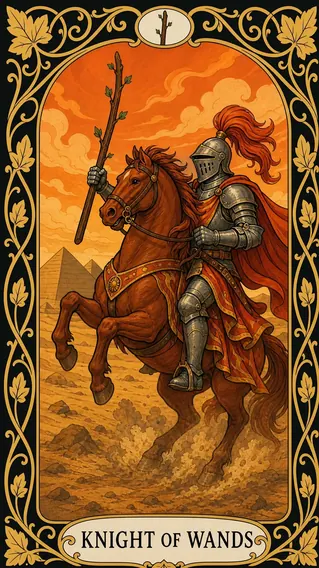
- The motionless horse — the direct opposite of the rearing steed of the Knight of Wands. The horse is not straining to gallop: it is heavy, stable, and stands where it stands. This is the exact image of the Knight of Pentacles—the strength here is not in the dash, but in the ability to stand still for as long as the task requires.
- The plowed field — the work has already begun, and this is the labor of a farmer, not a traveler: the land is being prepared for sowing, not crossed in transit. The harvest will not appear today, but the conditions for it have been conscientiously created.
- The pentacle in the raised hand — the knight does not shake the coin or boast about it, but studies it: the card is about respect for material results, not about showing off wealth.
- The green cloak with a golden leaf pattern over the armor—the same floral ornament as other knights in our deck, here signifies a connection to the earth and harvest in the most literal sense: fertility as the result of patient labor, not quick luck.
- The calm, cloudy sky and distant green hills — an even, inhabited landscape without storms or deserts: a world where nothing is collapsing and there is no need to rush anywhere.
At the top of the card in a medallion is the same pentacle with a star, the sign of the suit; at the bottom is the inscription KNIGHT OF PENTACLES.
The Knight of Pentacles as the card of the day
As the card of the day, the Knight of Pentacles is a signal not to chase quick results, but to calmly finish what has been put off for a long time: a routine task, a boring but necessary call, or household chores. This is a day when discipline works better for a person than inspiration.
A useful mindset for such a day: take a step according to the plan, even if it doesn't look impressive. Don't expect breakthroughs or bright events from such a day—its value lies elsewhere: in the fact that a small, reliable step today makes tomorrow a little easier.
Frequently asked questions about the Knight of Pentacles card
Is it a Major or Minor Arcana?
Minor Arcana, a court card of the Pentacles suit, Earth element. There are 56 Minor Arcana cards in the Tarot deck—14 cards in each of the four suits, and the Knight is one of the four court ranks within the Pentacles suit.
How does the Knight of Pentacles differ from the Knight of Wands?
Both are court cards of the Knight rank, but their elements are opposites. The Knight of Wands (Fire) is about impulse, speed, and action without long deliberation. The Knight of Pentacles (Earth) is about method, patience, and work that moves slowly but does not break down. If the Knight of Pentacles appears in a spread, the emphasis should be on reliability and consistency, not on the speed of the result.
Is the Knight of Pentacles a yes or no?
Yes, but not immediately: the card promises a result if you continue to work methodically and do not abandon the task halfway. If the question is about a quick outcome, the answer is likely negative; that is not its pace.
What does the reversed Knight of Pentacles mean?
The same thoroughness, but stuck: work is ongoing, but there is no progress, or caution has turned into a refusal to act at all. Another option is discipline that is maintained by stubbornness and gradually wears you out.
Is the Knight of Pentacles in relationships about a reliable partner?
Yes, most often that is exactly it: the card describes an attachment that manifests through actions and constancy, rather than through grand gestures. It does not describe a flash of love at first sight well, but it is great for relationships capable of withstanding everyday life and routine.