What the Knight of Wands means in Tarot
The Knight of Wands is a court card of the Wands suit, and it is primarily about action, not the outcome. If this were a person in a company, the Knight of Wands would be the one who stands up from the table first and says "let's go," without waiting for others to finish arguing.
An important caveat that applies to any Minor Arcana card: it does not describe a person's entire life, as the Major Arcana do. It is about an episode — a specific conversation, trip, or decision this week, not fate as a whole. The Knight of Wands is not "this is your character forever," but rather "this is the energy you need to act with now" or "this is who has appeared nearby and what they have brought."
Essentially, the card describes a burst of initiative: the desire to take off, start something new, and prove something through action rather than talk. Fire as an element is read literally here — fast, bright, and sometimes uneven. The Knight of Wands rarely calculates risks in advance: in the deck, that is the job of other cards (the curiosity of the Page or the endurance of the King), not the Knight.
Reversed Knight of Wands: meaning
The reversed Knight of Wands is the same impulse, but it either finds no outlet or goes in the wrong direction. Usually, the spread can be reduced to one of three options.
- Energy is there, but there is no action. The person is wound up and full of plans, but keeps putting off the start — the familiar story of "I'll start on Monday."
- Action happened, but too hastily. The decision was made on emotion without checking the circumstances, and now they are dealing with the consequences.
- The impulse turned into irritation. Instead of a leap forward — a flash, a sharp word, a slammed door; the same fire, but directed the wrong way.
The difference from the upright position is simple: the upright card is about movement, the reversed one is about movement that got stuck at the start or broke down halfway.
Knight of Wands in a "yes or no" spread
In "yes/no" spreads, the Knight of Wands is usually read as a confident yes — but with a condition: you must act quickly while you have the determination. The card is not about long deliberations or the perfect moment that will come later; it is about the fact that taking a step now is better than waiting.
If the question is "should I take a risk" or "should I start," the answer is likely positive, but without guarantees of a neat result: the Knight of Wands is not about everything going smoothly, but about the fact that standing still is worse than taking a step.
The reversed position in this spread shifts the answer to "not yet" — not because the idea is bad, but because the moment is poorly chosen: there isn't enough determination yet, or haste has already interfered with the matter, spoiling everything.
Knight of Wands in relationships and feelings
In a relationship spread, the upright Knight of Wands is about rapid development: a meeting that quickly turns into a plan to go somewhere together, a confession without long preparation, a relationship where everything happens faster than the usual "don't rush" advice suggests.
In the position of feelings, the card describes passion rather than attachment: a bright, exciting infatuation that burns intensely but does not promise to burn for long. The Knight of Wands is not about stability — it is about the intensity of the moment here and now.
There is also a downside: the same fire can mean impatience with a partner who cannot keep up with the pace, or resentment that the other side is slow to respond. An important nuance that is lost in retellings: the Knight of Wands rarely wants to hurt anyone — he just doesn't know how to wait.
The reversed position in relationships is a cooling off after the first burst: an infatuation that faded as quickly as it flared up, or an argument out of nowhere from accumulated irritation.
Knight of Wands in work and money
In career spreads, the Knight of Wands is about changing jobs without long deliberation, launching a project that has been delayed for months, or negotiations where the one who makes the first offer wins. The card well describes business trips, moving for work, or sudden business travel.
In money, the Knight of Wands is more often about impulsive spending or investing based on enthusiasm rather than calculation: buying equipment for a new idea, investing in a project that sparked interest from the first conversation. Neighboring cards will show whether the impulse will pay off — with the Ace of Pentacles or Ten of Pentacles, it is a successful risk; with the Five of Swords or the Tower, it is overestimated confidence.
The reversed position in work is a project that was started with fire and then abandoned halfway: a typical trap of the Knight of Wands — inspiration burns brightly and fades quickly if there is no one nearby to see the matter through to the end.
Knight of Wands as a person: man and woman
When the Knight of Wands appears in the "what kind of person" position, it is a description of a specific type, not a literal hint at age or gender. This is someone who appears in life as an accelerator: with them, plans that have been stalling for months suddenly move forward in one conversation.
A male Knight of Wands is direct, charismatic, and impatient; he promises quickly and acts quickly, but loses interest just as quickly if things drag on. A female Knight of Wands is the one who is the first to suggest taking a risk, the first to buy tickets, and the first to say aloud what others have been thinking about for a week.
This type has a downside: it is easy to get burned around them — not out of malice, but because they don't always calculate where their impulse will lead. A good companion for a sprint, but not always for a marathon.
Knight of Wands in the thoughts position
In the thoughts position, the Knight of Wands represents a state where a decision is almost made, and the person is mentally asking not "should I?" but "how exactly?" and "when?". The mind is occupied with a concrete plan of action rather than doubts.
Sometimes this is healthy impatience—it's time to stop thinking and start doing. Sometimes it's anxious haste, where one rushes not because they are ready, but because they cannot stand uncertainty. Neighboring cards help distinguish this: next to the Star or the Sun, it is more of a confident mindset; next to the Five of Wands or swords, it is a nervous desire to end the waiting as soon as possible.
What to do if you draw the Knight of Wands
The card's direct advice: act while you have the resolve, but don't skip the basic check. The Knight of Wands rarely fails due to speed—he fails because he forgets to look before he leaps.
What you should actually do:
- Determine what is actually urgent. A real opportunity versus boredom from inaction are different things, and the latter is no reason for rash decisions.
- Give yourself one day, not a month. The point of the card is not to stall indefinitely, but not to confuse an impulse with a plan.
- Find someone to see it through. If the task is long, think in advance about who will take over when the initial excitement fades.
- Don't take your frustration out on those who are slower. Annoyance at someone else's pace is the most common side effect of this energy.
And separately: if the decision the reading asks about concerns money, health, or serious relationships, haste is not your friend. The cards show the mood of the moment, but a balanced decision remains up to the person.
What is depicted on the card
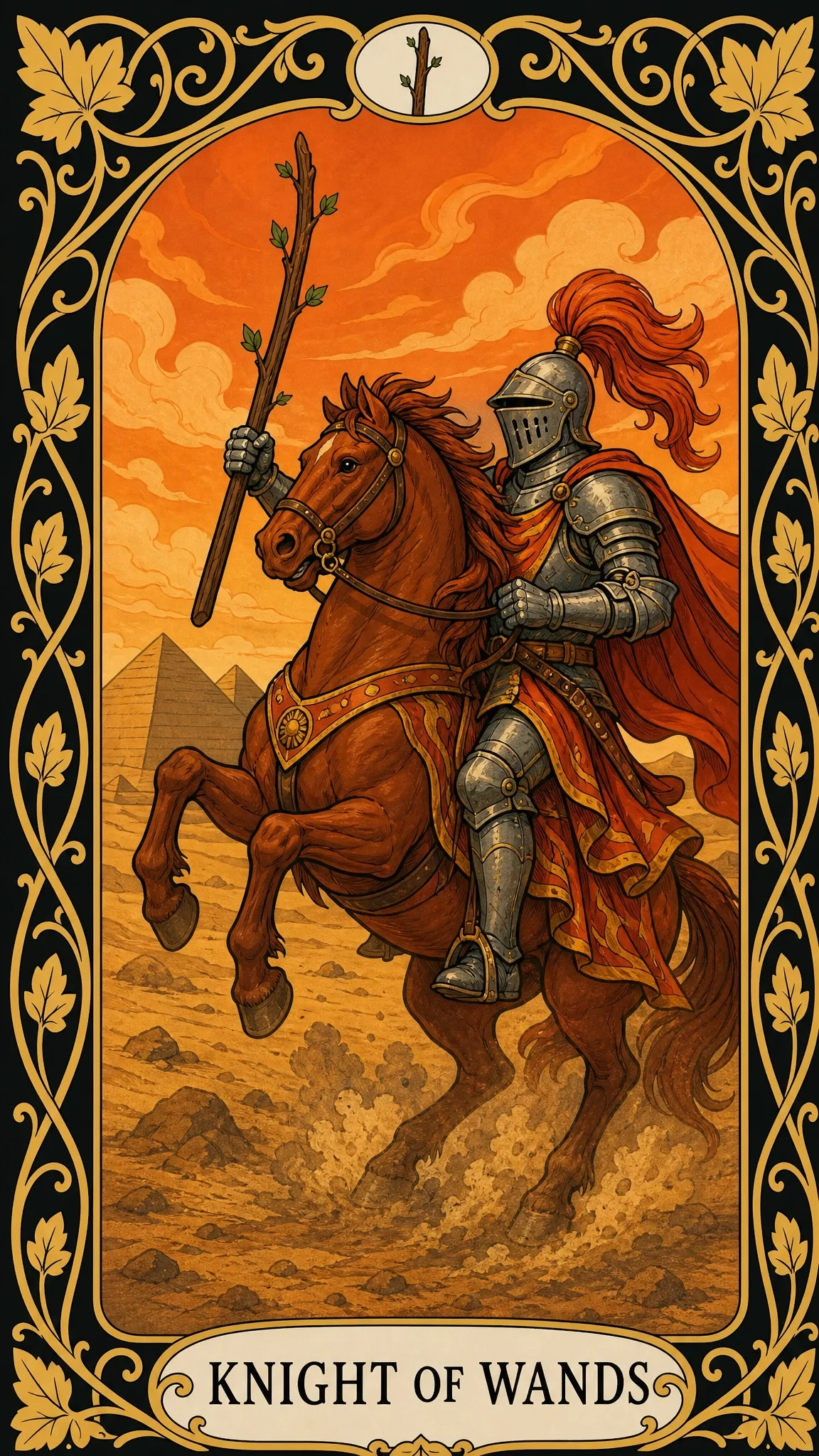
On our card, the Knight of Wands is a warrior in full silver plate armor on a rearing chestnut horse, against a backdrop of a scorching orange sky and a desert with silhouettes of pyramids in the distance. A bright ginger plume bursts from under the helmet's visor, and a long red cloak trails behind.
The scene is read as follows:
- Rearing horse — the horse isn't running, it's rearing: pure impulse not yet turned into forward motion. This is the exact image of the Knight of Wands—all the power is gathered, but it will be released in the next second, not now.
- Wand with green leaves in the raised hand — the same living, sprouting staff as in other cards of the Wands suit: the idea is not dead, it is in the process of growth, even if you are carrying it at a gallop.
- Desert and pyramids on the horizon — a distant, foreign path. Among the four suits, the Knight of Wands is the one most likely to rush off on a journey, and the landscape speaks directly to this.
- Plate armor instead of the usual light tunic — our deck gives the Knight more protection than classical iconography. You can read this as an emphasis: even the most impulsive person in this deck doesn't set out naked—he has armor; the only question is whether he manages to use it at such a pace.
At the bottom of the card is the label KNIGHT OF WANDS, and at the top in a medallion is the same wand with leaves: a sign that we are looking at the Knight of the Wands suit, not to be confused with the other three.
Knight of Wands as the card of the day
As the card of the day, the Knight of Wands is a signal not to put off what is already ripe: call, propose, leave earlier, answer immediately rather than "thinking until the evening." This is a day when decisiveness works for you more than caution.
A useful mindset for such a day: one sharp move is fine, but ten is overkill. Choose one task where speed is important, bring it to a noticeable result, and don't waste all your fire by spreading yourself thin between different ideas. And don't forget: the person moving slower next to you isn't stalling on purpose—they just have a different card of the day.
Frequently asked questions about the Knight of Wands card
Is it a Major or Minor Arcana?
Minor Arcana, a court card of the Wands suit, Fire element. There are 56 Minor Arcana cards in the Tarot deck—14 cards in each of the four suits, and the Knight is one of the four court ranks within the Wands suit.
How does the Knight of Wands differ from the Knight of Cups?
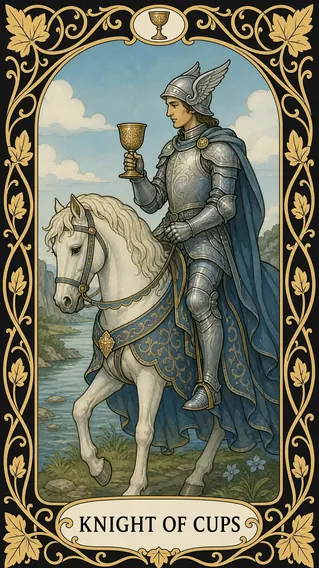
Both are court cards of the Knight rank, but the elements are different. The Knight of Wands (Fire) is about impulse, speed, and action without long deliberation. The Knight of Cups (Water) is about a proposal made from feeling, softer and without the haste of Wands. If the Knight of Wands appears in a reading, the focus should be on pace and initiative, not emotional depth.
Is the Knight of Wands a yes or no?
More likely yes, but with the condition of acting quickly while you have the resolve. The card does not promise an easy result—it is about the fact that moving now is better than waiting for the perfect moment.
What does the reversed Knight of Wands mean?
The same impulse that finds no outlet: there is energy but no action, or a decision was made too hastily and you are already dealing with the consequences. Another option is irritation instead of moving forward.
Is the Knight of Wands in relationships about a new crush?
Often yes: the card describes a swift, bright infatuation that develops faster than usual. But it does not guarantee longevity—the Knight of Wands is about the intensity of the moment, not stability for years to come.