What the Knight of Cups means in Tarot
The Knight of Cups is a court card of the suit of Cups, the element of water. Among the four knights of the deck, he is the most peaceful: on the card, the horse walks at a slow, steady pace rather than galloping like the others. This is also a meaning—the Knight of Cups does not rush into attack; he offers.
An important nuance often lost in retellings: a court card describes a role in a specific episode, not a person's character for life. The Knight of Cups is a moment when someone (including the querent themselves) makes a beautiful, emotional gesture: confesses, invites someone out, proposes a joint project, or brings good news with the intent to impress. It is not a major theme of destiny, but a specific offer here and now.
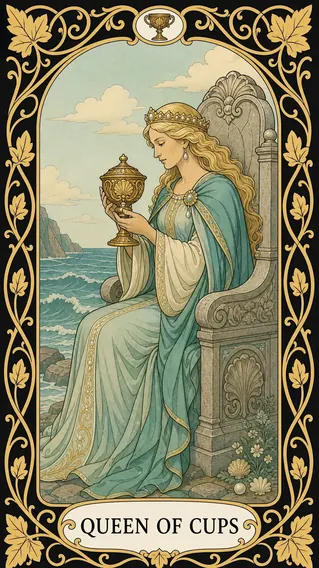
The upright position is read as a sincere impulse: the person acts out of feeling rather than calculation and wants the gesture to be noticed. The flip side of the same card is that the Knight of Cups is in love with the gesture itself as much as the result, and sometimes a beautiful offer turns out to be more important than its execution. How reliable this specific offer will be is suggested by surrounding cards—for example, the Queen of Cups nearby adds depth and constancy to the feeling, while Swords nearby hint that one should verify the action behind the beautiful words.
Reversed Knight of Cups: meaning
The reversed Knight of Cups is the same romantic impulse but lacking a foundation. Usually, the spread refers to one of three options.
- Beautiful words without action. The offer was made, but nothing follows it: no call, no next step.
- Emotional roller coaster. The mood swings from delight to disappointment in a single day, and it is difficult to rely on this mood.
- Escaping into fantasy instead of action. The person dreams of a romantic outcome but avoids the real conversation or action that would bring it closer.
There is also a softer reading: sometimes the reversed position is not deception, but the ordinary insecurity of a romantic who is afraid of appearing intrusive and therefore retreats prematurely. The difference lies in whether there is any intention behind the beautiful facade to see the matter through to the end.
Knight of Cups in a "yes or no" spread
In "yes/no" spreads, the Knight of Cups in the upright position is read as yes, but check for sincerity: an offer or opportunity will indeed appear; the question is whether real steps are ready to back it up. If the question is "will he or she take the first step," "will I receive an invitation," or "will I be offered an interesting project"—the answer is likely yes.
If the question is about the reliability of the result ("can I count on this," "should I believe the promise")—the card answers with a cautious "it is too early," because the knight describes an intention, not a completed action.
The reversed position in this spread means "no, it remained just words": the gesture was there, but there will be no follow-up until someone takes the next step themselves.
Knight of Cups in relationships and feelings
In a relationship spread, the Knight of Cups is one of the most favorable cards for romance: a confession, an invitation to a date, a beautiful and sincere sign of attention. This is a card of courtship, not an established union—it is about the moment when a feeling is first voiced aloud or shown through an action.
In the position of feelings, the knight describes infatuation through idealization: the partner is seen as slightly better, more romantic, and more interesting than in everyday life. This is not deception, but a natural stage—but it is useful to remember that the relationship will later have to withstand the test of daily life, not just beautiful gestures.
If the relationship is already long-term, an upright Knight of Cups in a spread is a signal that one of the partners wants to bring back the romance: to arrange something special, to surprise, to remind the other of feelings through an action rather than a conversation.
The reversed Knight of Cups in relationships means jealousy, inconstancy, or courtship that does not transition into a real relationship: there is talk of the future, but no specifics.
Knight of Cups in work and money
In career spreads, the Knight of Cups is an offer made on inspiration: a creative project, an invitation to collaborate, an idea that is liked for its own sake, not just for its profit. The card describes negotiations well where the decision is made not by calculation, but by sympathy for the idea or the person proposing it.
Regarding money, the upright position speaks more of a generous gesture or an attractive offer than a guaranteed income: it is important to check the favorable terms separately because the Knight of Cups sells an idea beautifully, not necessarily profitably.
The reversed Knight of Cups in work is an offer that sounds promising but is not backed by specifics: deadlines, amounts, or obligations. The advice is the same as in relationships: before agreeing, it is worth translating beautiful words into a concrete plan.
Knight of Cups as a person: man and woman
When the Knight of Cups appears in the "what kind of person" position, he describes a romantic and a dreamer: someone who courts beautifully, knows how to talk about feelings, brings gifts, and makes gestures that are remembered later. Usually, this is a person with an artistic temperament—interested in art, music, poetry, and loves beautiful details.
The Knight of Cups man is charming, sensitive, courts slowly, and knows how to surprise; the downsides are that he falls in love easily and cools down just as easily. The Knight of Cups woman is the one who is the first to suggest a romantic step, is finely attuned to the moods of others, and expects the same in return.
The flip side for both is the same: such a person can confuse the act of courtship with true attachment. If the card is important as a forecast of reliability, it is worth looking at the surrounding cards—the Queen of Cups nearby adds constancy, while Swords suggest that one should verify the action behind the words.
Knight of Cups in the position of thoughts
In the position of thoughts, the Knight of Cups represents a dreamy, slightly idealized state of mind: a person is playing a romantic scenario in their head, imagining a beautiful outcome to a conversation or meeting, focusing on the gesture rather than the facts.
It is a pleasant state, but one that easily detaches from reality: the desired is mistaken for the already achieved. If Swords appear nearby in the spread, it is worth checking the fantasy against facts; next to Pentacles, the idea is more likely to have a practical continuation rather than remaining just a dream.
What to do if you draw the Knight of Cups
The advice of the Knight of Cups is: make a beautiful gesture, but don't stop there. The card is good for the moment of confession, invitation, or creative proposal — and weak if it is not followed up with a concrete step.
What you should actually do:
- Turn the gesture into action. If a proposal is made, set a date and discuss details instead of letting beautiful words hang in the air.
- Verify sincerity through your own actions, not just others'. It is easy to get carried away by your own idealization just as much as by someone else's promise.
- Do not confuse eloquence with reliability. Pleasant words and real commitments are different things, especially in money and work.
- Give feelings time. The Knight of Cups describes the beginning of courtship, not a ready-made union — there is no need to rush things.
If the question concerns a serious decision — for example, trusting someone with money or changing your life for a romantic impulse — the spread does not replace a sober conversation with someone you trust or a professional.
What is depicted on the card
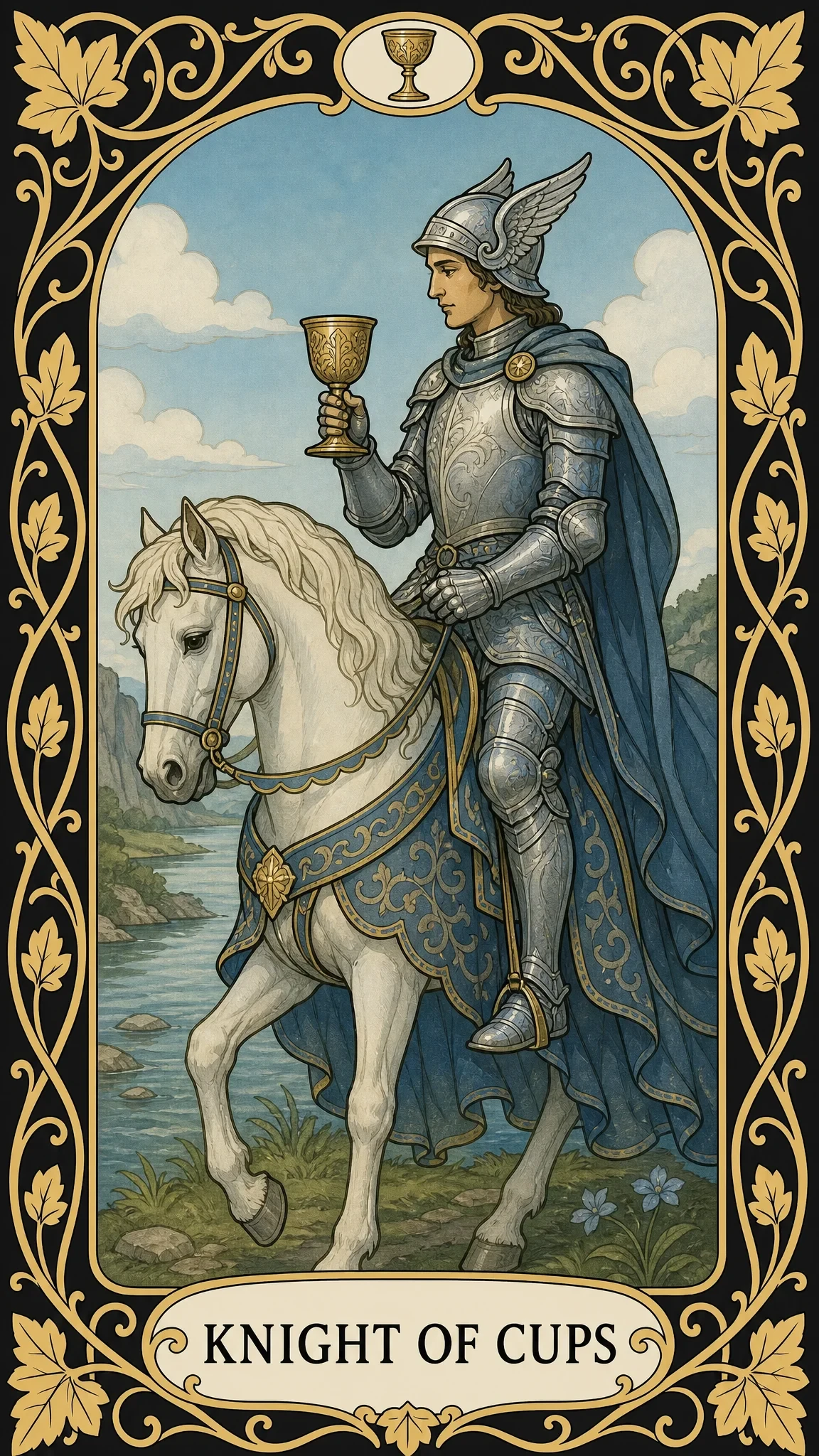
On our card, a young knight in silver armor and a helmet with a wing on the side is turned in profile. In his raised hand, he holds a golden cup of an intricate shape, as if he is offering it forward rather than just carrying it with him. A blue cloak with a golden pattern flutters behind his back, and the horse, under an embroidered blue caparison, steps along the green bank with a leisurely, almost ceremonial gait — unlike knights of other suits, there is no galloping or attacking here.
The scene is read as follows:
- The raised cup — a gesture directed outward, toward someone: this is not a card of solitary feeling, but a card of proposal, confession, and invitation.
- The winged helmet — imagination and the ease with which the knight follows his feelings without looking back at obstacles.
- The horse's calm step — an important detail of this specific knight: he is not in a hurry and does not force the event; the feeling unfolds smoothly.
- The river next to the road — the element of water is physically present in the landscape, reminding us that the knight's path runs along the emotion, not against it.
At the bottom of the card is a plaque with the English name KNIGHT OF CUPS, and at the top in a medallion is the cup itself as the emblem of the suit: our deck is drawn in the Rider-Waite tradition, where each suit has its own symbol on the border.
The Knight of Cups as the card of the day
The Knight of Cups as the card of the day is a good reason for a romantic or creative gesture: to confess, invite, propose an idea, or do something beautiful without expecting an immediate benefit. The day is favorable to feelings, not to deals.
If the card is drawn reversed, it is worth being more attentive to other people's promises and your own: it is easy to promise more than you can deliver. A useful mindset for such a day is to speak about feelings and intentions honestly, but to verify them with further action, not just words.
Frequently asked questions about the Knight of Cups card
Is it a Major or Minor Arcana?
Minor Arcana, suit of Cups, element of Water. There are 56 Minor Arcana in the Tarot deck in total — 14 cards for each of the four suits, and the Knight is the third court card in the suit of Cups, between the Page and the Queen.
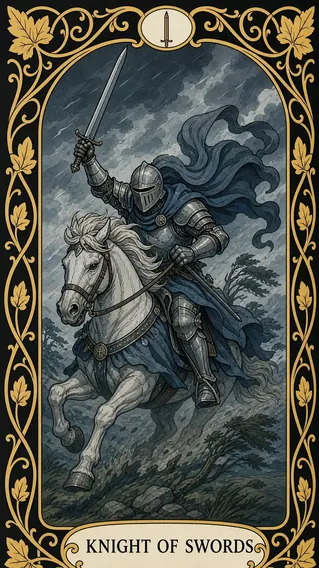
How does the Knight of Cups differ from the Knight of Swords?
Both knights are court cards of action, but of different elements. Cups are the element of water, feelings: the Knight of Cups is about a romantic proposal, courtship, and moving toward a goal through emotion. Swords are the element of air, thought and word: the Knight of Swords is about a sharp argument, a quick decision, and pressure in a dispute, not in feeling. If you are interested in relationships and confession in a spread, it is about Cups; if it is about a dispute, negotiations, or a sharp action, it is about Swords.
Is the Knight of Cups a yes or no?
More likely yes, but with a caveat: the card promises the appearance of a proposal or gesture, not a guarantee that it will be followed up. If the question is about the chance itself, the answer is affirmative; if it is about the reliability of the result, you need to look at the neighboring cards.
What does the reversed Knight of Cups mean?
The same romantic impulse, but without support: beautiful words without action, emotional swings, or retreating into fantasies instead of taking a real step. Sometimes it is just the insecurity of a romantic who is afraid of seeming intrusive — the difference lies in whether there is any intention behind the gesture.
Is the Knight of Cups in relationships about serious feelings?
Not necessarily about depth, but rather about the stage: this is a card of courtship and the first confession, not an established union. For long-term relationships, it more often means that someone wants to bring back romance through an action, rather than that feelings are being tested for the first time.