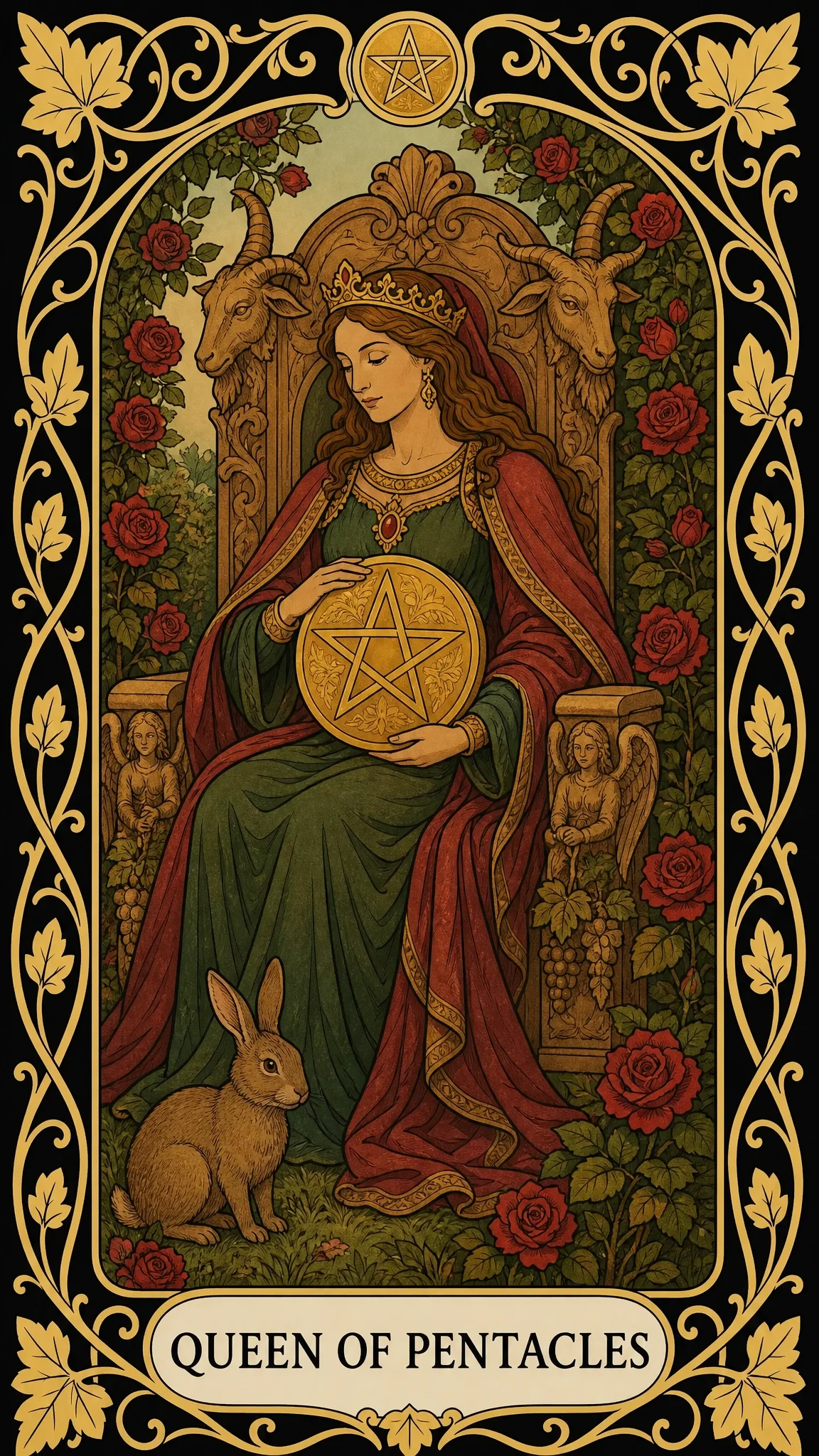
What the Queen of Pentacles means in Tarot
Queens in Tarot represent the element of their suit brought to a mature, lived-in form: not an impulse or cold calculation, but the manner of acting of a person who has already found common ground with this element. The Queen of Pentacles is about earth: about the body, home, money, daily life, and caring for what can be touched with your hands.
An important nuance to mention right away: a minor arcana card describes not fate or a whole character, but a specific way of behaving in a specific situation—here and now, not forever. The Queen of Pentacles in a spread is more of a behavioral mode than a label for a person: calm, practical care, the ability to organize resources so that everyone nearby feels fed, warm, and calm, in a literal or figurative sense.
The upright position is read as support: stability, generosity without strain, the ability to take care of both business and loved ones without forgetting yourself. But behind this comfort lies work—the Queen of Pentacles is not flashy; her contribution is noticeable by the result, not the process: a full fridge, paid bills, a child who has everything needed for school.
Reversed Queen of Pentacles: meaning
The reversed Queen of Pentacles is the same instinct for care, but thrown out of balance. Usually, the spread refers to one of three options, and the question itself helps to choose.
- Care to the point of exhaustion. A person continues to provide for and organize everyone around them, already at their last resource, but does not admit it even to themselves.
- Shift to the material. Care is replaced by money and things where time and attention are actually needed.
- Neglected home life. The opposite case: home, health, and finances are left to drift, even though they are usually monitored.
There is also a softer reading: sometimes the reversed Queen of Pentacles is a person who has finally allowed themselves not to carry everything alone and has passed some responsibilities to others. The difference is whether it feels like relief or a loss of control.
The Queen of Pentacles in a "yes or no" spread
In "yes/no" spreads, the Queen of Pentacles is read as yes, but on her terms: the result will come if you act practically, without haste, and with a sober assessment of what is actually at hand. If the question is about stability, security, or a well-managed household, the answer is affirmative, but not instantaneous.
If the question is about a quick or risky result, the card warns with restraint: not now and not like this; first, you need to put your resources in order.
The reversed position in this spread is read as "yes, but at the cost of overload": the result is achievable, but the person risks burning themselves out by ensuring it alone.
The Queen of Pentacles in relationships and feelings
In a relationship spread, the upright Queen of Pentacles describes caring, physical, lived-in love: not stormy confessions, but a shared life, a warm home, and a partner who remembers bills, health, and dinner. This is a card of reliable attachment, not flashy gestures.
In the position of feelings, the Queen of Pentacles is noticeably grounded: feelings are expressed through action—cooking, arranging, supporting financially—rather than through words of love. For established relationships, the upright position often means a period when partners invest in a shared home or budget, which brings them closer than words ever could.
The reversed Queen of Pentacles in relationships is care that turns into total control or the complaint "I'm carrying everything alone," or a partner for whom money and things replace attention.
The Queen of Pentacles in work and money
In career spreads, the Queen of Pentacles is about economical, practical management: careful handling of affairs, caring for the team, a stable small business, or work related to the home, health, food, finances, or real estate. The card well describes a person who keeps things running firmly and without fuss.
In money, the upright position is not sudden wealth, but the result of methodical accumulation and reasonable spending: savings grow because the budget is well-thought-out, not because of luck. This is one of the most "financially literate" cards in the deck in the everyday sense of the word.
The reversed Queen of Pentacles in work and money is exhaustion from carrying a budget or business alone, or, conversely, neglected finances: spending without tracking, bills that are put off being opened.
The Queen of Pentacles as a person: man and woman
An important caveat for court cards: the Queen of Pentacles describes a manner of behaving, not necessarily the gender of the person in the spread. Both a man and a woman can manifest this way—the grammatical gender of the card is conventional; the meaning is more important than the letter.
In the "what kind of person" position, this card describes someone who cares practically and without drama: they ensure that those around them are warm, fed, and calm, they remember household details that others miss, and they are usually generous without being showy.
A Queen of Pentacles woman is the one on whom the home and often the family budget rests; she is calm, reliable, and not prone to loud gestures. A Queen of Pentacles man is a caring, thrifty person for whom caring for loved ones is expressed in concrete actions: repairs, cooking, a financial safety net.
The flip side for both is the same: such care can imperceptibly turn into overprotectiveness or a habit of controlling everything because "it's more reliable that way."
Queen of Pentacles in the mindset position
In the mindset position, the Queen of Pentacles represents calm, grounded focus on practical matters: budget, health, repairs, or household plans. Thoughts don't wander; they methodically organize tasks.
The challenge is that such a mind easily becomes overwhelmed by caring for everyone at once and struggles to switch focus to itself. Next to Swords, this can turn into anxious risk assessment; next to Cups, it can manifest as care driven by guilt rather than reason.
What to do if you draw the Queen of Pentacles
The card's advice is simple: take practical care, but don't forget to include yourself in that care. The Queen of Pentacles is about stability, and stability isn't built on exhausting the person creating it.
What you should actually do:
- Organize one specific resource. Budget, schedule, health — not everything at once, but where it's really needed right now.
- Don't confuse care with control. Organizing a household is not the same as deciding how others should live their lives.
- Include yourself in the list of those being cared for. If the Queen of Pentacles describes a person carrying everything alone, it's worth asking who is taking care of them.
- Rely on what you already have. The card is not about a breakthrough, but about the reasonable use of existing resources.
If the reason for your question is not daily life, but a difficult life situation involving money or health, the reading does not replace a specialist's consultation: the card describes a way of caring, not a ready-made solution to a complex problem.
What is depicted on the card
On our card, a woman in a crown sits on a carved golden throne in a garden: she wears a red mantle over a green dress, holding a large golden pentacle on her lap with both hands, carefully, almost like a child. On the sides of the throne are two mountain goat heads protruding from the back; around her are rose bushes and grapevines, and at her feet is a hare in tall grass.
The scene reads as follows:
- The pentacle on her lap — the material here is not separate from the person but held in her hands: wealth that is nurtured and grown, not just accumulated.
- Goat heads on the throne — in the classic Rider-Waite deck, the Queen of Pentacles' throne always features a carved goat, a sign of the earthy, practical element; our deck enhances this detail by making the goats two and more prominent.
- Roses and grapevines — beauty and fertility grown from care, not chance: the garden is not wild, but lived-in.
- Hare at her feet — a traditional symbol of fertility and domestic abundance for this card, almost invisible unless you look closely — just as the Queen's care is often not noticed immediately.
At the bottom of the card is a plaque with the English name QUEEN OF PENTACLES.
Queen of Pentacles as the card of the day
As the card of the day, the Queen of Pentacles is a good reason to focus on domestic and practical matters: sort out bills, cook a proper meal, call someone you've been meaning to take care of. The day is suitable for organizing resources, not for sudden leaps or risky decisions.
If the card is drawn reversed, the day is more about how caring for others is crowding out self-care. A useful mindset for today: leave at least one item on your to-do list for yourself.
Frequently asked questions about the Queen of Pentacles
Is this a Major or Minor Arcana?
Minor Arcana, suit of Pentacles, element of Earth. There are 56 Minor Arcana cards in a Tarot deck — 14 cards for each of the four suits, and the Queen is one of the four court cards of Pentacles.
How does the Queen of Pentacles differ from the Queen of Wands?
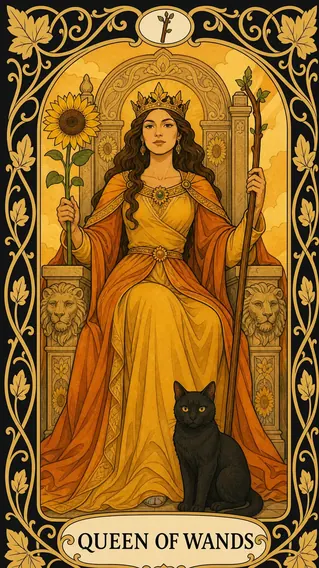
Both cards are about a mature, feminine way of mastering their element, but the elements are different. Pentacles are Earth: practical care, home, money, body. Wands are Fire: charisma, initiative, energy of action. The Queen of Pentacles cares and organizes; the Queen of Wands inspires and ignites.
Is the Queen of Pentacles a yes or no?
Likely yes, but on her terms: the result will come if you act practically and without haste. For quick or risky questions, the card advises organizing your resources first.
What does the reversed Queen of Pentacles mean?
The same care, but thrown out of balance: exhaustion from carrying everything alone, substituting attention with money, or, conversely, a neglected household. Sometimes it's just a person who has finally delegated some responsibilities to others — the difference lies in whether it feels like a relief.
Does the Queen of Pentacles always mean a woman in a reading?
No. A court card describes a way of behaving — practical care and domesticity — not the person's gender. A man can manifest this way too: the card's meaning is more important than its grammatical gender.