What the Ten of Cups means in Tarot
The Ten of Cups is a Minor Arcana card, and it is worth keeping this in mind from the very first line: the card does not summarize an entire life, as Major Arcana cards like The World or The Sun do. It describes a specific state — an evening with family, the feeling that home has finally become a true home, a moment when daily bustle recedes for a second and it becomes clear that everything is truly well.
In the sequence of the Cups suit, this is the finale: the Ace provided the first spark of feeling, the Six — warmth without calculation, the Nine — the fulfillment of a personal desire, and the Ten elevates joy to the level of the family and home as a whole. If the Nine of Cups is "I am happy," then the Ten is "we are happy," and these are not the same thing: personal satisfaction here becomes shared with loved ones.
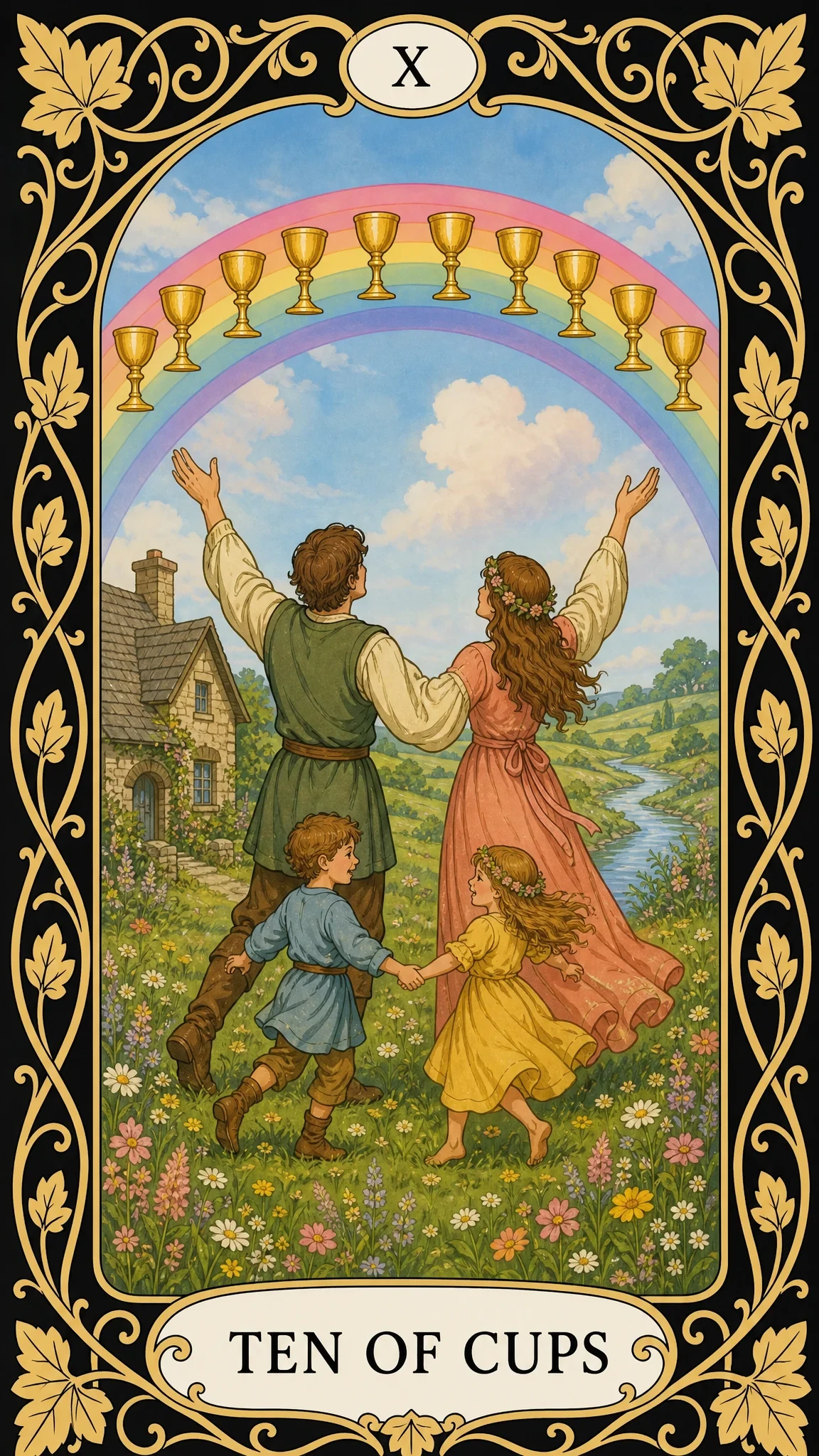
An important nuance often lost in retellings: on the card, the family does not hold the cups in their hands — they look up at the rainbow, reaching their arms toward the sky. The ten cups hang in the air, physically unreachable, and that is the essence of the card: it is not about accumulated wealth or property, but about an internal sense of fulfillment that cannot be touched, but can be felt with the whole body while standing in the middle of one's own yard.
Reversed Ten of Cups: meaning
The reversed Ten of Cups is read in one of three directions, and the question of the spread helps to clarify the specific case.
- Performative happiness. The family looks prosperous from the outside, but inside there are resentments and silence that are not meant to be shown to outsiders.
- Different ideas about home. Partners or relatives sincerely want to be happy together, but each puts a different meaning into it — one dreams of quiet time for two, another of a large, noisy family.
- An ideal that is postponed. The dream of such a day exists, but it is constantly pushed to the future: first finish the chores, pay off the loan, get through a difficult period.
The common thread in all three readings is the gap between the image of family happiness and what is actually happening. The reversed card does not cancel the desire to be together; it shows that the path to that day has not yet been fully traveled.
Ten of Cups in a "yes or no" spread
In "yes/no" spreads, the upright Ten of Cups is one of the most confident yes cards if the question concerns family, home, or harmony with loved ones: they will reconcile, reach an agreement, find common ground, and gather together.
The answer becomes more cautious if the question is about scale or speed: the card is not about a quick breakthrough or large sums — it is about the fact that general harmony will eventually be achieved, not about exactly when it will happen.
The reversed Ten of Cups in this spread is yes, but not in its current form: agreement is possible, but only if you first honestly discuss what is causing friction between loved ones, rather than replacing the conversation with a pretty picture.
Ten of Cups in relationships and feelings
In a relationship spread, the upright Ten of Cups is one of the most auspicious cards: a stable couple, a family where things are truly good, a feeling that being next to this person is like being home, not just a temporary stop. If the question is about the future, the card describes life together well, rather than the initial infatuation: for a romantic spark in a spread, it is better to look at the Two or Ace of Cups.
In terms of feelings, the Ten of Cups is calm gratitude, not euphoria: the feeling that "I have everything I need," without the anxiety that it might disappear. For couples without children, the card works the same way: family here is primarily a sense of community, not necessarily children in the literal sense.
The reversed card in relationships indicates a divergence in what each considers happiness: one is ready for compromises for the sake of a shared home, the other holds onto their own conditions. Sometimes this is a long-term couple that has not talked for a long time about what each of them actually wants.
Ten of Cups in work and money
In career spreads, the Ten of Cups brings to the forefront not the work itself, but what it is needed for: stability that allows one to live peacefully at home, time to be with family rather than chasing the next achievement. The card describes the decision to choose a calmer job for the sake of balance, rather than the most lucrative one.
Regarding money, the Ten of Cups speaks not of large profits, but of sufficiency: there is enough money for a normal life, and in a spread, this is not a problem, but an honest result. Growth of capital and new sources of income are more likely represented by the Ten or Ace of Pentacles — this is a different, more material joy.
The reversed card in a work context means a job that takes more time away from the family than is justified, or a situation where there is prosperity, but no warmth at home added by it.
Ten of Cups as a person: man and woman
In the "what kind of person" position, the Ten of Cups describes not the entire character, but the role of the guardian of domestic harmony: someone for whom family and loved ones are not a background, but the main priority, for which it is easy to give up extras.
A Ten of Cups woman is warm, home-oriented, for whom a Sunday dinner with loved ones is more important than a new status. A Ten of Cups man is someone who chooses to be with his family rather than staying late at work for recognition.
The weak point for both is the risk of confusing real intimacy with its appearance: such a person may hold onto the image of a happy family even when a difficult conversation has long been overdue.
Ten of Cups in the thoughts position
In the thoughts position, the Ten of Cups represents calm reflections on home, family, and what truly matters beyond current tasks. A person isn't making ambitious plans but is mentally taking stock: what is already there, and is it really enough?
This is a good state of mind for gratitude, but it's easy to stop noticing real cracks: next to Swords, such a thought is more likely an attempt to convince oneself that everything is fine; next to Pentacles, it signifies a sober assessment of prosperity and stability.
What to do if you draw the Ten of Cups
The card's advice is simple: notice what is good while it is good, not just when it disappears. The Ten of Cups rarely asks for radical change—more often, it asks you to stop running past the well-being that has already been established.
What you should actually do:
- Name out loud what has worked out in your family and home. Shared gratitude is stronger than unspoken gratitude.
- Check if the picture matches reality. If the card is reversed, start an honest conversation about what everyone defines as "home."
- Don't put off a day that seems perfect. You don't have to wait for a special occasion to bring everyone together.
- Don't confuse material success with family harmony. These are different achievements, and one does not replace the other.
If a difficult family situation lies behind your question—a long-standing conflict, alienation, or divorce—the spread describes the general feeling but does not replace a conversation with loved ones or a family therapist.
What is depicted on the card
On our card, there is a family of four in the middle of a green meadow: a man and a woman stand in the center, arms around each other's shoulders, raising their free hands to the sky, while in front of them, holding hands, a girl in a yellow dress and a boy in a blue tunic dance in a circle. Above them all is a bright rainbow, along which ten golden cups float in a row. On the hill to the left is a stone house with an attic window; to the right, a winding river among the hills; and around the children's feet, a scattering of wildflowers.
The scene is read as follows:
- Cups in the sky, not in hands — the joy of this card cannot be claimed or held physically; it can only be noticed and felt while standing right there in the middle of the yard.
- Parents look at the rainbow, children at each other — adults reach for the very feeling of fulfillment, while children simply live in it without wondering where it came from.
- House on the hill to the left — a lived-in, stable place to which one can always return; it is not in the center of the scene because the family itself is more important here than the walls.
- River flowing into the distance on the right — life that continues beyond this moment: the card captures a happy pause, not the end of the journey.
At the top of the card is the Roman numeral X, and at the bottom is the caption TEN OF CUPS: our deck is drawn in the Rider-Waite tradition, where the Ten of Cups completes the minor suit of Cups.
Ten of Cups as the card of the day
The Ten of Cups as the card of the day is a good day to spend time with family or loved ones for no particular reason: a regular dinner, a walk, a call to parents. The day does not promise major events—it is about noticing the warmth you already have rather than looking for new things.
If the card is drawn reversed, it is worth taking a closer look to see if real intimacy is being replaced by a convenient image: perhaps a conversation that has been put off for months should be started today.
Frequently asked questions about the Ten of Cups
Is it a Major or Minor Arcana?
Minor Arcana, suit of Cups, element of Water. There are 56 Minor Arcana cards in the Tarot deck in total—14 cards for each of the four suits, and the Ten of Cups completes the numerical sequence of its suit.
How does the Ten of Cups differ from the Ten of Wands?
Both cards complete the numerical sequence of their suit, but they speak of a different price for the outcome. The Ten of Wands is about the burden of what has been achieved: there is success, but it is paid for with fatigue and overload. The Ten of Cups is about a light, emotional outcome: peace, family, and the feeling that everything fell into place on its own, without struggle. If the price of the result is important in a spread, look at the Wands; if the emotional state is important, look at the Cups.
Is the Ten of Cups a yes or no?
One of the most confident "yes" cards if the question is about family, home, or harmony with loved ones. The card does not answer about the speed and scale of events—it is about the final state, not the timeline.
What does the reversed Ten of Cups mean?
A gap between the image of a happy family and what is actually happening: ostentatious well-being, different ideas about home among loved ones, or an ideal that is constantly being postponed. The card does not cancel the desire to be together—it shows that you still need to reach an agreement.
Is the Ten of Cups necessarily about children and marriage?
No, the literal family in the picture is an image, not a condition. The card equally describes a couple without children, a friendship that has become a family in essence, or simply the feeling of home and having your people nearby. The main thing in its meaning is the feeling of fulfillment and harmony, not the specific composition of the family.