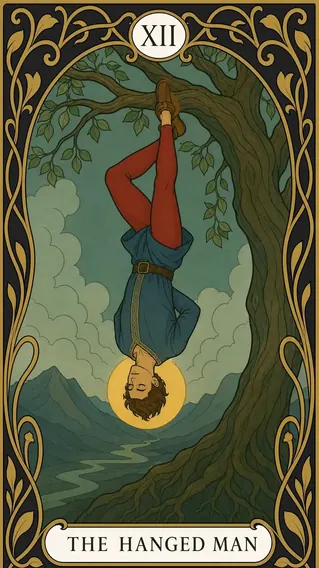
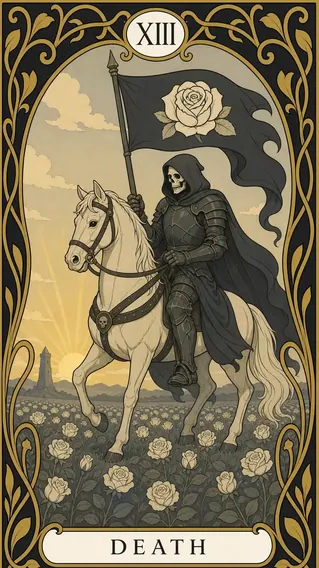
What the combination of The Hanged Man and Death means
The Hanged Man and Death stand one after another in the Rider-Waite deck—the twelfth and thirteenth arcana—and the combination is read as one process divided into two phases: the pause and its result.
The meaning of the combination is that the suspended state is approaching a point where one can no longer sit still: either the situation has matured and needs to be closed, or it has already closed itself, and the person has not yet acknowledged it.
Which card is the leader determines from which side to read the pair. If The Hanged Man is the leader, the reading focuses on the process: the person is still inside the pause, looking for meaning in it, delaying the decision—and then Death nearby shows not the current state, but where this pause will inevitably lead. If Death is the leader, the order is reversed: the content has already ended, the deed is done, and The Hanged Man describes the aftermath—why formalities, habits, or hope are still keeping the situation open, even though there is nothing left to decide.
The practical difference: with a leading Hanged Man, the advice is to set a deadline for waiting; with a leading Death, the advice is to stop delaying the acknowledgment of what has already happened.
The Hanged Man and Death in the reversed position
The reversed position in this pair changes who is stuck and why.
If only The Hanged Man is reversed, the pause has ceased to be productive: the person is not rethinking the situation but simply stalling, even though the upright Death nearby already shows that the decision is ripe. This is the most common version of getting stuck in this pair—waiting has turned into a habit, and the reason to wait has long been exhausted.
If only Death is reversed and The Hanged Man is upright: the person is honestly in a pause and looking for a way out, but cannot call things by their names because they fear the very end that has already effectively arrived. Here, the pause is meaningful, and the stalling comes from the side of acknowledging the fact.
If both cards are reversed, the reading describes a prolonged dead end with no movement: neither is the pause used for its intended purpose, nor is the end acknowledged—the situation is held exclusively by the unwillingness to change anything. This is the heaviest version of the pair, and the way out of it begins not with a decision, but with an honest question about what exactly the person is protecting by continuing to stall.
The Hanged Man and Death in relationships
In relationships, the Hanged Man and Death pair is one of the most common scenarios of prolonged uncertainty: the couple knows the old format no longer works, but neither one says it out loud.
With the Hanged Man leading, the focus is on waiting: one or both partners hold onto the relationship in the hope that the pause will resolve itself without conversation or a decision. Death nearby reminds us that this hope will sooner or later end along with the substance that made it worth waiting for.
With Death leading, the focus shifts to the fact that the relationship has internally already ended, feelings have burned out, and formal attachment—shared life, children, fear of change—keeps the couple together longer than makes sense. The Hanged Man here describes not hope, but inertia.
An important caveat: the couple is not saying that a breakup is literally inevitable—sometimes it's about the relationship transitioning into a different quality. But it definitely means that living in the old way is no longer possible.
The Hanged Man and Death in work and money
In work and money, this combination most often describes a role or project that formally still exists but has long been exhausted in substance.
With the Hanged Man leading, it is a freeze that lasts longer than usual: a decision on a position is postponed, a project is kept "on pause," even though it would be more honest to close it. Death nearby shows that sooner or later the decision will be made not by one's own initiative—circumstances will do it for the person.
With Death leading, the focus is on the fact that the work's substance has already ended: the task is completed, the role is played out, and the person continues to occupy the spot more out of inertia or fear of starting over. The Hanged Man here is not a search for meaning, but a simple hanging in status.
In money, the pair is often about income that was counted on as permanent but has effectively ceased, even though it is still formally listed in plans. There is only one piece of advice: do not wait for the situation to resolve itself—the cost of delay is growing, not decreasing.
What to do if this combination appears
This combination requires not divination of the outcome, but an honest audit: what of what is happening is actually still holding on, and what has already ended and is held only by the unwillingness to admit it.
Practically, three things should be done. First, call things by their names, at least to yourself: if the substance is gone, a formal continuation will not bring it back. Second, if the pause is justified, set a specific deadline for it rather than leaving it open-ended: "I'll wait until such and such a moment, then I'll act differently." Third, use the pause time for its intended purpose rather than spending it solely on waiting: learn more, prepare a backup plan, talk to those involved in the situation.
If the reading concerns a difficult topic—loss, illness, addiction—the cards describe only the nature of the moment, not a diagnosis or a deadline. Decisions in such matters are made by the person themselves, if necessary with a doctor or other specialist, not with a reading.
Frequently asked questions about the Hanged Man and Death combination
What is more important in this pair, the Hanged Man or Death?
Look at which card appeared first or closer to the question in the reading—that is the leading one. If the Hanged Man is leading, the reading is primarily about the process of waiting itself; if Death is leading, it is about the already occurred fact of completion, and the Hanged Man's pause describes only why this has not yet been acknowledged.
What do the Hanged Man and Death mean together in the reversed position?
Both cards reversed describe a prolonged deadlock: the pause is not used for its intended purpose, and the completion is not acknowledged—the situation is held only by the unwillingness to change it. This requires not patience, but an honest question about what exactly such a position is protecting.
Is the Hanged Man and Death in relationships always a breakup?
Not necessarily in the literal sense of a breakup. The pair says that living in the old format is no longer possible: sometimes it is a breakup, sometimes a transition to a different quality of relationship. The commonality is that returning to what was is no longer possible.
Can one understand from this pair when the waiting will end?
No, the reading does not provide deadlines and does not predict events. It describes the nature of the situation—that the pause is coming to an end and a decision is ripe, not when exactly this will happen and how.