What the Four of Cups means in Tarot
The upright Four of Cups describes a state where everything seems sufficient, but there is no joy. The hero of the card has three cups in front of them—what they already have and what works: relationships, work, a familiar routine. But their gaze is not directed at them, but inward, and they simply turn away from the fourth cup offered.
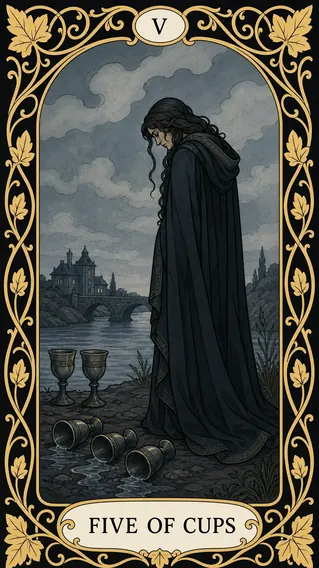
An important nuance often lost in retellings: the card is not about a lack of opportunities, but about the inability to notice them. A hand from a cloud extends a cup—meaning the chance is already there, it's just not being looked at. This is how the Four differs from cards of true lack like the Five of Cups: there, there is truly nothing to take; here, one simply doesn't want to reach out.
It is worth noting the scale: this is a Minor Arcana card, and it describes not fate or character for years to come, but a specific segment—a week, a conversation, a period when interest in what previously brought joy fades. A Major Arcana card like the Moon speaks of prolonged self-deception; the Four of Cups is about a specific episode of fatigue, from which one usually emerges on their own, without a major breakdown.
Reversed Four of Cups: meaning
The reversed Four of Cups is read in one of two ways, and the context of the spread helps distinguish them.
- Apathy begins to lift. The person finally lifts their head and notices what has been offered to them for a long time: interest, an invitation, an option they previously overlooked.
- Apathy has hardened. Instead of a temporary slump, it becomes a habit of not reacting to anything at all; the state drags on for months, and the person no longer notices that nothing brings them joy.
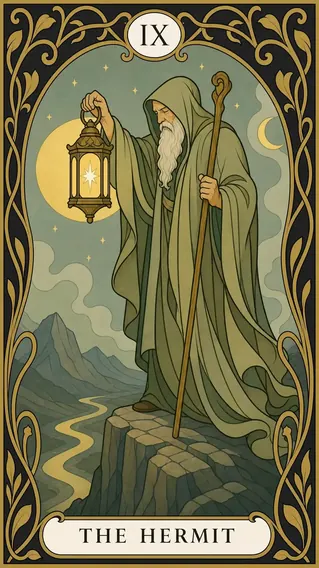
The difference is usually visible in the surrounding cards: next to active Wands or Swords, it is more likely an awakening; next to the Moon, the Hermit, or other cards of stagnation, it is more likely the second option. If the same meaning of "I am indifferent to everything" repeats in consecutive spreads, this is a reason not for a new reading, but for self-care outside of the cards: prolonged indifference to everything is treated not by divination, but by talking to a specialist.
Four of Cups in a "yes or no" spread
In "yes/no" spreads, the Four of Cups leans towards no—not because the event is impossible, but because the person being asked will likely not notice the moment and will not react in time. The card describes not an external obstacle, but an internal lack of engagement.
The answer becomes more definite if the question is about an initiative or a conversation that needs to be started by the querent: here the card directly answers "not now," until the indifference passes. If the question concerns an offer made by someone else, the answer is more likely "yes, the offer will come," it's just not guaranteed that it will be accepted.
The reversed position shifts the answer to a more favorable one: since the apathy is lifting, the chance of noticing the offer and reacting is higher.
Four of Cups in relationships and feelings
In relationships, the upright Four of Cups is not about a breakup or infidelity, but about emotional numbness within generally normal relationships. One of the partners (or both) stops reacting to what used to touch them: words, attempts to get closer, and signs of attention are perceived with indifference, not because they have become bad, but because perception has temporarily dulled.
For single people, the card in this position often describes fatigue from dating: offers exist, but there is no desire to respond to them, and the person is more likely to close off than to reciprocate interest.
In the position of feelings, the Four of Cups is specifically indifference, not cooled-down love: the feeling has not gone anywhere, it is obscured by fatigue or resentment that has not been voiced. The difference is important: cooled-down feelings require a decision, while dulled ones require a pause and self-care.
The reversed card in a couple is the moment when one of the partners begins to notice the other again: they write first, suggest a meeting, or return to conversation after a lull.
Four of Cups in work and money
In a career spread, the Four of Cups is burnout out of nowhere: the work hasn't changed, the tasks are the same, but the interest is gone. The card often appears for those who are formally satisfied with everything but cannot explain where the irritation with routine tasks came from.
A separate scenario is a missed offer: a career opportunity, a job offer, or an interesting project arrives exactly at the moment when one doesn't want to change anything, and the person refuses or delays the response, even though the offer is objectively good.
Regarding money, the card does not speak of a lack—rather of inertia: income is stable, but there is neither pleasure from spending nor a desire to deal with finances. The Five of Cups nearby intensifies this to regret over what was missed; the Nine or Ten of Cups nearby is a sign that the fatigue is against a background of abundance, not poverty.
The reversed Four of Cups in work is the moment when an offer is finally accepted, albeit with a delay.
Four of Cups as a person: man and woman
In the "what kind of person" position, the Four of Cups describes someone who is currently closed off and not reacting to external signals—not out of spite, but out of fatigue. Such a person may not respond to invitations for months, not because they don't value the company, but because it is difficult for them to want anything at all.
The Four of Cups man in a spread is pensive, withdrawn, often literally with his arms crossed: it is difficult to start a conversation with him, not because he is dissatisfied with the interlocutor, but because he has nothing to say right now.
The Four of Cups woman is someone who is tired of responding to others' expectations and has temporarily switched off from paying attention to others, including those who are sincerely offering her something.
This is a description of a temporary state, not a character: the same person in another spread could easily appear as an active Three or Six of Cups.
Four of Cups in the position of thoughts
In the position of thoughts, the card shows mental rumination around the same thing: a person dwells on what they are unhappy with but doesn't move beyond internal complaining. This isn't anxiety like the Swords, nor a plan like the Pentacles — it's being stuck in place.
Often, this is driven by unarticulated disappointment: they expected one thing, got a functional but bland result, and instead of acknowledging it, they keep thinking that "something is wrong" without naming exactly what.
A useful question to ask yourself in this position: what exactly is missing — not abstractly, but specifically. Until there is an answer, thoughts will continue to spin in circles.
What to do if you draw the Four of Cups
The card's advice is simple and not the most pleasant: notice the fourth cup. Almost always, there is already an offer, an option, or a person nearby that is simply being ignored because the gaze is turned inward, toward one's own dissatisfaction.
What you should actually do:
- Name exactly what you are unhappy with. "I'm tired of everything" is not a diagnosis, but a way to avoid dealing with it. A specific reason can almost always be found.
- Check if you've missed a real offer. An invitation, a conversation, an option you've been avoiding — sometimes apathy acts as a convenient excuse not to respond.
- Don't confuse a pause with a decision. You shouldn't quit your job, break up, or turn down something important while in the state described by this card: decisions made out of fatigue are often reconsidered later.
- Let yourself recover, don't drag out the slump. A pause, sleep, or a change of scenery for a few days works better than trying to force yourself to be happy.
And separately: if indifference describes not just one episode, but a persistent state — when nothing brings joy for weeks or months and you've lost interest not just in one thing, but in everything — this is not a reason for a new reading, but a reason to consult a specialist. The card describes a specific episode of fatigue well; prolonged indifference to everything can be a symptom that psychologists and doctors work with, not fortune-telling.
What is depicted on the card
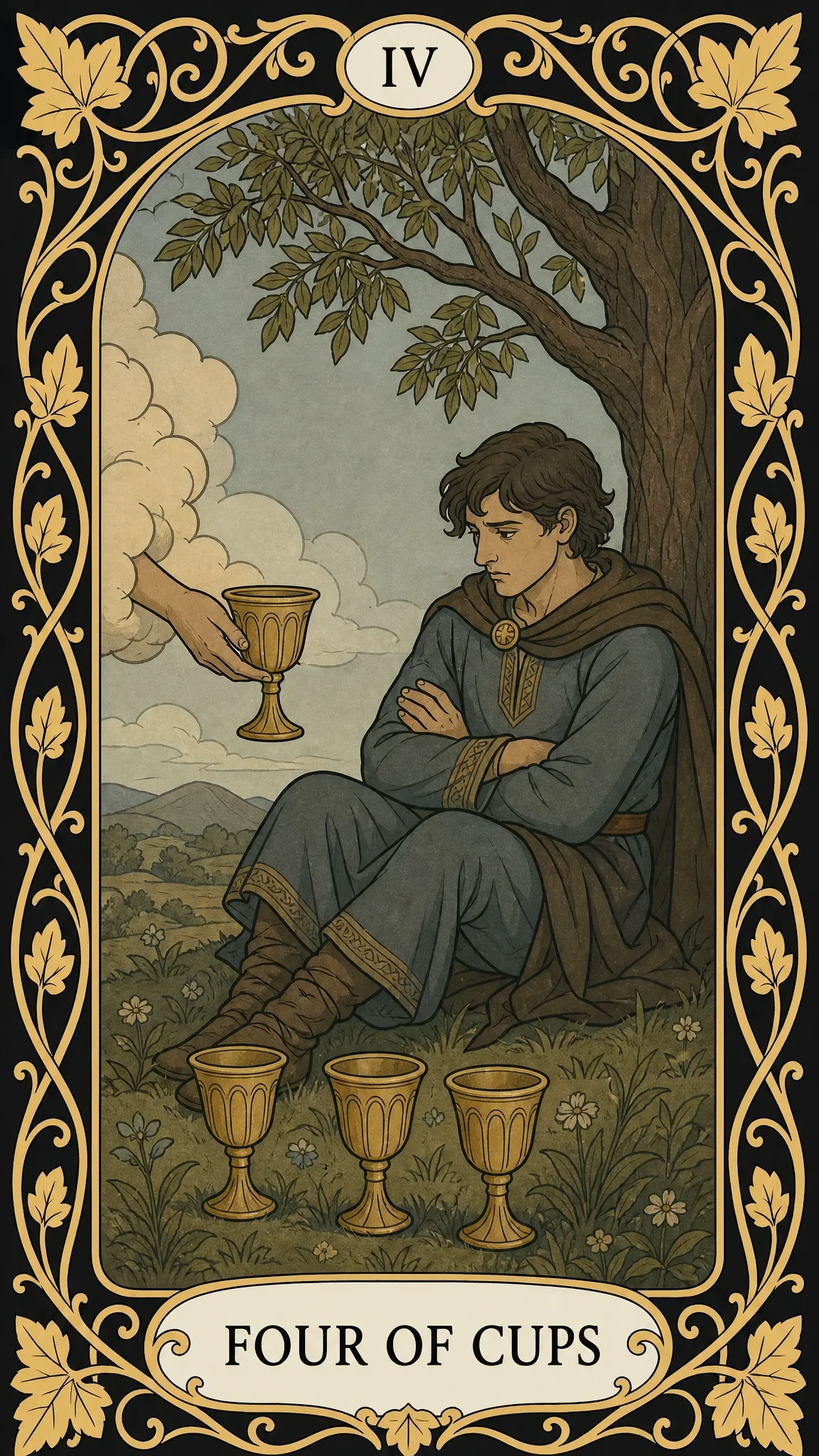
On our Four of Cups, a young man in gray-blue clothes sits on the grass under a sprawling tree, arms crossed over his chest. His gaze is lowered, his face is focused and sullen: he is looking not outward, but as if inside himself.
The scene is read as follows:
- Three cups on the ground in front of him — what is already there and obtained: they stand steadily, no one is taking them away. It is this calm "already have" that creates a feeling of satiety, behind which boredom hides.
- The fourth cup from a hand in a cloud — a new opportunity, offered as if from nowhere, without any effort on his part.
- Crossed arms and lowered gaze — the hero is physically closed off from the offer: he doesn't even look toward the cup, even though it is very close.
- The tree overhead — a shelter and a trap at the same time: the shade is comfortable, but it is exactly what prevents him from seeing what is happening in the light.
- The calm landscape in the distance — hills, flowers, no danger; the apathy here is not from difficult circumstances, but despite their absence.
At the top of the card is the Roman numeral IV, at the bottom is the English name FOUR OF CUPS: our deck is drawn in the Rider-Waite tradition, where the fourth numbered card of the Cups suit is labeled this way.
The Four of Cups as the card of the day
As the card of the day, the Four of Cups warns not of bad events, but of the risk of not noticing them. Most likely, there will be at least one small offer during the day — to meet, to try something, to answer a message — that you might reflexively want to skip.
A useful mindset: today, it is worth consciously looking at what is being offered before refusing on autopilot. And don't demand a high mood from yourself — if the day feels bland, it's a normal temporary state, not a cause for anxiety.
Frequently asked questions about the Four of Cups card
Is it a Major or Minor Arcana?
A Minor Arcana of the Cups suit, element Water. There are 56 Minor Arcana in total — 14 in each of the four suits, plus 22 Major Arcana, for a total of 78 cards in the deck.
How does the Four of Cups differ from the Four of Swords?
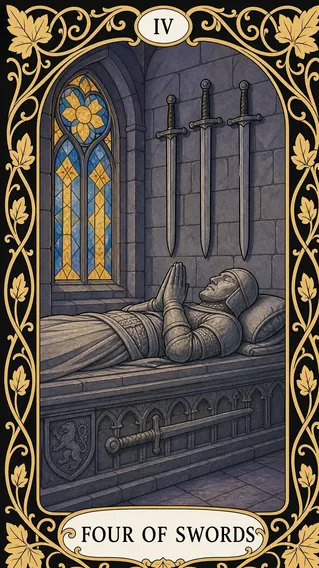
The Four of Swords is conscious rest: a person deliberately takes a pause after an effort to recover, and it is their choice. The Four of Cups is not a chosen pause, but apathy: indifference to what is being offered, without the feeling that you are resting on purpose.
Is the Four of Cups a bad card?
No. It describes a temporary state of fatigue and disengagement, not a punishment or a character trait. It is worse when this state goes unnoticed and people continue to live in it for months — then it is worth paying attention to yourself, not the cards.
What does the reversed Four of Cups mean?
Most often, it means that apathy is starting to lift: the person is noticing offers and interest in life again. Less often, it means that indifference, on the contrary, has become a habitual state rather than a temporary slump. The surrounding cards in the spread help to distinguish between these.
Is the Four of Cups a "yes" or "no"?
More likely "no", and not because of external obstacles: the card shows that the person themselves might not notice the moment or react in time. If the question is about someone else's initiative or offer — the answer is likely positive, but without a guarantee that it will be accepted.