What the Three of Cups means in Tarot
The Three of Cups is a card of a specific evening, not destiny. Three women raise their cups to each other: friends, colleagues, sisters, an old group that has finally gathered in one place. This is the difference between the Minor and Major Arcana — the Three of Cups does not describe a life lesson like The Sun or a breakdown like The Tower; it describes an episode: a specific meeting, a specific occasion, specific people.
The key meaning is shared joy, which becomes stronger because it is not kept inside. Good news that you want to tell several people at once; a celebration that makes no sense to celebrate alone; gratitude addressed not to one person, but to a group.
An important nuance often lost in retellings: the card is specifically about a group, not a couple. If the Two of Cups is nearby, it's about two people; the Three almost always adds a third, a fourth, a whole group. Joy here expands rather than deepens.
Reversed Three of Cups: meaning
The reversed Three of Cups flips the very idea of a group. Three readings occur more often than others, and the question of the spread helps to choose.
- Celebration for the sake of celebration, without substance. There is fun, but no real reason — a person drowns out with noise what should have been discussed alone with themselves.
- The group has fallen apart. The same circle of friends that used to gather easily now doesn't: someone has drifted away, someone is in a fight, schedules don't align.
- Gossip and outsiders in the circle. The joy of three turns into whispering behind the fourth's back — the flip side of a close-knit group.
Neighboring cards help distinguish the readings: next to Swords, it is more likely gossip or a quarrel; next to the Five of Cups, it is the loss of a social circle rather than one person.
Three of Cups in a "yes or no" spread
In "yes/no" spreads, the upright Three of Cups is a confident yes if the question is about a meeting, an occasion to gather, or a warm welcome. The card answers well to questions like "will we be able to celebrate," "will my friends support me," or "will the group be on my side."
It answers poorly to questions about one specific person or serious commitments — this is not its territory; for a precise answer about a couple, one usually looks at the Two of Cups.
In this spread, the reversed Three of Cups is more likely no: there is no reason, the group will not gather, the meeting will feel strained. If the question was about whether to expect support from your usual circle, the answer is cautious.
Three of Cups in relationships and feelings
In a relationship spread, the upright Three of Cups is almost never about one-on-one romance — it is about the environment around the couple or friendship that grows into something more. A wedding, an engagement, meeting friends — the card describes moments when the personal becomes a shared occasion for joy.
In the position of feelings, it means lightness and gratitude not tied to one person: warmth toward friends, toward the group, toward the very fact that there are people nearby. This card describes romantic attraction weakly — for that, one looks at the Two or Ten of Cups.
In relationships, the reversed Three of Cups is a triangle in the everyday sense: the third wheel in a group, jealousy of other people's friends, a quarrel over mutual acquaintances. Sometimes it is simply fatigue from the fact that the couple's personal time is constantly shared with someone else.
Three of Cups in work and money
In career spreads, the Three of Cups is the successful completion of a joint project, a team result, an occasion to gather as a team and celebrate it. This is a card of a bonus for the whole department, not a personal bonus; good news that the manager announces to everyone.
Regarding money, the card speaks of spending on a shared celebration, a group gift, a party — not a major purchase. Next to Pentacles cards, this is usually a small, pleasant, and justified expense.
Advice from the card in a work spread: do not take credit for what the team did, and do not skimp on the moment when it is worth celebrating a shared result — this strengthens relationships within the team more cheaply than it seems.
Three of Cups as a person: man and woman
When the Three of Cups appears in the "what kind of person" position, it describes not a character, but the role of the life of the party: the one who calls everyone together, remembers the reasons to gather, and easily unites people around the table.
A Three of Cups woman is warm, sociable, for whom joy only makes sense if it is shared with someone; she is often the one who maintains the connection between different people in the circle. A Three of Cups man is the one who brings a reason to gather: good news, an initiative, an idea for a meeting.
This is not a description of character depth, but a description of a function at a specific moment: it is natural to find yourself in a group next to this person, rather than alone.
Three of Cups in the thoughts position
In the thoughts position, the Three of Cups represents thoughts about people rather than the task at hand: who to write to, who to invite, who to share news with. The person is focused not on solving a problem, but on maintaining connections—sometimes productively, sometimes as a way to distract themselves from what actually requires attention in solitude.
Reversed in this position, it indicates anxiety about a social circle falling apart, or thoughts about a specific conflict within a group that are going in circles without a resolution.
What to do if you draw the Three of Cups
The advice of the Three of Cups is simple: don't put off a reason to get together. The card rarely asks you to solve a problem—more often, it asks you to notice the good and share it rather than passing it by.
What you should actually do:
- Name the occasion out loud. Don't wait for the "perfect moment"—a small victory is a reason enough if you share it.
- Invite more than one person. The meaning of the card is in the company, not just a pair—if you feel drawn to several people at once, don't artificially narrow the circle.
- Check who is real and who is incidental in your circle. If the card is reversed, you should start with this question, not with the conflict.
- Don't turn a celebration into an excuse for avoidance. If fun is used to avoid thinking about difficult things, it doesn't help; it only delays them.
What is depicted on the card
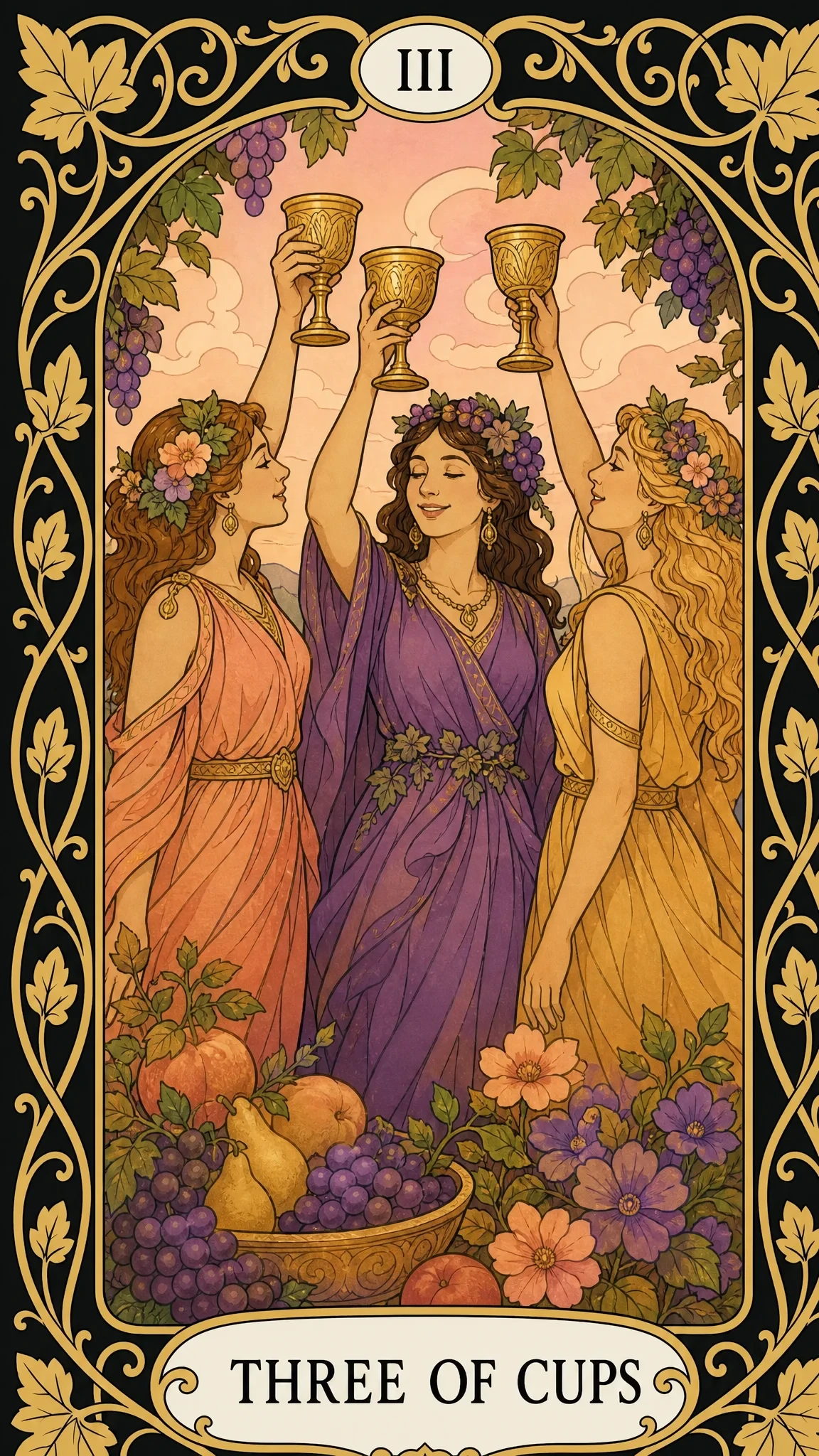
On our Three of Cups, there are three women in antique tunics: peach, lilac, and golden. They stand against a pale pink sky with clouds, each holding a golden cup in her raised hand, and all three cups meet at almost a single point above their heads—a gesture of a shared toast. All three have wreaths of flowers and grape leaves in their hair; the central figure has the most lush wreath with clusters of grapes.
At the women's feet is a wicker basket with pears, peaches, and grapes, and flowers are scattered around: pink, lilac, and mauve. The card is framed at the top by hanging grapevines with clusters, and on the sides by a golden ornament with grape leaves on a black background.
The scene is read as follows:
- Three figures, not two — this is the very difference between the Three and the Two of Cups: joy here is always with someone else, not just between two people.
- Cups meeting at a single point above their heads — the shared toast is more important than the contents of each cup individually; the moment unites, regardless of who is drinking what.
- Grapes and ripe fruits — the harvest, the result that has already been gathered and can be shared, rather than something yet to be grown.
- Pink sky without storm clouds — unlike many other cards in this suit, there is no hint of hidden anxiety here: the scene is specifically about the lightness of the moment.
At the top of the card is the Roman numeral III, at the bottom is the English name THREE OF CUPS: our deck is drawn in the Rider-Waite tradition, where the Three of Cups is the third card in the suit of Cups.
Three of Cups as the card of the day
The Three of Cups as the card of the day is a good reason to call someone instead of putting it off. Usually, on this day, things related to people succeed: a warm conversation, a chance meeting, an invitation that is worth accepting rather than declining out of habit.
A useful mindset for such a day: don't spend it alone by default—even a short call with someone from your old social circle usually pays off. The reversed version in this position is a signal to notice if your connection with friends has recently been maintained only through texting, and it is worth turning it into a real meeting.
Frequently asked questions about the Three of Cups card
Is the Three of Cups a Major or Minor Arcana?
Minor Arcana, suit of Cups, element of Water. There are 56 Minor Arcana cards in total—14 in each of the four suits, and the Three of Cups is the third card in the suit of Cups.
How does the Three of Cups differ from the Three of Swords?
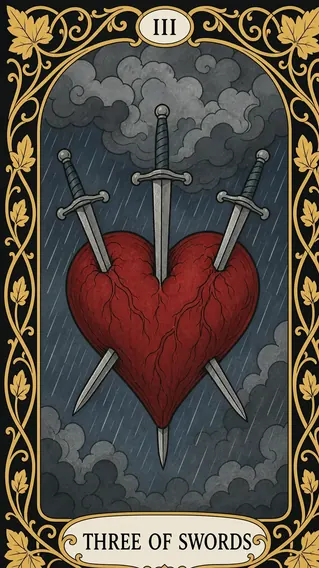
Both cards are the third step of their suit, but opposite in mood: the Three of Cups is about shared joy and company, the Three of Swords is about the pain caused by words or betrayal. If the Three of Cups brings people together, the Three of Swords more often describes the rift between them.
Does the Three of Cups mean a wedding?
Not necessarily, but the card often appears in spreads about weddings, engagements, and large family celebrations—it describes well the moment when personal joy becomes a reason to gather a group around. The card does not guarantee marriage in itself.
What does the reversed Three of Cups mean in friendship?
Usually, it means that your social circle has weakened: someone has drifted away, meetings have become less frequent, or gossip and unspoken tensions have appeared within the group. It is a reason to figure out who has remained in your circle for real, rather than out of inertia.
Is the Three of Cups a yes or no?
If the question is about a meeting, a celebration, or support from a group—yes. If the question is about one specific person or strong commitments, the card gives a weak answer—other cards in the spread, such as the Two of Cups, will tell you more accurately.